A construction site safety checklist should include pre-shift inspections, PPE verification, equipment checks, hazard assessments, emergency preparedness protocols and proper documentation. Whether you're running a high-rise in Vancouver or a road project outside Calgary, this checklist keeps your crew compliant with Canadian OH&S regulations - and more importantly, keeps them going home safe. Below is the complete, field-tested checklist updated for 2026 provincial requirements including WorkSafeBC, Alberta OHS and Ontario's OHSA.
If you've ever scrambled to put together a jobsite safety checklist before an inspector showed up, you know the pain. Crumpled paper forms. Missing signatures. That one guy who swears he did his harness check but can't prove it. This guide fixes that. It's built for foremen, site supervisors and safety coordinators who need something practical - not a 90-page binder that collects dust in the trailer.
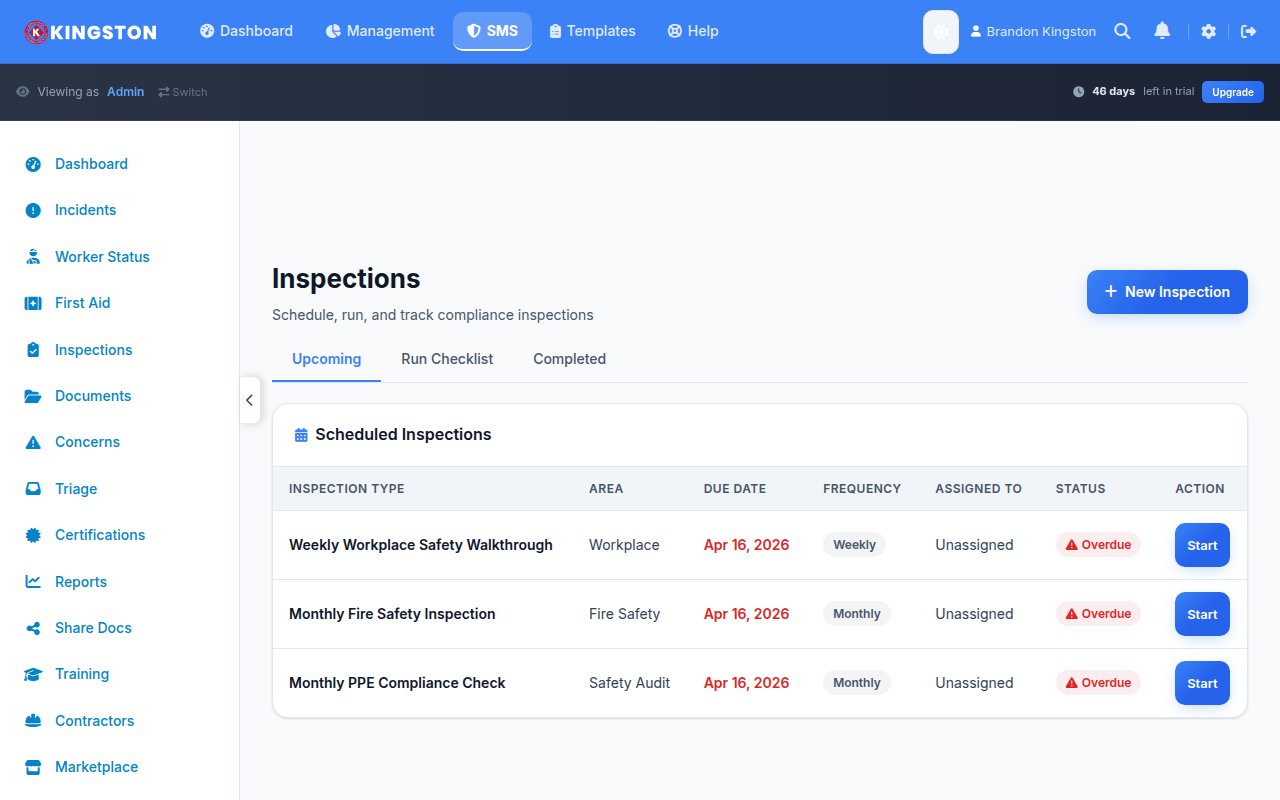
Need to digitize your checklists and run them from a phone or tablet? Make Safety Easy's inspection tools let you build custom construction checklists your crew can complete on-site in minutes.
Free Download: 5 Safe Work Procedures
Choose from 112 professionally written SWPs. No credit card required.
Get Free SWPs1. Pre-Shift Safety Checklist
Every shift starts here. Before a single boot hits the dirt, the supervisor on duty needs to confirm these items. Miss one and you're rolling the dice.
- ☐ Site orientation completed for all new workers - Confirm every new arrival has received site-specific orientation covering hazards, emergency exits, muster points and reporting procedures. This is mandatory under most provincial OH&S acts.
- ☐ Toolbox talk delivered and documented - A brief 5-10 minute safety talk relevant to the day's tasks. Topics might include fall protection, excavation safety, or heat stress. Use pre-built toolbox talk templates to save time.
- ☐ Weather conditions assessed - Check wind speed (critical for crane operations over 35 km/h), lightning risk, extreme cold or heat advisories and precipitation that could affect excavation stability or scaffold safety.
- ☐ Work permits verified - Confirm all required permits are in place: hot work permits, confined space entry permits, excavation permits and any municipal or utility clearances.
- ☐ Crew fitness for duty confirmed - Supervisors must verify that workers are fit for duty. That means no signs of impairment, adequate rest and no medical restrictions that conflict with assigned tasks.
- ☐ Communication systems tested - Radios charged. Emergency contact list posted. Air horn or alarm system functional.
- ☐ Previous shift notes reviewed - Check the logbook. Were there near-misses? Outstanding corrective actions? Open work orders? Don't start blind.
2. PPE Requirements Checklist
PPE is your last line of defence. Not your first - but it had better be there when everything else fails. Canadian provincial regulations are specific about minimum PPE requirements on construction sites and enforcement has tightened considerably heading into 2026.
Mandatory PPE for All Personnel On-Site
- ☐ CSA-approved hard hat (Class E or Class G) - Inspect for cracks, dents and UV degradation. Replace every 5 years or after any impact. No stickers covering damage.
- ☐ CSA-approved safety footwear (Grade 1) - Steel or composite toe. Green triangle patch must be visible and intact.
- ☐ High-visibility vest or clothing (Class 2 minimum) - Required in all traffic areas and anywhere mobile equipment operates.
- ☐ Safety glasses or goggles (CSA Z94.3) - Mandatory during any cutting, grinding, drilling, or concrete work.
- ☐ Hearing protection - Required when noise levels exceed 85 dBA. Post signage at entry points to high-noise zones.
Task-Specific PPE
| Task / Hazard | Required PPE | Standard |
|---|---|---|
| Work at heights (above 3 m / 10 ft) | Full-body harness, shock-absorbing lanyard, anchor point | CSA Z259 series |
| Welding / hot work | Welding helmet, fire-resistant gloves, leather apron | CSA W117.2 |
| Concrete / silica exposure | N95 or P100 respirator, chemical-resistant gloves | CSA Z94.4 |
| Confined space entry | Gas monitor, SCBA or supplied air, rescue harness | CSA Z1006 |
| Excavation / trenching | High-vis, hard hat, proximity to shoring/trench box | Provincial OHS regs |
| WHMIS-controlled substances | As per SDS - may include respirator, face shield, chemical gloves | WHMIS 2015 (GHS) |
Pro tip: PPE inspections shouldn't just happen at the start of a shift. Fall protection equipment - harnesses, lanyards, self-retracting lifelines - needs a documented pre-use inspection every single time. No exceptions.
3. Equipment Inspection Checklist
Equipment failure kills. It's that blunt. A malfunctioning excavator, a frayed sling, a crane with a dodgy limit switch - these aren't inconveniences. They're fatality risks. Run these checks daily.
Heavy Equipment & Mobile Plant
- ☐ Walk-around inspection completed - Check fluid levels, tire/track condition, lights, mirrors, backup alarms and structural damage.
- ☐ Operator certification verified - Confirm the operator holds valid certification for the specific equipment class. Check expiry dates.
- ☐ Seat belt and ROPS functional - Roll-over protective structures and seat belts save lives. No seat belt, no operation. Period.
- ☐ Fire extinguisher mounted and charged - Required on all heavy equipment per most provincial fire codes.
- ☐ Exclusion zones established - Barricades and signage around swing radius, load paths and travel routes.
Scaffolding, Ladders & Elevated Platforms
- ☐ Scaffold erected by competent person - Documented sign-off required. Tagged with green (safe) / red (do not use) system.
- ☐ Guardrails, mid-rails and toe boards in place - Top rail at 1.0 m to 1.07 m height. No gaps wider than 50 mm at the platform edge.
- ☐ Ladder condition inspected - No bent rungs, cracked side rails, or missing feet. 3-point contact rule posted and enforced.
- ☐ Aerial work platforms (AWPs) daily checked - Controls, outriggers, hydraulic leaks, rated capacity labels visible and legible.
Hand & Power Tools
- ☐ Guards in place on all grinders, saws and drills - Removed guards = immediate stop work.
- ☐ Electrical cords inspected - No cuts, no splices, no missing ground prongs. GFCI protection on all temporary power.
- ☐ Powder-actuated tools - Operator must carry valid certificate. Tools stored locked when not in use.
Track all your equipment inspections digitally so nothing slips through the cracks. Make Safety Easy's inspection module stores records, flags overdue checks and generates audit-ready reports.
4. Hazard Assessment Checklist
A formal hazard assessment isn't optional in Canada. It's the law. Alberta's OHS Act, BC's WorkSafeBC regulations, Ontario's OHSA - they all require employers to identify, assess and control hazards before work begins. Here's what your field-level hazard assessment (FLHA) must cover.
- ☐ Identify hazards for each task - Walk the area. Look up, look down, look around. What can fall? What can collapse? What's energized? Where's the traffic?
- ☐ Assess risk level - Use a simple severity-times-probability matrix. High risk = stop and implement additional controls before proceeding.
- ☐ Apply the hierarchy of controls - Elimination first, then substitution, engineering controls, administrative controls and finally PPE. If your only control is PPE, you haven't done enough.
- ☐ Fall protection plan in place for work above 3 m - This includes guardrails, travel restraint, fall arrest systems, or safety nets. The plan must be written and site-specific.
- ☐ Excavation safety verified - Trenches deeper than 1.2 m (or 1.5 m in some provinces) require shoring, sloping, or a trench box. Locate underground utilities before any digging - call before you dig.
- ☐ Confined space assessment completed - Atmospheric testing, ventilation plan, rescue plan and entry permit all in place before anyone goes in.
- ☐ Energized systems identified and locked out - Lockout/tagout procedures for electrical, hydraulic, pneumatic and gravity energy sources.
- ☐ WHMIS compliance checked - Safety Data Sheets accessible within the work area. All controlled products labelled. Workers trained on GHS pictograms.
- ☐ Crew reviewed and signed the FLHA - Every worker on that task signs the assessment. No signature, no work.
A hazard assessment done right takes 10 minutes. A missed hazard can cost a life. There is no shortcut worth taking.
5. Emergency Preparedness Checklist
When something goes wrong on a construction site, it goes wrong fast. You don't have time to figure out your emergency plan in the middle of a trench collapse or a chemical spill. Preparation is everything.
- ☐ Emergency response plan posted and current - Site-specific plan covering fire, medical emergency, structural collapse, chemical spill and severe weather. Posted in the site trailer and at all access points.
- ☐ Muster points identified and communicated - Clear of potential secondary hazards. All workers know where to go.
- ☐ First aid personnel and supplies confirmed - At least one certified first aid attendant per shift. First aid kit stocked per provincial requirements. AED on site and tested monthly.
- ☐ Emergency numbers posted - 911, Poison Control, nearest hospital, utility emergency lines and site supervisor's direct number.
- ☐ Fire extinguishers inspected and accessible - Monthly visual inspections. Annual professional servicing. Clear paths - no storage blocking access.
- ☐ Spill kits available - Located near fuel storage, chemical storage and any area where hydraulic equipment operates.
- ☐ Evacuation drill conducted - At minimum, one drill per project phase or quarterly, whichever is more frequent.
When incidents do happen, fast and accurate reporting protects your crew and your company. Digital incident reporting captures photos, witness statements and corrective actions in real time - right from the field.
6. Documentation & Compliance Requirements
If it isn't documented, it didn't happen. That's not just a safety saying - it's how regulators, insurers and courts see it. Here's what must be on file and current.
- ☐ Daily site inspection logs completed - Signed by the supervisor. Include date, time, weather, crew count and any deficiencies noted.
- ☐ Toolbox talk records filed - Topic, date, attendee signatures. Keep these for a minimum of 3 years (longer in some provinces).
- ☐ Training records up to date - Fall protection, WHMIS, confined space, first aid, equipment operation. Track certification expiry dates proactively.
- ☐ Incident and near-miss reports filed - Provincial regulators require reporting of serious injuries, fatalities and dangerous occurrences within 24-72 hours depending on jurisdiction.
- ☐ Hazard assessments archived - FLHAs, job hazard analyses (JHAs), and site-specific safety plans must be retained and accessible for audit.
- ☐ Equipment maintenance and inspection logs current - Crane log books, scaffold tags, rigging inspection records, vehicle pre-trip inspections.
- ☐ Joint Health and Safety Committee (JHSC) minutes on file - Required on projects with 20+ workers in most provinces. Monthly meetings documented.
- ☐ COR or SECOR audit preparation - If your company holds a Certificate of Recognition, ensure all program elements are being actively maintained - not just at audit time.
Paper-based systems break down. Binders get lost. Forms get coffee-stained and illegible. That's why more Canadian construction companies are switching to digital safety management platforms built for construction.
Why a Digital Checklist Beats Paper Every Time
A printed checklist is better than no checklist. But it has real limitations on a busy jobsite. Forms blow away. Handwriting is illegible. Records sit in a trailer for weeks before anyone files them. And when a WorkSafeBC inspector asks for your last 6 months of FLHA records? Good luck finding them.
Digital construction safety checklists solve these problems:
- Instant access - Pull up any checklist on your phone, even offline in remote areas.
- Photo documentation - Snap a picture of a hazard or deficiency. It's timestamped and geotagged automatically.
- Automatic notifications - Flag a critical deficiency and the right person gets notified immediately. No waiting for a paper form to reach the office.
- Audit-ready records - Every completed checklist is stored, searchable and exportable. COR audits become dramatically less painful.
- Trend analysis - Spot recurring issues before they become incidents. Which crew keeps flagging the same fall protection deficiency? Now you know.
Get Your Crew Set Up in Minutes
Make Safety Easy was built for Canadian construction teams who need safety software that actually works in the field - not just in the boardroom. Foremen love it because it's fast. Safety managers love it because it's thorough. And your accountant will love it because it's affordable.
Ready to ditch the paper and protect your crew with smarter checklists?
- View pricing plans - Flexible options for crews of any size.
- Book a free demo - See how it works on a real construction project in under 15 minutes.
Your crew deserves better than a clipboard. Give them the tools to stay safe and stay compliant - every shift, every site.
Ready to simplify your safety program?
Make Safety Easy helps teams run toolbox talks, inspections, incident reports and more - all from one platform.
Start Your Free TrialNo credit card required. 14-day free trial.