If your workplace uses, stores or handles any hazardous chemicals, you are legally required to maintain Safety Data Sheets (SDS) for every product. An SDS is a standardized document that provides detailed information about a chemical's hazards, safe handling procedures, storage requirements and emergency response measures.
This guide explains what an SDS is, how to read all 16 sections, the transition from MSDS to SDS under GHS and what employers must do to stay compliant.
What is a Safety Data Sheet (SDS)?
A Safety Data Sheet is a standardized 16-section document that communicates critical hazard information about a chemical product. Every manufacturer, importer or distributor of a hazardous chemical must provide an SDS to downstream users.
Free Download: 5 Safe Work Procedures
Choose from 112 professionally written SWPs. No credit card required.
Get Free SWPsThe SDS serves multiple purposes:
- Worker safety - tells employees what hazards they face and how to protect themselves
- Emergency response - provides first aid, firefighting and spill response information
- Regulatory compliance - satisfies OSHA, WHMIS and GHS documentation requirements
- Medical treatment - gives healthcare providers exposure and toxicology data
Keeping your SDS binder current is a full-time job.
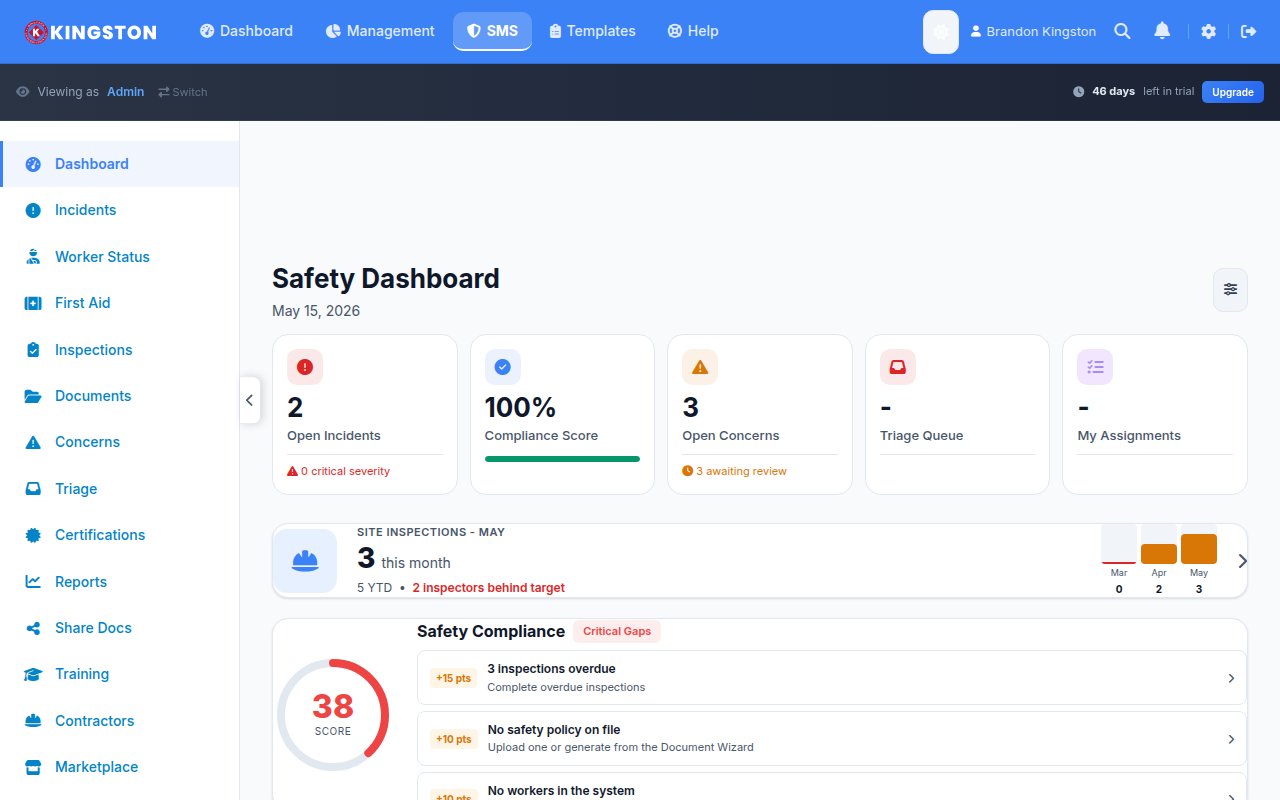
Make Safety Easy stores every Safety Data Sheet digitally and searchable by product, so your whole crew is one tap from the right SDS on any device.
Start Your Free TrialFree 14-day trial · No credit card required
MSDS vs SDS: What Changed?
Before 2012, chemical hazard information was communicated through Material Safety Data Sheets (MSDS). The format, content and quality of MSDSs varied widely between manufacturers, making it difficult for workers to find the information they needed quickly.
In 2012, OSHA revised its Hazard Communication Standard (HazCom 2012, 29 CFR 1910.1200) to align with the Globally Harmonized System (GHS) of classification and labeling of chemicals. The key changes:
| Feature | MSDS (Old) | SDS (Current) |
|---|---|---|
| Format | Variable - no standard layout | Standardized 16-section format |
| Hazard classification | Varied by manufacturer | GHS-standardized categories |
| Pictograms | Varied symbols and colors | Nine standardized GHS pictograms |
| Signal words | Inconsistent | "Danger" or "Warning" only |
| International consistency | Country-specific formats | Globally harmonized |
The transition deadline for most US employers was June 1, 2016. If your workplace still has MSDSs (the old format), they must be replaced with current SDS documents. In Canada, WHMIS 2015 implemented the same GHS-aligned format.
For a deeper understanding of GHS, see our GHS glossary entry and SDS glossary definition.
The 16 Sections of an SDS - Explained
Section 1: Identification
Product name, manufacturer name and contact information, recommended use and restrictions on use, emergency phone number (usually a 24-hour poison control or CHEMTREC number).
Section 2: Hazard(s) Identification
GHS classification, signal word (Danger or Warning), hazard statements, precautionary statements, GHS pictograms and any hazards not otherwise classified.
Section 3: Composition/Information on Ingredients
Chemical name, common names, CAS number, concentration or concentration ranges for each hazardous ingredient. Trade secret claims may withhold specific identities but must still disclose hazard information.
Section 4: First-Aid Measures
Immediate treatment for exposure by route (inhalation, skin contact, eye contact, ingestion), most important symptoms and indication of immediate medical attention needed.
Section 5: Fire-Fighting Measures
Suitable and unsuitable extinguishing media, specific hazards from the chemical (toxic fumes, explosion risk), special protective equipment for firefighters.
Section 6: Accidental Release Measures
Personal precautions, protective equipment, emergency procedures, containment and cleanup methods, environmental precautions.
Section 7: Handling and Storage
Safe handling precautions, conditions for safe storage (temperature, incompatibilities, ventilation requirements), specific end uses.
Section 8: Exposure Controls/Personal Protection
OSHA Permissible Exposure Limits (PELs), ACGIH Threshold Limit Values (TLVs), engineering controls required, PPE specifications (respiratory, hand, eye, skin).
Section 9: Physical and Chemical Properties
Appearance, odor, pH, melting/boiling point, flash point, flammability, vapor pressure, density, solubility and other physical data.
Section 10: Stability and Reactivity
Chemical stability under normal conditions, conditions to avoid (heat, sparks), incompatible materials, hazardous decomposition products.
Section 11: Toxicological Information
Routes of exposure, related symptoms, acute and chronic effects, numerical measures of toxicity (LD50, LC50), carcinogenicity listings.
Section 12: Ecological Information
Aquatic and terrestrial toxicity, persistence and degradability, bioaccumulation potential, mobility in soil. (Not enforced by OSHA but required by GHS.)
Section 13: Disposal Considerations
Waste treatment methods, safe disposal practices, contaminated packaging disposal. Must comply with federal, state and local regulations.
Section 14: Transport Information
UN number, proper shipping name, transport hazard class, packing group, environmental hazards during transport.
Section 15: Regulatory Information
Safety, health and environmental regulations specific to the product (TSCA, SARA, state right-to-know lists, Canadian DSL/NDSL).
Section 16: Other Information
Date of preparation or last revision, changes from previous version, abbreviations and references used.
Employer Responsibilities
Under OSHA's Hazard Communication Standard, employers must:
- Maintain an SDS for every hazardous chemical in the workplace
- Ensure SDS accessibility - workers must be able to access the SDS for any chemical they work with during their shift, without leaving the work area
- Train employees - workers must understand how to locate and read an SDS
- Keep SDS current - obtain updated SDS when manufacturers revise them
- Maintain a chemical inventory - a list of all hazardous chemicals present in the workplace, cross-referenced to their SDS
- Label all containers - with GHS-compliant labels matching SDS information
SDS Storage and Management
Physical Binders
The traditional approach is a physical SDS binder at each work location. Binders must be organized (alphabetically or by work area), kept up to date and accessible without a supervisor's assistance.
Digital SDS Management
Digital SDS systems offer significant advantages over paper binders:
- Instant search - find any SDS in seconds by product name, manufacturer or CAS number
- Automatic updates - receive notifications when manufacturers revise SDS documents
- Multi-site access - one central repository accessible from any location
- Audit trail - track who accessed which SDS and when
- Compliance reporting - generate chemical inventories and regulatory reports automatically
Make Safety Easy's document management system provides a centralized digital repository for all your SDS documents, accessible from any device in the field or office.
How to Read an SDS Quickly in an Emergency
In an emergency, you do not have time to read all 16 sections. Focus on these sections in this order:
- Section 2 - Hazard identification (what are we dealing with?)
- Section 4 - First aid measures (what do we do right now?)
- Section 8 - Exposure controls/PPE (what protection is needed?)
- Section 6 - Accidental release (how do we contain a spill?)
- Section 5 - Firefighting measures (if fire is involved)
Common SDS Compliance Mistakes
Hazard Communication is consistently one of the most-cited OSHA standards. The most common SDS-related compliance mistakes include:
- Outdated SDS documents - keeping SDS that are 10+ years old when the manufacturer has issued revisions. Check Section 16 for the revision date.
- Incomplete chemical inventory - missing SDS for maintenance chemicals, cleaning products, lubricants or products stored in secondary containers
- Inaccessible SDS - binders locked in a supervisor's office, electronic systems that require passwords workers do not have, or tablets that are uncharged when needed
- No training records - employers train workers on SDS use but fail to document the training with dates, topics covered and attendee signatures
- Unlabeled secondary containers - transferring chemicals to unmarked spray bottles, buckets or drums without GHS-compliant labels
- No written HazCom program - OSHA requires a written program even if you only have a handful of chemicals
GHS Pictograms and What They Mean
The GHS system uses nine standardized pictograms (red-bordered diamonds with black symbols on white backgrounds) to communicate hazard types at a glance:
- Flame - flammable gases, liquids, solids and aerosols
- Flame over circle - oxidizers that can intensify fires
- Exploding bomb - explosives, self-reactive substances
- Skull and crossbones - acutely toxic substances (fatal or toxic)
- Corrosion - corrosive to metals, skin corrosion, serious eye damage
- Exclamation mark - irritant, skin sensitizer, acute toxicity (harmful), narcotic effects
- Health hazard - carcinogens, mutagens, reproductive toxins, respiratory sensitizers, organ toxicity
- Gas cylinder - gases under pressure
- Environment - hazardous to the aquatic environment
Workers should be able to recognize all nine pictograms and understand what general precautions each one requires. This should be covered in your annual HazCom training.
Transitioning from Paper Binders to Digital SDS
If you are still managing SDS in physical binders, here is a practical migration plan:
- Audit your current inventory - pull every SDS from every binder and create a master list of products
- Check revision dates - any SDS older than 3 years likely has a newer version available from the manufacturer
- Request current SDS - contact manufacturers or use free SDS databases to obtain the latest versions
- Upload to your digital system - scan and upload each SDS, tagging it with product name, manufacturer, location and hazard class
- Provide access devices - ensure every work area has a tablet, computer or QR code poster that gives workers immediate SDS access
- Train your team - show workers how to search and access digital SDS
- Keep a paper backup - maintain one physical binder per location in case of power outages or system downtime
Make Safety Easy's document management handles the entire SDS lifecycle - upload, organize, search, access control and automatic revision tracking - in one platform.
Frequently Asked Questions
Is MSDS the same as SDS?
Not exactly. An SDS is the updated, GHS-aligned replacement for the older MSDS format. The content is similar, but the SDS follows a mandatory 16-section structure and uses standardized hazard classification, pictograms and signal words. All MSDSs should have been replaced with SDS documents by June 2016 in the US and December 2018 in Canada.
How long do you need to keep SDS on file?
OSHA requires employers to maintain SDS for at least 30 years after the chemical is no longer used in the workplace (under the Access to Employee Exposure and Medical Records standard, 29 CFR 1910.1020). However, the SDS may be replaced with a record of the chemical identity, where and when it was used and the duration of use.
Who is responsible for providing the SDS?
The chemical manufacturer, importer or distributor must provide an SDS with the first shipment and whenever the SDS is updated. The employer is responsible for obtaining and maintaining SDS for every hazardous chemical in the workplace and ensuring workers can access them.
Do I need an SDS for consumer products?
If a consumer product is used in the workplace in the same manner and duration as normal consumer use, an SDS is not required. However, if workers use the product more frequently, in larger quantities or in a different manner than typical consumer use, an SDS is required.
Can I keep SDS digitally instead of in a binder?
Yes. OSHA allows electronic SDS access as long as workers can access the SDS immediately during their shift without barriers (passwords that delay access, unreliable internet, devices that are not available). A paper backup plan is recommended in case of power outages or system failures.
Go Digital with Make Safety Easy
Replace paper checklists, inspection logs and compliance binders with one platform your whole team can use - from the field to the office. Start tracking inspections, incidents and training in minutes.