Toolbox talks (also called tailgate meetings or safety moments) are short, focused safety discussions held at the start of a shift. Done well, they take less than 10 minutes and dramatically reduce incident rates. Done poorly, they become a box-checking exercise that nobody takes seriously.
Here's how to run toolbox talks that actually work - plus free templates you can start using today.
Why Toolbox Talks Matter
Research from the Construction Industry Institute found that crews who receive regular, quality toolbox talks experience up to 50% fewer recordable incidents compared to crews that don't. WorkSafeBC's own data shows that most workplace injuries occur when workers are not adequately briefed on the day's specific hazards.
Free Download: 5 Safe Work Procedures
Choose from 112 professionally written SWPs. No credit card required.
Get Free SWPsA toolbox talk isn't just a compliance checkbox - it's your most direct line of communication with workers about the hazards they'll face today.
Step 1: Choose a Relevant Topic (2 minutes prep)
The most effective toolbox talks address what's happening right now. Choose topics based on:
- Today's specific tasks: If you're doing elevated work, talk about fall protection. If you're receiving a chemical shipment, talk about WHMIS and SDS.
- Recent incidents or near-misses: A near-miss yesterday is the most powerful teaching moment you'll get.
- Seasonal hazards: Heat stress in summer, ice and visibility in winter, spring rain and mud conditions.
- Regulatory updates: New WorkSafeBC requirements, updated PPE standards, or changes to site procedures.
Step 2: Prepare Your Key Points (3 minutes prep)
You don't need a PowerPoint. You need 3-4 key points and a real-world example. Structure your talk like this:
- The hazard: What could go wrong? Be specific. "Working at height" is vague. "We're installing ductwork on scaffolding at 18 feet today" is actionable.
- The controls: What are we doing about it? Harnesses inspected, guardrails in place, spotter assigned.
- Your role: What does each worker need to do personally? Clip in before stepping onto the scaffold, report any loose planks immediately.
- The question: Ask one open-ended question to confirm understanding. "What would you do if you noticed a damaged guardrail?"
Step 3: Deliver With Energy (5-7 minutes)
Stand where everyone can see you. Make eye contact. Speak like you mean it - because you do.
- Start with a hook: A stat, a recent incident, or a question. "Did you know that falls from scaffolding account for 30% of construction fatalities in BC?"
- Keep it conversational: This is not a lecture. Invite questions. Ask workers to share their own experiences.
- Use real examples: "Last Tuesday, Mike noticed a cracked rung on the ladder and tagged it out. That's exactly what we're talking about today."
- End with a clear call to action: "Before you step onto that scaffold today, check your harness and confirm the guardrails are secure. Let's have a zero-incident day."
Step 4: Document and Get Sign-Off (2 minutes)
Every toolbox talk should be documented with:
- Date, time and location
- Topic covered
- Key points discussed
- Attendee names and signatures
- Any follow-up actions identified
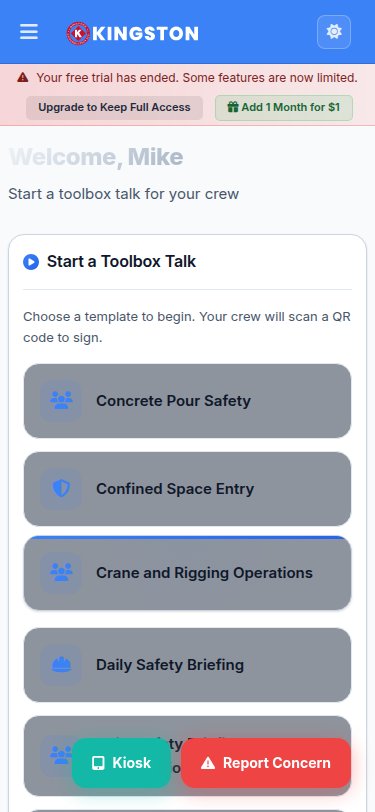
Paper sign-off sheets work, but they're easy to lose and hard to audit. Digital tools like Make Safety Easy's Toolbox Talks module let workers sign off on a tablet or phone, automatically log attendance and store everything in a searchable, audit-ready format.
Free Toolbox Talk Templates
Here are three templates you can adapt for your site:
Template 1: General Hazard Awareness
Topic: [Specific hazard - e.g., "Working Near Mobile Equipment"]
Date: _____ Presenter: _____
Key Points:
1. The hazard: [What could go wrong]
2. Our controls: [What protections are in place]
3. Your responsibility: [What each worker must do]
Discussion Question: [Open-ended question]
Attendees: [Names and signatures]
Template 2: Incident Review Talk
Topic: Review of [incident/near-miss description]
What happened: [Brief factual summary - no blame]
Root cause: [What allowed this to happen]
Corrective actions: [What changed as a result]
Lesson for today: [How this applies to our work today]
Template 3: Seasonal Safety Talk
Topic: [Season]-Specific Hazards
Conditions today: [Weather, temperature, visibility]
Hazards to watch: [e.g., ice on walkways, heat stress, UV exposure]
Required PPE adjustments: [e.g., sun protection, insulated gloves]
Hydration/break schedule: [If applicable]
Make It a Habit, Not a Chore
The best safety cultures treat toolbox talks as a non-negotiable part of every shift. When talks are relevant, engaging and short, workers actually look forward to them - because they know it's about keeping them safe, not just ticking a box.
Ready to digitize your toolbox talks? Book a demo and see how Make Safety Easy streamlines the entire process - from topic selection to digital sign-off to audit reporting.
Ready to simplify your safety program?
Make Safety Easy helps teams run toolbox talks, inspections, incident reports and more - all from one platform.
Start Your Free TrialNo credit card required. 14-day free trial.