Excavation and Trenching Safety: OSHA Requirements and Best Practices
Trench collapses are among the most lethal hazards in construction, killing an average of 40 workers per year in the United States according to the Bureau of Labor Statistics. A single cubic yard of soil can weigh over 3,000 pounds - enough to crush a worker in seconds. OSHA's excavation standard, 29 CFR 1926 Subpart P, requires protective systems in trenches 5 feet or deeper, a competent person on every excavation site and daily inspections before each shift. In Canada, requirements under provincial regulations such as Ontario's O. Reg. 213/91 Sections 222-242 and WorkSafeBC Part 20 impose similar - and in some cases stricter - protections. Compliance is not optional and the consequences of ignoring these rules are measured in lives, not dollars.
Key Definitions: Excavation vs. Trench
OSHA distinguishes between the two and the distinction matters for regulatory purposes:
- Excavation: Any man-made cut, cavity, trench, or depression in the earth's surface formed by earth removal.
- Trench: A narrow excavation where the depth exceeds the width (and the width does not exceed 15 feet).
All trenches are excavations, but not all excavations are trenches. The protective system requirements in Subpart P apply to both, but certain simplified design tables (Appendices A and B) are specific to trenches.
Free Download: 5 Safe Work Procedures
Choose from 112 professionally written SWPs. No credit card required.
Get Free SWPsOSHA Excavation Requirements (29 CFR 1926 Subpart P)
The Competent Person Requirement
Every excavation site must have a competent person - someone who can identify existing and predictable hazards, has the authority to take corrective measures and is trained in soil classification. This is arguably the most critical requirement. The competent person must:
- Classify soil type (Stable Rock, Type A, Type B, or Type C) using at least one visual and one manual test.
- Inspect the excavation, adjacent areas and protective systems daily before each shift, after rainstorms and after any event that could affect stability.
- Have the authority to immediately remove workers from the excavation if a hazard is detected.
There is no OSHA "certification" for competent persons - the standard requires demonstrated knowledge and authority, not a card. However, formal training from a recognized provider is the practical standard for demonstrating competence in court or during an inspection.
Protective Systems
OSHA requires a protective system for any trench 5 feet (1.5 metres) or deeper, unless the excavation is made entirely in stable rock. For trenches 20 feet or deeper, the system must be designed by a registered professional engineer. The three acceptable methods are:
1. Sloping and Benching
Cutting back the trench walls to an angle that reduces the risk of collapse. Maximum allowable slopes depend on soil type:
| Soil Type | Maximum Slope (H:V) | Slope Angle |
|---|---|---|
| Stable Rock | Vertical | 90° |
| Type A | ¾:1 | 53° |
| Type B | 1:1 | 45° |
| Type C | 1½:1 | 34° |
Sloping requires significant additional excavation - often impractical in urban environments or near existing structures.
2. Shoring
Installing support structures (hydraulic, mechanical, or timber) to prevent soil movement. Shoring is commonly used in Type A and Type B soils where space is limited. Tabulated data in OSHA Appendix C provides design specifications, or an engineer can design a custom system.
3. Shielding (Trench Boxes)
Placing a steel or aluminum trench box inside the excavation to protect workers. Trench boxes do not prevent cave-ins - they protect workers if one occurs. They must be rated for the depth and soil conditions and workers must remain inside the shielded area at all times.
Access and Egress
OSHA requires that a means of egress - a ladder, ramp, or stairway - be provided in trenches 4 feet or deeper. These must be located so that no worker has to travel more than 25 feet laterally to reach one. This requirement saves lives: when a trench begins to collapse, seconds determine survival.
Other Critical Requirements
- Spoil piles: Excavated material must be kept at least 2 feet from the edge of the trench.
- Utilities: Underground utilities must be located (call 811 in the U.S., provincial one-call systems in Canada) before digging begins.
- Water accumulation: Workers must not work in excavations with accumulated water unless adequate protections are in place (pumping, diversion, or harnesses).
- Atmospheric hazards: Test for oxygen deficiency, combustible gases and toxic atmospheres in excavations deeper than 4 feet where such hazards could exist.
- Surcharge loads: Heavy equipment, vehicles and material stockpiles near the edge create additional lateral pressure. The competent person must account for these in the protective system design.
Canadian Excavation Requirements
Canadian provinces generally impose stricter thresholds. Key differences include:
- Ontario (O. Reg. 213/91): Protective systems required at 1.2 metres (4 feet) depth. Soil classification is mandatory. Engineering drawings required for excavations deeper than 6 metres.
- British Columbia (WorkSafeBC Part 20): Shoring required at 1.2 metres unless the walls are sloped to a safe angle. A qualified person (equivalent to OSHA's competent person) must be designated.
- Alberta (OHS Code Part 32): Protective systems at 1.5 metres. Specific requirements for temporary and permanent shoring.
Internationally, the UK's CDM Regulations 2015 and Australia's WHS Regulations follow similar principles, with variations in depth thresholds and engineering requirements.
Daily Inspection Checklist for Excavations
The competent person must inspect the excavation before each shift. A thorough inspection covers:
- Soil conditions: Has rain, vibration, or loading changed the soil classification?
- Protective system integrity: Are shoring jacks holding pressure? Is the trench box plumb and undamaged? Are slope angles maintained?
- Spoil pile placement: Is excavated material at least 2 feet from the edge?
- Access/egress: Are ladders in place, secured and within 25 feet of workers?
- Water conditions: Any accumulation or seepage that requires pumping?
- Surface encumbrances: Are sidewalks, pavement, or structures adjacent to the trench showing signs of cracking or movement?
- Atmospheric conditions: Has the atmosphere been tested if required?
- Heavy equipment position: Are surcharge loads being controlled?
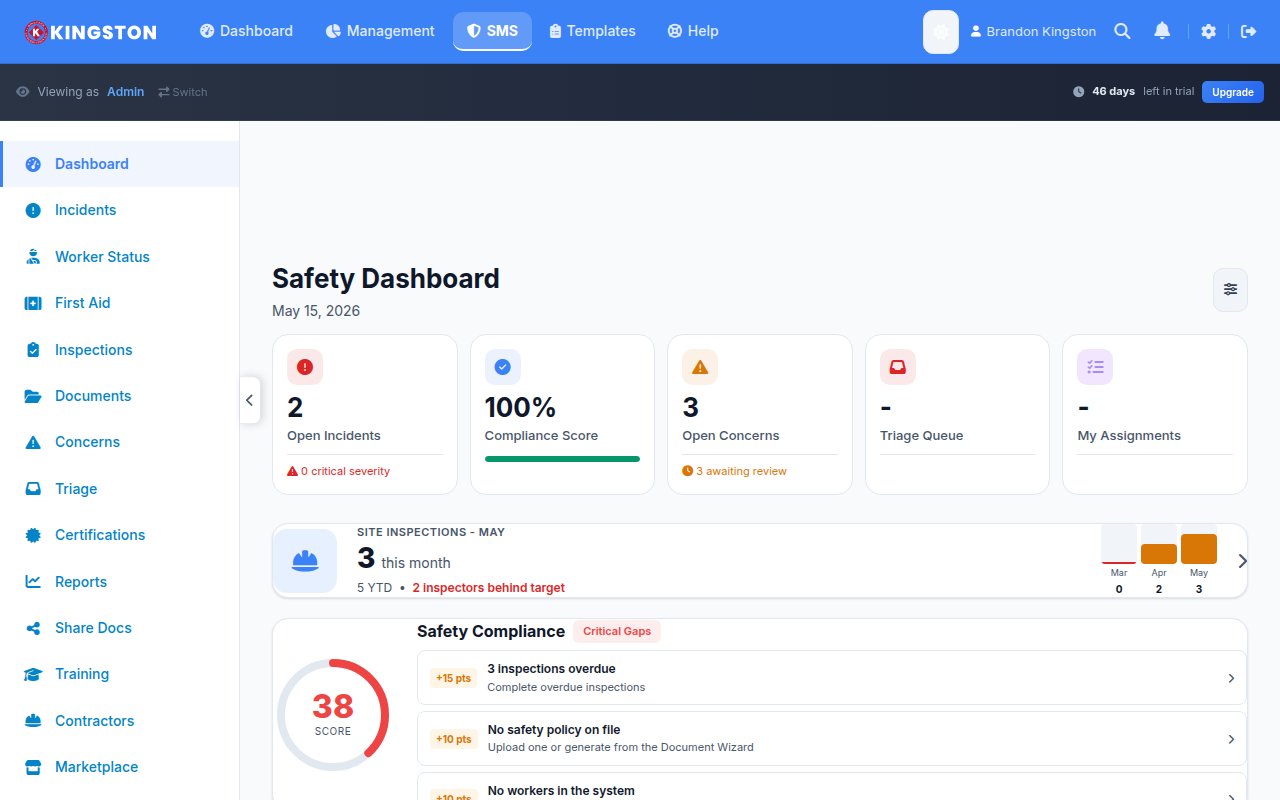
Paper inspection forms slow the process down and create a documentation gap. Digital inspection checklists let the competent person complete and submit inspections from a mobile device, with timestamped records and photo attachments that hold up during regulatory audits.
Best Practices Beyond Compliance
Meeting the minimum standard keeps you legal. These practices keep workers alive:
- Treat every trench as Type C soil unless you have definitive test results proving otherwise. Type C (the weakest) demands the most conservative protective measures - and you can always scale back if testing confirms better conditions.
- Brief the crew every morning. A five-minute safety huddle covering the day's excavation plan, hazard conditions and emergency procedures prevents complacency. Pre-built construction safety resources make these briefings fast and consistent.
- Have a rescue plan - and practice it. OSHA does not specifically require a trench rescue plan, but the General Duty Clause and common sense demand one. Know who calls 911, who directs arriving crews and where the nearest confined-space rescue team operates.
- Report near-misses. A small slough of soil from a trench wall today can be a full collapse tomorrow. Use a digital incident reporting system to capture near-misses and track corrective actions.
OSHA Penalties for Excavation Violations
Excavation violations are among the most frequently cited - and most severely penalized - in OSHA's enforcement portfolio. In 2025, maximum penalties reached:
- Serious violation: Up to $16,550 per instance.
- Willful violation: Up to $165,514 per instance.
- Repeat violation: Up to $165,514 per instance.
After a fatality, OSHA routinely issues multiple willful citations, pushing total penalties into the hundreds of thousands. In Canada, penalties can exceed $1.5 million under Ontario's OHSA and individual supervisors face potential imprisonment.
Protect Your Crew and Your Business
Excavation safety is non-negotiable - and getting it right requires systematic documentation, daily inspections and a culture that treats every trench as potentially deadly. Make Safety Easy gives construction teams the tools to run compliant excavation programs: digital inspection checklists, centralized incident reporting, and a documentation trail that proves due diligence.
Don't wait for an incident to modernize your excavation safety program. Book a demo today or check our pricing to find the right fit for your crew.
Ready to simplify your safety program?
Make Safety Easy helps teams run toolbox talks, inspections, incident reports and more - all from one platform.
Start Your Free TrialNo credit card required. 14-day free trial.