An incident just happened on your site. Someone is hurt, something is damaged, or something nearly went wrong. Your next job is to document it. The incident report you write in the next 24 hours will be read by your safety manager, your insurance company, a regulatory inspector, and possibly a lawyer. What you write matters.
A good incident report captures what happened, why it happened, and what needs to change to prevent it from happening again. A bad incident report says "worker fell" and leaves everyone guessing.
What Is an Incident Report?
An incident report is a written record of any workplace event that resulted in injury, illness, property damage, environmental release, or a near-miss. The report documents:
Free Download: 5 Safe Work Procedures
Choose from 112 professionally written SWPs. No credit card required.
Get Free SWPs- What happened (the event)
- Who was involved (workers, witnesses, supervisors)
- When and where it happened (date, time, location)
- How it happened (sequence of events)
- Why it happened (contributing factors and root causes)
- What action is being taken (corrective and preventive measures)
When to Write an Incident Report
Write a report for:
- Any injury requiring medical attention beyond basic first aid
- Any injury involving lost work time, restricted duties, or job transfer
- Property or equipment damage
- Environmental releases (spills, emissions, discharges)
- Near-miss events
- Vehicle incidents
- Fires, explosions, or structural failures
- Any event that could have resulted in a serious injury or fatality
Near-misses deserve the same quality of report as actual injuries. A near-miss is a free warning. The only difference between a near-miss and a fatality is luck.
What to Include in an Incident Report
1. Basic Information
- Date and time of incident
- Date and time report was written
- Location (site, area, specific spot)
- Name and role of person completing the report
- Name, role, and department of injured/involved person(s)
- Names and contact information of witnesses
2. Description of the Incident
Write a clear, factual narrative of what happened. Include what the worker was doing immediately before the incident, what task was being performed, what happened, what the immediate outcome was, what equipment was involved, and what environmental conditions were present.
Be specific. "Worker fell" is not a description. "Worker was descending a 12-foot extension ladder at the south wall of Building C. On the third rung from the bottom, his left foot slipped on a wet rung. He fell approximately 4 feet and landed on the concrete floor on his right side, striking his right hip and shoulder."
Be factual. Report what happened, not what you think happened. If you did not see it, say "the worker reported that..." Do not speculate.
3. Injury Details
- Nature of injury (laceration, fracture, sprain, burn, etc.)
- Body part(s) affected
- First aid provided on site
- Medical treatment sought
- Lost time or restricted duty
4. Contributing Factors and Root Cause
Immediate causes:
- Unsafe act (what did someone do or fail to do?)
- Unsafe condition (what physical condition contributed?)
Root causes: Ask "why" five times.
- Why did the worker fall? The ladder rung was wet.
- Why was the rung wet? Rain had blown into the work area.
- Why was the ladder used in a wet condition? No pre-use inspection was done.
- Why was no inspection done? There is no procedure for checking ladders before use.
- Why is there no procedure? Ladder safety training does not include pre-use inspection requirements.
Now you have something actionable: update ladder safety training to include mandatory pre-use inspection, and implement a wet-condition protocol.
5. Corrective Actions
For each contributing factor, document:
- What action will be taken
- Who is responsible
- When it will be completed (specific date)
- How completion will be verified
"Tell the worker to be more careful" is not a corrective action. "Implement mandatory pre-use ladder inspection checklist and provide training to all crews by May 15" is.
Incident Report Example
Incident Date: April 15, 2026, 10:45 AM
Location: Building C, south exterior wall
Reported By: Sarah Chen, Site Supervisor
Description: James Rodriguez was descending a 24-foot aluminum extension ladder positioned against the south wall of Building C after installing exterior sheathing. Light rain had started approximately 30 minutes prior. At the third rung from the bottom, his left work boot slipped on a wet rung. He fell approximately 4 feet, landing on the concrete on his right side.
Injuries: Bruised right hip (contusion), strained right shoulder. First aid on site. X-rays negative. Restricted duty for 5 days.
Corrective Actions:
| Action | Responsible | Due Date |
|---|---|---|
| Implement weather-change reassessment procedure | S. Chen | April 22 |
| Add pre-use ladder inspection to daily toolbox talk | S. Chen | April 16 |
| Update ladder safety training for wet conditions | Safety Dept | May 1 |
| Update JHA for exterior sheathing with weather triggers | S. Chen | April 25 |
Common Incident Report Mistakes
1. Writing it days later. Memory fades. Write the report on the same day.
2. Blaming the worker. "Worker was careless" is not an investigation. Ask why the worker did what they did.
3. Vague descriptions. "Worker was injured while working" tells nobody anything.
4. No corrective actions. A report without corrective actions is an obituary, not a prevention tool.
5. No follow-up. Corrective actions that are written but never implemented create a documented record that you knew about the hazard and chose not to fix it.
6. Not reporting near-misses. If a heavy tool falls from the third floor and misses a worker by 2 feet, that needs a report before the next one does not miss.
OSHA Reporting Requirements
In the United States, OSHA requires:
Report within 8 hours: All work-related fatalities
Report within 24 hours: In-patient hospitalization, amputation, loss of an eye
Record on OSHA 300 Log: Deaths, days away from work, restricted work cases, medical treatment beyond first aid, loss of consciousness, significant diagnosed injuries
Maintain records for 5 years. Other jurisdictions have their own reporting thresholds and timeframes.
Paper vs. Digital Incident Reports
Paper incident reports are slow, hard to read, easy to lose, and impossible to analyze.
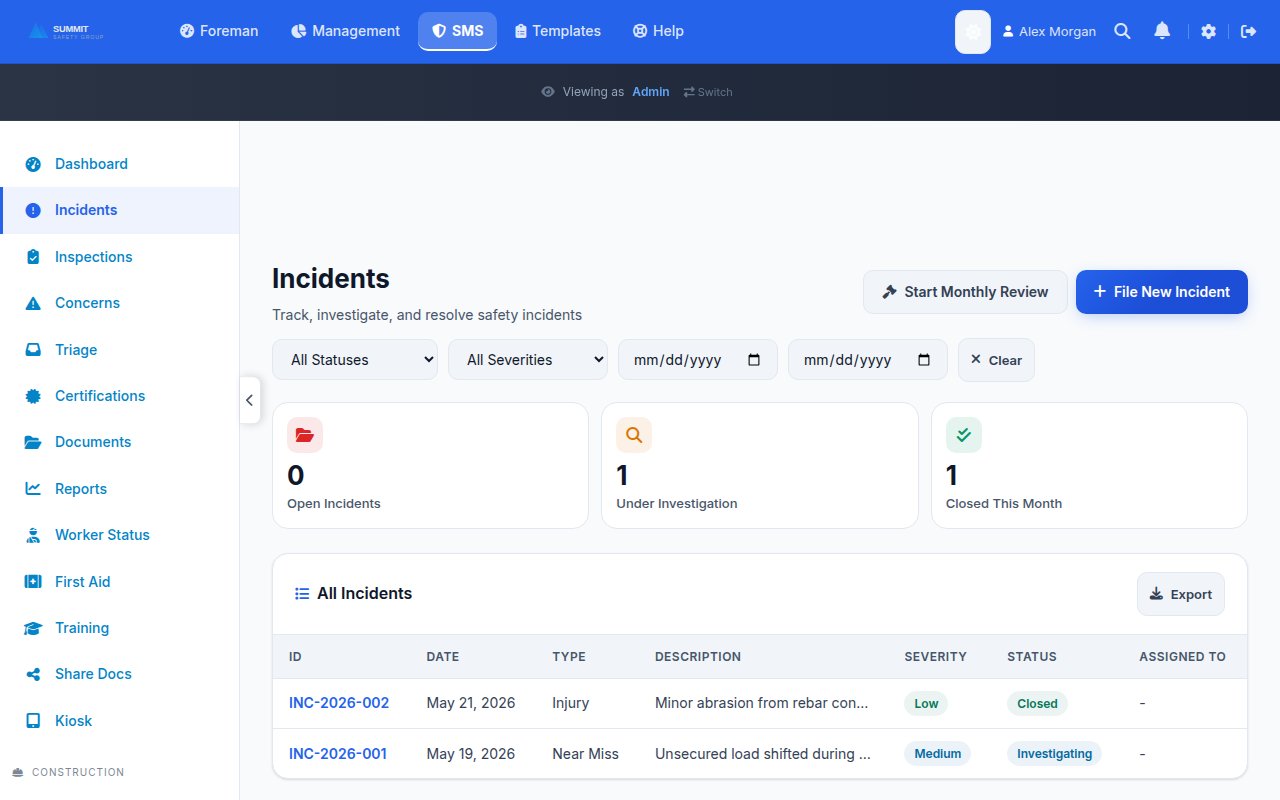
Make Safety Easy makes incident reporting fast enough to actually get done in the field:
- Workers submit reports from their phone in under 5 minutes
- Photos are attached inline with automatic GPS and timestamp
- Corrective actions are assigned with due dates and tracked through closure
- Management dashboards show incident trends and overdue corrective actions
- Full reports export to PDF for auditors, insurers, and legal
Your workers need a reporting tool that is faster than ignoring the incident. Your safety team needs data they can act on.
Go Digital with Make Safety Easy
Replace paper checklists, inspection logs and compliance binders with one platform your whole team can use - from the field to the office. Start tracking inspections, incidents and training in minutes.
Free Safety Templates
While you evaluate software, grab our free professionally designed templates:
View all 10 free templates →