Incident investigation is a systematic process of examining workplace events - injuries, near-misses, equipment failures and property damage - to identify root causes and implement corrective actions that prevent recurrence. Whether you follow OSHA's recommended investigation practices in the United States or comply with provincial occupational health and safety requirements in Canada, the core methodology remains the same: stop blaming individuals and start fixing systems. This guide covers every step from initial response through corrective action verification, using proven root cause analysis techniques that actually work on job sites.
Here's the uncomfortable truth most safety departments won't say out loud. The majority of incident investigations fail - not because people don't care, but because they stop too early. They find a surface cause ("the worker slipped"), slap on a corrective action ("remind everyone to watch their step"), and file it away. Six months later, someone else slips in the same spot. Sound familiar?
A genuine root cause analysis digs deeper. It asks "why" until you reach the organizational, procedural, or design failures that actually allowed the incident to happen. That's where lasting change lives. And that's exactly what we'll walk through in this guide.
Free Download: 5 Safe Work Procedures
Choose from 112 professionally written SWPs. No credit card required.
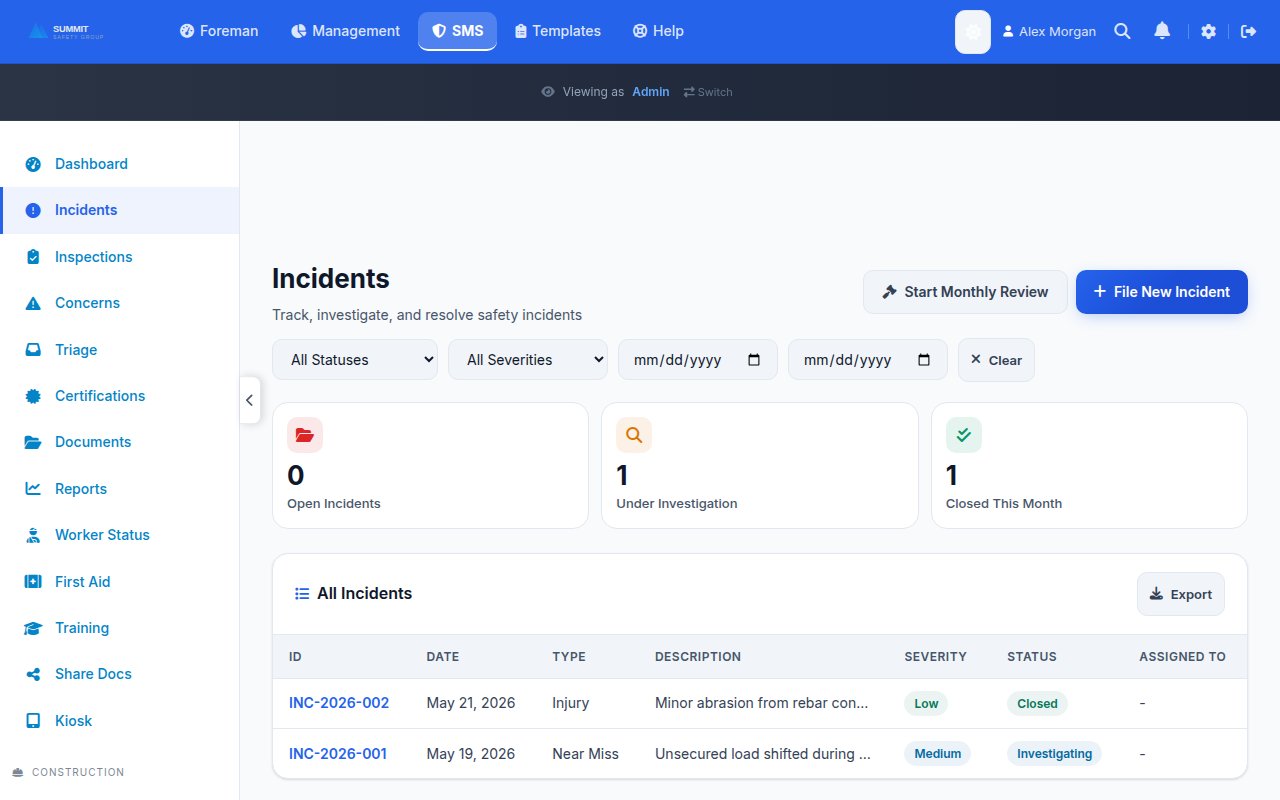
Get Free SWPsNeed to streamline your entire investigation workflow - from first report to final corrective action? Make Safety Easy's incident reporting tools let your team report events from the field in minutes, with photos, witness statements and automatic supervisor notifications built right in.
Why Incident Investigation Matters
Incident investigations aren't just a regulatory checkbox. They're your single best tool for predicting and preventing serious injuries. Consider the data:
- OSHA estimates that for every serious workplace injury, there are approximately 10 minor injuries, 30 property-damage incidents and 600 near-misses. Investigating any of those earlier events could have prevented the serious one.
- Canadian jurisdictions - including Ontario (OHSA s.51-53), Alberta (OHS Act s.18), and British Columbia (WorkSafeBC Part 3) - require employers to investigate incidents and report certain categories to regulatory authorities within 24 to 72 hours depending on severity.
- OSHA 29 CFR 1904 requires employers to record and report work-related fatalities within 8 hours and in-patient hospitalizations, amputations, or losses of an eye within 24 hours.
But compliance is the floor, not the ceiling. Organizations that investigate near-misses and minor events - not just recordable injuries - consistently outperform their peers on every safety metric. They see patterns before those patterns produce catastrophic outcomes.
The 8 Steps of an Effective Incident Investigation
Below is a proven, field-tested investigation process that aligns with OSHA guidelines, CSA Z1000 (Occupational Health and Safety Management), and the Canadian Centre for Occupational Health and Safety (CCOHS) recommendations.
Step 1: Secure the Scene and Provide First Aid
Your first priority is always people. Ensure injured workers receive medical attention. Then secure the scene to prevent additional injuries and preserve evidence. Barricade the area. Shut down affected equipment. Don't move anything unless it's necessary for rescue or to prevent further harm.
Take photographs and video immediately - before anyone cleans up, resets equipment, or "fixes" the problem. Time-stamped photos are among the most valuable evidence you'll collect.
Step 2: Notify Appropriate Parties
Depending on severity, you may need to notify:
- Internal management and your safety department
- The joint health and safety committee (JHSC) or worker safety representative
- Your provincial OHS regulator or OSHA area office
- Insurance carriers and workers' compensation boards
- Union representatives, if applicable
Know your reporting timelines in advance. In Ontario, a critical injury requires immediate notification to the Ministry of Labour, Immigration, Training and Skills Development (MLITSD) and to the JHSC. In the U.S., OSHA fatality and severe injury reporting timelines are strict and non-negotiable.
Step 3: Assemble the Investigation Team
An investigation should never be a one-person show. Assemble a team that includes:
- The direct supervisor of the area or task
- A worker representative (JHSC member or safety rep)
- A subject-matter expert familiar with the equipment or process
- A trained investigator (internal or external)
Keep the team small enough to be efficient but broad enough to capture different perspectives. The worker representative is not optional - Canadian OHS legislation in most provinces explicitly requires worker participation in investigations.
Step 4: Gather Evidence
This is where thoroughness pays off. Collect:
- Physical evidence: Equipment condition, material samples, environmental measurements (lighting, noise, temperature)
- Documentary evidence: Training records, maintenance logs, SOPs, inspection reports, work permits
- Photographic evidence: Wide-angle context shots, close-ups of damage or defects, measurements with scale references
- Witness statements: Interview witnesses individually, as soon as possible after the event. Use open-ended questions: "Walk me through what happened" is far more effective than "Did you see the worker trip?"
Digital tools dramatically improve evidence collection quality. Incident reporting software allows field workers to capture photos, GPS locations and detailed descriptions on their phones the moment an event occurs - before memory fades and conditions change.
Step 5: Determine the Sequence of Events
Build a timeline. Map out exactly what happened, in what order, starting well before the incident itself. Use a visual timeline or flowchart. This is where most investigations start revealing gaps between "what should have happened" (the procedure) and "what actually happened" (the practice).
Include environmental and contextual factors: shift changes, weather, production pressure, staffing levels, recent changes to equipment or procedures. Incidents rarely have a single cause - they sit at the intersection of multiple contributing factors.
Step 6: Conduct Root Cause Analysis
This is the core of your investigation. Surface causes are obvious. Root causes require structured analysis methods. Here are the three most effective techniques for workplace safety investigations:
Root Cause Analysis Method 1: The 5 Whys
The simplest and most widely used technique. Start with the incident and ask "why" repeatedly until you reach a systemic cause. Example:
- Why did the worker fall from the scaffold? - The guardrail was missing.
- Why was the guardrail missing? - It was removed for material hoisting and never replaced.
- Why wasn't it replaced? - There's no procedure requiring sign-off after guardrail removal.
- Why is there no procedure? - Scaffold modifications aren't covered in the current safe work procedure.
- Why aren't scaffold modifications covered? - The procedure hasn't been updated since the company started doing multi-story work.
The root cause isn't "the worker fell." It's that safe work procedures weren't updated to match the scope of current operations. That's actionable.
Root Cause Analysis Method 2: Fishbone (Ishikawa) Diagram
This method organizes contributing factors into categories. For workplace incidents, the standard categories are:
| Category | Questions to Investigate |
|---|---|
| People | Was the worker trained? Experienced? Fatigued? Distracted? Following procedures? |
| Equipment | Was equipment properly maintained? Inspected? Appropriate for the task? Defective? |
| Environment | Were conditions (lighting, weather, noise, housekeeping) a factor? |
| Procedures | Did a written procedure exist? Was it current? Was it followed? Was it adequate? |
| Management | Were resources adequate? Was there production pressure? Were inspections conducted? |
| Materials | Were materials appropriate? Stored correctly? Labeled properly? Defective? |
Root Cause Analysis Method 3: Barrier Analysis
Every workplace has layers of protection (barriers) that should prevent hazards from reaching workers. Barrier analysis examines which barriers existed, which ones failed and why. Barriers include physical controls (guards, ventilation), administrative controls (procedures, training), and PPE. When an incident occurs, at least one barrier failed or was absent entirely.
Step 7: Develop Corrective Actions
Corrective actions must address root causes, not just symptoms. And they must follow the hierarchy of controls:
- Elimination - Remove the hazard entirely
- Substitution - Replace the hazard with something less dangerous
- Engineering controls - Physically isolate workers from the hazard
- Administrative controls - Change procedures, training, signage, or scheduling
- PPE - Provide personal protective equipment as a last line of defense
Every corrective action needs an owner, a deadline and a verification method. "Retrain workers" without specifying who, when and how you'll confirm effectiveness is not a corrective action - it's a wish.
Step 8: Document, Communicate and Follow Up
Write the investigation report. Include the facts, analysis, root causes and corrective actions with timelines. Share findings with affected workers, the JHSC and management. Then - and this is the step most organizations skip - follow up to verify that corrective actions were actually implemented and are working.
Track all of this in one place. Monthly safety reviews give you a structured opportunity to revisit open corrective actions, verify completion and identify trends across multiple incidents.
Common Incident Investigation Mistakes
Even experienced safety professionals fall into these traps:
- Stopping at the surface cause. "Worker error" is almost never a root cause. The question is: why did the system allow or encourage that error?
- Assigning blame instead of finding causes. A blame culture guarantees that workers will stop reporting near-misses and minor incidents - the very events that predict and prevent serious injuries.
- Waiting too long to investigate. Evidence disappears. Memories change. Conditions shift. Start within hours, not days.
- Writing vague corrective actions. "Be more careful" is not a corrective action. "Install permanent guardrail at loading dock edge by April 30" is.
- Never following up. A corrective action that was assigned but never verified is worse than useless - it creates a false sense of security.
Near-Miss Investigations: Your Greatest Prevention Tool
A near-miss is a free lesson. Something went wrong, but nobody was hurt - yet. The conditions that produced the near-miss haven't changed. Without investigation and correction, the next occurrence might produce an injury or fatality.
Organizations with mature safety cultures investigate near-misses with the same rigor as actual injuries. They understand that the pyramid of incidents (near-misses at the base, fatalities at the top) means every prevented near-miss pulls the entire pyramid down.
Making near-miss reporting easy and non-punitive is critical. If it takes 20 minutes to fill out a paper form and the worker fears disciplinary action, they won't report. If it takes 60 seconds on a phone app and the culture rewards reporting, they will.
Regulatory Requirements: OSHA and Canadian Jurisdictions
A quick reference for incident investigation obligations:
| Jurisdiction | Investigation Required? | Key Reporting Timelines |
|---|---|---|
| OSHA (U.S. Federal) | Recommended for all incidents; mandatory recording under 29 CFR 1904 | Fatality: 8 hours. Hospitalization/amputation/eye loss: 24 hours. |
| Ontario (OHSA) | Mandatory for critical injuries, fatalities and certain prescribed incidents | Critical injury/fatality: immediate notification to MLITSD and JHSC |
| Alberta (OHS Act) | Mandatory for serious injuries and incidents | Serious injury: as soon as possible. Fatality: immediately. |
| British Columbia (WorkSafeBC) | Mandatory; preliminary report within 48 hours for serious incidents | Serious injury/fatality: immediately by phone to WorkSafeBC |
| Federal (Canada Labour Code) | Mandatory for federally regulated workplaces | Serious injury/fatality: immediately to the employer, then to ESDC |
Failure to investigate and report as required can result in significant fines, increased inspection scrutiny and in serious cases, personal liability for officers and directors.
Building a Proactive Investigation Culture
The best investigation programs share a few traits. They're blame-free. They're fast. They're thorough. And they close the loop - every corrective action gets verified and the lessons learned get shared across the organization. This doesn't happen by accident. It requires leadership commitment, training and the right tools.
You don't need a massive safety department to run effective investigations. You need a clear process, trained people and a system that doesn't let corrective actions fall through the cracks.
Ready to transform how your organization handles incident investigations? Make Safety Easy gives you digital incident reporting, root cause analysis workflows and corrective action tracking - all in one platform your team will actually use. Book a free demo or check out our pricing plans to get started.
Ready to simplify your safety program?
Make Safety Easy helps teams run toolbox talks, inspections, incident reports and more - all from one platform.
Start Your Free TrialNo credit card required. 14-day free trial.