Multi-site safety management is the practice of standardizing, coordinating and monitoring workplace safety programs across two or more physical locations from a centralized leadership structure. The core challenge is maintaining consistent safety standards at every site when you cannot physically be present at all of them simultaneously. Companies that manage safety well across multiple locations use a combination of clear standards, local accountability, technology-driven visibility and regular verification to ensure that what happens at the home office level actually happens on every job site and facility floor.
Why Multi-Location Safety Is Harder Than Single-Site
A single-site safety program benefits from proximity. The safety manager walks the floor, sees conditions firsthand, talks to workers daily and catches problems in real time. Scale that to five, ten or fifty locations and every advantage of proximity disappears.
Common Multi-Site Challenges
- Inconsistent execution - Site A follows the inspection schedule perfectly while Site B treats it as optional. Without visibility, you will not know until an injury or audit reveals the gap.
- Local culture drift - Each location develops its own safety culture over time. Some drift toward excellence. Others drift toward complacency. Without intervention, the gap between your best and worst sites widens every month.
- Communication breakdowns - Safety alerts, policy updates and lessons learned from incidents at one site may never reach other locations. Information that sits in email inboxes or on bulletin boards at one facility is invisible to the rest of the organization.
- Regulatory variation - Different states, provinces and countries have different safety regulations. A program that is compliant in Texas may fall short in California or Ontario. Multi-jurisdictional compliance adds layers of complexity.
- Data fragmentation - When each site tracks safety data in its own spreadsheet, binder or software system, rolling up organizational performance into a single view is nearly impossible.
- Accountability gaps - Distance creates plausible deniability. Site managers who know corporate safety leadership rarely visits can deprioritize safety activities without consequence.
Build a Standardized Safety Framework
The foundation of multi-site safety management is a standardized framework that every location follows. Standardization does not mean rigidity - it means establishing a common baseline that ensures minimum performance everywhere while allowing sites to address local hazards and conditions.
Free Download: 5 Safe Work Procedures
Choose from 112 professionally written SWPs. No credit card required.
Get Free SWPsCore Program Elements to Standardize
- Written safety policies - One set of policies that applies organization-wide. Local variations should be additive (addressing site-specific hazards) rather than reductive (watering down corporate requirements).
- Inspection checklists and schedules - Every site should use the same checklist format and follow the same inspection frequency. This makes cross-site comparison possible and ensures no location falls below the minimum. Use Make Safety Easy's Inspections feature to deploy standardized checklists to every site and track completion in real time.
- Incident reporting procedures - A single reporting process and classification system ensures that incidents at all locations are captured, categorized and investigated the same way.
- Training requirements - Define minimum training requirements by role, not by location. A forklift operator at Site C needs the same training as one at Site A.
- Corrective action management - Standardize how corrective actions are assigned, tracked and verified. Without a consistent process, items identified at remote sites disappear into the void.
Allow Local Flexibility Where It Matters
While the framework should be standardized, certain elements must flex to accommodate local conditions:
- Site-specific hazard assessments that reflect unique equipment, processes and environmental conditions
- Emergency action plans tailored to each facility's layout, local emergency services and geographic hazards (hurricanes, earthquakes, tornadoes)
- Regulatory compliance procedures that address state or provincial requirements beyond the federal baseline
- Language and cultural adaptations for workforces with different primary languages or communication norms
Establish Local Safety Leadership
You cannot manage every site remotely. Each location needs a designated safety leader - whether that is a full-time safety manager, a site supervisor with safety responsibilities or a safety committee. The local safety leader serves as your eyes, ears and voice on the ground.
Define the Local Safety Leader Role
Give local safety leaders clear, written responsibilities:
- Conduct or coordinate all required inspections on schedule
- Deliver or arrange toolbox talks at the required frequency
- Investigate incidents and near-misses within 24 hours
- Track corrective actions through completion
- Communicate safety performance to corporate leadership on a defined schedule
- Serve as the point of contact for workers who want to report hazards or concerns
Support and Develop Local Leaders
Assigning responsibility without providing support is a recipe for failure. Invest in local safety leaders through:
- Formal training in safety management fundamentals, investigation techniques and regulatory requirements
- Regular one-on-one meetings with corporate safety leadership
- Peer networking opportunities where local leaders from different sites share challenges and solutions
- Access to the same tools and technology that corporate safety uses
- Recognition and career development that signals safety leadership is valued, not just tolerated
Centralize Your Safety Data
Data is the antidote to distance. When every inspection, incident report, training record and corrective action from every location feeds into a single platform, you gain the visibility that physical presence cannot provide at scale.
What Centralized Data Gives You
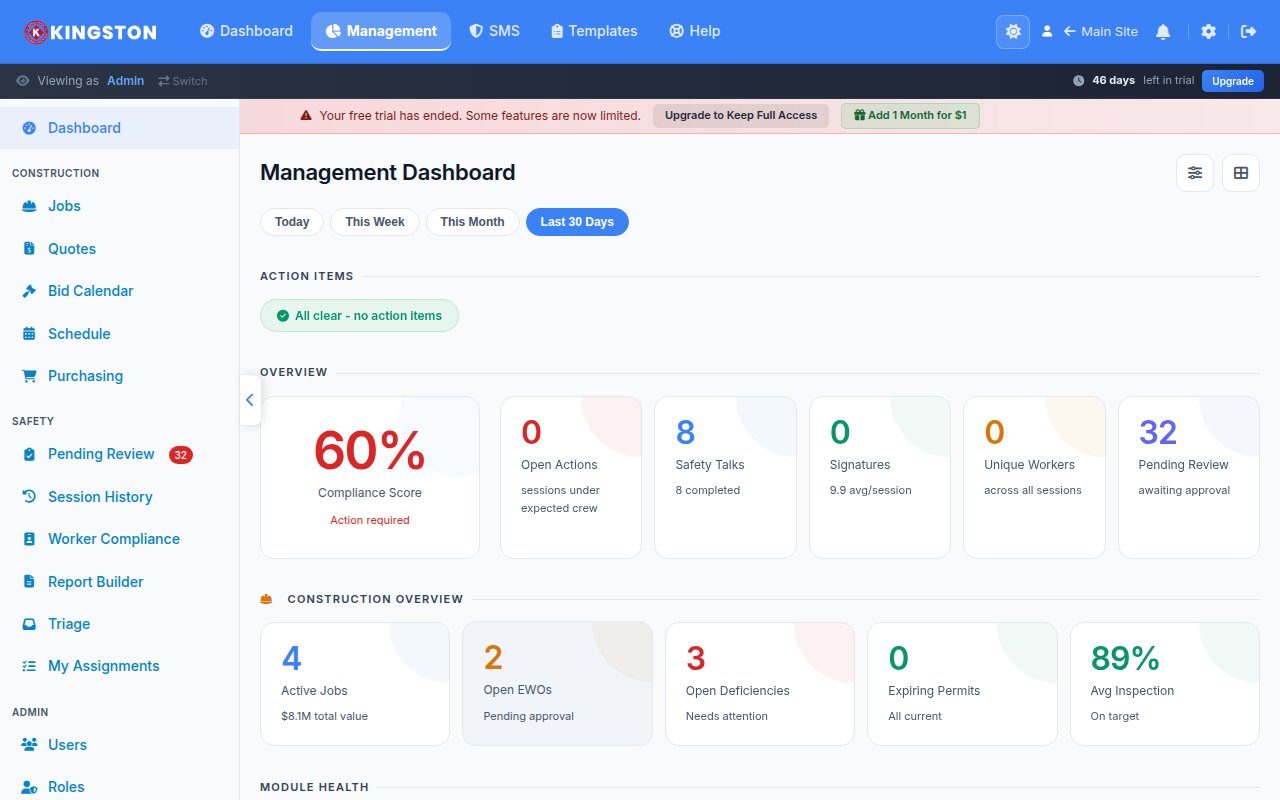
- Real-time dashboards - See inspection completion rates, open corrective actions, incident trends and training compliance for every site on one screen.
- Cross-site comparison - Identify which sites are outperforming and which are struggling. Dig into the data to understand why.
- Trend detection - Spot patterns that individual sites might miss. If three different locations report similar near-misses in the same month, that is a systemic issue, not a coincidence.
- Audit readiness - When a regulator shows up at any location, the records are already organized, searchable and complete. No scrambling through file cabinets or calling the home office.
- Executive reporting - Generate organization-wide safety performance reports for leadership without manually aggregating data from multiple sources.
Schedule recurring reviews of your centralized data using Make Safety Easy's Monthly Reviews feature to ensure you are not just collecting data but acting on it consistently across all sites.
Implement a Cadence of Accountability
Standardized programs and centralized data mean nothing without a rhythm of review and accountability that keeps every site engaged. Build a cadence that operates at multiple frequencies.
Daily
- Local safety leaders verify that required inspections were completed
- Toolbox talks are delivered and attendance documented
- New incidents or near-misses are reported and acknowledged
Weekly
- Corporate safety reviews open corrective actions for all sites
- Local safety leaders submit a brief status update (can be automated through your platform)
- High-priority items are escalated and assigned
Monthly
- Full safety performance review comparing all sites against targets
- Incident trend analysis identifying emerging patterns
- Recognition of top-performing sites and action plans for underperformers
- Training compliance verification
Quarterly
- In-depth program audits at a rotating selection of sites
- Face-to-face (or video) meetings between corporate and local safety leaders
- Budget and resource allocation review
- Regulatory update briefing covering any changes that affect operations
Annually
- Comprehensive safety program review across all locations
- Goal setting for the next year based on data-driven priorities
- Safety culture survey administered to all workers at all sites
- Full regulatory compliance audit
Leverage Technology for Consistency
Technology is the force multiplier that makes multi-site safety management feasible. Without it, you are relying on phone calls, email chains and spreadsheets that cannot scale. With the right platform, your safety program operates with the same consistency at a remote satellite office as it does at headquarters.
Essential Technology Features for Multi-Site Operations
- Role-based access - Local leaders see their site's data. Regional managers see their region. Corporate leadership sees everything. The right people get the right view without information overload.
- Mobile-first design - Workers and supervisors at field locations need tools that work on phones and tablets without reliable Wi-Fi.
- Automated notifications - Overdue inspections, open corrective actions and missed training deadlines trigger alerts to the responsible person and their supervisor.
- Standardized templates - Inspection forms, incident reports and training records follow the same format at every site, ensuring data consistency.
- Offline capability - Remote sites with limited connectivity need the ability to complete inspections and reports offline, syncing when a connection becomes available.
Conduct Site Visits That Matter
Physical site visits remain essential even with the best technology. But visits should be strategic, not ceremonial. A visit that consists of a conference room meeting and a quick walk-through tells you almost nothing about actual safety performance.
Make Visits Count
- Review data before arriving - Know the site's inspection completion rates, incident trends and open corrective actions before you walk through the door.
- Talk to frontline workers - Ask about hazards, near-misses and whether they feel comfortable reporting concerns. Their answers reveal more about safety culture than any report.
- Verify documentation matches reality - If the inspection log says guards are in place, go check. If training records show everyone is current, ask workers what they were trained on.
- Follow up on previous visit findings - If you identified issues last time, verify they were corrected. Repeat findings indicate systemic problems.
- Leave actionable feedback - Document your observations and share them with the local safety leader and site management. Include specific corrective actions with deadlines.
Handle Incidents Consistently Across Sites
When an incident occurs at one location, the response should follow the same protocol as it would at any other. Standardized incident management includes:
- Immediate notification to corporate safety leadership for incidents above a defined severity threshold
- A standard investigation methodology (root cause analysis, 5-Why, fishbone diagram) used at every site
- Lessons-learned distribution to all locations, not just the site where the incident occurred
- Corrective action tracking that verifies implementation at the incident site and preventive action at all other sites
The most valuable outcome of any incident is the lesson it teaches. If that lesson stays at one site while the same hazard exists at ten others, you have missed the point of investigation entirely.
Scale Your Safety Program With Confidence
Multi-site safety management does not have to mean choosing between control and scalability. With the right framework, local leadership, centralized data and a disciplined cadence of accountability, you can maintain high safety standards at every location regardless of how fast you grow.
Make Safety Easy was built for organizations managing safety across multiple sites. Our platform gives you standardized inspections, real-time dashboards, automated compliance tracking and monthly reviews that keep every location aligned and accountable. Schedule a demo to see how we help multi-site operations stay consistent, or explore our pricing options to find the right plan for your organization.
Ready to simplify your safety program?
Make Safety Easy helps teams run toolbox talks, inspections, incident reports and more - all from one platform.
Start Your Free TrialNo credit card required. 14-day free trial.