Near-Miss Reporting: Why It Matters and How to Build a Program
A near miss (also called a "close call" or "near hit") is an unplanned event that did not result in injury, illness, or damage - but had the potential to do so. A scaffold board that falls and lands inches from a worker's head. A forklift that nearly clips a pedestrian at a blind corner. A chemical splash that just misses someone's eyes. These events are not lucky breaks to be forgotten. They are warnings - and organizations that systematically capture and act on them experience dramatically fewer serious incidents.
The logic is rooted in one of the most well-known principles in occupational safety: Heinrich's Triangle (sometimes updated as the Bird/Germain ratio). For every serious injury, there are roughly 10 minor injuries, 30 property-damage incidents and 600 near misses. The near miss is the broad base of that pyramid. Address the base and you shrink everything above it.
Near Miss vs. Incident: What Is the Difference?
The distinction matters - both for accurate record-keeping and for the culture you are trying to build.
Free Download: 5 Safe Work Procedures
Choose from 112 professionally written SWPs. No credit card required.
Get Free SWPs| Term | Definition | Example |
|---|---|---|
| Near Miss | An unplanned event that could have caused harm but did not. | A worker slips on an oily floor but catches themselves on a handrail. No injury. |
| Incident (No Injury) | An unplanned event that caused property damage or process disruption but no injury. | A forklift strikes a storage rack, damaging product. No one was in the area. |
| Incident (Injury/Illness) | An unplanned event that resulted in harm to a person. | A worker falls from a ladder and fractures their wrist. |
| Recordable Incident | An injury or illness that meets OSHA's recording criteria (29 CFR 1904). | The fractured wrist requires medical treatment beyond first aid. |
The critical takeaway: a near miss and a serious incident often share identical root causes. The only difference is luck - the timing of a step, the angle of a splash, a gust of wind. Treating them with equal analytical rigor is what separates proactive organizations from reactive ones.
Why Organizations Resist Near-Miss Reporting (And Why They Shouldn't)
If near-miss reporting is so valuable, why don't more companies do it well? The barriers are cultural, not technical.
Fear of blame. Workers worry that reporting a near miss will lead to discipline - especially if their own behavior contributed. This fear is the single greatest obstacle. If your culture punishes honesty, you will never see the data you need.
Normalization of deviance. When a hazardous condition persists without consequence, people stop seeing it as hazardous. "We've always done it that way" becomes a shield against reporting. The oily floor has been there for months. Nobody has fallen yet. So it must be fine.
"Nothing happened" thinking. Supervisors and managers sometimes dismiss near misses because no one was hurt. This short-sighted view ignores the statistical certainty that repeated exposure to the same hazard will eventually produce a different outcome.
Complicated reporting processes. If filing a near-miss report requires a 30-minute paper form, a trip to the safety office and a follow-up meeting, workers will simply stop reporting. The process must be fast, easy and accessible.
The Business Case for Near-Miss Reporting
Beyond the moral imperative, there are hard financial reasons to invest in a near-miss program:
- Lower incident rates. Organizations with mature near-miss programs report 50% or greater reductions in recordable injury rates, according to data from the National Safety Council and the Campbell Institute.
- Reduced workers' compensation costs. Fewer injuries mean fewer claims, lower premiums and less administrative overhead.
- Regulatory goodwill. OSHA and Canadian provincial regulators view near-miss programs as evidence of a proactive safety culture. This can influence the outcome of inspections and the severity of citations.
- Operational continuity. Near misses that involve equipment failures, process upsets, or environmental releases often signal problems that affect productivity as well as safety.
- Improved morale. Workers who see their reports lead to real corrective actions feel valued and engaged. They become partners in safety rather than passive recipients of rules.
How to Build a Near-Miss Reporting Program: Step by Step
Step 1: Secure Leadership Commitment
No safety program succeeds without visible, sustained support from senior leadership. This means more than signing a policy document. Leaders must talk about near misses in meetings. They must ask for reports. They must celebrate reporting rather than punishing it. When a worker files a near-miss report and the CEO mentions it positively in a company-wide communication, the message is unmistakable.
Step 2: Define What Constitutes a Near Miss
Ambiguity kills participation. Provide clear definitions and examples tailored to your operations. Use the table above as a starting point, then add industry-specific scenarios. In construction, a near miss might be a dropped tool from height. In a lab, it might be an unexpected chemical reaction. In an office, it might be a tripping hazard near the stairwell. Make the definition concrete.
Step 3: Create a Simple Reporting Mechanism
The easier it is to report, the more reports you will receive. Best practices include:
- A mobile app that allows photo uploads and voice-to-text descriptions.
- A QR code posted on site that links directly to the reporting form.
- An option for anonymous reporting - at least initially, until trust is established.
- A form that takes less than two minutes to complete.
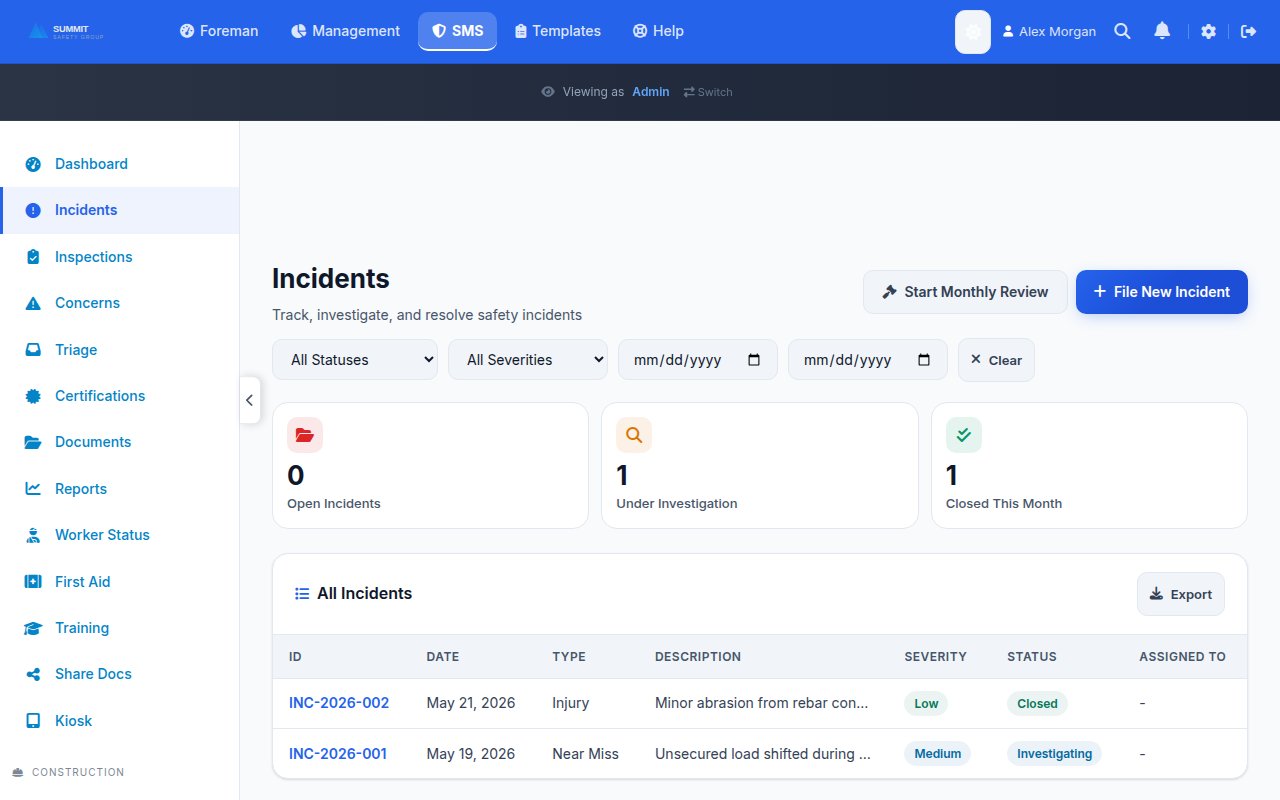
Make Safety Easy's incident reporting feature supports all of these approaches, allowing workers to submit near-miss reports from any device, on or offline.
Step 4: Eliminate the Fear Factor
This is non-negotiable. Publish a clear policy stating that near-miss reporters will not face discipline for reporting in good faith. Some organizations go further, implementing recognition programs that reward the quantity and quality of near-miss reports. A simple "thank you" from a supervisor, delivered promptly and publicly, goes a long way.
Step 5: Investigate and Act
Every near-miss report deserves a response - even if that response is brief. For simple hazards (a spill, a missing guardrail), the corrective action might be immediate. For systemic issues, a root cause analysis using a method like the "5 Whys" or a fishbone diagram is appropriate.
The investigation does not need to be as exhaustive as a serious-incident investigation. But it must happen. And the results must be communicated back to the reporter and the broader team. This "closing the loop" step is where most programs fail - and where the best programs build trust.
Step 6: Analyze Trends
Individual near-miss reports are valuable. Aggregated data is transformative. Look for patterns:
- Are near misses concentrated in a specific area, shift, or task?
- Are the same root causes appearing repeatedly?
- Are certain types of near misses increasing in frequency?
Trend analysis converts anecdotal data into strategic insight. It tells you where to invest your safety budget, which procedures to revise and which training gaps to address. Tools like Make Safety Easy's inspection and analytics features automate this analysis, surfacing patterns that would be invisible in a stack of paper forms.
Step 7: Communicate Results
Share near-miss data regularly - in safety meetings, on dashboards, in newsletters. Highlight reports that led to meaningful corrective actions. Tell the story: "Last month, a crew member reported a frayed sling on Crane 3. We inspected all slings on site, found two more that were degraded and replaced them before anyone was hurt. That single report may have prevented a serious incident."
Stories like this are worth more than a hundred policy memos.
Near-Miss Reporting and Regulatory Requirements
OSHA does not explicitly require near-miss reporting programs, but the General Duty Clause obligates employers to provide a workplace "free from recognized hazards." A pattern of unreported near misses involving a known hazard can be cited as a violation of this clause.
In Canada, several provinces require the reporting of "dangerous occurrences" - events that could have caused serious injury even if no injury resulted. Alberta's OHS Act, British Columbia's Workers Compensation Act, and Ontario's Occupational Health and Safety Act all contain provisions that functionally mandate near-miss reporting for certain categories of events.
The American National Standards Institute (ANSI) and the International Organization for Standardization (ISO 45001) both identify near-miss reporting as a best practice for occupational health and safety management systems.
Measuring Program Success
How do you know if your near-miss program is working? Track these metrics:
- Reporting rate: Number of near-miss reports per worker per month. An increasing rate (especially in the first year) indicates growing trust.
- Time to close: How quickly are reported hazards addressed? Faster closure builds confidence in the system.
- Corrective action completion rate: What percentage of identified corrective actions are implemented on time?
- Incident rate trend: Over time, a mature near-miss program should correlate with a declining serious-incident rate.
- Participation breadth: Are reports coming from all departments and levels, or just a few individuals?
Get Started with Near-Miss Reporting
Building a near-miss reporting program is not a massive capital project. It starts with a decision - a decision to treat every close call as a gift of information rather than a non-event to be forgotten. The tools and frameworks exist. The regulatory expectations are clear. The business case is overwhelming. The only question is whether your organization will act on the warnings it receives or wait for the warning that comes too late.
Make Safety Easy provides the digital infrastructure to launch your near-miss program in days, not months - with mobile reporting, automated notifications, trend analytics and audit-ready documentation. Book a free demo to see how it works, or check out our plans to get started today.
Ready to simplify your safety program?
Make Safety Easy helps teams run toolbox talks, inspections, incident reports and more - all from one platform.
Start Your Free TrialNo credit card required. 14-day free trial.