In general industry, OSHA requires ladders to be inspected before first use in each work shift (29 CFR 1910.23(b)(9)). In construction, a competent person must inspect them periodically and after any event that could affect safe use (1926.1053(b)(15)). Defective ladders are tagged and removed until repaired.
Key takeaways
- Set non-self-supporting ladders about 1 foot out for every 4 feet of working length (1926.1053(b)(5)(i)).
- For roof access, extend the ladder at least 3 feet above the landing.
- Use ladders with nonconductive side rails where they could contact energized equipment (1926.1053(b)(12)).
- New fixed ladders over 24 feet need a ladder safety system or personal fall arrest (1910.28).
OSHA's ladder standards under 29 CFR 1910.23 (general industry) and 29 CFR 1926.1053 (construction) establish clear requirements for ladder selection, use and inspection - yet ladder violations consistently rank among the top 10 most-cited OSHA standards.
This guide covers the inspection requirements, common defect criteria and key rules that every safety professional needs to know in 2026.
OSHA Ladder Standards Overview
OSHA addresses ladders in two primary standards:
Free Download: 5 Safe Work Procedures
Choose from 112 professionally written SWPs. No credit card required.
Get Free SWPs- 29 CFR 1910.23 - Ladders in general industry (manufacturing, warehousing, offices)
- 29 CFR 1926.1053 - Ladders in construction
Both standards require employers to ensure that ladders are maintained in good condition, inspected regularly and removed from service when defective. The construction standard is generally more prescriptive because construction sites present greater fall hazards.
How often must ladders be inspected?
Before Each Use
In general industry, ladders must be inspected before initial use in each work shift, and more often as necessary (29 CFR 1910.23(b)(9)). In construction, a competent person must inspect ladders periodically and after any occurrence that could affect their safe use (1926.1053(b)(15)). This pre-use inspection is the most important safeguard because it catches damage that occurred during transport, storage or prior use.
Periodic Inspections
Beyond pre-use checks, OSHA expects employers to conduct periodic inspections as part of their overall safety program. OSHA does not set a calendar interval for periodic inspections. Set one in your program based on how often and where each ladder is used, with closer attention to fixed ladders in corrosive or high-traffic areas.
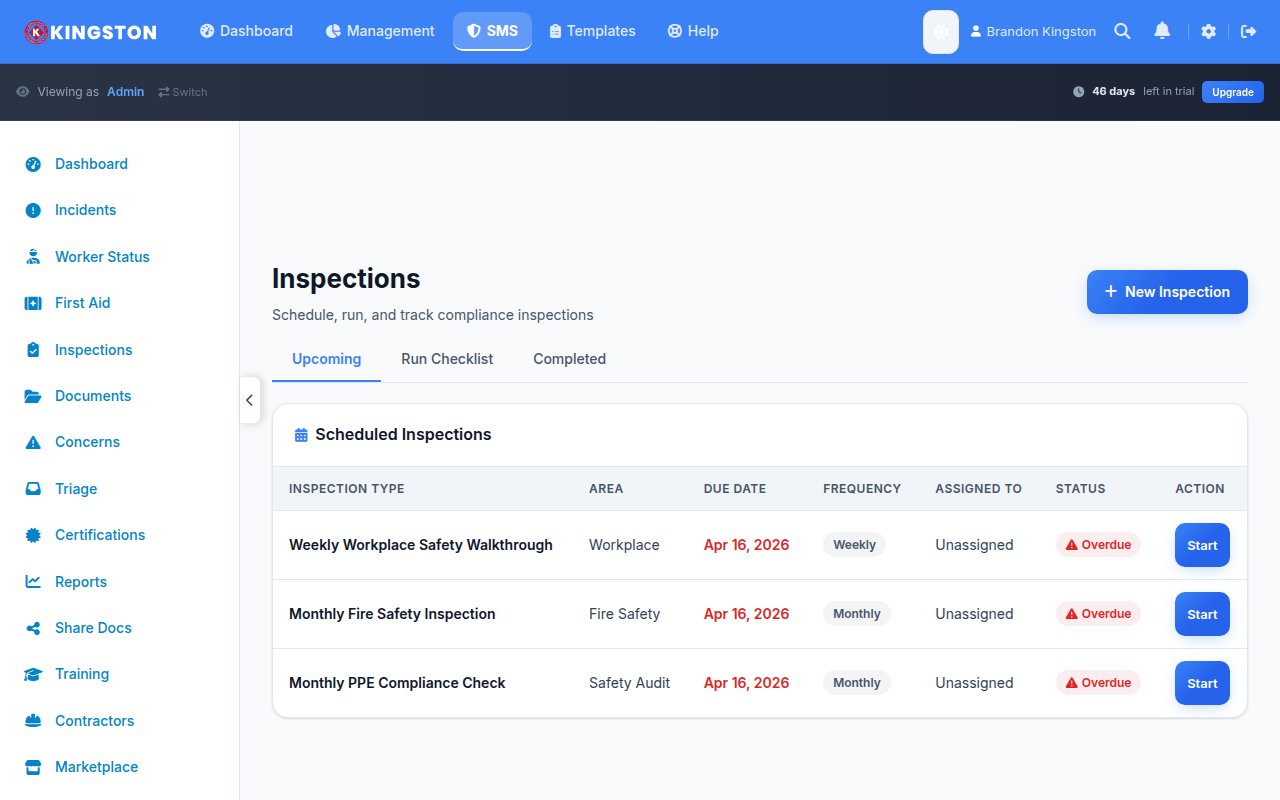
Document every inspection with Make Safety Easy's inspection tracking system, which lets you set recurring schedules and receive automatic reminders when inspections are due.
Portable Ladder Inspection Checklist
When inspecting a portable ladder (step ladder, extension ladder or combination ladder), check for:
Structural Components
- Side rails - no cracks, bends, splits or corrosion
- Rungs/steps - secure, no bending, no missing rungs
- Rung locks (extension ladders) - engaging properly on both sides
- Spreader bars (step ladders) - fully locking when ladder is opened
- Feet/shoes - non-slip pads present and in good condition
Hardware and Accessories
- Bolts, rivets and fasteners - tight, none missing
- Rope and pulley (extension ladders) - rope not frayed, pulley turns freely
- Labels - duty rating label present and legible
- Safety shoes/spurs - not worn smooth
Overall Condition
- No paint or coating that could hide defects (wooden ladders must not be painted)
- No excessive dirt, grease or oil on rungs
- No signs of heat damage, chemical exposure or electrical arc marks
Fixed Ladder Inspection Requirements
Fixed ladders (permanently attached to structures) have additional inspection requirements:
- Mounting brackets - secure to the structure, no loose bolts or corroded anchors
- Cage or well guards - intact with no missing sections (for ladders over 20 feet prior to the 2018 rule change)
- Personal fall arrest system - for ladders over 24 feet installed after November 2018, a ladder safety system (cable/rail) must be present
- Landing platforms - required every 150 feet of unbroken climbing
- Clearance - minimum 7 inches from the centerline of rungs to the nearest permanent object behind the ladder
The 4-to-1 Rule
One of the most important ladder safety rules is the 4-to-1 setup ratio for non-self-supporting ladders (extension ladders and straight ladders). For every 4 feet of working length, the base of the ladder must be 1 foot away from the supporting structure.
For example, if the contact point is 16 feet high, the base should be 4 feet out from the wall. This 75-degree angle provides optimal stability and reduces the risk of the ladder sliding out at the base or tipping backward.
OSHA Requirements for Roof Access Ladders
Ladders used for roof access have specific OSHA requirements that are frequently overlooked:
- 3-foot extension - the ladder must extend at least 3 feet above the roof edge or landing point
- Secured at the top - the ladder must be tied off, blocked or otherwise secured to prevent displacement
- Landing area - a clear landing area at the top with grab rails or a stable grasping point
- No gaps - if transitioning from a fixed ladder to a roof hatch, no gap greater than 12 inches between the ladder and the roof edge
For permanent roof access, fixed ladders with ladder safety systems (rail or cable) are strongly preferred over portable ladders. Read our detailed guide on ladder safety and OSHA inspection best practices.
OSHA Rolling Ladder Safety Requirements
Rolling ladders (also called mobile ladder stands or rolling step ladders) are common in warehouses, retail and manufacturing. OSHA requires:
- Locking casters - wheels must lock automatically when weight is applied or have manual locks that engage before climbing
- Handrails - required on platforms 4 feet or higher above the floor
- Non-slip surfaces - steps and platform must have slip-resistant tread
- Capacity rating - clearly labeled and never exceeded
- Stable base - base width must be sufficient to prevent tipping at maximum reach
When must a ladder be removed from service?
Remove a ladder from service immediately and tag it "Do Not Use" if any of the following defects are found:
- Cracked, bent or broken side rails
- Missing, loose or broken rungs/steps
- Broken or non-functioning rung locks or spreader bars
- Corroded components that reduce structural integrity
- Missing or illegible duty rating label
- Heat damage (discoloration, warping from fire exposure)
- Missing safety feet or worn non-slip pads
- Any modification not approved by the manufacturer
Defective ladders must be tagged "Do Not Use" and kept out of service until repaired or replaced (1910.23(b)(10); 1926.1053(b)(16)). Never leave a tagged-out ladder where someone might use it.
Common OSHA Ladder Violations
The most frequently cited ladder violations include:
- Ladders not extending 3 feet above the landing surface for roof access
- Using damaged or defective ladders
- Ladders not secured against displacement
- Incorrect setup angle (not following the 4-to-1 rule)
- Missing ladder safety systems on fixed ladders over 24 feet
Ladder Inspection Documentation Best Practices
While OSHA does not explicitly require written records for every pre-use ladder inspection, maintaining documentation is strongly recommended for several reasons:
- OSHA defense - documented inspections demonstrate your good-faith compliance efforts during an OSHA investigation
- Liability protection - if a worker is injured in a ladder fall, inspection records show due diligence
- Fleet management - tracking inspection data reveals which ladders are frequently damaged and need replacement
- Accountability - when inspections are documented, workers take them more seriously
Best practice is to assign a unique identifier (barcode, QR code or asset tag) to each ladder and link inspections to that identifier in your safety management system. This creates a complete maintenance history for every ladder in your fleet.
Ladder Safety Training Requirements
OSHA requires employers to train each employee who uses a ladder. Under 1910.30(b)(1) (general industry) and 1926.1060 (construction), training must enable workers to recognize hazards related to ladders and must cover:
- The nature of fall hazards in the work area
- Correct procedures for erecting, maintaining and disassembling fall protection systems
- Proper construction, use, placement and care of ladders
- Maximum load capacity and load ratings
- The 4-to-1 setup rule for non-self-supporting ladders
- How to inspect ladders and recognize defective ladders
Retraining is required when an employee does not demonstrate the skills needed for safe ladder use, when changes in workplace conditions create new hazards or when the employer has reason to believe the employee does not have the required understanding.
Portable Ladder Selection Guide
Selecting the right ladder for the job prevents both safety violations and injuries. Consider these factors:
| Factor | Guidance |
|---|---|
| Height needed | Never stand on the top two rungs of a step ladder or the top three rungs of an extension ladder |
| Duty rating | Choose Type I (250 lbs) minimum for commercial/industrial use; Type IA (300 lbs) or IAA (375 lbs) for heavy trades |
| Material | Fiberglass near electrical hazards (never aluminum); aluminum for lightweight portability where no electrical hazard exists |
| Environment | Non-conductive materials near power lines; corrosion-resistant in marine or chemical environments |
| Access type | Extension ladders for roof access (3-foot extension rule); step ladders for stable platform work |
Frequently Asked Questions
How often do ladders need to be inspected per OSHA?
In general industry, before initial use in each work shift (1910.23(b)(9)). In construction, a competent person inspects periodically and after any occurrence that could affect safe use (1926.1053(b)(15)). Document all inspections for compliance records.
Can you repair a damaged ladder?
Only if the repair meets the original manufacturer's specifications and restores the ladder to its original strength. In practice, most employers replace damaged ladders because improper repairs create serious liability. Never use field expedient repairs like duct tape, wire or wood splints.
What are the OSHA requirements for roof access ladders?
The ladder must extend at least 3 feet above the roof edge, be secured against displacement and provide a stable transition point at the top. For permanent roof access over 24 feet, a fixed ladder with a ladder safety system (cable or rail) is required for installations after November 2018.
Do rolling ladders need to be inspected?
Yes. Rolling ladders must be inspected before each use, with special attention to caster locks, handrails, step treads and the overall structural condition. Monthly documented inspections are recommended for rolling ladders in daily use.
What is the weight limit for OSHA-compliant ladders?
OSHA does not set a single weight limit. Instead, ladders are rated by duty classification: Type IAA (375 lbs), Type IA (300 lbs), Type I (250 lbs), Type II (225 lbs) and Type III (200 lbs). The combined weight of the worker, tools and materials must not exceed the ladder's rated capacity.
Go Digital with Make Safety Easy
Replace paper checklists, inspection logs and compliance binders with one platform your whole team can use - from the field to the office. Start tracking inspections, incidents and training in minutes.