An overhead crane safety checklist is a structured inspection document that operators and maintenance crews use before, during and after crane operations to verify that the equipment is safe for lifting. Proper bridge crane inspection prevents catastrophic failures that can drop loads, collapse structures and kill workers. OSHA standard 29 CFR 1910.179 requires regular inspections of overhead and gantry cranes and a thorough checklist is the most practical way to meet that requirement consistently.
Why Overhead Crane Inspections Are Non-Negotiable
Overhead cranes handle some of the heaviest loads in any industrial setting. A single failure - a worn wire rope, a cracked hook, a malfunctioning brake - can release tons of material onto workers below. According to OSHA, crane-related incidents account for an average of 42 fatalities per year in the United States. The majority of those deaths are preventable with proper inspection and maintenance procedures.
Beyond the human cost, crane failures shut down production lines, damage expensive equipment and trigger OSHA investigations that can result in six-figure penalties. A disciplined inspection program using a detailed overhead crane checklist is the most cost-effective insurance your facility can carry.
Free Download: 5 Safe Work Procedures
Choose from 112 professionally written SWPs. No credit card required.
Get Free SWPsTypes of Overhead Crane Inspections
OSHA and the American Society of Mechanical Engineers (ASME B30.2) define three inspection intervals for bridge cranes and overhead cranes. Each serves a different purpose and requires different levels of detail.
- Pre-shift (daily) inspections - Visual and functional checks performed by the operator before each shift. These catch obvious defects and confirm basic operability.
- Frequent inspections - More detailed checks performed daily to monthly depending on usage. These cover components that wear gradually.
- Periodic inspections - Comprehensive examinations conducted monthly to annually by qualified personnel. These include load testing, structural assessments and detailed component analysis.
Pre-Shift Overhead Crane Safety Checklist
Every operator should complete these checks before making the first lift of each shift. This checklist takes ten to fifteen minutes and catches the defects most likely to cause immediate failure.
Visual Inspection Items
- Wire rope condition - Check for broken wires, kinking, crushing, birdcaging or corrosion. OSHA mandates removal when you find six randomly distributed broken wires in one rope lay or three broken wires in one strand.
- Hook condition - Look for cracks, deformation, increased throat opening or twist. Any visible deformation means the hook must be taken out of service immediately.
- Safety latch - Verify the hook safety latch closes fully and springs back into position. A missing or bent latch is a citation waiting to happen.
- Reeving - Confirm the wire rope is properly seated in sheave grooves and wound correctly on the drum.
- Hoist chain or rope - Check for excessive wear, stretch or damaged links on chain hoists.
- Pendant or remote control - Inspect for damaged buttons, frayed cables and clear labeling of all controls.
Functional Test Items
- All motions - Test hoist up, hoist down, trolley travel and bridge travel in both directions. Listen for unusual sounds.
- Upper limit switch - Slowly raise the empty hook block to verify the upper limit switch stops the hoist before the block contacts the drum or sheaves.
- Brakes - Lift a light test load a few inches and verify the hoist brake holds when the control is released.
- Warning devices - Test the horn or alarm. If the crane is equipped with audible travel alarms, verify they activate during bridge movement.
- Emergency stop - Confirm the emergency stop button on the pendant or remote kills all crane motion immediately.
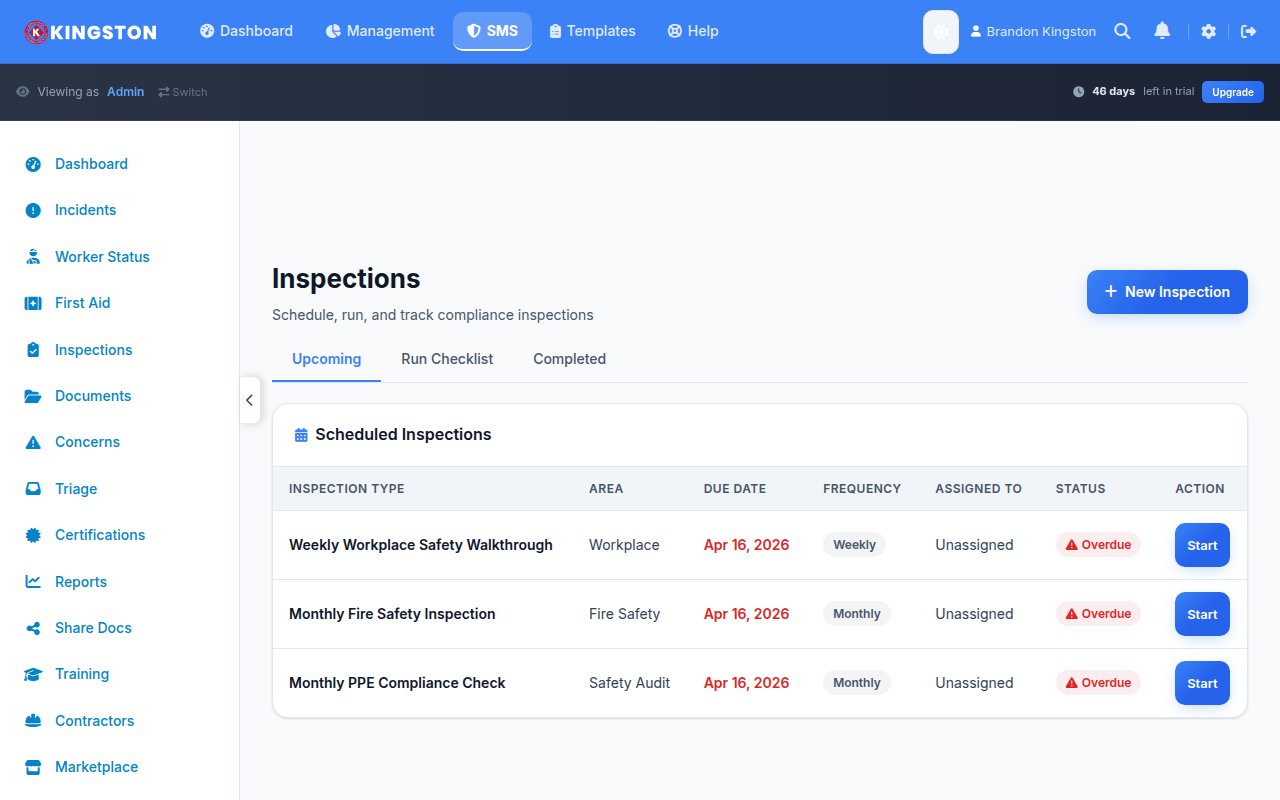
Any deficiency found during the pre-shift check must be reported and corrected before the crane is used. Tag the crane out of service using a lockout-tagout procedure until repairs are complete. Document all findings using a digital inspection platform like Make Safety Easy's Inspections feature to maintain a searchable, time-stamped record.
Frequent Inspection Checklist
Frequent inspections go deeper than the daily pre-shift check. Depending on how heavily the crane is used, these should happen weekly to monthly. A qualified person - not necessarily a certified inspector, but someone trained in crane mechanics - should perform these checks.
- Operating mechanisms - Inspect for excessive wear, adjustment needs or unusual noise in gears, bearings and shafts.
- Electrical apparatus - Check contactors, limit switches, pushbutton stations and conductors for signs of wear, pitting or overheating.
- Rope reeving compliance - Verify reeving matches the crane manufacturer's diagram and that the rope has not jumped a sheave.
- Hooks (detailed) - Measure throat opening with calipers and compare to manufacturer specifications. Check for twist exceeding 10 degrees from the plane of the unbent hook.
- Hoist chains - Look for stretch, wear at contact points and evidence of heat damage or corrosion.
- End stops - Verify bridge and trolley end stops are in place, properly aligned and securely bolted.
- Bumpers - Inspect bridge and trolley bumpers for cracks, deterioration or missing fasteners.
Periodic (Annual) Inspection Checklist
Periodic inspections are the most comprehensive. They should be performed by a qualified inspector - often a third-party specialist - and must be thoroughly documented. These inspections satisfy ASME B30.2 requirements and form the backbone of your crane maintenance program.
Structural Components
- Bridge girders - Inspect for cracks, deformation, corrosion and excessive deflection under rated load.
- End trucks - Check wheel flanges for wear, bearings for play and structural members for cracks.
- Trolley frame - Examine for cracks at weld joints, bearing wear and wheel condition.
- Runway rails and supports - Look for rail wear, misalignment, loose clips and structural deterioration of support columns.
Mechanical Components
- Gearboxes - Check oil levels, inspect for leaks and listen for abnormal gear noise. Sample oil for contamination if due.
- Brakes (all) - Measure brake disc or lining wear. Verify torque settings meet manufacturer specifications.
- Bearings - Check for excessive play, overheating or contamination. Replace on schedule per manufacturer recommendations.
- Drums and sheaves - Inspect for wear, grooving and cracks. Measure sheave groove diameter against wire rope diameter - groove wear beyond 10% requires replacement.
- Wire rope - Perform a thorough inspection including measurement of rope diameter reduction. Reduction beyond the manufacturer's threshold requires immediate replacement.
Electrical Systems
- Festoon or conductor bar systems - Check for wear, alignment and secure connections.
- Motor insulation - Test motor insulation resistance. Low readings indicate moisture intrusion or insulation breakdown.
- Control panels - Inspect contactors, relays and overload devices. Replace pitted or worn contacts.
- Wiring - Look for damaged insulation, loose connections and evidence of overheating.
Load Testing Requirements
OSHA requires a load test before a new or substantially repaired crane is placed into service. ASME B30.2 recommends testing at 100% of rated load for operational tests and 125% for static load tests. During a load test, check for:
- Proper brake holding capacity at rated load
- Structural deflection within acceptable limits
- Smooth operation of all motions under load
- Correct function of limit switches and overload devices
- No abnormal sounds, vibrations or overheating
Never exceed the crane's rated capacity during testing unless the test is supervised by a qualified engineer and the crane structure has been evaluated for the test load. For more details on rigging practices and load calculations, see our crane safety rigging and load charts guide.
Operator Responsibilities During Crane Operation
Inspections are only part of the safety equation. Operators must follow safe operating practices during every lift to prevent incidents that no checklist can catch.
Before Every Lift
- Know the weight of the load. Never guess. Check documentation, shipping tags or weigh the load if uncertain.
- Verify the load does not exceed the crane's rated capacity.
- Ensure the rigging is appropriate for the load weight, shape and center of gravity.
- Confirm the load path is clear of personnel and obstructions.
- Communicate with the signal person using standard hand signals or radio protocol.
During the Lift
- Never leave the crane controls unattended with a load suspended.
- Never carry loads over personnel.
- Avoid side-pulling - the crane should always lift vertically.
- Travel with the load as low as possible while maintaining clearance.
- Use taglines to control load swing.
Documenting Crane Inspections for OSHA Compliance
Inspection findings must be documented and retained. OSHA does not specify a retention period for crane inspection records, but best practice is to keep records for the life of the crane. Periodic inspection reports should include:
- Date of inspection and name of the inspector
- Crane identification (serial number, manufacturer, capacity and location)
- Condition of each inspected component
- Any deficiencies found and corrective actions taken
- Date deficiencies were corrected and by whom
Paper logs stuffed in filing cabinets are technically compliant but practically useless when you need to pull records quickly. A digital inspection system like Make Safety Easy's Inspections feature stores every record in a searchable database, tracks corrective actions through completion and generates compliance reports on demand.
Building a Crane Maintenance Schedule
Inspections identify problems. Maintenance prevents them. Your overhead crane maintenance schedule should include:
- Lubrication - Wire ropes, sheave bearings, gearboxes and wheel bearings on the manufacturer's recommended interval.
- Brake adjustment - As wear occurs, brakes need adjustment to maintain proper torque. Check monthly at minimum.
- Electrical maintenance - Clean and tighten connections, replace worn contactors and test safety devices quarterly.
- Structural inspection - Annual structural evaluations by a qualified engineer prevent catastrophic failures that routine inspections might miss.
Start Inspecting Smarter Today
A thorough overhead crane safety checklist is only as good as the system you use to execute and document it. Pen-and-paper checklists leave gaps. Spreadsheets get lost. Your crews need a tool built for the job.
Make Safety Easy provides customizable crane inspection checklists that your team can complete from any mobile device. Every finding is time-stamped, photo-documented and tracked through resolution. Schedule a demo to see how our platform simplifies bridge crane inspection across your entire operation, or visit our pricing page to get started today.
Go Digital with Make Safety Easy
Replace paper checklists with digital forms your crew can complete on any device. QR code sign-off, automatic compliance tracking and instant PDF reports.
Start Your Free Trial