Powered platform safety covers the use of suspended scaffolds, swing stages and similar mechanically operated platforms that raise and lower workers on the exterior or interior of buildings and structures. OSHA regulates these systems under 29 CFR 1910.66 for general industry and 29 CFR 1926.451-454 for construction, with specific requirements for design, installation, inspection, operation and fall protection. Falls from suspended scaffolds remain one of the leading causes of death in the construction industry, making compliance with these standards a matter of survival - not just regulation.
What Qualifies as a Powered Platform
A powered platform is any building maintenance equipment that is suspended from a building or structure and uses power to raise, lower or move workers to different positions. The most common types include:
- Two-point suspended scaffolds (swing stages) - The most widely used type in construction and building maintenance. Two wire ropes suspend a platform from overhead supports, with electric or air-powered hoists controlling vertical movement.
- Single-point adjustable scaffolds (boatswain's chairs) - A single suspension point supports a seat or small platform for one worker. Common in window washing and light maintenance.
- Multi-point adjustable scaffolds - Platforms with three or more suspension points, used for large-area work on wide building facades.
- Catenary scaffolds - Platforms suspended from horizontal wire ropes stretched between two points. Used when overhead rigging is impractical.
- Interior hung scaffolds - Suspended from ceiling or roof structures for interior work such as painting, lighting installation or mechanical system maintenance.
OSHA Requirements for Suspended Scaffold Safety
OSHA's requirements for powered platforms and suspended scaffolds are extensive. The following sections cover the core obligations that employers and operators must meet.
Free Download: 5 Safe Work Procedures
Choose from 112 professionally written SWPs. No credit card required.
Get Free SWPsCompetent Person Requirement
OSHA requires a competent person to inspect all suspended scaffold components before each use. A competent person is someone who can identify existing and predictable hazards and has the authority to take corrective measures. This is not a vague suggestion - it is a defined regulatory requirement with specific legal implications.
The competent person must verify that:
- All scaffold components are in safe working condition
- Rigging points are adequate for the intended load
- Wire ropes meet minimum diameter and strength requirements
- Hoists function correctly, including brakes and safety devices
- Guardrails, toeboards and personal fall arrest systems are in place
Load Capacity
Suspended scaffolds must be designed and loaded to support at least four times the maximum intended load (a 4:1 safety factor). The maximum intended load includes the combined weight of workers, tools, materials and the platform itself. Each wire rope must independently support at least six times its share of the load.
Exceeding the rated capacity is one of the most common - and most deadly - violations in suspended scaffold work. Never stack materials on a swing stage beyond what the load calculation permits, even temporarily.
Fall Protection
Every worker on a suspended scaffold must use a personal fall arrest system (PFAS) independent of the scaffold support system. This means:
- Full-body harness - Not a body belt. OSHA prohibits body belts for fall arrest in construction.
- Independent lifeline - The lifeline must be attached to a separate anchorage point, not to the scaffold or its suspension ropes. If the scaffold fails, the lifeline must hold the worker independently.
- Self-retracting lifeline or rope grab - The connecting device must limit free fall to six feet or less and bring the worker to a complete stop within 3.5 feet of deceleration distance.
- Anchorage strength - Each anchorage point must support at least 5,000 pounds per attached worker, or be designed by a qualified person as part of a complete personal fall arrest system with a safety factor of at least two.
Pre-Use Inspection Checklist for Swing Stages
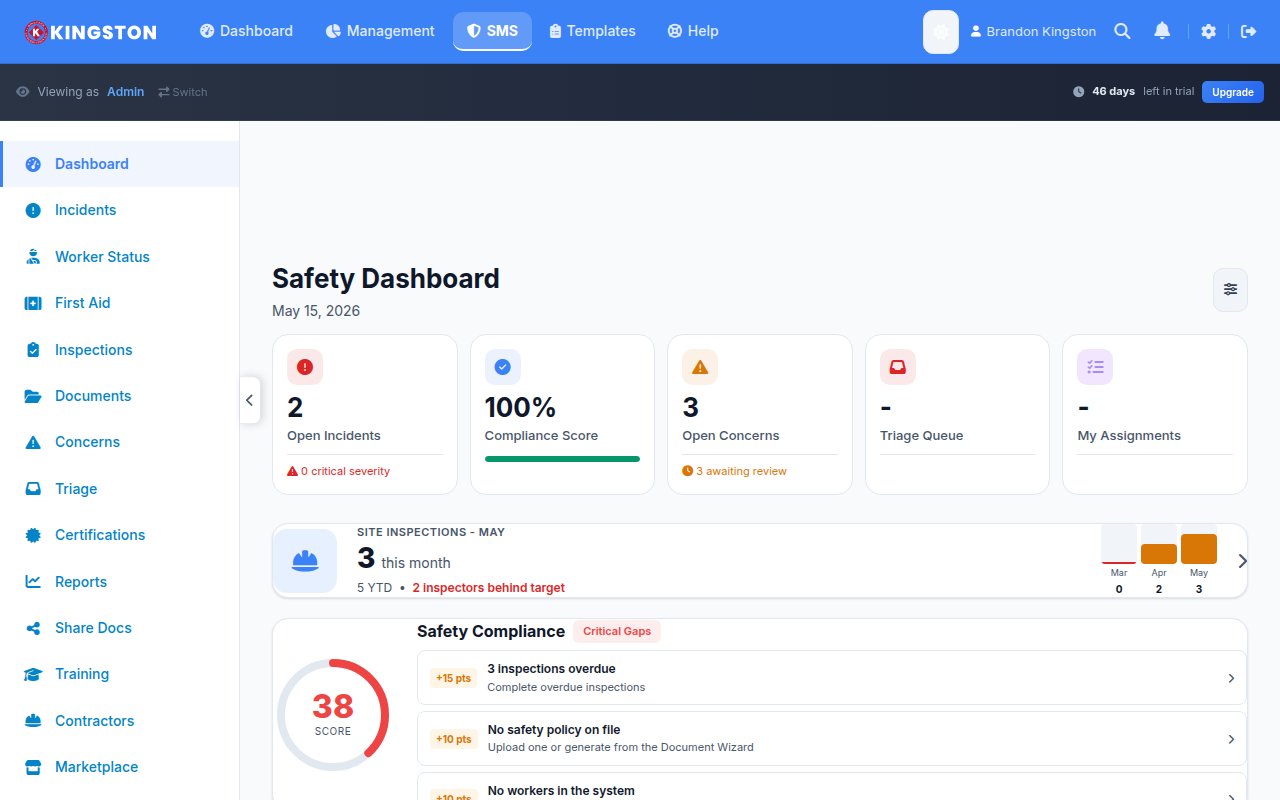
Before any worker steps onto a suspended platform, the competent person must complete a thorough inspection. Use this checklist to ensure nothing is missed. Track and document every inspection using a digital tool like Make Safety Easy's Inspections feature for time-stamped, photo-verified records.
Rigging and Suspension
- Roof rigging or outrigger beams are properly positioned and secured with adequate counterweights or tiebacks
- Counterweights are the type specified by the manufacturer - never substitute with random materials
- Wire ropes are free of kinks, broken wires, corrosion and bird caging
- Wire rope connections (thimbles, clips, swaged fittings) are secure and properly installed
- Hoists are the correct type and capacity for the platform
- Hoist brakes hold the platform at any point of travel
- Secondary braking systems function independently of the primary brake
Platform Condition
- Platform decking is intact, without cracks, holes or excessive wear
- Stirrups and bolted connections are tight and undamaged
- Guardrails are installed on all open sides - top rail at 42 inches (plus or minus 3 inches), midrail and toeboard
- Toeboards are at least 4 inches high and secured along the entire platform edge
- Platform is level when suspended
Electrical and Mechanical
- Power supply cables are free of damage and properly connected
- Ground fault circuit interrupter (GFCI) protection is in place
- Control switches operate correctly and return to the "off" position when released
- Emergency stop functions work on each hoist
- Overload detection systems are functional (if equipped)
Fall Protection Equipment
- Independent lifelines are rigged to separate anchorage points
- Lifeline anchorages are verified for 5,000-pound capacity
- Full-body harnesses are inspected for cuts, fraying, burns or deformation at buckles and D-rings
- Self-retracting lifelines or rope grabs are functioning and within their service date
- Lifelines do not contact sharp edges without edge protection
Operator Training Requirements
OSHA requires that every worker who operates or rides a powered platform be trained by a qualified person. Training must cover:
- Recognition of hazards associated with the type of scaffold being used
- Procedures for erecting, disassembling, operating and inspecting the scaffold
- Correct use of personal fall arrest systems
- Maximum load capacity and load distribution
- Electrical hazards, including contact with overhead power lines
- Emergency procedures, including rescue plans for stranded or fallen workers
- Weather restrictions - most manufacturers prohibit operation in winds exceeding 25 mph
Retraining is required when workplace conditions change, when the scaffold type changes, when workers demonstrate unsafe behavior or when a competent person determines that retraining is needed.
Common Hazards and How to Control Them
Uneven Loading
When one end of a swing stage carries significantly more weight than the other, the platform tilts. Workers shift their weight to compensate, tools slide and the situation escalates rapidly. Distribute materials evenly across the platform and never exceed the rated load at any point.
Wind
Suspended platforms act as sails. Wind creates lateral forces that can swing the platform into the building face, push it away or cause it to oscillate. Most swing stage manufacturers set a maximum wind speed of 25 mph for operation. Monitor weather forecasts and have a clear policy for when to stop work.
Power Line Contact
Wire ropes and metal platforms create an electrocution hazard near overhead or building-mounted power lines. Maintain a minimum clearance of 10 feet from energized power lines. If work must occur within 10 feet, coordinate with the utility company to de-energize or insulate the lines.
Rope Deterioration
Wire ropes degrade from use, weather and chemical exposure. Inspect ropes daily and replace them at the first sign of significant wear. OSHA requires removal from service when you find six randomly broken wires in one rope lay, three broken wires in one strand, or any evidence of corrosion, kinking or core protrusion.
Rescue Planning
OSHA 1926.502(d)(20) requires employers to have a rescue plan for each worker using fall protection. For suspended scaffold work, this means planning for two scenarios: a worker suspended in a harness after a fall (suspension trauma can become life-threatening within 15 to 20 minutes) and workers stranded on a platform that cannot be lowered due to mechanical failure.
Your rescue plan should identify:
- Who will perform the rescue and their training qualifications
- What equipment is available on site (rescue descent systems, ladders, aerial lifts)
- How quickly the rescue can be executed from the time of the incident
- Communication protocols between the stranded worker and the rescue team
- Coordination with local emergency services if self-rescue is not possible
Industry-Specific Considerations
Powered platform use varies significantly between industries. Construction operations typically use swing stages for exterior finishing, glazing and caulking, where platforms are installed temporarily and relocated frequently. Building maintenance operations use permanently installed davit systems for ongoing facade access. Industrial maintenance may use interior suspended platforms for work on large equipment, tanks or silos.
Each application introduces unique hazards that the competent person must evaluate. A construction swing stage on a 40-story building faces different wind loads, access challenges and rescue logistics than an interior platform in a manufacturing plant. Tailor your inspection checklists and training programs to the specific application.
Elevate Your Safety Standards
Powered platform and suspended scaffold safety demands meticulous attention to inspection, training, fall protection and rescue planning. The margin for error is measured in stories, not inches. Every component must be verified, every worker trained and every lift documented.
Make Safety Easy provides digital inspection checklists purpose-built for suspended scaffold work, with mobile access for crews at any height and automatic documentation that satisfies OSHA requirements. Request a demo to see how we help teams working at height stay compliant and safe, or visit our pricing page to explore your options.
Ready to simplify your safety program?
Make Safety Easy helps teams run toolbox talks, inspections, incident reports and more - all from one platform.
Start Your Free TrialNo credit card required. 14-day free trial.