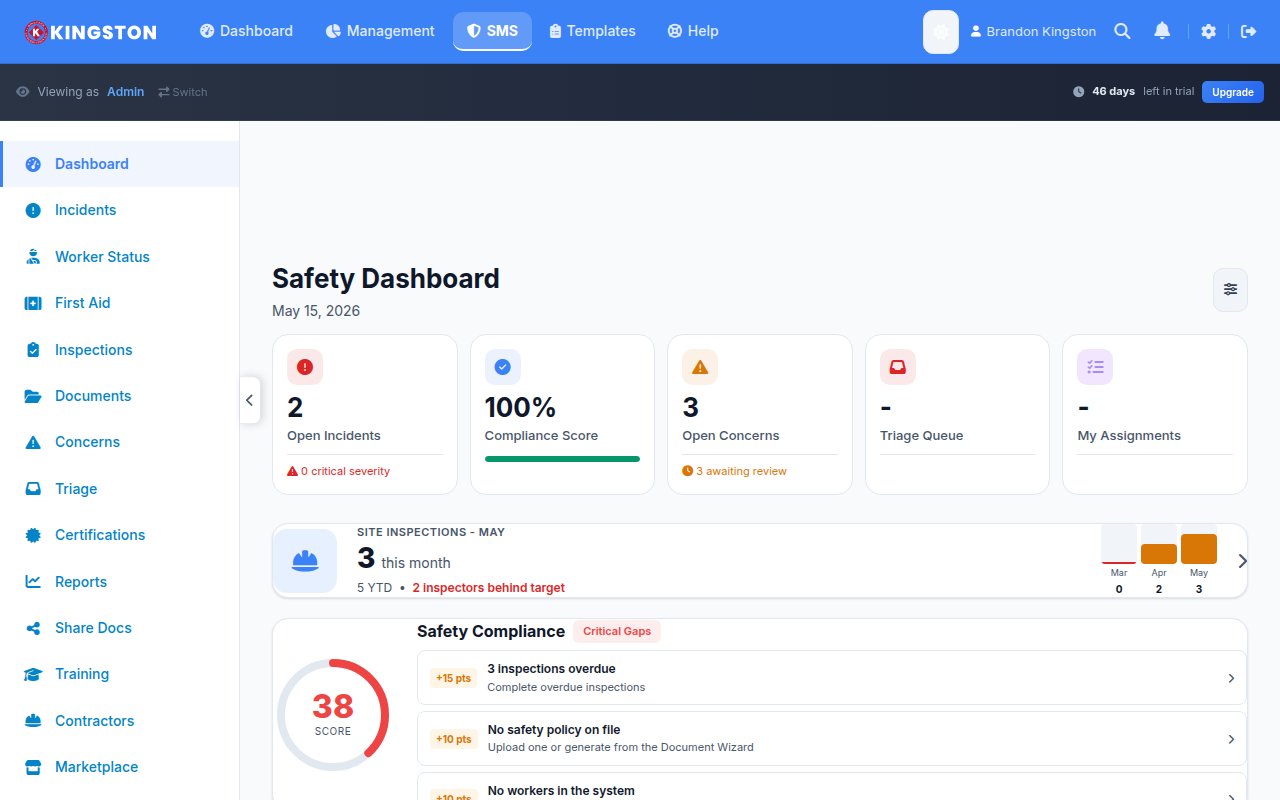
Safety leading indicators measure proactive safety activities - like inspection completion rates, near-miss reporting frequency and training compliance - that predict future safety performance, while lagging indicators measure reactive outcomes - like injury rates, lost-time incidents and workers' compensation costs - that tell you what already went wrong. Tracking both is essential, but organizations that over-rely on lagging indicators are essentially driving by looking in the rearview mirror. This guide explains the difference, shows you exactly which KPIs to track and gives you a practical framework for building a balanced safety measurement system.
Here's the uncomfortable truth about most safety programs: they measure failure. Total Recordable Incident Rate. Lost Time Injury Frequency. Days Away, Restricted, or Transferred. These metrics tell you how badly you got hurt last quarter. They tell you nothing about whether you're about to get hurt next quarter. And yet, for decades, these lagging indicators have been the primary - sometimes the only - metrics used to evaluate safety performance.
That's changing. Forward-thinking safety professionals and regulators are increasingly emphasizing leading indicators as the true measure of a safety management system's health. But the shift isn't automatic. It requires understanding what to measure, how to measure it and why it matters. Let's break it down.
Free Download: 5 Safe Work Procedures
Choose from 112 professionally written SWPs. No credit card required.
Get Free SWPsWhat Are Lagging Indicators in Safety?
Lagging indicators are outcome-based metrics that measure events that have already occurred. They're called "lagging" because by the time you see the data, the damage is done - someone is already injured, property is already damaged, or production is already disrupted.
Common Lagging Indicators
| Indicator | What It Measures | Calculation |
|---|---|---|
| Total Recordable Incident Rate (TRIR) | Number of OSHA-recordable injuries per standardized hours | (Recordable incidents × 200,000) / Total hours worked |
| Lost Time Injury Frequency Rate (LTIFR) | Injuries resulting in time away from work | (Lost-time injuries × 1,000,000) / Total hours worked |
| Days Away, Restricted, or Transferred (DART) | Severity of injuries that affect work capacity | (DART cases × 200,000) / Total hours worked |
| Severity Rate | Total days lost per standardized hours | (Lost days × 200,000) / Total hours worked |
| Workers' Compensation Costs | Financial impact of workplace injuries | Total claim costs per period |
| Fatality Rate | Work-related deaths per hours worked | (Fatalities × 200,000) / Total hours worked |
The Problem with Relying on Lagging Indicators Alone
Lagging indicators are necessary - you need to know your incident rates for regulatory reporting, insurance purposes and benchmarking. But they have serious limitations as management tools:
- They're reactive by definition - You can't prevent an injury that's already happened. By the time TRIR spikes, the failures that caused it occurred weeks or months ago.
- Low-frequency events create statistical noise - A small company might go years without a recordable incident, then have two in one month. Does that mean their safety program collapsed? Probably not. Small sample sizes make lagging indicators unreliable for trend analysis.
- They incentivize under-reporting - When bonuses, contracts and management evaluations are tied to low injury rates, people stop reporting injuries. The metric improves. Actual safety doesn't.
- They can't distinguish luck from management - A company with zero injuries might have an excellent safety program. Or they might just be lucky - cutting corners daily without consequence yet. Lagging indicators can't tell the difference until the luck runs out.
What Are Leading Indicators in Safety?
Leading indicators are proactive, process-based metrics that measure the activities, behaviors and conditions that prevent incidents from occurring. They're "leading" because they indicate future safety performance - for better or worse.
Think of it this way: if lagging indicators are the score at the end of the game, leading indicators are the practice hours, the play execution and the conditioning work that determine whether you win or lose.
Common Leading Indicators
| Indicator | What It Measures | Why It Matters |
|---|---|---|
| Inspection Completion Rate | Percentage of scheduled inspections completed on time | Incomplete inspections mean unidentified hazards. If this rate drops, incidents rise. |
| Near-Miss Reporting Frequency | Number of near-miss reports per worker or per hours worked | High near-miss reporting indicates a healthy reporting culture. Low reporting means hazards are being ignored or hidden. |
| Corrective Action Closure Rate | Percentage of identified hazards corrected within the assigned timeframe | Open corrective actions are uncontrolled hazards. A declining closure rate signals system failure. |
| Training Compliance | Percentage of workers current on required safety training | Expired training means workers may lack the knowledge to recognize or respond to hazards. |
| Safety Observation Rate | Number of formal safety observations conducted by supervisors | Supervisors who are actively observing work practices catch at-risk behaviors before they cause injuries. |
| Toolbox Talk Attendance | Percentage of workers attending scheduled safety talks | Regular safety communication keeps hazards top-of-mind and reinforces safe behaviors. |
| Preventive Maintenance Compliance | Percentage of scheduled equipment maintenance completed on time | Deferred maintenance is a ticking clock. Equipment failure is one of the leading causes of workplace injuries. |
| Management Safety Engagement | Frequency of management participation in safety walks, meetings and reviews | When management visibly prioritizes safety, the entire organization follows. When they don't, nobody believes safety is really a priority. |
Building a Balanced Safety KPI Dashboard
The goal isn't to replace lagging indicators with leading ones. It's to build a dashboard that gives you both the rearview mirror and the windshield. Here's a practical framework for constructing that dashboard.
Step 1: Select Your Core Metrics
Don't try to track everything. A dashboard with 30 metrics is a dashboard nobody looks at. Select 4-6 leading indicators and 2-3 lagging indicators that are most relevant to your operations and risk profile.
For a mid-sized construction or industrial company, a strong starting set looks like this:
- Leading: Inspection completion rate, near-miss reporting frequency, corrective action closure rate, training compliance percentage
- Lagging: TRIR, LTIFR, first aid frequency rate
Step 2: Set Targets - But Set Them Wisely
Leading indicator targets should drive action, not gaming. For example:
- Good target: 95% of scheduled inspections completed on time each month
- Bad target: Zero injuries this quarter (incentivizes under-reporting)
- Good target: Increase near-miss reporting by 20% over last year (rewards reporting culture)
- Bad target: Reduce workers' comp costs by 15% (incentivizes claims management, not hazard reduction)
Step 3: Establish Data Collection Systems
Leading indicators require active data collection. Someone has to track inspections, log observations and monitor corrective actions. Paper-based systems make this painful and error-prone. Digital platforms automate the collection, calculation and visualization of safety KPIs, giving supervisors and managers real-time visibility.
Digital inspection tools automatically calculate completion rates. Incident and near-miss reporting systems track reporting frequency by site, crew and time period. Monthly review dashboards pull it all together so leadership can see the full picture without chasing spreadsheets.
Step 4: Review Regularly and Act on Trends
Data without action is decoration. Schedule monthly safety performance reviews that examine both leading and lagging indicators. Look for correlations. Did inspection completion drop on the night shift last month? Did incidents increase on that shift two months later? Those connections reveal where your system is working - and where it's breaking down.
The Correlation Between Leading and Lagging Indicators
Research consistently shows a relationship between leading indicator performance and lagging outcomes. Organizations with higher inspection completion rates, more robust near-miss reporting programs and faster corrective action closure times experience fewer injuries and lower severity rates over time.
But the relationship isn't always linear or immediate. Leading indicators are predictive, not deterministic. A month of perfect inspection scores doesn't guarantee zero injuries - other factors (human behavior, unexpected conditions, equipment failure) always play a role. What leading indicators provide is a statistically significant improvement in the probability of good outcomes. Over time, that probability advantage compounds dramatically.
The inverse is even more telling. Organizations that neglect leading indicators - where inspections are routinely skipped, corrective actions pile up and near-miss reporting is nonexistent - are sitting on a statistical powder keg. Their low incident rate isn't evidence of safety. It's evidence of luck.
Common Mistakes When Implementing Leading Indicators
Shifting toward leading indicators sounds straightforward. In practice, organizations stumble on several predictable pitfalls:
- Measuring activity instead of quality - Counting the number of inspections completed means nothing if the inspections are superficial check-the-box exercises. A "completed" inspection that misses obvious hazards is worse than useless - it creates a false sense of security. Audit inspection quality, not just quantity.
- Creating a reporting burden without resources - If supervisors are expected to conduct observations, complete inspections, track corrective actions and submit reports - all without additional time or tools - the system collapses. Leading indicators require investment in time, technology, or both.
- Punishing the metrics instead of the conditions - If a site's near-miss reports increase and management responds with criticism ("Why are there so many near-misses at your site?"), you've just killed your reporting culture. Increasing near-miss reports is a positive sign. It means people are engaged and trust the system enough to speak up.
- Failing to connect metrics to action - A dashboard that shows declining inspection completion rates is only valuable if someone is accountable for investigating why and fixing it. Metrics without accountability are wallpaper.
Industry Standards and Frameworks for Safety Metrics
Several recognized frameworks support the use of leading indicators in safety management:
- OSHA's Recommended Practices for Safety and Health Programs (2016) - Explicitly encourages the use of leading indicators alongside lagging metrics
- ANSI/ASSP Z10-2019 - The American National Standard for Occupational Health and Safety Management Systems includes requirements for performance monitoring using both leading and lagging indicators
- ISO 45001:2018 - The international OHS management system standard requires organizations to monitor, measure, analyze and evaluate OHS performance - including proactive measures
- CSA Z45001:19 - Canada's adoption of ISO 45001, with the same emphasis on balanced performance measurement
- API RP 754 - The American Petroleum Institute's process safety performance indicators, which define a four-tier system from lagging (Tier 1 and 2) to leading (Tier 3 and 4)
Start Measuring What Matters
If your safety dashboard shows nothing but TRIR and LTIFR, you're measuring the past and hoping the future will be different. That's not a strategy. A balanced approach that weights leading indicators - inspection discipline, near-miss engagement, corrective action velocity, training currency - gives you the ability to intervene before someone gets hurt.
The shift isn't just philosophical. It's practical. And it requires tools that make leading indicator tracking as easy as pulling an injury report.
Make Safety Easy gives you automated inspection tracking, near-miss and incident reporting dashboards, and monthly safety review tools that present leading and lagging indicators side by side - so you can see where your program is strong and where it needs attention.
Book a demo and see what a real safety dashboard looks like, or check out our pricing to get started.
Ready to simplify your safety program?
Make Safety Easy helps teams run toolbox talks, inspections, incident reports and more - all from one platform.
Start Your Free TrialNo credit card required. 14-day free trial.