What Is a Safety Management System (SMS)?
A safety management system (SMS) is a systematic, organization-wide approach to managing safety risks through policies, procedures and practices that are continuously monitored and improved. Rather than reacting to incidents after they happen, an SMS framework shifts your organization toward proactive hazard identification and risk mitigation - reducing injuries, regulatory penalties and operational downtime. According to the International Labour Organization (ILO), workplaces with formalized safety management systems experience up to 52% fewer recordable incidents compared to those relying on informal safety practices.
Whether you operate under OSHA regulations in the United States, provincial OHS legislation in Canada, or international frameworks like ISO 45001, an SMS provides the structural backbone for compliance and continuous improvement. This guide walks you through every component - from foundational pillars to practical implementation - so you can build a system that actually works.
The Four Pillars of a Safety Management System
Every effective SMS framework rests on four interconnected pillars. Miss one and the entire structure weakens. Here's what each pillar entails and why it matters.
Free Download: 5 Safe Work Procedures
Choose from 112 professionally written SWPs. No credit card required.
Get Free SWPs1. Safety Policy and Objectives
Your safety policy is the foundation. It's a written commitment from senior management that defines the organization's safety goals, assigns accountability and sets expectations for every employee. This isn't a document that lives in a binder on a shelf - it must be a living declaration that shapes daily decisions.
- Management commitment: Leadership must allocate resources (budget, personnel, time) and visibly participate in safety activities.
- Defined objectives: Set measurable safety targets such as reducing lost-time injury frequency by 20% within 12 months.
- Roles and responsibilities: Every person - from the CEO to the newest hire - should know their specific safety duties.
- Regulatory alignment: Policies must reference applicable standards (OSHA 29 CFR 1910/1926, CSA Z45001, provincial OHS acts).
2. Safety Risk Management
Risk management is where your SMS moves from theory to practice. This pillar involves identifying hazards, assessing the severity and likelihood of associated risks and implementing controls to eliminate or minimize them.
- Hazard identification: Use workplace inspections, job hazard analyses (JHAs), and worker input to catalog every hazard.
- Risk assessment: Apply a risk matrix to rank hazards by probability and consequence - focus resources on the highest-risk items first.
- Hierarchy of controls: Eliminate the hazard where possible, then substitute, engineer controls, implement administrative measures and use PPE as a last resort.
- Change management: Reassess risks whenever processes, equipment, or personnel change.
3. Safety Assurance
Safety assurance is your quality-control mechanism. It answers one critical question: are the controls you put in place actually working?
- Performance monitoring: Track both leading indicators (inspection completion rates, training hours, near-miss reports) and lagging indicators (incident rates, severity rates, workers' compensation costs).
- Internal audits: Conduct regular audits using monthly safety reviews to verify compliance with your own policies and external regulations.
- Incident investigation: Use a structured incident reporting process to determine root causes - not just immediate causes - and prevent recurrence.
- Management review: Senior leadership should review SMS performance quarterly, at minimum and adjust objectives accordingly.
4. Safety Promotion
An SMS only works when everyone in the organization understands it, believes in it and actively participates. Safety promotion is the cultural engine that drives engagement.
- Training and competency: Go beyond initial orientation - deliver ongoing, role-specific training that addresses current hazards.
- Communication: Share safety bulletins, incident lessons learned and performance updates regularly through toolbox talks, digital dashboards and team meetings.
- Reporting culture: Create psychological safety so workers report hazards and near misses without fear of reprisal.
- Recognition: Celebrate safety milestones and individual contributions to reinforce positive behaviors.
SMS Frameworks and Regulatory Standards
The concept of a safety management system isn't one-size-fits-all. Several frameworks exist, each tailored to specific industries and jurisdictions. Understanding which applies to your organization is essential.
| Framework/Standard | Jurisdiction | Industry Focus | Key Features |
|---|---|---|---|
| ISO 45001:2018 | International | All industries | Plan-Do-Check-Act cycle; integrates with ISO 9001 and ISO 14001 |
| OSHA VPP | United States | All industries | Voluntary Protection Programs; recognizes employers with exemplary safety systems |
| CSA Z45001-19 | Canada | All industries | Canadian adoption of ISO 45001; aligns with provincial OHS legislation |
| ANSI/ASSP Z10 | United States | All industries | American consensus standard for OHS management; complements OSHA regulations |
| COR / SECOR | Canada | All industries | Certificate of Recognition; provides WCB premium discounts in most provinces |
| ICAO SMS | International | Aviation | Mandatory for airlines, airports and air navigation service providers |
How to Implement a Safety Management System: Step-by-Step
Building an SMS from scratch can feel overwhelming, but breaking it into phases makes the process manageable. Here's a practical implementation roadmap.
Step 1: Conduct a Gap Analysis
Before building anything new, assess what you already have. Compare your existing safety policies, procedures and practices against the framework you're targeting (ISO 45001, COR, etc.). Document what's missing, what's outdated and what's working well. This gap analysis becomes your project plan.
Step 2: Secure Leadership Buy-In
No SMS survives without genuine executive commitment. Present the business case: reduced incidents, lower insurance premiums, fewer regulatory fines, improved employee retention and stronger contract eligibility. Leadership must commit publicly and financially.
Step 3: Establish the Safety Policy
Draft a clear, concise safety policy that reflects your organization's specific risks and industry context. Have senior leadership sign it. Communicate it to every worker - not just through email, but through visible postings, orientation packages and team discussions.
Step 4: Build Your Hazard Identification and Risk Assessment Process
Create standardized templates for hazard assessments, job hazard analyses, and workplace inspections. Train supervisors and workers on how to use them. Schedule regular assessments and document everything - digital tools make this significantly easier and more consistent.
Step 5: Develop Procedures and Controls
For every significant hazard, create a documented safe work procedure. These should be written in plain language, include step-by-step instructions and be accessible to workers at the point of task. Address emergency procedures, PPE requirements and specific high-risk activities.
Step 6: Implement Reporting and Investigation Processes
Establish a clear incident reporting system that captures near misses, first aids, medical aids and lost-time injuries. Define investigation procedures that go beyond "worker error" to identify systemic root causes. Set timelines for completing investigations and implementing corrective actions.
Step 7: Launch Training Programs
Develop a training matrix that maps required training to each role. Include new hire orientation, refresher training, task-specific certifications and emergency response drills. Track completion and expiry dates rigorously.
Step 8: Monitor, Audit and Review
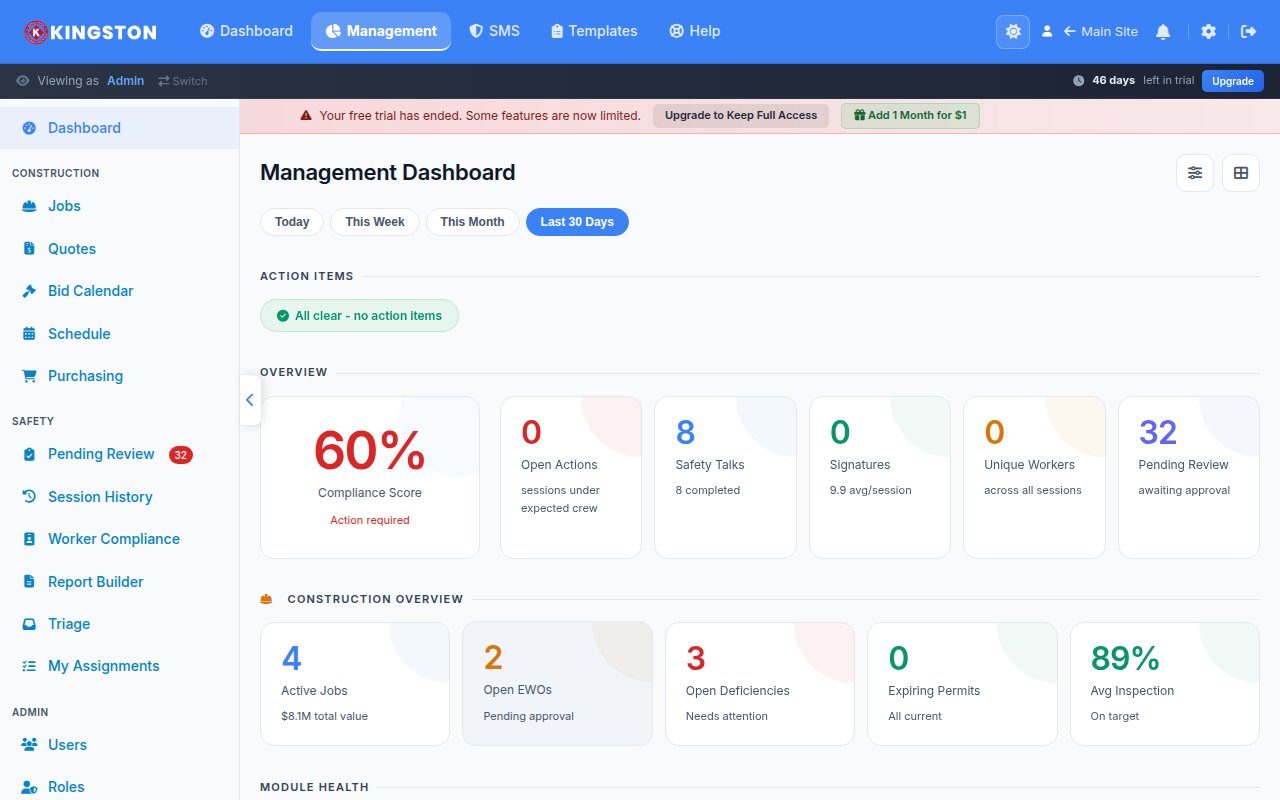
Set up a performance monitoring dashboard that tracks your leading and lagging indicators. Schedule internal audits - monthly for high-risk operations, quarterly for lower-risk environments. Conduct formal management reviews at least annually to evaluate overall SMS effectiveness and adjust objectives.
Common SMS Implementation Mistakes
Even well-intentioned organizations stumble. Here are the most frequent pitfalls and how to avoid them.
- Paper-only systems: If your SMS lives in binders that nobody reads, it's decoration - not protection. Digitize your system to make it accessible, searchable and actionable.
- Ignoring worker input: Frontline workers see hazards that management never will. Failing to involve them in hazard identification and procedure development undermines both the system's effectiveness and worker buy-in.
- Treating it as a one-time project: An SMS is a continuous improvement cycle, not a checkbox. The moment you stop auditing and updating, your system starts decaying.
- Overcomplicating procedures: A 40-page safe work procedure that nobody reads is worse than a clear, concise one-pager. Write for comprehension, not compliance theater.
- No accountability: When nobody is responsible for specific SMS elements, everything falls through the cracks. Assign ownership of each component and hold people accountable through regular reviews.
Digital SMS vs. Paper-Based Systems
The shift from paper to digital safety management isn't just a convenience upgrade - it's a fundamental improvement in how safety data is captured, analyzed and acted upon.
| Capability | Paper-Based | Digital SMS Platform |
|---|---|---|
| Incident reporting speed | Hours to days | Real-time from any device |
| Data analysis | Manual, error-prone | Automated dashboards and trend reports |
| Inspection scheduling | Calendar reminders | Automated assignments with notifications |
| Document control | Filing cabinets, version confusion | Centralized, version-controlled repository |
| Audit readiness | Days of preparation | Instant report generation |
| Worker accessibility | Office-only | Mobile access in the field |
How Make Safety Easy Supports Your SMS
Building and maintaining a safety management system doesn't have to be a bureaucratic nightmare. Make Safety Easy provides an all-in-one digital platform designed specifically to support every pillar of your SMS - from incident reporting and inspections to monthly management reviews and corrective action tracking.
Our platform helps organizations of all sizes replace fragmented paper processes with a centralized, mobile-friendly system that keeps your safety data organized, your compliance obligations met and your workers protected.
Ready to build a safety management system that actually works? Book a free demo to see how Make Safety Easy can streamline your SMS implementation, or explore our pricing plans to find the right fit for your organization.
Ready to simplify your safety program?
Make Safety Easy helps teams run toolbox talks, inspections, incident reports and more - all from one platform.
Start Your Free TrialNo credit card required. 14-day free trial.