A safety manager is the person responsible for developing, implementing and overseeing an organization's health and safety program. Their core responsibilities include conducting risk assessments, ensuring regulatory compliance, investigating incidents, delivering training and fostering a safety culture across all levels of the organization. Whether you are hiring for this role or stepping into it yourself, understanding the full scope of safety manager responsibilities is the first step toward success.
What Does a Safety Manager Do?
Safety managers wear many hats. On any given day, they might review incident reports in the morning, lead a site inspection before lunch, update training materials in the afternoon and present safety metrics to leadership before the end of the day. The role demands a mix of technical expertise, communication skills and the ability to influence behavior at every level of the organization.
The scope of the role varies by industry. A safety manager at a manufacturing plant focuses heavily on machine guarding, lockout/tagout and chemical exposure. A safety manager in construction prioritizes fall protection, excavation safety and crane operations. In office environments, the emphasis shifts to ergonomics, fire prevention and emergency preparedness. Regardless of setting, the objective is the same: prevent harm.
Free Download: 5 Safe Work Procedures
Choose from 112 professionally written SWPs. No credit card required.
Get Free SWPsCore Safety Manager Responsibilities
Program Development and Maintenance
- Develop, implement and maintain the organization's health and safety management system
- Write and update safe work procedures, policies and emergency response plans
- Ensure the program meets all applicable federal, state/provincial and local regulations
- Manage the safety budget and recommend investments in equipment, training and technology
Regulatory Compliance
- Monitor changes in OSHA, EPA and state/provincial OHS regulations
- Conduct internal audits to verify compliance with applicable standards
- Prepare for and manage external regulatory inspections
- Maintain required records including OSHA 300 logs, training documentation and inspection reports
Hazard Identification and Risk Assessment
- Perform regular workplace inspections and job hazard analyses
- Evaluate new processes, equipment and materials for potential risks
- Prioritize hazards using risk matrices and recommend appropriate controls
- Track corrective actions through to completion
Incident Investigation and Reporting
- Lead investigations of workplace incidents, near misses and property damage events
- Conduct root cause analysis using methods such as the "5 Whys" or fishbone diagrams
- Document findings and implement corrective and preventive actions
- Use incident reporting software to track trends and measure improvement
Training and Communication
- Design and deliver safety orientation for new hires
- Coordinate ongoing training including toolbox talks, refresher courses and specialized certifications
- Communicate safety performance metrics to leadership and frontline workers
- Facilitate safety committee meetings and employee engagement initiatives
Data Analysis and Reporting
- Track leading indicators such as inspection completion rates, near-miss reports and training participation
- Analyze lagging indicators including TRIR (Total Recordable Incident Rate), DART rate and lost-time injuries
- Prepare monthly safety reviews for management with actionable recommendations
- Benchmark performance against industry standards and set improvement targets
Required Qualifications
Education
Most safety manager positions require a bachelor's degree in occupational health and safety, environmental science, engineering or a related field. Some employers accept equivalent combinations of education and experience, particularly for candidates with extensive field backgrounds.
Certifications
Professional certifications significantly strengthen a candidate's profile. The most recognized credentials include:
- CSP (Certified Safety Professional) - issued by the Board of Certified Safety Professionals
- ASP (Associate Safety Professional) - a stepping stone toward the CSP
- CHST (Construction Health and Safety Technician) - focused on construction environments
- CRSP (Canadian Registered Safety Professional) - the Canadian equivalent of the CSP
- NEBOSH - widely recognized in international and oil-and-gas settings
Experience
Entry-level safety coordinator roles typically require 1-3 years of experience. Mid-level safety manager positions generally call for 3-7 years. Director-level or VP-level roles often expect 10 or more years plus demonstrated leadership in multi-site or multi-national operations.
Essential Skills for Safety Managers
| Technical Skills | Soft Skills |
|---|---|
| Regulatory knowledge (OSHA, NFPA, ANSI) | Communication and presentation ability |
| Risk assessment and hazard analysis | Influence without direct authority |
| Incident investigation methodology | Conflict resolution |
| Industrial hygiene fundamentals | Attention to detail |
| Data analysis and reporting | Adaptability under pressure |
| Safety management software proficiency | Empathy and active listening |
Safety Manager Salary Expectations (2026)
Compensation varies by region, industry and experience level. In the United States, safety managers typically earn between $70,000 and $120,000 annually, with senior roles in high-hazard industries (oil and gas, mining, heavy construction) commanding salaries above $140,000. In Canada, the range is approximately CAD $80,000 to CAD $130,000. Certification, multi-site responsibility and bilingual ability often push compensation toward the higher end of these ranges.
A Day in the Life of a Safety Manager
Understanding the daily rhythm helps set realistic expectations for the role:
- Morning - Review overnight incident reports, check corrective action dashboards and prioritize the day's tasks
- Mid-morning - Conduct a scheduled site inspection or accompany a supervisor on a safety walkthrough
- Lunch - Attend a safety committee meeting or deliver a toolbox talk
- Afternoon - Update training records, prepare regulatory submissions or investigate a reported near miss
- Late afternoon - Analyze safety metrics, draft monthly reports and plan the following week's inspection schedule
The role is rarely desk-bound. Effective safety managers spend significant time on the floor, in the field and in conversations with workers at every level.
Challenges Safety Managers Face
The safety manager role comes with unique pressures that organizations should understand and address:
- Competing priorities - production schedules and budget constraints often push back against safety recommendations. Safety managers must build business cases that demonstrate the financial return of prevention.
- Resistance to change - introducing new procedures or enforcing existing ones can meet resistance from workers and supervisors who see safety as an obstacle to getting work done.
- Information overload - tracking dozens of regulatory standards, hundreds of inspection findings and thousands of training records requires systems that scale. Manual tracking methods break down quickly.
- Isolation - in many organizations, the safety manager is a department of one. Without peer support or mentorship, burnout is a real risk.
- Staying current - regulations change, best practices evolve and new hazards emerge. Continuous professional development is not optional.
Organizations that set their safety managers up for success provide adequate staffing, invest in professional development, give them a seat at the leadership table and equip them with modern tools that eliminate administrative busywork.
Career Path and Advancement
The safety profession offers clear advancement opportunities for those who invest in their development:
- Safety Coordinator / Safety Technician - entry-level roles focused on inspections, documentation and supporting the safety manager
- Safety Specialist - mid-level roles with subject matter expertise in specific areas like industrial hygiene, fire protection or ergonomics
- Safety Manager - full program ownership for a site or business unit
- Regional / Corporate Safety Director - oversight of multiple sites or an entire organization's safety strategy
- VP of EHS / Chief Safety Officer - executive-level leadership integrating safety into corporate strategy and governance
Each step typically requires additional certifications, broader experience and demonstrated leadership. Safety professionals who can speak the language of business - translating hazard data into financial impact and strategic risk - advance fastest.
How Technology Empowers Safety Managers
Modern safety managers rely on digital tools to manage the sheer volume of tasks, data and documentation the role demands. Paper-based systems cannot keep pace with multi-site operations, remote workforces and real-time reporting expectations.
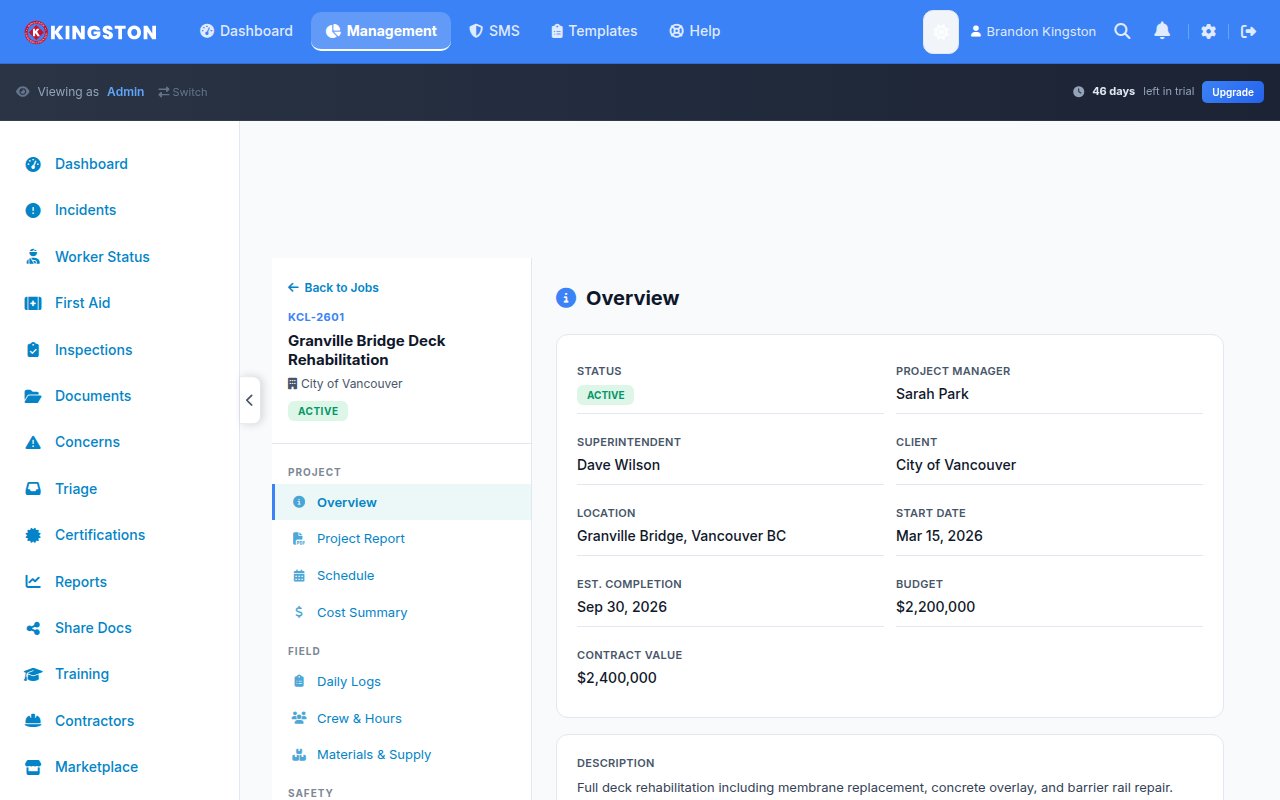
Safety management software consolidates inspections, incident reports, training records and compliance documents into a single platform. Automated reminders ensure inspections happen on schedule. Dashboards surface trends instantly instead of requiring hours of spreadsheet work. Mobile access lets managers capture findings on site and push corrective actions to the responsible parties in seconds.
The right technology does not replace the safety manager. It amplifies their impact. A safety manager spending 60% of their time on data entry, report formatting and chasing people for overdue documents is not managing safety - they are managing paperwork. Digital tools flip that ratio so the majority of their time goes toward prevention, coaching, analysis and strategic improvement.
Key Performance Indicators for Safety Managers
Organizations should evaluate safety manager performance using a balanced set of metrics rather than relying solely on injury counts. Effective KPIs include:
- Inspection completion rate - are scheduled inspections being conducted on time?
- Corrective action closure rate - are identified hazards being resolved within target timeframes?
- Training compliance - what percentage of required training is current across the workforce?
- Near-miss reporting volume - a healthy reporting culture generates a steady flow of near-miss reports
- Regulatory audit outcomes - results from internal and external compliance audits
- Employee engagement - participation in safety committees, toolbox talks and hazard identification programs
Sample Job Description Template
Use the following template as a starting point when writing your posting:
Job Title: Safety Manager
Reports To: Director of Operations / VP of EHS
Location: [City, State/Province]
Type: Full-time, ExemptSummary: The Safety Manager develops, implements and manages the organization's health and safety program to ensure a safe work environment and regulatory compliance.
Key Responsibilities: Conduct inspections, investigate incidents, deliver training, maintain compliance documentation, analyze safety data and report to leadership.
Qualifications: Bachelor's degree in OHS or related field. CSP or equivalent preferred. 5+ years of progressive safety experience.
Set Your Safety Manager Up for Success
Hiring a great safety manager is only half the equation. Giving them the right tools, authority and organizational support determines whether they thrive or burn out. Invest in a platform that handles the administrative burden so your safety manager can focus on what matters most: keeping people safe.
Book a demo to see how Make Safety Easy streamlines inspections, incident tracking and monthly reviews for safety managers. Visit our pricing page to explore plans built for teams of every size.
Ready to simplify your safety program?
Make Safety Easy helps teams run toolbox talks, inspections, incident reports and more - all from one platform.
Start Your Free TrialNo credit card required. 14-day free trial.