A safety observation card is a short form workers use to record safe and at-risk behaviors, unsafe conditions and near misses they see on the job. An observation program collects the cards, reviews the trends on a schedule and acts on them, so hazards get fixed before someone is hurt.
Key takeaways
- Keep the card under two minutes to complete, with checkboxes for common categories.
- Record safe behaviors as well as at-risk ones.
- Never use observation cards to discipline workers, or people stop filling them in.
- Review the data on a schedule and show workers what changed because of their cards.
A safety observation card program is a system where workers document safe and unsafe behaviors, conditions and near-misses using structured forms - giving safety managers real-time data on workplace risks before incidents happen. Workers carry pocket-sized cards, note what they see (positive or negative), and submit them anonymously. Safety teams analyze trends weekly and act on patterns, not just individual reports.
Safety Observation Card Examples
Five sample entries showing how a worker fills out a card - two positive, three at-risk. Copy these into your own program or start from our free template.
- Safe behavior - Worker clipped off with a full-body harness before stepping onto the scaffold deck at 4 m. Recognized on the spot.
- Safe condition - Lay-down area walkways kept clear all shift; no trip hazards observed.
- At-risk behavior - Operator skipped the backup-alarm check on the skid steer. Coached immediately; pre-start checklist reviewed.
- At-risk condition - Extension cord run across a pedestrian route with no cord cover. Corrected within 10 minutes.
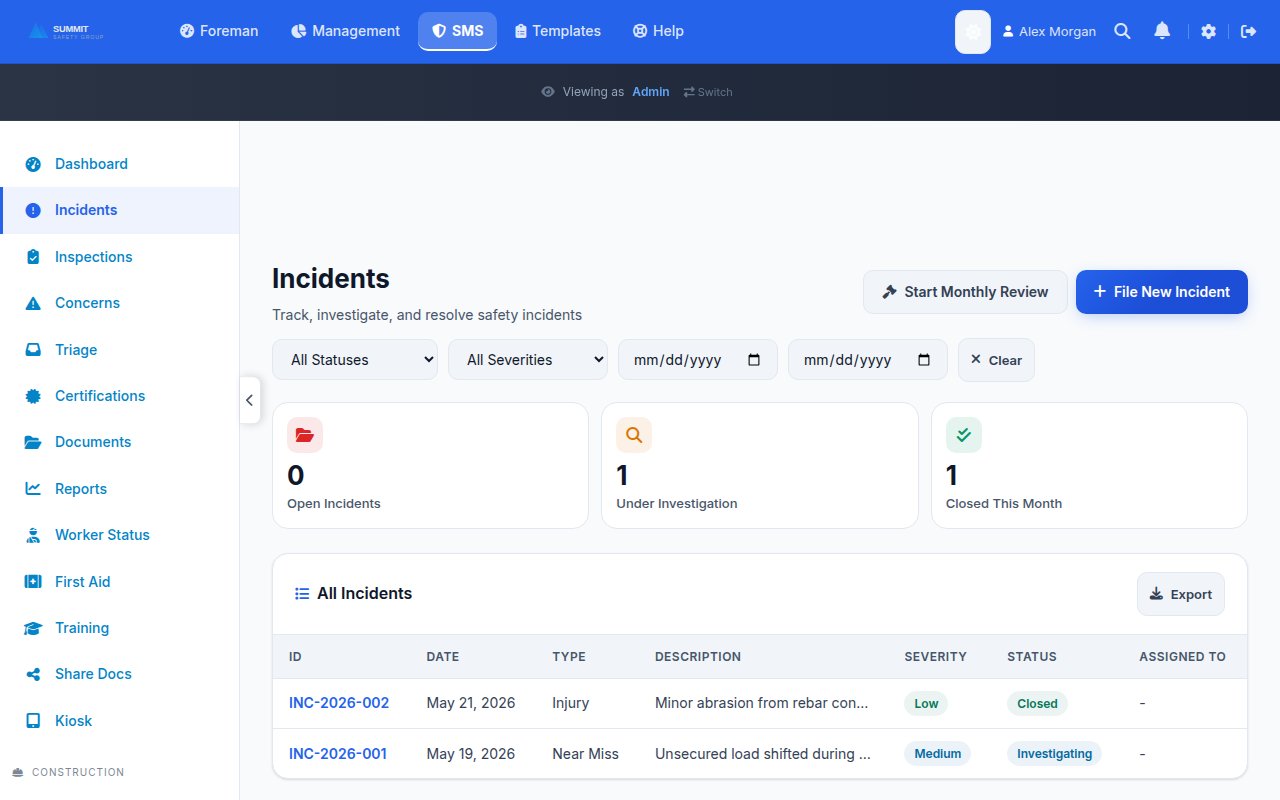
- Near-miss - Unsecured load shifted during a lift; no injury. Rigging procedure re-briefed with the crew.
What Is a Safety Observation Program?
A safety observation program is a systematic approach to workplace safety that relies on trained observers - often frontline employees and supervisors - to watch, document and provide feedback on work behaviors and conditions. Unlike traditional safety programs that react to incidents after they happen, observation programs are proactive. They identify the precursors to incidents and address them in real time.
Free Download: 5 Safe Work Procedures
Choose from 112 professionally written SWPs. No credit card required.
Get Free SWPsThe observation card is the primary data collection tool within this framework. Each card typically captures the date, location, task observed, specific safe or at-risk behaviors noted and any immediate corrective actions taken. The cumulative data from hundreds or thousands of observations reveals patterns that guide safety improvement efforts.
The Link to Behavioral Safety
Safety observation programs are rooted in behavior-based safety (BBS) principles. BBS starts from the fact that human behavior is a contributing factor in many workplace incidents. By observing behaviors systematically, organizations can identify which unsafe acts are most common, understand why they occur and design targeted interventions.
The distinction between a successful BBS observation program and a failed one often comes down to culture. Programs that feel punitive - where observations are used to discipline workers - quickly lose participation. Programs that emphasize positive reinforcement and treat observations as coaching opportunities thrive.
What should a safety observation card include?
The observation card itself is the engine of the program. A poorly designed card collects useless data. A well-designed card makes observation quick, consistent and actionable.
Essential Card Fields
Every safety observation card should include these core elements:
- Observer information: Name (or anonymous option), department, date and time
- Location: Specific work area, building or job site
- Task being performed: Brief description of the activity observed
- Observation type: Safe behavior, at-risk behavior, unsafe condition or near miss
- Category: PPE use, body positioning, housekeeping, tool/equipment condition, procedures followed
- Description: What specifically was observed
- Immediate action taken: Conversation held, hazard corrected, work stopped
- Follow-up needed: Yes/no with description if applicable
Balancing Detail and Speed
The biggest design challenge is collecting enough data to be useful without making the card so complex that nobody fills it out. The best observation cards take less than two minutes to complete. Use checkboxes and dropdown selections for common categories and reserve free-text fields for descriptions and follow-up notes only.
Paper vs. Digital Cards
Paper observation cards are inexpensive to produce but expensive to manage. They require manual data entry, are prone to loss and damage and create significant lag between observation and analysis. Digital observation cards - delivered through mobile apps or web platforms - solve these problems by enabling real-time submission, automatic categorization and instant reporting.
Digital incident reporting and observation tools make submitting an observation quicker than paper. The convenience factor alone drives participation and the data quality improves dramatically when observers can attach photos, drop location pins and select from standardized category lists.
Launching a Safety Observation Program
A successful launch requires careful planning across four dimensions: leadership commitment, observer training, communication strategy and data infrastructure.
Step 1: Secure Leadership Buy-In
Executive and middle management support is non-negotiable. Leaders must visibly participate in the observation process, allocate time for employees to conduct observations and respond to the data the program generates. When workers see that leadership reads observation reports and acts on findings, credibility follows.
Step 2: Train Your Observers
Observation quality depends entirely on observer skill. Training should cover:
- What constitutes a meaningful observation versus a superficial one
- How to observe without disrupting work or creating a surveillance atmosphere
- Conversation techniques for providing constructive feedback to workers
- How to distinguish between at-risk behaviors and at-risk conditions
- Recognizing and documenting safe behaviors (not just unsafe ones)
- Using the observation card or digital tool correctly
Initial training typically takes 2-4 hours, with annual refreshers of 1-2 hours. Pairing new observers with experienced ones for their first few observations accelerates competence.
Step 3: Communicate the Program Purpose
Every employee - not just observers - needs to understand why the program exists and how the data will be used. Be explicit: observations are for improvement, not punishment. Share examples of how observation data has led to positive changes at other organizations or within your own company. Address concerns about surveillance, anonymity and fairness directly and honestly.
Step 4: Set Participation Targets
Establish clear expectations for observation frequency. Common targets include:
- Supervisors: 2-4 observations per week
- Safety committee members: 1-2 observations per week
- General employees (voluntary): encouraged but not mandated
Avoid setting targets so high that observers rush through cards or fabricate observations to meet quotas. Quality matters more than quantity, especially in the early stages of the program.
Analyzing Observation Data
Raw observation data is meaningless without analysis. The real value of a safety observation program emerges when you aggregate, categorize and trend the data over time.
Key Metrics to Track
Monitor these indicators to gauge program health and safety performance:
- Observation volume: Total observations per week/month by department and observer
- Safe behavior ratio: Percentage of observations documenting safe vs. at-risk behaviors
- Category distribution: Which behavior categories appear most frequently
- Repeat findings: At-risk behaviors or conditions that recur despite corrective actions
- Time to resolution: How quickly identified hazards are corrected
- Participation rate: Percentage of trained observers actively submitting cards
Turning Data into Action
Monthly observation data reviews should involve safety committees, department supervisors and senior management. The review process should identify the top three to five at-risk trends, assign corrective actions with deadlines and track those actions to completion. Sharing anonymized findings with the broader workforce closes the feedback loop and demonstrates that observations lead to real change.
Correlation with Incident Data
The most powerful analysis connects observation trends with actual incident data. If your observation data shows a rising trend in at-risk behaviors related to manual lifting and your incident records show an increase in back injuries, the correlation validates both data streams and prioritizes the intervention. Organizations that integrate observation and incident data into a single platform gain this insight automatically.
Common Pitfalls and How to Avoid Them
Many observation programs start strong and fade within 6-12 months. Understanding the common failure modes helps you build a program that endures.
The Punishment Trap
Using observation data to discipline employees is the fastest way to kill a program. Workers will stop participating, observers will stop reporting honestly and the data becomes worthless. Maintain a firm boundary: observation data is for system improvement, not individual punishment.
Data Graveyard Syndrome
Collecting observations without analyzing or acting on the data is equally destructive. Workers who take time to submit observations and never see results will disengage. Commit to regular data review cycles and visible corrective actions.
Observer Fatigue
Asking the same small group of observers to carry the entire program leads to burnout. Rotate observation responsibilities, recognize high-performing observers and periodically refresh training to maintain engagement.
Ignoring Positive Observations
Programs that only track at-risk behaviors miss half the picture. Documenting and celebrating safe behaviors reinforces the actions you want to see more of. Aim for a ratio of at least 3:1 safe to at-risk observations as your program matures.
Integrating Observations with Your Safety Management System
Standalone observation programs deliver moderate value. Observation programs integrated into a comprehensive safety management system deliver transformational results. When observations feed into the same platform that manages inspections, incidents, corrective actions and training, every data point enriches the whole.
For example, an observation that identifies a recurring housekeeping issue in a specific area can automatically trigger an inspection, generate a corrective action and flag the relevant training module - all without manual intervention. This level of integration is only possible with a digital safety management platform designed for connected workflows.
Measuring Program ROI
Demonstrating return on investment keeps leadership engaged and secures ongoing funding for the program. Track these financial indicators:
- Workers' compensation costs: Compare pre-program and post-program claim frequency and severity
- OSHA recordable rates: Track TRIR and DART rate changes over 12-24 months
- Production downtime: Measure reductions in safety-related work stoppages
- Insurance premiums: Document EMR improvements and resulting premium reductions
Take Your Observation Program Digital
Paper observation cards served their purpose, but the modern workplace demands faster data collection, real-time analytics and seamless integration with your broader safety program. A digital observation platform eliminates data entry backlogs, increases participation and turns every observation into an actionable insight.
Ready to transform your safety observation program? Request a demo to see how Make Safety Easy digitizes observations from the field to the dashboard, or check our pricing to get started today.
Ready to simplify your safety program?
Make Safety Easy helps teams run toolbox talks, inspections, incident reports and more - all from one platform.
Start Your Free TrialNo credit card required. 14-day free trial.
Frequently asked questions
What should a safety observation card include?
The date, location, task observed, observation type (safe behavior, at-risk behavior, unsafe condition or near miss), a short description and any immediate action taken.
Should safety observation cards be anonymous?
Offering an anonymous option can help participation, especially early on. Whatever you choose, make it clear that cards are used to improve the work, never to discipline the person observed.
How many observations should supervisors complete?
There is no legal number. Many programs set a weekly target for supervisors, and the quality of each observation matters more than the count.