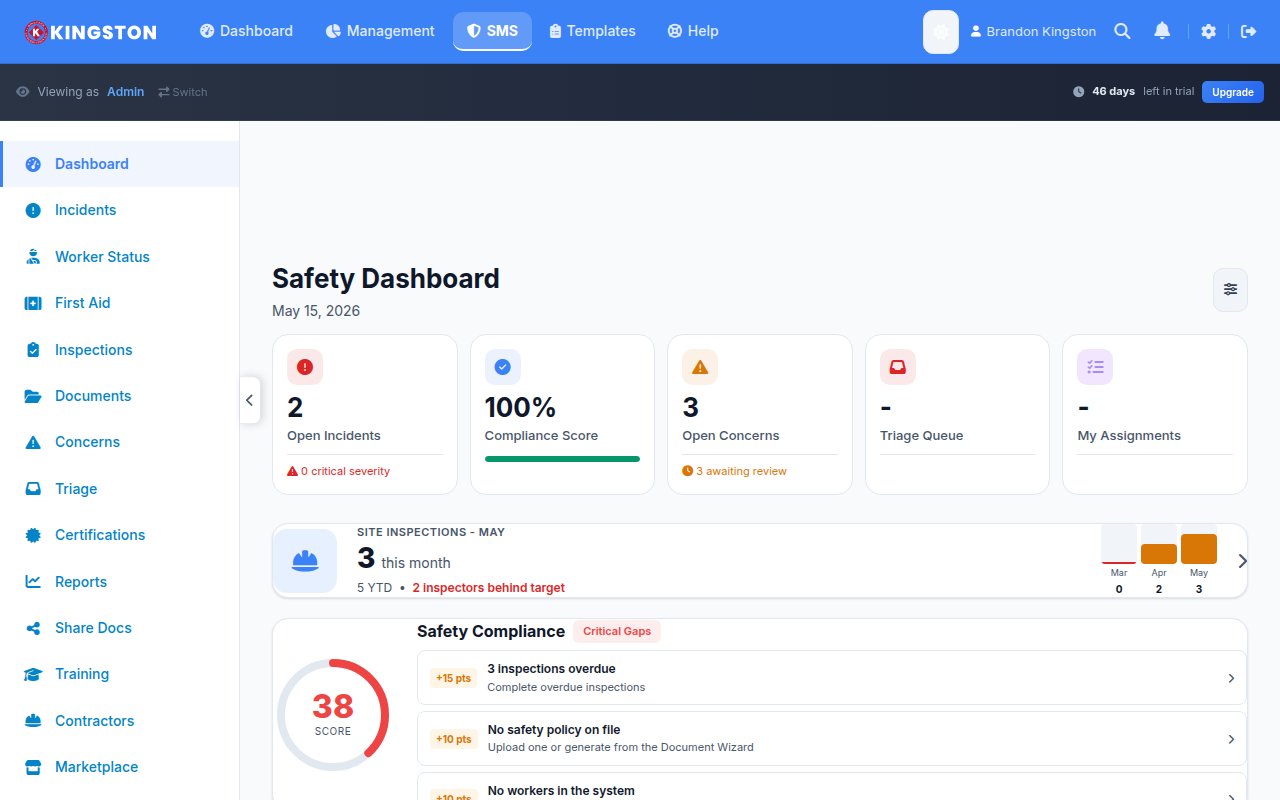
The return on investment for safety software typically ranges from 3:1 to 10:1 within the first two years, depending on your industry, team size and current incident rates. Calculating safety software ROI requires measuring both hard cost reductions (workers' compensation, fines, lost productivity) and soft value gains (culture improvement, audit readiness, employee retention). This guide gives you the exact formulas and benchmarks to build a credible business case for EHS software investment.
Why ROI Calculation Matters
Safety professionals know that better safety management saves lives and money. The challenge is proving it to leadership in financial terms they care about. A well-structured ROI analysis transforms "we need safety software" from an expense request into a business investment with measurable returns. Without hard numbers, safety software budgets compete against revenue-generating projects and often lose.
The Core ROI Formula
The basic formula for safety software ROI is straightforward:
Free Download: 5 Safe Work Procedures
Choose from 112 professionally written SWPs. No credit card required.
Get Free SWPsROI = (Total Benefits - Total Costs) / Total Costs x 100
The complexity lives in accurately quantifying the benefits. Here is how to break it down into measurable components.
Quantifying Hard Cost Savings
Workers' Compensation Reduction
This is typically the largest line item in your ROI calculation. According to the National Safety Council, the average cost of a medically consulted workplace injury is over $44,000 (2024 data, adjusted for inflation). Organizations that implement digital safety management systems routinely report 20-40% reductions in recordable incidents within the first 18 months.
Formula: (Current annual WC costs) x (Estimated % reduction) = Annual WC savings
Example: A company spending $200,000/year on workers' compensation that achieves a 25% reduction saves $50,000 annually.
OSHA Fine Avoidance
In 2026, OSHA serious violation penalties exceed $16,000 per instance, with willful violations reaching over $160,000. Repeat violations compound. Digital safety management provides the documentation trail that prevents citations and demonstrates good faith compliance.
Formula: (Probability of citation) x (Average fine amount) = Expected annual fine avoidance value
Productivity Recovery
Every workplace incident creates productivity loss beyond the injured worker. Investigations take time. Teams slow down. Replacement workers need training. The indirect costs of a workplace injury typically run 2-4x the direct costs.
Formula: (Hours spent on manual safety admin per week) x (Hourly rate) x 52 = Annual admin time savings
Example: A safety coordinator spending 10 hours/week on manual processes at $35/hour saves $18,200/year by automating those workflows.
ROI Benchmarks by Company Size
| Company Size | Typical Annual Software Cost | Estimated Annual Savings | Estimated ROI | Payback Period |
|---|---|---|---|---|
| 10-25 employees | $1,200 - $3,600 | $8,000 - $25,000 | 300-600% | 1-3 months |
| 25-100 employees | $3,600 - $12,000 | $25,000 - $100,000 | 400-700% | 1-4 months |
| 100-500 employees | $12,000 - $48,000 | $75,000 - $400,000 | 300-800% | 2-6 months |
| 500+ employees | $48,000+ | $200,000+ | Varies widely | 3-12 months |
Note: These benchmarks are based on industry averages and published case studies. Actual results depend on your specific risk profile, industry and current safety performance. Visit Make Safety Easy's ROI page for a calculator tailored to your business.
Quantifying Soft Value
Some benefits are harder to assign dollar values to but are equally important in a business case:
Insurance Premium Reductions
Many insurers offer 5-15% premium discounts for organizations with documented digital safety management programs. Contact your insurer to get a specific estimate. This alone can offset the cost of safety software for smaller businesses.
Improved Employee Retention
Workers who feel safe stay longer. The cost of replacing a skilled trades worker ranges from $15,000 to $50,000 when you factor in recruiting, training and lost productivity. Even a small improvement in retention driven by better safety culture generates meaningful savings.
Contract and Bid Qualification
Increasingly, general contractors and corporate clients require documented safety management systems as a condition of doing business. Safety software does not just reduce costs. It opens revenue opportunities by qualifying your business for contracts you would otherwise lose.
Audit and Compliance Readiness
The time saved preparing for regulatory audits, client audits and insurance reviews is substantial. Organizations using digital safety platforms report reducing audit preparation time by 60-80%. For teams that face multiple audits per year, this translates to weeks of recovered productive time.
Building Your Business Case: Step by Step
Follow this framework to create an ROI analysis your leadership team will take seriously:
Step 1: Establish Your Baseline
Document your current costs: workers' compensation premiums, OSHA fines (if any), hours spent on manual safety administration, lost productivity from incidents and insurance premiums. Pull data from the last two to three years for accuracy.
Step 2: Set Conservative Improvement Targets
Do not promise a 50% reduction in incidents. Use conservative estimates (15-25% improvement in year one) that you can realistically achieve. Understating and overdelivering builds credibility for future budget requests.
Step 3: Calculate Total Cost of Ownership
Include software subscription costs, implementation time (for enterprise platforms, this can be significant), training hours and any integration costs. For platforms like Make Safety Easy with same-day setup and transparent pricing, this calculation is simple. For enterprise platforms, include consulting fees and internal project management time.
Step 4: Build a Three-Year Projection
Year one typically shows the lowest ROI due to implementation and adoption curves. Years two and three show compounding returns as the system matures and your safety culture improves. Present a three-year view to capture the full investment picture.
Step 5: Present in Leadership Language
Frame safety software as risk management, not an expense. Use terms like "risk reduction," "liability mitigation" and "compliance assurance." For more on the metrics that matter, see How to Calculate Safety ROI Metrics.
Common ROI Pitfalls to Avoid
- Overestimating adoption rates: Software only delivers ROI if people use it. Factor in realistic adoption timelines.
- Ignoring implementation costs: Enterprise platforms with six-month implementations carry significant hidden costs.
- Comparing only subscription prices: The cheapest software that takes three months to implement and requires a consultant is not actually cheap.
- Forgetting the cost of doing nothing: The status quo has costs too. Every month without proper safety management is a month of accumulated risk.
How Make Safety Easy Maximizes ROI for SMBs
Make Safety Easy delivers strong ROI for small and mid-sized businesses through three mechanisms. First, same-day setup eliminates implementation costs and accelerates time to value. Second, transparent pricing with no per-module fees means your total cost of ownership is predictable. Third, high adoption rates driven by intuitive mobile design ensure the software actually gets used, which is the single most important factor in realizing safety software ROI.
Features like automated incident reporting, monthly safety reviews and corrective action tracking directly reduce the manual workload that drains safety coordinator productivity. Every hour saved on paperwork is an hour invested in proactive safety improvement.
The Bottom Line on Safety Software ROI
Safety software is one of the few business investments that simultaneously reduces costs, mitigates legal risk, protects employees and opens revenue opportunities. The ROI is real and measurable. The key is choosing a platform where the total cost of ownership is low enough and the adoption rate is high enough to realize those returns quickly.
For SMBs, the math is especially compelling. A platform that costs a few hundred dollars per month and prevents even one recordable incident per year delivers returns that dwarf the investment.
Calculate your specific ROI. Visit the Make Safety Easy ROI calculator or book a demo to see how the numbers work for your business.
Ready to simplify your safety program?
Make Safety Easy helps teams run toolbox talks, inspections, incident reports and more - all from one platform.
Start Your Free TrialNo credit card required. 14-day free trial.