If your workplace safety program relies on luck instead of leading indicators, it is already failing. A safety program that looks good in a binder but fails on the shop floor puts workers at risk and exposes your organization to regulatory penalties, skyrocketing WCB premiums and reputational damage. Across Canada, workplace injuries cost employers an estimated $29 billion annually in direct and indirect costs, according to the Association of Workers' Compensation Boards of Canada. The good news: the warning signs are predictable and every one of them is fixable.
Below, we break down the five most common indicators that a safety program is not working - drawn from OH&S best practices, WorkSafeBC guidance and real patterns we see across hundreds of Canadian worksites. If even one of these signs sounds familiar, it is time to act.
Sign 1: You Only Measure Lagging Indicators
This is the single most common trap. Your dashboard tracks lost-time injuries, total recordable incident rates and workers' compensation claims. These are lagging indicators - they tell you what already went wrong. They are the rearview mirror of workplace safety.
Free Download: 5 Safe Work Procedures
Choose from 112 professionally written SWPs. No credit card required.
Get Free SWPsThe problem? By the time a lagging indicator spikes, someone has already been hurt.
A healthy safety program balances lagging indicators with leading indicators: metrics that predict future performance. Think near-miss reports filed, safety observations completed, toolbox talks delivered, inspection close-out rates and percentage of corrective actions resolved on time. WorkSafeBC's own guidance on safety program evaluation emphasizes that organizations tracking leading indicators identify hazards before they produce injuries - not after.
How to Fix It
- Start tracking near-miss reporting rates. A workplace that reports zero near misses is not safe - it is blind. Research from the National Safety Council suggests that for every serious injury, there are roughly 300 near misses. If you are not capturing them, you are missing your best early-warning system.
- Set targets for proactive activities. Measure how many workplace inspections are completed on schedule, how many toolbox talks are delivered per crew per month and how quickly corrective actions are closed.
- Build a balanced scorecard. Use monthly safety reviews to compare leading and lagging indicators side by side so leadership sees the full picture.
Sign 2: Incident Reports Are Shallow, Late, or Missing Entirely
Pull your last ten incident reports. How many were filed within 24 hours? How many include a root-cause analysis that goes deeper than "worker error"? If your reports read like one-sentence afterthoughts, your investigation process is broken.
Shallow reporting is a culture problem disguised as a paperwork problem. When workers believe that filing a report leads to blame instead of improvement, they stop reporting. When supervisors treat investigations as box-checking, the same hazards resurface again and again. The Canadian Centre for Occupational Health and Safety (CCOHS) states plainly that effective incident investigation is a cornerstone of any functional safety management system.
And here is the real cost. Incomplete investigation means incomplete corrective action, which means repeat incidents and escalating severity. We have written extensively about the true cost of workplace injuries in Canada - the numbers are staggering when you factor in indirect costs like overtime, retraining and production delays.
How to Fix It
- Make reporting effortless. If filing an incident report requires a 20-minute paper form and a trip to the site office, reports will not get filed. Mobile-first incident reporting tools let workers submit reports from the field in under two minutes - with photos, GPS location and guided root-cause prompts.
- Train supervisors on root-cause analysis. The "5 Whys" method is simple and effective. Move beyond "human error" as a conclusion and dig into the systemic conditions that allowed the error to happen.
- Close the feedback loop. When a worker reports a hazard, tell them what was done about it. Nothing kills a reporting culture faster than silence.
Sign 3: Safety Training Is a Once-a-Year Event
Annual safety orientations are necessary. They are also wildly insufficient.
The "forgetting curve," first described by psychologist Hermann Ebbinghaus, shows that people forget roughly 70% of new information within 24 hours unless it is reinforced. A single annual training session - no matter how polished the PowerPoint - does not build safety culture. It builds compliance paperwork.
Canadian OH&S regulations across most provinces require employers to provide training that is adequate, current and relevant to the specific hazards workers face. In practice, that means ongoing reinforcement. WorkSafeBC's inspection officers routinely flag programs where training records show a single annual session with no follow-up as evidence of a deficient safety program.
How to Fix It
- Shift to micro-learning. Short, focused toolbox talks delivered weekly or biweekly keep safety top of mind without pulling workers off the job for hours. Five minutes of targeted discussion about a real hazard on your site beats a two-hour lecture every time.
- Tie training to real incidents. When an incident or near miss occurs, use it as an immediate teaching moment. This is where leading indicators and training intersect.
- Document everything. Digital records of who attended, what was covered and when it happened protect you during a workplace safety audit and demonstrate due diligence to regulators.
Sign 4: Your Inspections Are Predictable and Performative
If every worker on site knows that "the safety walk happens Thursday at 10 a.m.," your inspections are theatre. The site looks perfect at 10 a.m. on Thursday. It may look very different at 6 a.m. on Monday.
Predictable inspections create a cycle of temporary compliance. Hazards get hidden, not fixed. Housekeeping improves for an hour, then deteriorates. This is not cynicism - it is human nature. And it is a sign that your inspection program measures performance rather than reality.
A robust workplace safety audit process uses a mix of scheduled and unannounced inspections, covers different shifts and areas, and - critically - tracks whether identified deficiencies are actually corrected. The inspection itself is only half the equation. The corrective action follow-through is where the real value lives.
How to Fix It
- Randomize your schedule. Vary inspection days, times and areas. Use digital inspection management tools to assign and track inspections across shifts so no crew or zone is overlooked.
- Track corrective action close-out rates. An inspection that finds 15 deficiencies but closes only 3 is worse than useless - it creates a false sense of action. Set targets: 90% of corrective actions closed within 14 days is a reasonable benchmark.
- Involve workers. Joint health and safety committee members, lead hands and frontline workers should participate in inspections. They know where the real hazards are.
Sign 5: Leadership Treats Safety as a Cost Centre, Not a Value
This is the root cause behind all the other signs.
When senior leadership views safety as an expense to be minimized rather than an investment that protects people and profit, every downstream element suffers. Budgets get cut. Training gets deferred. Near-miss reporting gets deprioritized because "nobody got hurt." The safety manager becomes a paper-pusher instead of a strategic advisor.
The data tells a different story. A landmark study by the Institute for Work & Health in Toronto found that every dollar invested in workplace injury prevention returns between $1.50 and $5.80 to the employer through reduced WCB premiums, lower absenteeism and improved productivity. Safety is not a cost centre. It is one of the highest-ROI investments a Canadian business can make.
| Approach | Typical Annual Cost (50-person crew) | Outcome |
|---|---|---|
| Reactive (post-incident only) | $80,000-$250,000+ per serious incident | Regulatory fines, premium surcharges, lost productivity, potential prosecution |
| Proactive (digital safety management) | $3,000-$10,000 in software and training | Fewer incidents, lower premiums, stronger safety culture, audit readiness |
How to Fix It
- Speak the language of the boardroom. Present safety data in terms leadership cares about: dollars saved, premium reductions, production days preserved and regulatory risk mitigated. Use monthly review dashboards to make the business case visible.
- Make safety visible at the executive level. Safety metrics should appear on the same dashboard as revenue and project timelines. When leadership reviews safety data monthly, the rest of the organization notices.
- Celebrate leading indicators publicly. Recognize crews with high near-miss reporting rates, perfect inspection scores and consistent toolbox talk attendance. What gets recognized gets repeated.
The Common Thread: You Cannot Fix What You Cannot See
Every one of these five warning signs shares a root cause - lack of visibility. Paper-based systems bury data in filing cabinets. Spreadsheets create silos. When safety information is scattered, incomplete, or weeks old by the time anyone reviews it, hazards persist and workers pay the price.
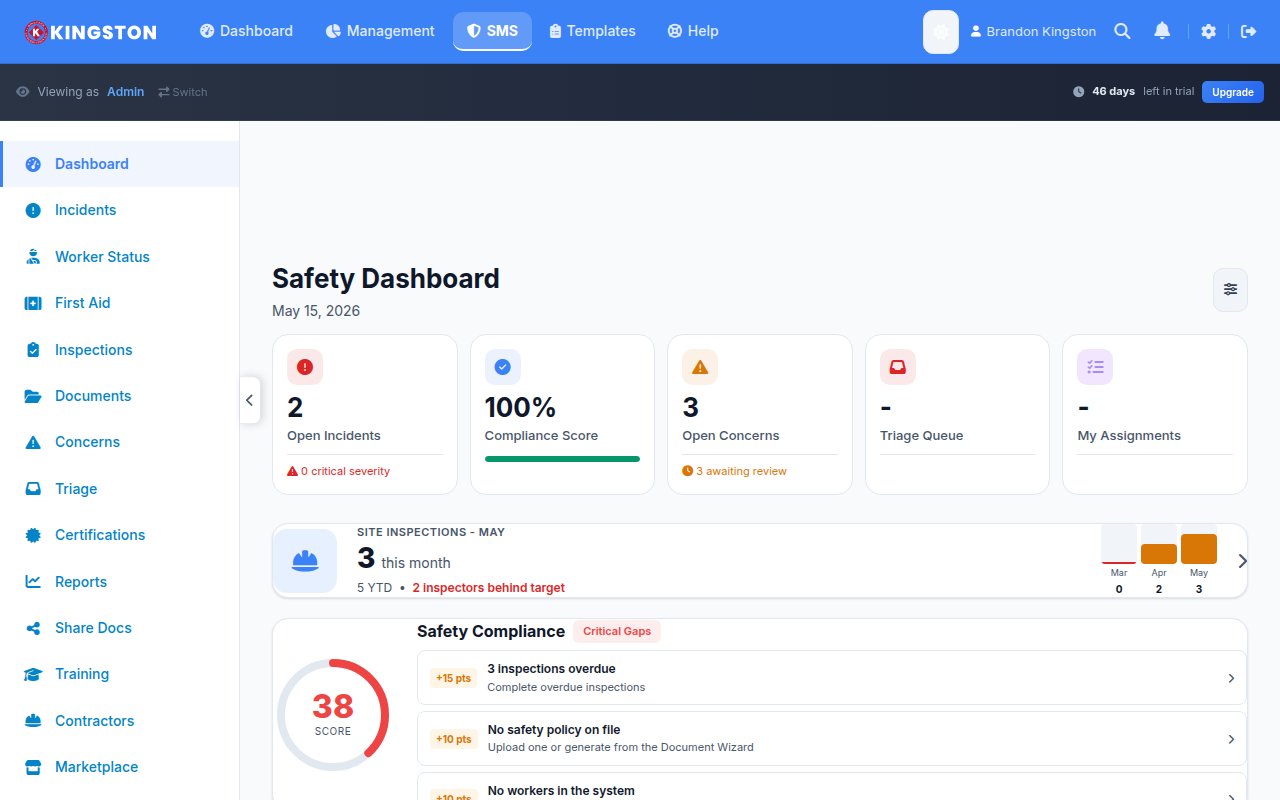
Modern safety management platforms solve this by centralizing incident reporting, inspections, toolbox talks, and monthly reviews in a single system - accessible from the field, updated in real time and built for the way Canadian crews actually work.
That is exactly what Make Safety Easy was designed to do.
Stop Guessing. Start Seeing.
If you recognized your organization in any of the five signs above, you are not alone. Most Canadian safety programs were built with good intentions and then left to stagnate. The difference between a program that protects workers and one that just checks boxes comes down to visibility, consistency and follow-through.
Make Safety Easy gives you all three - without the complexity, the learning curve, or the enterprise price tag.
Ready to see what a modern safety program looks like?
Frequently asked questions
What are the signs a safety program is failing?
The five most common signs are: relying only on lagging indicators, shallow or missing incident reports, annual-only safety training, predictable and performative inspections and leadership treating safety as a cost centre rather than a value.
What is the difference between leading and lagging safety indicators?
Lagging indicators measure past outcomes such as injury rates and lost-time incidents. Leading indicators measure proactive activities that predict future safety performance, such as near-miss reports filed, inspections completed, toolbox talks delivered and corrective actions closed on time.
How much do workplace injuries cost Canadian employers?
Workplace injuries cost Canadian employers an estimated $29 billion annually in direct and indirect costs, according to the Association of Workers' Compensation Boards of Canada. Individual serious incidents can cost a single employer $80,000 to $250,000 or more.
How can I improve my workplace safety program in Canada?
Start by tracking leading indicators alongside lagging ones, make incident reporting easy and mobile-accessible, deliver ongoing micro-training through regular toolbox talks, randomize inspections across shifts and present safety data to leadership in business terms. Digital safety management platforms like Make Safety Easy centralize these activities in one system.