You started a contracting business because you're good at building things. Not because you love reading 800-page regulatory documents written in language that requires a law degree to decode.
But here's the reality: WorkSafeBC doesn't care how small you are. A 5-person framing crew has the same legal obligations as a 500-person general contractor. The fines are the same. The stop-work orders are the same. And the consequences of getting it wrong are the same.
This guide cuts through the legalese and tells you exactly what you need to do. No fluff, no jargon, no "consult your legal advisor" cop-outs. Just the requirements, explained in plain language.
Free Download: 5 Safe Work Procedures
Choose from 112 professionally written SWPs. No credit card required.
Get Free SWPsThe 8 Things Every BC Employer Must Have
1. A Written Health and Safety Program
If you have 20 or more workers, you need a formal written OHS program. Under 20? You still need basic written safe work procedures, but the formal program requirement kicks in at 20.
What it includes:
- A written policy statement signed by the employer
- Assignment of safety responsibilities (who does what)
- Procedures for identifying and controlling hazards
- Training requirements
- Incident investigation procedures
- Inspection schedules
- Worker participation (joint committee or worker representative)
2. A Joint Health and Safety Committee (JOHSC) or Worker Representative
- 20+ workers regularly employed: You need a JOHSC with at least 4 members (equal employer/worker representation)
- 10-19 workers: You need a worker health and safety representative
- Under 10: No formal requirement, but you still need to involve workers in safety
- Meets monthly (minutes must be kept)
- Conducts regular workplace inspections
- Investigates incidents and refusals to work
- Makes recommendations to the employer
3. Hazard Assessments
Before any work activity, you must identify the hazards and determine how to control them. This isn't optional. This isn't just for high-risk work.
Types you need:
- Job Hazard Analysis (JHA): Task-specific assessment before non-routine work
- Field Level Hazard Assessment (FLHA): Quick daily assessment at the work location
- Site-specific assessment: For new project sites
4. Worker Training and Orientation
Every worker must receive safety orientation before starting work. Not on their second day. Not "when we get around to it." Before they touch a tool.
Orientation must cover:
- Your health and safety program
- Hazards specific to their work
- Emergency procedures and exits
- Where to find first aid
- How to report hazards and incidents
- Their right to refuse unsafe work
- Fall protection (before working at heights)
- Confined space entry
- WHMIS/GHS (before handling chemicals)
- Equipment operation (forklifts, cranes, aerial lifts)
- First aid (minimum one Level 1 attendant per site)
5. Incident Investigation and Reporting
When someone gets hurt, two things need to happen: take care of the worker, then figure out what went wrong.
You must report to WorkSafeBC:
- Any injury requiring medical treatment beyond first aid
- Any incident that could have caused serious injury (serious near-miss)
- Any fatality or serious injury (immediately by phone)
- What happened (sequence of events)
- Why it happened (root cause, not just "worker error")
- How to prevent it from happening again (corrective actions)
- Timeline for implementing corrective actions
6. First Aid
Every workplace must have:
- At least one certified first aid attendant (Level 1 minimum for low-risk, Level 3 for high-risk/remote)
- A stocked first aid kit appropriate for the hazard level and number of workers
- Transportation plan for getting injured workers to medical care
- First aid records maintained and accessible
| Workers on site | Risk Level | First Aid Attendant Required | |—-|—-|—-| | 1-5 | Low | Level 1 | | 6-15 | Low | Level 1 | | 16-50 | Low | Level 1 | | 1-5 | High | Level 1 | | 6-15 | High | Level 2 | | 16-50 | High | Level 3 |
7. Regular Workplace Inspections
Inspections must be conducted regularly. How often depends on the hazard level, but for construction sites, daily inspections of active work areas are standard practice.
Who inspects:
- A competent person (someone with knowledge, training, and experience)
- JOHSC members (monthly inspections minimum)
- Supervisors (daily walkthroughs)
- Everything on the daily checklist above
- Equipment and tools
- PPE condition and availability
- Housekeeping
- Compliance with safe work procedures
8. Young and New Worker Orientation
Workers under 25 and workers new to the job have the highest injury rates. WorkSafeBC requires specific orientation for these groups.
For young workers (under 25):
- Orientation before first shift
- Direct supervision until competence is demonstrated
- Age-appropriate task assignments (some tasks restricted for workers under 18)
- Site-specific orientation before starting
- Introduction to hazards they'll encounter
- Review of emergency procedures
- Assignment of a mentor or experienced partner
The Rights Your Workers Have (And You Can't Take Away)
Every worker in BC has three fundamental rights:
1. The right to know about hazards in their workplace 2. The right to participate in health and safety activities 3. The right to refuse unsafe work without fear of discipline
That third one trips up a lot of employers. If a worker refuses work they believe is unsafe, you cannot discipline them, dock their pay, or fire them. You investigate the concern, fix it if valid, and move on.
If you retaliate against a worker for refusing unsafe work, the fine is the least of your problems. WorkSafeBC takes discrimination complaints seriously, and the burden of proof shifts to the employer.
How Small Contractors Actually Get Fined
It's rarely one dramatic failure. It's usually an accumulation of small gaps that add up:
- No written safe work procedures (because "everyone knows what to do")
- Training happened but wasn't documented (because "who has time for paperwork")
- Inspections were done mentally but not recorded (because "we check things every day")
- Near-misses went unreported (because "nothing bad happened")
- The first aid kit is in someone's truck (because "it's always nearby")
The Easiest Way to Stay Compliant
The gap between a compliant company and a non-compliant company isn't effort — it's systems. The compliant company isn't doing more work. They're documenting the work they're already doing.
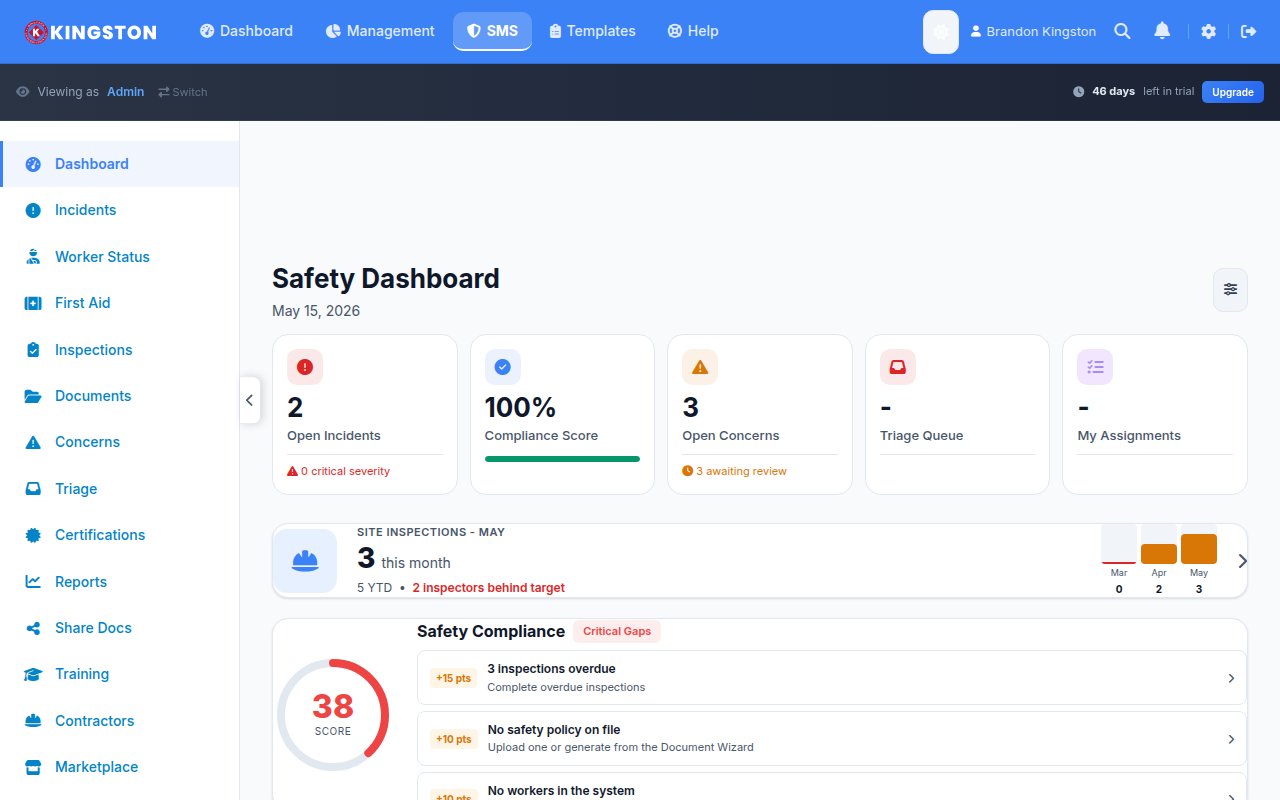
Make Safety Easy gives small contractors the same compliance infrastructure that big companies have, without the complexity or the price tag:
- Digital inspections with templates you can customize for your trade
- Toolbox talk tracking with QR code sign-off and attendance records
- Incident reporting with investigation workflows and corrective action tracking
- First aid logs linked to incident records
- Certification tracking with expiry alerts so you never have an expired ticket on site
- Audit-ready reports generated in seconds, not hours
Related Resources
Go Digital with Make Safety Easy
Replace paper checklists with one platform your whole team can use.