Trucking safety management is the systematic process of identifying hazards, training drivers and maintaining vehicles to prevent accidents across commercial fleet operations. With over 5,000 fatal crashes involving large trucks reported annually by the National Highway Traffic Safety Administration (NHTSA), a structured trucking safety program is not optional - it is a legal and moral requirement for every carrier and owner-operator in North America.
Whether you manage a fleet of five vehicles or five hundred, the principles of DOT safety compliance remain the same. This guide walks you through the essential components of a trucking safety management system, from pre-trip inspections to post-incident reporting, so your operation stays compliant and your drivers stay safe.
Why Trucking Safety Management Matters
The trucking industry is the economic engine of North America. According to the American Trucking Associations, trucks move roughly 72% of all freight tonnage in the United States alone. That volume of activity means enormous exposure to risk - and enormous consequences when safety systems fail.
Free Download: 5 Safe Work Procedures
Choose from 112 professionally written SWPs. No credit card required.
Get Free SWPsEffective trucking safety management reduces the frequency and severity of crashes, lowers insurance premiums and protects your operating authority. Carriers with poor safety records face higher Compliance, Safety, Accountability (CSA) scores, which can trigger DOT interventions, audits and even out-of-service orders that halt operations entirely.
Beyond regulatory pressure, the financial cost of a single serious truck accident can exceed $1 million when factoring in medical expenses, legal fees, cargo damage and lost productivity. Prevention is always cheaper than response.
Core Components of a Trucking Safety Program
Driver Qualification and Hiring
Your safety program begins before a driver ever turns a key. Federal Motor Carrier Safety Administration (FMCSA) regulations require carriers to maintain a Driver Qualification (DQ) file for every commercial motor vehicle operator. This file must include a valid CDL, medical examiner's certificate, motor vehicle record (MVR) and employment history verification.
Best practices go beyond the regulatory minimum. Screen for previous safety violations using the FMCSA Pre-Employment Screening Program (PSP). Conduct thorough road tests and verify that drivers understand your company-specific policies before assigning them to routes.
Vehicle Inspections and Maintenance
The Federal Motor Carrier Safety Regulations (FMCSRs) require drivers to perform pre-trip and post-trip inspections on every vehicle before and after each trip. These inspections must cover brakes, tires, lights, mirrors, coupling devices and emergency equipment.
Paper-based inspection logs are prone to errors, omissions and loss. Digital inspection platforms allow drivers to complete thorough checks on a mobile device, attach photos of defects and automatically route reports to maintenance teams for corrective action. This creates an auditable trail that proves compliance during DOT audits.
Preventive maintenance schedules should follow manufacturer recommendations at a minimum. Track oil changes, brake adjustments, tire rotations and DOT annual inspections in a centralized system so nothing falls through the cracks.
Hours of Service (HOS) Compliance
Driver fatigue is a leading factor in trucking accidents. FMCSA Hours of Service regulations limit driving time to 11 hours after 10 consecutive hours off duty, with a 14-hour on-duty window. The electronic logging device (ELD) mandate requires most carriers to track HOS electronically.
Your safety management system should monitor HOS compliance proactively - not just reactively. Flag drivers who are approaching their limits and build schedules that account for realistic driving times, loading delays and weather conditions.
DOT Safety Compliance: The Regulatory Framework
DOT safety compliance encompasses a broad set of federal regulations that apply to commercial motor vehicles operating in interstate commerce. Key regulatory areas include:
- 49 CFR Part 382: Drug and alcohol testing requirements, including pre-employment, random, post-accident and reasonable suspicion testing
- 49 CFR Part 391: Driver qualification standards covering age, medical fitness and driving record requirements
- 49 CFR Part 392: Driving rules addressing distracted driving, seat belt use and safe vehicle operation
- 49 CFR Part 393: Equipment standards for brakes, lighting, tires and load securement
- 49 CFR Part 395: Hours of Service regulations and ELD requirements
- 49 CFR Part 396: Inspection, repair and maintenance standards
State-level regulations may impose additional requirements, particularly in Canadian provinces where National Safety Code standards apply. Carriers operating cross-border routes must comply with both U.S. and Canadian regulatory frameworks.
Building a Safety Culture in Your Fleet
Driver Training and Ongoing Education
Initial training is just the starting point. Effective trucking safety programs include regular refresher training on defensive driving, cargo securement, hazardous materials handling and seasonal driving techniques. Winter driving in northern climates and mountain driving in western regions present unique hazards that demand specialized skills.
Toolbox talks - short, focused safety discussions - are an excellent way to reinforce key topics without pulling drivers off the road for extended periods. Topics might include backing safety, intersection awareness, following distance and distracted driving prevention.
Incident Reporting and Investigation
Every incident, near-miss and unsafe condition must be reported and investigated. A robust incident reporting system captures the details while they are fresh - location, conditions, contributing factors and witness statements.
Investigation should focus on root causes rather than blame. If a driver rear-ended another vehicle, was it because of fatigue, distraction, inadequate following distance or a brake defect? Each root cause leads to a different corrective action. Without proper investigation, the same incidents repeat.
Safety Metrics and KPIs
What gets measured gets managed. Track these key performance indicators to evaluate your trucking safety program:
- Recordable crash rate: Number of DOT-recordable crashes per million miles driven
- Out-of-service rate: Percentage of vehicles or drivers placed out of service during roadside inspections
- CSA BASIC scores: Monitor all seven Behavior Analysis and Safety Improvement Categories
- Inspection completion rate: Percentage of required pre-trip inspections completed on time
- Training compliance rate: Percentage of drivers current on required training modules
Review these metrics monthly at minimum. Share results with drivers and managers to create accountability and transparency across the organization.
Technology in Trucking Safety Management
Modern trucking safety management relies heavily on technology. Dashcams with AI-powered event detection can identify risky behaviors like hard braking, lane departure and following too closely. Telematics systems provide real-time data on speed, location and driving patterns.
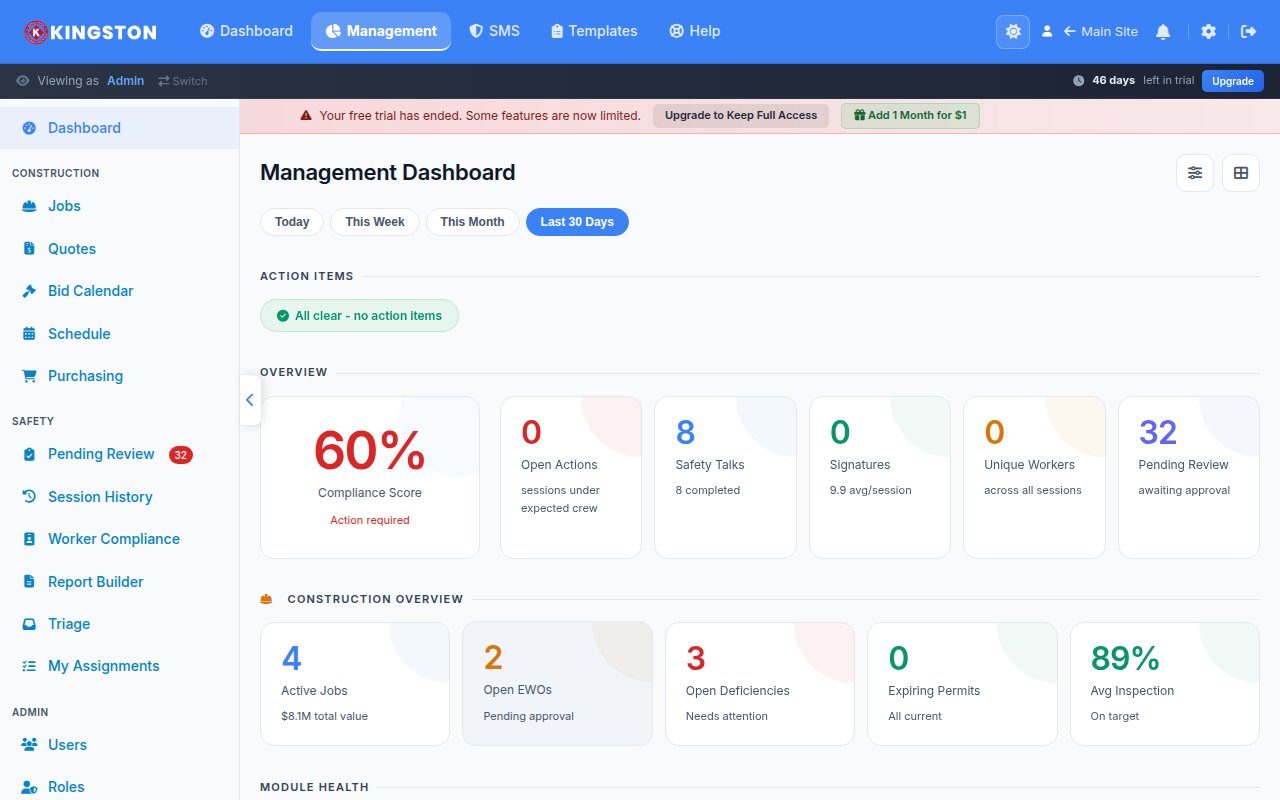
However, the most impactful technology investment for many fleets is a centralized safety management platform. Rather than juggling spreadsheets, paper forms and disconnected apps, a single platform can handle vehicle inspections, incident reports, training records and compliance documentation in one place.
This consolidation saves administrative time, reduces errors and makes it dramatically easier to demonstrate compliance during audits. When a DOT auditor asks for your inspection records from the past six months, you can produce them in seconds rather than days.
Common Trucking Safety Violations and How to Avoid Them
FMCSA data consistently shows the same violations appearing at the top of roadside inspection reports:
- Brake system defects: The most common out-of-service violation. Implement regular brake inspections and adjust or replace components before they reach failure thresholds.
- Hours of Service violations: Ensure drivers understand the rules and use ELDs correctly. Monitor logs for patterns that suggest falsification.
- Tire and wheel defects: Check tread depth, inflation pressure and lug nut torque during every pre-trip inspection.
- Lighting defects: Replace burned-out bulbs immediately. Carry spares on every vehicle.
- Load securement failures: Train drivers on proper tie-down methods and inspect cargo at every stop.
Addressing these five areas alone can dramatically improve your roadside inspection pass rate and lower your CSA scores.
Emergency Preparedness for Trucking Operations
Every truck should carry an emergency kit that includes reflective triangles, a fire extinguisher, first aid supplies and spill containment materials for hazmat loads. Drivers should know how to respond to breakdowns, accidents, cargo spills and medical emergencies on the road.
Develop written emergency response procedures and review them during training sessions. Include contact numbers for dispatch, emergency services, hazmat response teams and insurance carriers. Quick response minimizes secondary damage and protects both the driver and the public.
Get Started with Digital Trucking Safety Management
Managing trucking safety with paper forms and spreadsheets is a liability waiting to happen. A digital safety management platform streamlines inspections, automates compliance tracking and gives you real-time visibility into your fleet's safety performance.
Make Safety Easy provides the tools trucking companies need to build and maintain a best-in-class safety program. From mobile inspection checklists to automated incident reporting workflows, every feature is designed to reduce risk and simplify compliance.
Ready to modernize your fleet's safety program? Book a demo to see how Make Safety Easy can help your trucking operation stay DOT-compliant and protect your drivers on every mile. Or explore our pricing plans to find the right fit for your fleet size.
Ready to simplify your safety program?
Make Safety Easy helps teams run toolbox talks, inspections, incident reports and more - all from one platform.
Start Your Free TrialNo credit card required. 14-day free trial.