A warehouse safety program needs seven core pillars to protect Canadian workers and satisfy provincial regulators: forklift operating procedures, racking inspection protocols, loading dock hazard controls, slip/trip/fall prevention, fire safety planning, ergonomic risk assessments and full WHMIS compliance. Miss even one and you are gambling with worker lives - and inviting costly compliance orders from bodies like Ontario's MOL or Alberta OHS. This guide walks you through each pillar, hands you actionable checklists and shows you how to tie everything together into a warehouse safety management system that actually works on the ground floor.
Why Warehouse Safety Management Matters in Canada
Canadian warehouses are growing fast. E-commerce demand, third-party logistics expansion and reshoring trends have pushed warehouse square footage to record levels across Ontario, British Columbia, Alberta and Quebec. More space means more workers. More workers means more exposure to hazards that have plagued this industry for decades.
The numbers tell a blunt story. Workplace injuries in the transportation and warehousing sector consistently rank among the highest across all Canadian industries, according to the Association of Workers' Compensation Boards of Canada (AWCBC). Musculoskeletal injuries, struck-by incidents and falls account for the majority of lost-time claims.
Free Download: 5 Safe Work Procedures
Choose from 112 professionally written SWPs. No credit card required.
Get Free SWPsHere is the part that should keep every operations manager awake: provincial regulators are tightening enforcement. Ontario's Bill 190 amendments, Alberta's updated OHS Code and BC WorkSafeBC's targeted warehouse audit campaigns all signal a shift toward proactive inspection and steeper penalties. A reactive approach - fixing things after someone gets hurt - is no longer a viable strategy.
Effective warehouse safety management is not a binder on a shelf. It is a living system of regular inspections, documented training, hazard assessments and incident follow-up that runs every single shift.
Forklift Safety: The Biggest Risk on Your Floor
Forklifts are the workhorses of warehouse operations. They are also responsible for some of the most severe injuries and fatalities in Canadian workplaces. A loaded counterbalance forklift can weigh over 4,000 kg. At walking speed, that is enough force to crush a person against a racking upright in under a second.
Critical Forklift Safety Requirements
- Operator certification: Every province requires documented forklift training. CSA standard B335 outlines competency requirements. Training must be equipment-specific - a reach truck licence does not cover an order picker.
- Pre-shift inspections: Operators must complete a circle check before every shift. Brakes, steering, mast chains, hydraulic lines, horn, lights and seat belt all get checked. No exceptions.
- Pedestrian separation: Floor markings, barriers, mirrors at blind intersections and designated pedestrian walkways are not optional - they are regulatory expectations.
- Speed limits and traffic rules: Post speed limits. Enforce them. Establish right-of-way rules at intersections and near dock doors.
- Load management: Overloaded or improperly stacked loads are a leading cause of tip-overs. Ensure load charts are posted on every truck.
Digitizing your pre-shift forklift inspections eliminates the paper trail problem. When an operator flags a defective brake on a tablet, the maintenance team gets notified instantly. No more crumpled checklists stuffed in a glovebox. Explore how digital inspection tools work.
Racking Inspections: Preventing Catastrophic Collapse
A racking collapse is one of the most violent events that can occur in a warehouse. Thousands of kilograms of product, steel and debris cascading across a work floor - the results are devastating and sometimes fatal.
Canadian standards are clear. CSA A344 and the Rack Manufacturers Institute (RMI) guidelines establish that pallet racking must be inspected regularly by competent persons, with an expert-level inspection conducted at least annually.
What to Look for During Racking Inspections
- Upright damage: Any visible dent, twist, or deformation in a column requires immediate assessment. Do not load the bay until an engineer clears it or the upright is replaced.
- Beam deflection: Beams bowing under load indicate overloading or material fatigue.
- Missing or disengaged safety clips: Every beam connector needs its locking pin. Period.
- Anchor bolt integrity: Base plates must be bolted to the floor. Loose or missing anchors compromise the entire structure.
- Load capacity signage: Every rack section must display its rated capacity. If the sign is missing, the rack is technically non-compliant.
- Column protectors: High-traffic aisles need guards to absorb forklift impacts before they reach the structural steel.
A traffic-light colour coding system (green, amber, red) helps warehouse teams prioritize racking damage during walk-through inspections. Green means monitor. Amber means restrict loading and schedule repair. Red means evacuate the area and barricade immediately.
Loading Dock Hazards and Controls
Loading docks are transition zones - and transition zones breed hazards. The gap between truck bed and dock floor. The height difference. The weather exposure. The time pressure to turn trailers around fast. All of it conspires against worker safety.
Key Dock Safety Controls
- Dock levellers and lip maintenance: A malfunctioning dock leveller can drop under a loaded forklift. Inspect hydraulics, springs and lip hinges regularly.
- Wheel chocks and trailer restraints: Trailer creep - where a truck slowly rolls away from the dock during loading - has caused fatal falls. Mechanical restraints are the gold standard; wheel chocks are the minimum.
- Dock lighting: Interior trailer lighting and dock-area illumination reduce struck-by and trip hazards.
- Communication protocols: The driver should never move the truck until the warehouse confirms loading is complete. Use a red light/green light system or physical lock-out.
- Weather controls: In Canadian winters, ice buildup on dock approaches is a serious slip hazard. Heated dock aprons, salt/sand stations and drainage management are essential.
When a near-miss occurs at the dock - a forklift tipping off a leveller edge, a trailer pulling away early - that event must be captured and investigated. Near-misses are free warnings. Ignore them and the next one might not be "near" anything. Set up near-miss reporting in your warehouse.
Slip, Trip and Fall Prevention
Falls remain the single most common cause of workplace injury in Canadian warehouses. Not dramatic falls from height (though those happen too) - routine slips on wet floors, trips over shrink wrap left on the ground and stumbles on uneven surfaces. These mundane incidents account for a staggering volume of lost-time injuries every year.
A Practical Prevention Approach
- Housekeeping standards: Define what "clean floor" means for each zone. Broken pallets, loose banding, shrink wrap scraps and spilled product must be cleared immediately - not "when we get a chance."
- Floor condition monitoring: Cracks, heaved concrete, damaged expansion joints and worn-out epoxy coatings create trip hazards. Map and repair them.
- Wet floor protocols: Roof leaks, condensation (especially in cold storage transitions), and liquid spills require immediate signage and cleanup.
- Footwear requirements: Specify slip-resistant, CSA-approved safety footwear. Enforce it.
- Fall protection for elevated work: Workers on mezzanines, elevated platforms, or using ladders need guardrails, harnesses, or both - depending on the height and provincial regulation.
Short, focused safety talks at shift start are one of the most effective ways to keep slip/trip/fall awareness front and centre. Five minutes. One topic. Every shift. That consistency builds the culture that prevents injuries. Browse ready-made toolbox talks for warehouse teams.
Fire Safety in Warehouse Environments
Warehouses are fire-prone by nature. Large open volumes, combustible packaging materials, flammable liquids, lithium-ion battery charging stations and limited compartmentalization create conditions where a small ignition source can escalate into a catastrophic blaze within minutes.
Fire Safety Essentials
- Sprinkler system maintenance: In-rack sprinklers and ceiling-level systems must be inspected per NFPA 25 and provincial fire codes. Do not stack product above the sprinkler line - this is one of the most commonly cited fire code violations in warehouses.
- Clear egress paths: Exits must be unobstructed and clearly marked at all times. Product staged in front of exit doors is a regulatory violation and a life-safety risk.
- Hot work permits: Any cutting, welding, or grinding inside the warehouse requires a documented hot work permit with fire watch.
- Charging station safety: Electric forklift and lithium-ion battery charging areas need proper ventilation, spill containment and fire suppression appropriate to the battery chemistry.
- Emergency response drills: Conduct fire drills at least twice per year. Ensure all shifts participate - not just day shift.
Canadian warehouses storing hazardous materials face additional requirements under the National Fire Code of Canada and provincial equivalents. If you stock flammable liquids, oxidizers, or compressed gases, your fire safety plan needs to reflect those specific storage and separation requirements.
Ergonomics: Protecting Your Workers' Bodies
Musculoskeletal disorders (MSDs) are the leading cause of lost-time claims in Canadian warehousing. Repetitive lifting, awkward postures, forceful exertions and prolonged standing break bodies down over months and years. The injury does not happen in a single dramatic moment - it accumulates, silently, until a worker cannot get out of bed one morning.
Ergonomic Controls That Work
- Lift-assist equipment: Vacuum lifters, scissor lift tables and tilt tables reduce the load on spines. They also increase throughput - ergonomics and productivity are not in conflict.
- Work height optimization: Packing stations, scanning stations and sortation areas should be adjustable to accommodate different worker heights.
- Job rotation: Rotating workers through different physical tasks distributes strain across muscle groups and reduces repetitive motion injury risk.
- Weight limits: Establish maximum single-person lift weights. The widely referenced guideline is 23 kg under ideal conditions (NIOSH Lifting Equation), but real-world warehouse conditions are rarely ideal - adjust downward for frequency, distance and asymmetry.
- Anti-fatigue matting: Standing on concrete for an 8- or 12-hour shift causes measurable circulatory and musculoskeletal harm. Anti-fatigue mats at fixed workstations are a low-cost, high-impact intervention.
Ergonomic risk assessments should be built into your regular workplace inspection program - not treated as a separate, infrequent exercise.
WHMIS Compliance in Warehouses
The Workplace Hazardous Materials Information System applies to every Canadian workplace that stores, handles, or transports hazardous products. Warehouses often handle hundreds of SKUs with hazardous classifications - cleaning chemicals, adhesives, solvents, aerosols, battery acid - and WHMIS compliance can slip through the cracks when product variety is high and turnover is fast.
WHMIS Requirements for Warehouse Operations
- Safety Data Sheets (SDS): An SDS must be available for every hazardous product on site. "Available" means workers can access them within their work area - not locked in a supervisor's office. Digital SDS management systems solve the access problem.
- Supplier and workplace labels: Incoming hazardous products must have GHS-compliant supplier labels. If product is decanted, transferred, or if a label is damaged, a workplace label must be applied immediately.
- Worker training: WHMIS education (general principles) and site-specific training (specific products in your warehouse) are both required. Training must be refreshed when new hazardous products are introduced.
- Storage compatibility: Flammables, oxidizers, corrosives and toxics have specific segregation requirements. Storing incompatible chemicals together is a fire, explosion, or toxic release waiting to happen.
- Spill response: Spill kits appropriate to the hazardous materials on site must be accessible, stocked and workers must know how to use them.
WHMIS training is a natural fit for regular safety talks. A five-minute refresher on reading an SDS, or on the pictograms for a new product arriving next week, keeps the knowledge fresh without pulling workers off the floor for hours. See toolbox talk templates for WHMIS topics.
Your Warehouse Safety Checklist
Use this checklist as a starting point for your warehouse safety management program. Adapt it to your specific operations, products and provincial requirements.
Daily Checks
- Forklift pre-shift circle checks completed and documented
- Floor housekeeping - clear of debris, spills and obstructions
- Dock levellers and restraints functional
- Emergency exits unobstructed
- PPE compliance spot check
Weekly Checks
- Racking walk-through inspection (traffic-light system)
- Fire extinguisher visual inspection
- Spill kit inventory verification
- Ergonomic concern follow-up from worker reports
- Toolbox talk delivered and documented
Monthly Checks
- Comprehensive facility inspection covering all zones
- Emergency lighting and alarm test
- SDS inventory reconciliation
- Near-miss and incident trend review
- Training compliance audit
Annual Checks
- Expert racking inspection per CSA A344
- Fire suppression system inspection per NFPA 25
- Full WHMIS training refresh
- Forklift operator competency re-evaluation
- Ergonomic risk assessment update
- Emergency response drill (minimum twice per year)
Paper checklists get lost, skipped and fudged. A digital inspection platform keeps every check timestamped, photo-documented and tied to corrective actions that actually get closed. See how Make Safety Easy handles warehouse inspections.
Building a Warehouse Safety Program That Sticks
The hardest part of warehouse safety management is not knowing what to do. It is getting it done - consistently, across every shift, every dock, every aisle - when production pressure is relentless and turnover keeps bringing in new faces.
Here is what separates warehouses with strong safety records from those that lurch from incident to incident:
1. Leadership Visibility
When supervisors and managers walk the floor, participate in inspections and visibly act on hazard reports, workers understand that safety is not a poster on the wall. It is a genuine operational priority. This does not require grand gestures. It requires showing up.
2. Worker Participation
The people closest to the hazards know the most about them. Joint health and safety committees (JHSCs) are legally required in most Canadian provinces for workplaces over a certain size. But beyond the legal minimum, actively soliciting worker input on hazard identification and control selection produces better outcomes than top-down mandates.
3. Streamlined Reporting
If reporting a hazard takes 15 minutes and three forms, workers will not report hazards. Full stop. The reporting process must be fast, accessible (mobile-friendly), and must result in visible action. Make incident and hazard reporting effortless for your team.
4. Consistent Training
Orientation-day training fades fast. Ongoing, bite-sized reinforcement - toolbox talks, safety moments, quick refreshers tied to actual incidents or near-misses from your own warehouse - keeps knowledge alive. Deliver consistent safety training with toolbox talks.
5. Data-Driven Decisions
Track your leading indicators (inspections completed, hazards reported, training participation) alongside your lagging indicators (incidents, lost-time injuries, compliance orders). When you can see trends forming - a spike in near-misses at Dock 3, recurring ergonomic complaints in the pick module - you can intervene before someone gets hurt.
6. Technology That Removes Friction
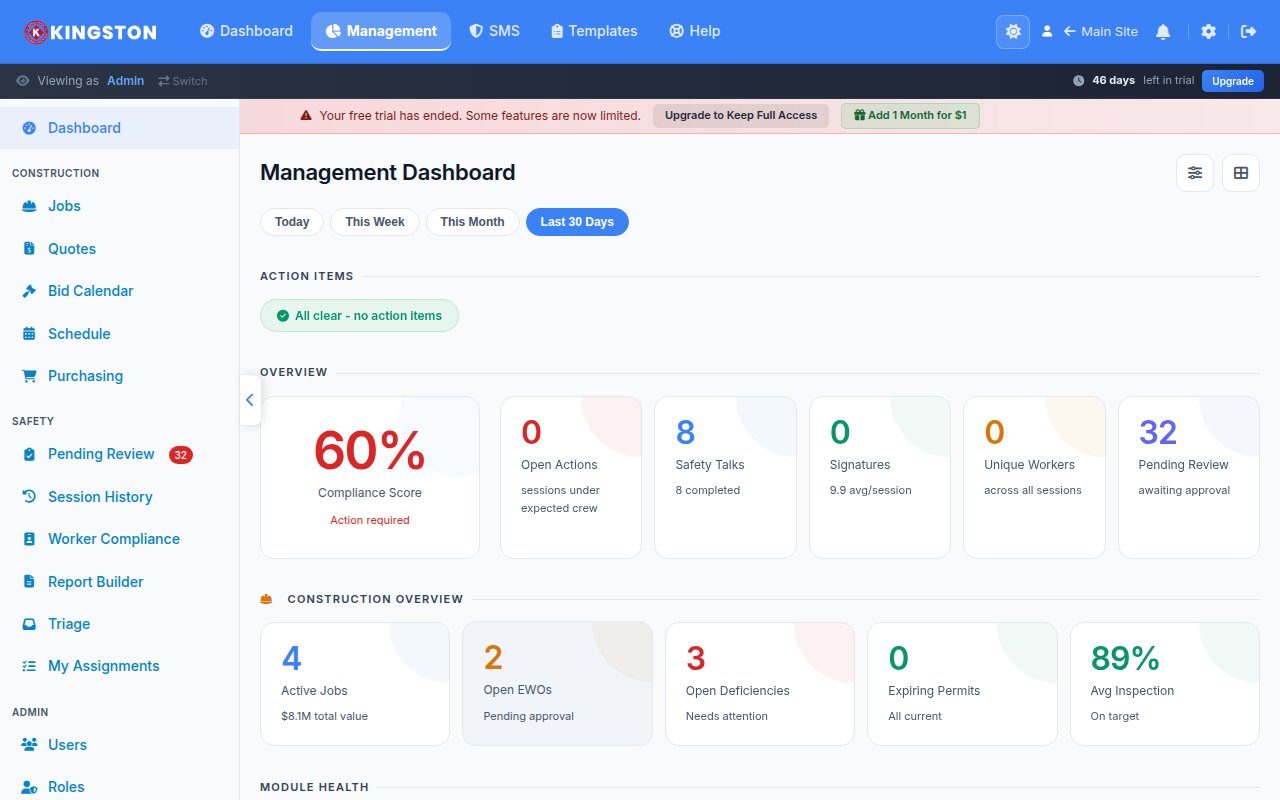
Safety management software does not replace safety culture. But it removes the administrative friction that kills good intentions. Digital inspections, automated corrective action tracking, centralized training records and real-time dashboards transform warehouse safety management from a paperwork exercise into an operational system.
Ready to simplify your safety program?
Make Safety Easy helps teams run toolbox talks, inspections, incident reports and more - all from one platform.
Start Your Free TrialNo credit card required. 14-day free trial.