Ergonomics in the Workplace: Preventing Musculoskeletal Injuries
Musculoskeletal disorders (MSDs) are the single largest category of workplace injury in North America, accounting for nearly 30% of all injuries requiring days away from work according to the U.S. Bureau of Labor Statistics. These injuries - sprains, strains, tears and repetitive motion disorders affecting muscles, tendons, ligaments and nerves - cost U.S. employers an estimated $20 billion per year in direct workers' compensation costs alone. Indirect costs (lost productivity, overtime, retraining) push the real figure far higher. A structured workplace ergonomics program that includes ergonomic assessments, targeted controls and ongoing monitoring is the most effective way to prevent MSDs - and it pays for itself many times over.
What Are Musculoskeletal Disorders?
MSDs are injuries or disorders of the muscles, nerves, tendons, joints, cartilage and spinal discs caused or aggravated by workplace risk factors. The most common include:
- Lower back injuries: The most frequently reported MSD, responsible for more lost workdays than any other single injury type.
- Carpal tunnel syndrome: Compression of the median nerve in the wrist, common in assembly, data entry and manufacturing tasks.
- Rotator cuff injuries: Shoulder tendon damage from repetitive overhead work.
- Tendinitis and epicondylitis (tennis/golfer's elbow): Tendon inflammation from repetitive gripping, twisting, or forceful motions.
- Herniated discs: Spinal injuries from heavy lifting, prolonged sitting, or vibration exposure.
MSDs develop over time. That is what makes them both insidious and preventable - the risk factors are identifiable before the injury occurs, but only if someone is looking for them.
Free Download: 5 Safe Work Procedures
Choose from 112 professionally written SWPs. No credit card required.
Get Free SWPsErgonomic Risk Factors
Ergonomic research has identified consistent risk factors that increase the probability of MSDs. The primary ones are:
- Repetition: Performing the same motion or series of motions continuously or frequently throughout a shift.
- Forceful exertion: Lifting, pushing, pulling, or gripping with excessive force.
- Awkward posture: Working with joints outside their neutral position - reaching overhead, bending at the waist, twisting the torso, or flexing the wrists.
- Static posture: Holding a fixed position for extended periods, including prolonged sitting or standing.
- Contact stress: Pressing a body part (hands, forearms, thighs) against a hard or sharp surface.
- Vibration: Whole-body vibration from vehicles or hand-arm vibration from power tools.
- Environmental factors: Cold temperatures reduce blood flow and increase injury risk during manual tasks.
When multiple risk factors combine - say, repetitive forceful gripping in an awkward posture - the probability of injury escalates dramatically. An effective ergonomic assessment identifies these combinations.
Regulatory Landscape: What Employers Must Do
United States: OSHA does not have a standalone ergonomics standard (the 2000 Ergonomics Program Standard was repealed in 2001). However, OSHA enforces ergonomic hazards under the General Duty Clause (Section 5(a)(1)) and has issued numerous citations for MSD hazards in meatpacking, warehousing, manufacturing and healthcare. OSHA's Ergonomics Guidelines for specific industries - including nursing homes, poultry processing and shipyards - outline recommended practices that function as de facto expectations during inspections.
Canada: Several provinces have explicit ergonomic requirements. British Columbia's WorkSafeBC Ergonomics (MSI) Requirements (Part 4, Division 7) mandate that employers identify and assess MSD risk factors and implement controls. Ontario's Industrial Establishments Regulation (O. Reg. 851) addresses material handling limits. Saskatchewan and Manitoba have similar provisions.
International: The EU's Manual Handling Directive (90/269/EEC) and Display Screen Equipment Directive (90/270/EEC) establish binding ergonomic requirements. ISO 11228 (parts 1-3) covers lifting, pushing/pulling and repetitive handling. Australia's WHS Code of Practice for Hazardous Manual Tasks is among the most comprehensive ergonomic frameworks globally.
How to Conduct an Ergonomic Assessment
An ergonomic assessment systematically evaluates jobs, tasks and workstations to identify MSD risk factors. Here is a practical approach that works across industries:
Step 1: Identify High-Risk Jobs
Start with data. Review your OSHA 300 logs, workers' compensation claims, and incident reports to identify jobs with the highest MSD rates. Common high-risk roles include:
- Assembly line workers
- Warehouse order pickers
- Healthcare workers (patient handling)
- Construction laborers
- Office/computer workers with prolonged screen time
- Commercial drivers
Step 2: Analyze Task Demands
Observe workers performing the task. Document the specific motions, forces, postures and durations involved. Standardized tools make this process objective and repeatable:
- NIOSH Lifting Equation: Calculates a recommended weight limit for manual lifting tasks based on six variables (horizontal distance, vertical height, asymmetry, frequency, coupling and travel distance).
- RULA (Rapid Upper Limb Assessment): Scores upper-body posture risk on a scale of 1-7. Scores above 5 indicate immediate intervention is needed.
- REBA (Rapid Entire Body Assessment): Evaluates whole-body posture, force and repetition. Useful for dynamic tasks common in manufacturing and construction.
- Strain Index: Quantifies risk for distal upper extremity disorders based on intensity of exertion, duration, frequency, posture and speed.
Step 3: Implement Controls Using the Hierarchy
As with any hazard, the hierarchy of controls applies:
- Elimination: Can the task be eliminated entirely through process redesign? Example: automating a palletizing task that required repetitive heavy lifting.
- Substitution: Replace heavy components with lighter materials. Use powered tools instead of manual ones.
- Engineering controls: Adjustable-height workstations, anti-fatigue mats, ergonomic tool handles, lift-assist devices, patient lift equipment in healthcare and conveyor systems in warehouses.
- Administrative controls: Job rotation to reduce repetitive strain exposure, mandatory micro-breaks, workload distribution adjustments and stretching programs.
- PPE: Anti-vibration gloves, knee pads and wrist supports. These address symptoms more than root causes and should be the last resort, not the first response.
Step 4: Monitor and Adjust
Ergonomic interventions must be tracked over time to confirm they are working. Monitor MSD incident rates, discomfort survey results and workers' compensation claims after implementing changes. Regular workplace inspections that include ergonomic observation questions catch new risk factors before they produce injuries.
Ergonomics by Industry
Office Environments
Despite the perception of "low-risk" work, office environments generate significant MSD claims - primarily from prolonged computer use. Key interventions include:
- Monitors positioned at eye level, an arm's length away
- Chairs with adjustable lumbar support, seat height and armrests
- Keyboard and mouse positioned to maintain neutral wrist posture
- Sit-stand desks to break up prolonged static posture
- The 20-20-20 rule for eye strain: every 20 minutes, look at something 20 feet away for 20 seconds
Manufacturing and Warehousing
These environments combine heavy lifting, repetitive motion and awkward postures - the highest-risk combination for MSDs. The manufacturing sector benefits most from:
- Adjustable-height work surfaces to eliminate bending
- Lift-assist devices and vacuum lifters for loads above the NIOSH action limit
- Powered pallet jacks replacing manual ones
- Job rotation schedules that alternate high-exertion and low-exertion tasks
- Tool balancers and articulating arms for powered tools
Healthcare
Patient handling is the leading cause of MSDs in healthcare. Safe patient handling programs using mechanical lifts, slide sheets and transfer boards have been shown to reduce nursing injury rates by 40-60% in published studies. Several U.S. states (including California, New York and Washington) have enacted safe patient handling legislation.
Construction
Construction ergonomics is often overlooked in favor of "acute" hazards like falls and electrocution, but MSDs account for a substantial portion of construction injuries. Key interventions include lightweight power tools, raised material platforms to reduce bending and tool lanyards that eliminate repeated bending to retrieve dropped tools.
Building the Business Case for Ergonomics
Ergonomic interventions consistently deliver a positive return on investment. Research published in the Journal of Occupational and Environmental Medicine has documented ROI ratios ranging from 3:1 to 15:1 for ergonomic programs. The savings come from multiple sources:
- Reduced workers' compensation claims and premiums
- Fewer lost workdays and restricted-duty assignments
- Lower turnover (MSD-heavy jobs have higher quit rates)
- Increased productivity (workers who aren't in pain work faster and make fewer errors)
Track, Measure and Improve With Make Safety Easy
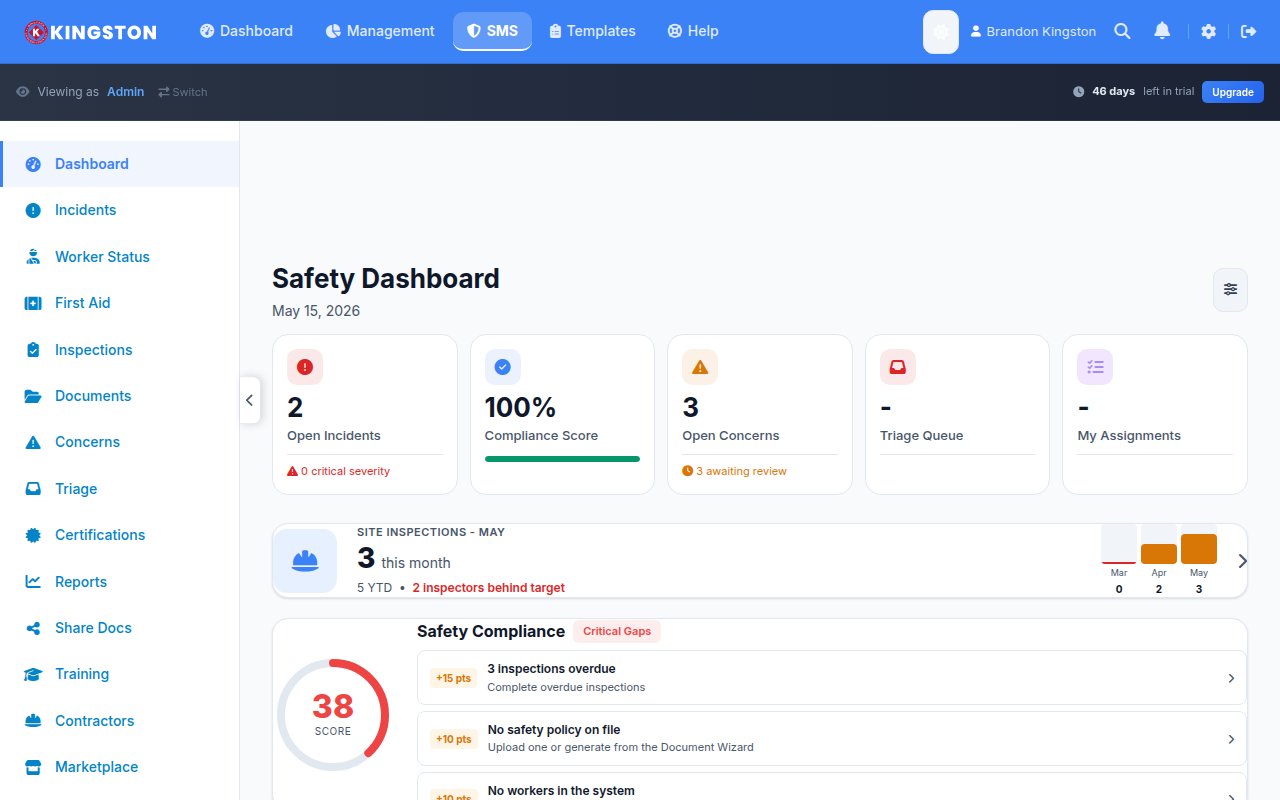
An ergonomics program is only as strong as its monitoring system. Make Safety Easy gives you the tools to track MSD-related incident reports, run ergonomic inspection checklists on mobile devices and analyze trends across teams, sites and time periods. For manufacturing and warehousing operations, that visibility is the difference between reacting to injuries and preventing them.
Musculoskeletal injuries are predictable - and preventable. Request a demo to see how Make Safety Easy can power your ergonomics program, or view pricing to get started.
Ready to simplify your safety program?
Make Safety Easy helps teams run toolbox talks, inspections, incident reports and more - all from one platform.
Start Your Free TrialNo credit card required. 14-day free trial.