What Is Workplace Safety Culture - And Why Do Most Organizations Get It Wrong?
A workplace safety culture is the collection of shared beliefs, values, attitudes and behaviors that determine how safety is prioritized in every decision an organization makes - from the boardroom to the shop floor. It's not a policy binder collecting dust in HR. It's not a slogan printed on hard hats. A real safety culture exists when every worker, at every level, genuinely believes that no task is so urgent it can't be done safely - and acts accordingly, even when nobody is watching.
Here's the problem: most companies think they have a safety culture. They point to their safety manual, their incident rates, their annual training budget. But culture isn't what you say. It's what you do when production deadlines collide with safety procedures. It's what happens when a new employee sees a veteran skip a lockout step and wonders whether to say something. It's the space between your stated values and your daily reality.
That gap is where injuries happen. And closing it requires something far more deliberate than most organizations realize.
Free Download: 5 Safe Work Procedures
Choose from 112 professionally written SWPs. No credit card required.
Get Free SWPsThe Four Stages of Safety Culture Maturity
Safety culture doesn't materialize overnight. Research from the Hudson Safety Culture Ladder and the DuPont Bradley Curve consistently shows that organizations progress through predictable stages. Understanding where you sit is the first step toward moving forward.
Stage 1: Reactive (Instinctive)
Safety is addressed only after incidents occur. There's minimal reporting, investigations are blame-focused and the prevailing attitude is "accidents happen." Management views safety as a cost center. Workers see it as someone else's responsibility. If your organization scrambles to respond every time something goes wrong but rarely takes proactive steps, you're here.
Stage 2: Dependent (Supervised)
Safety exists because of rules and enforcement. Compliance is driven by supervisors, inspections and the threat of consequences. Incident rates may improve, but only because people follow the rules when being watched. The moment oversight disappears - night shifts, remote sites, skeleton crews - so does compliance. Most organizations plateau at this stage and mistake compliance for culture.
Stage 3: Independent (Self-Motivated)
Individual workers take personal responsibility for their own safety. They wear PPE because they understand the risk, not because a supervisor is nearby. They participate in toolbox talks because they see the value, not because attendance is mandatory. This is significant progress, but it has a ceiling: individuals protecting themselves doesn't guarantee they'll protect each other.
Stage 4: Interdependent (Team-Driven)
This is where true safety culture lives. Workers look out for each other. They intervene when they see unsafe acts - not to enforce rules, but because they genuinely care about their coworkers' wellbeing. Reporting hazards and near misses is viewed as a contribution, not a complaint. Leadership is visible and engaged. Safety isn't a separate program; it's woven into every operational decision. Very few organizations reach this stage. Those that do typically see incident rates 60-90% lower than industry averages.
Why Safety Culture Fails: The 7 Root Causes
Before building something new, you need to understand why previous efforts failed. These are the patterns that sabotage safety culture initiatives across industries, from construction sites to corporate offices.
- Leadership lip service. Executives endorse safety in speeches but cut safety budgets when margins tighten. Workers read actions, not memos. When production pressure overrides safety protocols and management looks the other way, every employee receives a clear message about actual priorities.
- Blame culture. If reporting a near miss leads to discipline, paperwork, or sideways glances from supervisors, reporting stops. It doesn't mean hazards disappear. It means they go underground until someone gets hurt.
- Training as a checkbox. Annual safety training that consists of watching outdated videos and signing a sheet does almost nothing to change behavior. Adults learn through relevance, repetition and practical application - not passive information dumps.
- Middle management squeeze. Frontline supervisors are often caught between executive safety directives and operational production targets. Without clear authority to stop work for safety concerns, they default to production. Every time.
- Measurement fixation on lagging indicators. Organizations that only track injury rates are measuring failure. By the time your TRIR spikes, the cultural breakdown happened months ago. Without leading indicators - inspection completion, near-miss reporting rates, training participation - you're flying blind.
- One-size-fits-all approach. A safety culture strategy designed at corporate headquarters rarely translates directly to a manufacturing floor, a remote drilling site, or a municipal road crew. Culture must be adapted to the specific risks, demographics and operational realities of each work group.
- Initiative fatigue. When safety "programs" launch with fanfare and fade within months, workers learn to wait them out. Real culture change requires sustained effort measured in years, not quarters.
The Framework: 8 Pillars of a Lasting Safety Culture
Building a safety culture that survives leadership changes, economic downturns and organizational restructuring requires a systematic approach. These eight pillars work together - remove one and the structure weakens.
Pillar 1: Visible Leadership Commitment
This is non-negotiable. If leadership doesn't visibly, consistently and authentically prioritize safety, nothing else on this list matters. "Visible" means more than signing off on safety policies. It means:
- Executives and senior managers regularly participating in safety walks, not as auditors but as engaged learners
- Safety performance being a standing agenda item in every leadership meeting - discussed first, not last
- Leaders personally recognizing workers who report hazards or stop unsafe work
- Budget allocation that matches stated priorities - adequate PPE, proper staffing, functional equipment
- Stopping production when safety concerns are raised, without hesitation or resentment
The single most powerful thing a leader can do for safety culture is admit their own mistakes. When a site superintendent says "I walked past that tripping hazard this morning without flagging it and that's on me," it gives every worker permission to be honest about their own lapses.
Pillar 2: Open and Non-Punitive Reporting
A robust incident reporting system is the circulatory system of your safety culture. It needs to capture near misses, hazard observations and safety suggestions - not just injuries. For every serious injury, there are roughly 300 near misses that preceded it. Those near misses are free lessons, but only if people report them.
Non-punitive doesn't mean zero accountability. Willful, repeated violations of known safety rules should still carry consequences. The distinction is between honest mistakes and reckless behavior. Workers can tell the difference and so should your reporting system.
Make reporting easy. If filing a hazard report takes 20 minutes of paperwork, people won't do it. Digital reporting tools that allow workers to snap a photo, describe the issue in plain language and submit in under a minute dramatically increase participation.
Pillar 3: Meaningful Employee Engagement
Safety culture cannot be imposed from the top down. It must be built from the middle out. Workers who perform tasks daily understand risks that engineers and managers never see from their offices. Engaging them means:
- Joint health and safety committees with genuine authority and resources, not advisory-only groups
- Worker involvement in hazard assessments, procedure development and incident investigations
- Regular toolbox talks that are interactive conversations, not one-way lectures
- Anonymous feedback channels for workers uncomfortable speaking up publicly
- Genuine follow-through on suggestions - nothing kills engagement faster than asking for input and ignoring it
Pillar 4: Competency-Based Training and Education
Training should be role-specific, hazard-specific and verified through demonstrated competency - not just attendance signatures. The most effective safety training programs share several characteristics:
- They use real incidents from the organization (anonymized) as case studies
- They include hands-on practice, not just classroom instruction
- They're delivered in the worker's primary language
- They're refreshed regularly - not just during onboarding
- They include verification that workers can actually perform the safe procedure, not just describe it
Consider the difference between telling a worker how to inspect a fall arrest harness and having them physically inspect one while you observe. The second approach takes more time. It also actually works.
Pillar 5: Consistent Standards and Accountability
Rules must apply equally to everyone. When a senior operator is allowed to skip pre-use inspections because "he's been doing this for 30 years," you've told every new hire that safety rules are optional for the experienced. Consistency doesn't mean rigidity - it means the same standard of care applies to the CEO walking the plant floor as to the first-day apprentice.
Accountability also means recognizing and rewarding safe behaviors, not just disciplining unsafe ones. Regular monthly safety reviews help identify trends, recognize contributions and keep safety performance visible across the organization.
Pillar 6: Systematic Hazard Identification and Control
A strong safety culture is supported by strong safety systems. Workers need to see that when they identify a hazard, the organization has a structured process for assessing it, prioritizing it, implementing controls and verifying effectiveness. Without that visible system, reporting feels pointless.
This means formal hazard assessments, a hierarchy of controls applied consistently, documented corrective actions with assigned owners and deadlines and follow-up verification that controls are working as intended.
Pillar 7: Effective Communication
Safety information must flow in all directions - top-down, bottom-up and laterally between departments and shifts. Information silos are hazard factories. Critical communication elements include:
- Pre-shift safety briefings that address specific hazards for that day's work
- Cross-shift communication protocols so that hazards identified on day shift are known to night shift
- Clear, accessible safety procedures written for the people who actually use them
- Regular sharing of lessons learned from incidents, near misses and industry events
- Transparent reporting of safety metrics to all employees - not just management
Pillar 8: Continuous Improvement Through Data
Safety culture isn't a destination. It's a discipline. Organizations that sustain strong safety cultures treat their safety management system as a living entity that requires constant feeding - with data, analysis and adaptation.
Track leading indicators: inspection completion rates, corrective action closure times, training compliance percentages, near-miss reporting volumes, safety suggestion implementation rates. Use that data not to punish but to identify system weaknesses and invest in fixes.
Practical Implementation: A 12-Month Roadmap
Theory is useful. Execution is what saves lives. Here's a realistic timeline for organizations starting from a reactive or dependent stage.
Months 1-3: Foundation
- Conduct a safety culture assessment - anonymous surveys, focus groups, observation of actual practices vs. written procedures
- Secure explicit, public leadership commitment with specific, measurable pledges
- Implement or upgrade your incident and near-miss reporting system to reduce friction
- Establish baseline metrics for leading indicators
- Identify and empower "safety champions" at every level - not just the safety department
Months 4-6: Building Momentum
- Launch regular, interactive toolbox talk sessions tied to site-specific hazards
- Begin leadership safety walks with structured observation checklists
- Revise investigation processes to focus on root causes and system failures, not individual blame
- Start publicly recognizing safety contributions - in team meetings, newsletters, notice boards
- Address the top 3 hazards identified in your assessment with visible corrective action
Months 7-9: Deepening Engagement
- Expand joint safety committees and give them real authority over safety decisions
- Implement peer-to-peer safety observation programs (voluntary, non-punitive)
- Upgrade training to competency-based formats with hands-on verification
- Begin tracking and reporting leading indicator trends to all employees
- Conduct mid-point safety culture re-assessment to measure progress
Months 10-12: Sustaining and Refining
- Conduct structured monthly safety reviews analyzing both leading and lagging data
- Refine programs based on what's working and what isn't - kill initiatives that aren't gaining traction and double down on those that are
- Integrate safety performance into operational planning, procurement and hiring decisions
- Plan year-two objectives with more ambitious targets
- Celebrate progress transparently - share improvements with the entire workforce
Measuring Safety Culture: Beyond Incident Rates
You can't manage what you don't measure, but measuring culture requires different tools than measuring compliance. Use a combination of quantitative and qualitative metrics.
| Metric Category | What to Track | Why It Matters |
|---|---|---|
| Reporting Volume | Near-miss reports per month, hazard observations submitted | Increasing reports = increasing trust, not increasing danger |
| Corrective Action Closure | Average time to close corrective actions | Slow closure signals that reports aren't taken seriously |
| Training Engagement | Completion rates, competency verification pass rates | Attendance without comprehension is wasted time |
| Leadership Visibility | Number of safety walks conducted by senior leaders per quarter | Leaders who show up signal that safety matters at the top |
| Employee Perception | Anonymous culture survey scores over time | The gap between policy and perception is where risk lives |
| Participation | Toolbox talk attendance, committee meeting participation | Voluntary participation is a direct measure of engagement |
Common Mistakes That Derail Safety Culture Initiatives
Even well-intentioned efforts fail when organizations fall into these traps. Knowing them in advance improves your odds significantly.
Rewarding zero injuries instead of safe behaviors. Incentive programs that reward teams for going injury-free create powerful motivation to underreport - the opposite of what you need. Reward leading activities: reporting, participation, hazard identification.
Delegating culture to the safety department. Safety professionals are essential advisors and facilitators. But culture is owned by line management. When safety is "the safety guy's job," everyone else checks out.
Treating culture change as a project with an end date. Projects have budgets, timelines and completion criteria. Culture change has none of these. It's ongoing, evolving and never finished. The moment you declare victory, regression begins.
Ignoring the informal culture. Every organization has a formal culture (what's written in policies) and an informal culture (what actually happens). The informal culture - break room conversations, how experienced workers train new hires, what gets laughed off vs. taken seriously - is the real culture. If you're only addressing the formal side, you're repainting a wall while the foundation cracks.
Technology's Role in Safety Culture
Technology doesn't create safety culture, but the right tools can accelerate it. Digital safety management platforms remove friction from the behaviors you want to encourage - reporting, inspecting, communicating, learning.
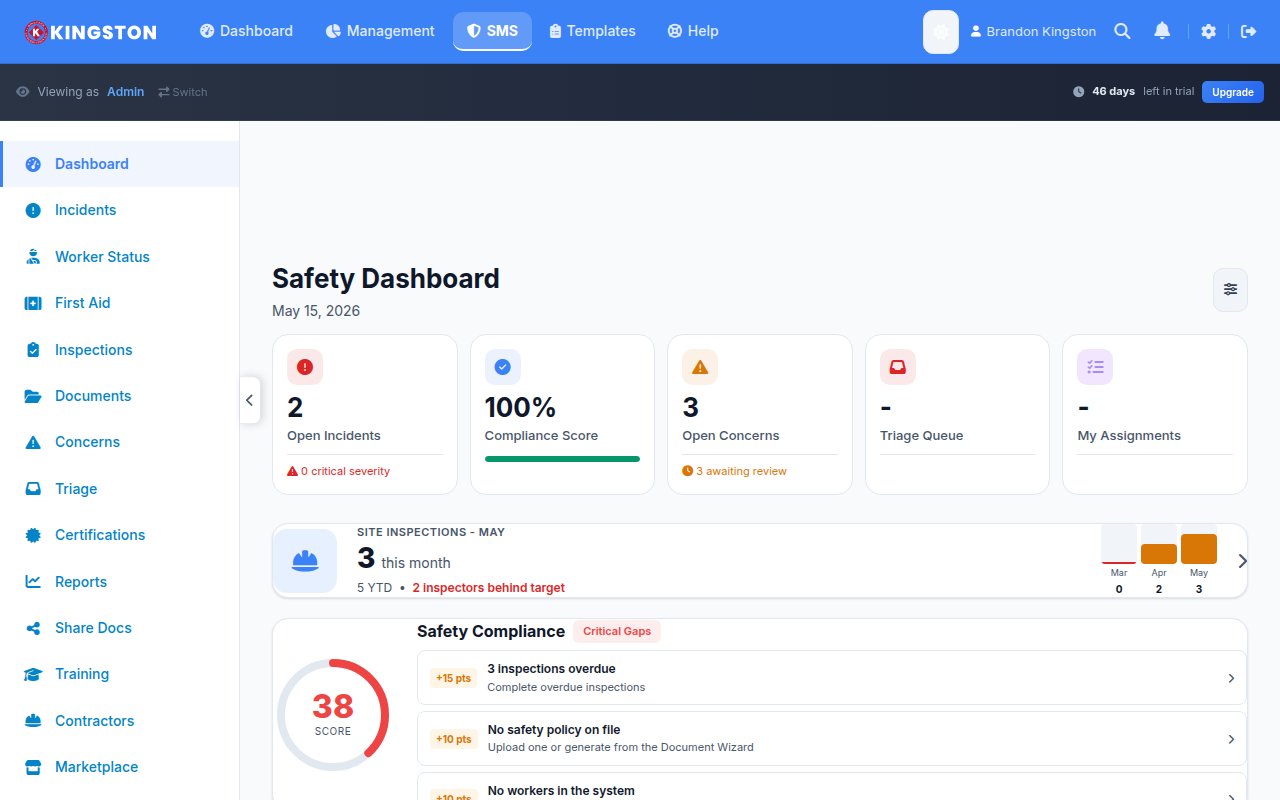
When a worker can submit a hazard report from their phone in 30 seconds, reporting goes up. When supervisors can schedule and track toolbox talks digitally, consistency improves. When leadership can see real-time dashboards of leading indicators, decisions get better. When incident investigations are structured and tracked, root causes get identified and corrective actions get closed.
The key is choosing tools that reduce administrative burden rather than adding to it. Safety software should make the right thing the easy thing.
Building a Safety Culture That Outlasts You
The ultimate test of a safety culture isn't how it performs when everything is going right. It's what happens during a leadership transition, an economic downturn, a pandemic, or a major organizational change. Cultures that are built on individual personalities collapse when those individuals leave. Cultures built on systems, shared values and embedded behaviors survive.
Start where you are. Be honest about your current state. Commit to the long game. And remember: every worker who goes home safe today is proof that the effort matters.
Ready to build the systems that support a lasting safety culture? Book a free demo to see how Make Safety Easy helps organizations move from compliance-driven safety to culture-driven safety - with digital toolbox talks, streamlined incident reporting and real-time safety dashboards. Or explore our pricing to find the right plan for your team.
Ready to simplify your safety program?
Make Safety Easy helps teams run toolbox talks, inspections, incident reports and more - all from one platform.
Start Your Free TrialNo credit card required. 14-day free trial.