A workplace safety program is a structured system of policies, procedures and practices designed to prevent injuries, illnesses and fatalities on the job. Whether you are launching a program from scratch or strengthening an existing one, the fundamentals remain the same: identify hazards, control risks, train workers and track outcomes. Organizations with effective safety programs see up to 40% fewer workplace injuries and significantly lower workers' compensation costs.
What Is a Workplace Safety Program?
At its core, a workplace safety program is your organization's formal commitment to keeping every employee safe. It encompasses written policies, hazard assessments, training protocols, inspection schedules and reporting systems that work together to minimize risk. Regulatory bodies like OSHA in the United States and provincial OHS authorities in Canada require employers to maintain these programs - but the real motivation goes far beyond compliance.
A well-designed program reduces downtime, lowers insurance premiums, boosts employee morale and protects your organization from costly litigation. It also signals to clients and partners that you take responsibility seriously.
Free Download: 5 Safe Work Procedures
Choose from 112 professionally written SWPs. No credit card required.
Get Free SWPsHow to Start a Safety Program: Step by Step
Step 1: Secure Leadership Commitment
No safety program succeeds without visible support from the top. Leadership must allocate budget, assign accountability and actively participate in safety initiatives. When executives walk job sites wearing PPE and attending safety meetings, it sends an unmistakable message: safety is not optional.
Document this commitment in a written safety policy statement. Include the organization's goals, the scope of the program and the responsibilities assigned to managers, supervisors and workers. Post it where every employee can see it.
Step 2: Identify Workplace Hazards
You cannot control what you have not identified. Conduct a thorough hazard assessment of every work area, task and process. Walk the floor, talk to frontline workers and review historical incident data. Common hazard categories include:
- Physical hazards - slips, trips, falls, machinery, noise and temperature extremes
- Chemical hazards - exposure to solvents, gases, dust and corrosive materials
- Biological hazards - bacteria, viruses, mold and animal-borne diseases
- Ergonomic hazards - repetitive motions, awkward postures and manual lifting
- Psychosocial hazards - workplace violence, harassment and excessive stress
Use a standardized inspection checklist to ensure nothing gets missed. Digital inspection tools let you capture photos, assign corrective actions and track completion in real time.
Step 3: Assess and Prioritize Risks
Not every hazard carries the same weight. Use a risk matrix to evaluate each one based on its likelihood of occurring and the severity of potential consequences. This helps you allocate resources where they matter most. High-probability, high-severity risks demand immediate engineering controls or procedural changes, while lower-tier risks may be addressed through training or PPE.
Step 4: Establish Controls
Apply the hierarchy of controls in order of effectiveness:
- Elimination - remove the hazard entirely
- Substitution - replace the hazard with something less dangerous
- Engineering controls - isolate workers from the hazard through physical changes
- Administrative controls - change the way people work through policies and procedures
- Personal protective equipment (PPE) - provide barriers between the worker and the hazard
Document every control measure and assign an owner responsible for implementation and verification.
Step 5: Develop Training Programs
Training bridges the gap between written policies and real-world behavior. Every worker needs to understand the hazards they face, the controls in place and the procedures to follow in an emergency. Effective training is:
- Role-specific and relevant to daily tasks
- Delivered in the language workers understand
- Documented with sign-off records
- Refreshed at regular intervals
Short, focused sessions - often called toolbox talks - are one of the most practical ways to keep safety top of mind without pulling workers off the job for hours at a time.
Step 6: Create an Incident Reporting System
When something goes wrong, you need to know about it immediately. A strong incident reporting system captures injuries, near misses, property damage and environmental releases. The data you collect feeds directly into your continuous improvement process.
Make reporting easy and accessible. Mobile-friendly forms, anonymous submission options and clear instructions remove barriers. Workers who fear retaliation will stay silent - and unreported hazards are the most dangerous kind.
Step 7: Conduct Regular Inspections
Scheduled workplace inspections catch hazards before they cause harm. Build a calendar that covers every area of your operation on a rotating basis. Include both formal inspections by trained personnel and informal walkthroughs by supervisors.
Track findings, assign corrective actions with deadlines and follow up to verify completion. Over time, inspection data reveals patterns that inform broader program improvements.
Step 8: Review and Improve
A safety program is never finished. Schedule quarterly or monthly reviews to evaluate leading indicators (inspection completion rates, training participation, near-miss reports) and lagging indicators (injury rates, lost-time incidents, workers' compensation claims). Use what you learn to update policies, retrain staff and close gaps.
Common Mistakes When Building a Safety Program
Even well-intentioned organizations stumble. Watch out for these pitfalls:
- Paper-only programs - policies that exist in a binder but not in practice
- Blame culture - punishing workers for reporting issues instead of fixing root causes
- One-size-fits-all training - generic content that does not address site-specific risks
- Ignoring near misses - treating them as non-events rather than warning signs
- Inconsistent enforcement - applying rules selectively based on role or seniority
Key Elements Every Program Needs
Regardless of your industry or size, a compliant and effective workplace safety program includes these components:
| Component | Purpose |
|---|---|
| Safety policy statement | Declares organizational commitment and goals |
| Hazard identification and risk assessment | Finds and prioritizes workplace dangers |
| Safe work procedures | Documents step-by-step instructions for high-risk tasks |
| Training and orientation | Ensures workers have the knowledge to work safely |
| Inspection program | Proactively identifies deficiencies before incidents occur |
| Incident reporting and investigation | Captures events and determines root causes |
| Emergency response plan | Prepares the organization for fires, spills and evacuations |
| Records and documentation | Demonstrates compliance and supports audits |
Measuring Safety Program Effectiveness
You cannot improve what you do not measure. Effective safety programs track both leading and lagging indicators to paint a complete picture of performance:
Leading Indicators
Leading indicators measure proactive effort. They tell you whether your program is being executed as designed before injuries occur. Examples include:
- Number of inspections completed versus scheduled
- Percentage of corrective actions closed on time
- Training completion rates across departments
- Near-miss reports submitted per month
- Safety observation cards completed by supervisors
- Toolbox talks delivered per week
Lagging Indicators
Lagging indicators measure outcomes after events have occurred. They are essential for benchmarking but should never be the only metrics you track. Common examples include:
- Total Recordable Incident Rate (TRIR)
- Lost Time Injury Frequency Rate (LTIFR)
- Days Away, Restricted or Transferred (DART) rate
- Workers' compensation costs and claim frequency
- Severity rate (lost workdays per recordable incident)
Organizations that focus exclusively on lagging indicators often develop a false sense of security. A low injury rate might mean the program is working - or it might mean injuries are going unreported. Leading indicators fill that gap by measuring the activities that prevent injuries in the first place.
Regulatory Requirements by Region
Safety program requirements vary by jurisdiction, but the core expectations are similar across North America:
- United States (Federal OSHA) - no single standard requires a comprehensive safety program, but OSHA's recommended practices and the Voluntary Protection Program (VPP) outline best-practice frameworks. Several OSHA standards mandate specific program elements such as written hazard communication programs and respiratory protection programs.
- California (Cal/OSHA) - requires every employer to have a written Injury and Illness Prevention Program (IIPP) under Title 8, Section 3203.
- Canada (Federal and Provincial) - most provinces require employers above a certain size to have a formal occupational health and safety program. British Columbia, Alberta, Ontario and other provinces each specify minimum program components through their respective OHS legislation.
Regardless of what your jurisdiction mandates as a minimum, building a comprehensive program protects your organization far beyond the regulatory baseline.
How Software Simplifies Safety Management
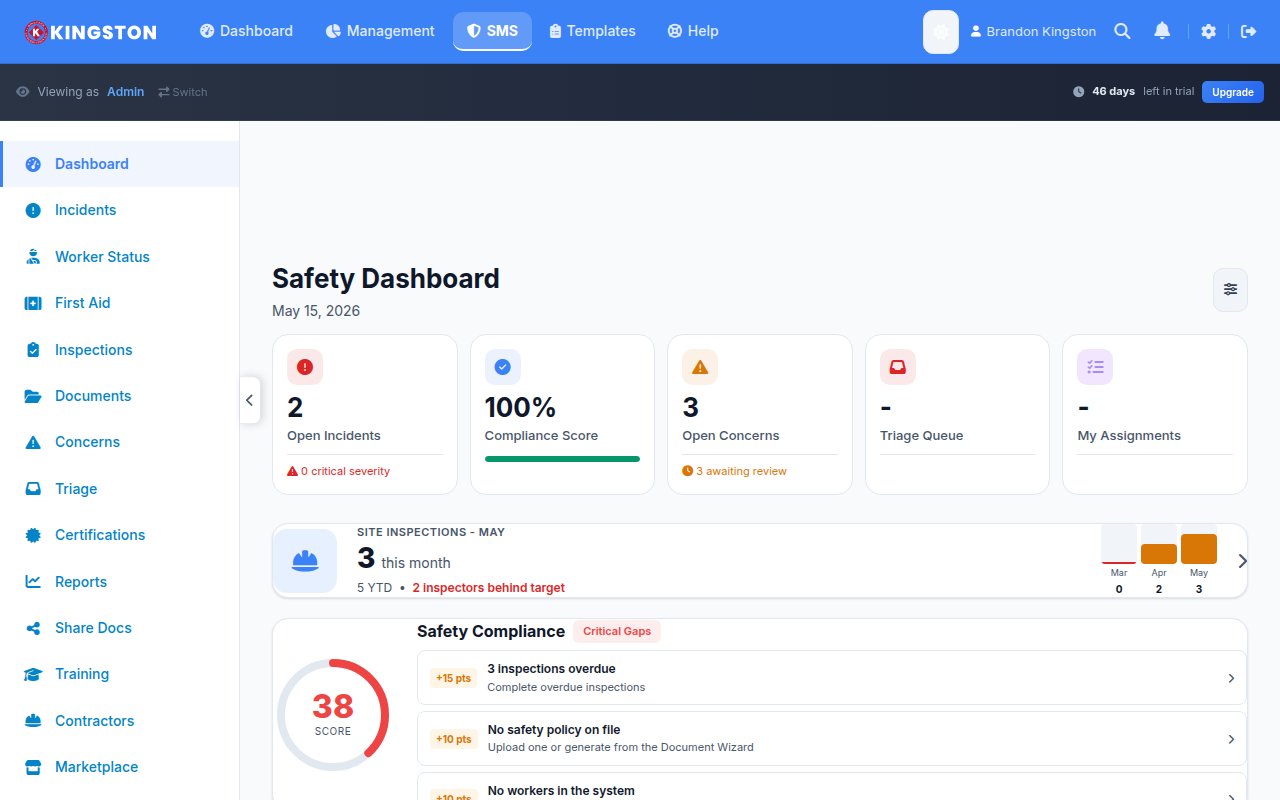
Managing all of these components with spreadsheets and paper forms is possible but inefficient. Safety management software centralizes your program into a single platform where you can schedule inspections, track incidents, deliver training and generate reports - all in real time.
Digital tools also improve worker engagement. When employees can submit a hazard report from their phone in under a minute, participation goes up. When supervisors receive instant notifications about corrective actions, response times drop. The result is a faster, more transparent safety culture.
The cost of safety software is a fraction of what organizations spend on a single lost-time injury. According to the National Safety Council, the average cost of a medically consulted workplace injury exceeds $44,000 when you factor in wage losses, medical expenses, administrative costs and employer productivity losses. A digital platform that prevents even one injury per year pays for itself many times over.
Get Your Safety Program Off the Ground
Starting a workplace safety program is one of the highest-return investments an organization can make. The steps are straightforward: commit at the leadership level, identify your hazards, build controls, train your people, track everything and keep improving.
If you are ready to move beyond spreadsheets and build a safety program that actually works, book a demo to see how Make Safety Easy helps organizations launch and manage every component from a single platform. Or explore our pricing plans to find the right fit for your team.
Ready to simplify your safety program?
Make Safety Easy helps teams run toolbox talks, inspections, incident reports and more - all from one platform.
Start Your Free TrialNo credit card required. 14-day free trial.