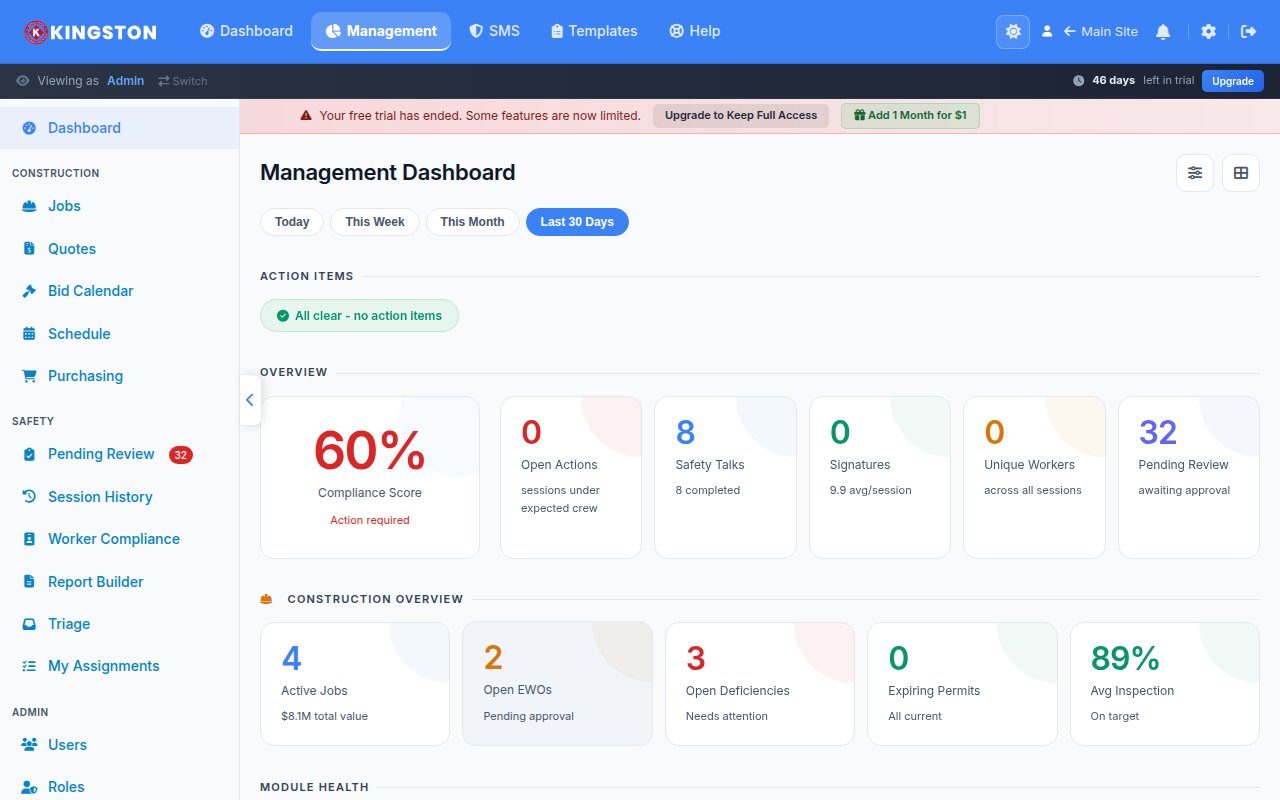
The best alternative to paper safety management in 2026 is purpose-built digital safety management software that handles incident reporting, inspections, toolbox talks and compliance tracking from a single platform. Canadian workplaces - from construction sites in Alberta to manufacturing floors in Ontario - are abandoning filing cabinets and clipboards at a record pace. And for good reason. Paper-based systems are slow, error-prone and increasingly incompatible with the regulatory demands of provincial OH&S authorities. This guide breaks down the top five paper safety management alternatives available right now, so you can pick the one that actually fits your operation.
Why Canadian Companies Are Ditching Paper Safety Management in 2026
Let's be blunt. Paper safety management was never "good." It was just familiar. And familiarity is a terrible reason to keep doing something that puts your workers - and your COR certification - at risk.
Here's what the numbers tell us. According to the Association of Workers' Compensation Boards of Canada (AWCBC), workplace incident claims across the country have remained stubbornly high, with over 277,000 accepted time-loss claims reported in the most recent national data. Many of these incidents trace back to gaps in hazard documentation, missed inspections and incomplete safety orientations - exactly the kind of failures that thrive in paper-based systems.
Free Download: 5 Safe Work Procedures
Choose from 112 professionally written SWPs. No credit card required.
Get Free SWPsThe problems compound fast:
- Lost or damaged records - A single coffee spill can wipe out months of inspection data.
- Delayed incident reporting - Paper forms sit in truck gloveboxes for days before reaching a safety manager's desk.
- Audit nightmares - Provincial OH&S auditors expect organized, searchable records. Shoeboxes of forms don't qualify.
- Zero real-time visibility - You can't spot a trend in near-miss reports if those reports are buried in a binder.
- Scalability ceiling - Adding a second jobsite means doubling your paper headache, not just your workforce.
Digital safety management software solves every single one of these issues. Not partially. Completely. The question isn't whether to switch - it's which platform deserves your business.
What to Look for in a Digital Safety Management Platform
Before we rank the alternatives, you need a framework for evaluating them. Not every safety management software is built for Canadian regulations and not every platform that looks slick on a demo actually works on a muddy jobsite in February.
Prioritize these criteria:
- Canadian regulatory alignment - Does it map to provincial OH&S legislation (Alberta OHS Act, Ontario OHSA, BC WorkSafeBC requirements)?
- Offline functionality - Cell service at remote worksites in Northern BC or the Yukon is not a given. Your software must work without it.
- Ease of adoption - If your field crew needs a two-day training course, you've already lost.
- Core feature coverage - At minimum: incident reporting, inspections, toolbox talks, corrective actions and document management.
- Pricing transparency - Watch out for per-user fees that balloon once you onboard your full team.
- Data ownership and residency - Canadian privacy law (PIPEDA and provincial equivalents) matters. Know where your data lives.
The Top 5 Alternatives to Paper Safety Management in 2026
1. Make Safety Easy (MSE) - Best Overall for Canadian Workplaces
There's a reason Make Safety Easy sits at the top of this list - and it's not because we're biased. It's because no other platform on the market was built this specifically for Canadian safety teams.
Make Safety Easy is a digital safety management platform designed from the ground up around Canadian OH&S regulations. It covers the full lifecycle of workplace safety: incident reporting, inspections and audits, toolbox talks, corrective action tracking and document management. Everything lives in one place. Everything syncs in real time.
What genuinely sets MSE apart:
- Built for Canada - Templates and workflows aligned to provincial legislation across all provinces and territories.
- Radical simplicity - Field workers can complete a safety inspection on their phone in under two minutes. No training manual required.
- Offline mode - Full functionality without cell service. Data syncs automatically when connectivity returns.
- Transparent pricing - Flat-rate plans with no per-user surprises. Scales from 5-person crews to enterprise operations.
- COR audit readiness - Generate audit-ready reports with a single click.
- Canadian data residency - Your data stays in Canada. Full stop.
Best for: Construction, oil & gas, manufacturing, utilities and any Canadian company that needs a no-nonsense digital safety management system that works on day one.
Explore Make Safety Easy pricing and start your free trial →
2. SafetyCulture (iAuditor) - Best for Inspection-Heavy Teams
SafetyCulture, formerly known as iAuditor, is a well-established platform with a strong inspection and checklist engine. It's popular globally and has a large template library that covers a broad range of industries.
Strengths:
- Massive library of pre-built inspection templates.
- Solid mobile app with photo and annotation capabilities.
- Integrations with third-party tools like Slack and Microsoft Teams.
Limitations for Canadian users:
- Not specifically designed around Canadian provincial OH&S frameworks - you'll need to customize templates yourself.
- Pricing is per-user, which gets expensive quickly for larger crews.
- Data is hosted internationally; Canadian data residency is not guaranteed by default.
Best for: Teams that run a high volume of inspections and need deep customization and are comfortable adapting a global platform to Canadian requirements.
3. Safesite - Best Free Tier for Small Teams
Safesite offers a genuinely useful free plan that makes it an attractive paper safety management alternative for very small operations. It covers basic hazard observations, inspections and incident logging.
Strengths:
- Free plan available for small teams - a real one, not a 7-day trial masquerading as "free."
- Simple interface that's easy to learn.
- Safety scoring system that gamifies compliance.
Limitations for Canadian users:
- US-centric design and regulatory focus (OSHA-oriented).
- Limited advanced features on the free tier - toolbox talks, custom reports and analytics are paywalled.
- Less robust offline functionality compared to Canadian-built platforms.
Best for: Very small Canadian operations (under 10 workers) looking for a zero-cost starting point before upgrading to a more comprehensive solution.
4. Safety Connect by Vector Solutions - Best for Enterprise Compliance
Vector Solutions (formerly IndustrySafe) is an enterprise-grade safety management software platform. It's a heavyweight. The feature set is vast: incident management, CAPA tracking, industrial hygiene monitoring, ergonomic assessments and regulatory compliance management.
Strengths:
- Extremely deep feature set for large, complex organizations.
- Robust analytics and dashboarding for executive-level reporting.
- Strong learning management system (LMS) integration for safety training.
Limitations for Canadian users:
- Significant implementation time - weeks or months, not days.
- Enterprise pricing puts it out of reach for most small and mid-sized Canadian businesses.
- The interface can feel overwhelming for field workers used to simple tools.
- Primarily designed for US regulatory environments; Canadian customization requires extra configuration.
Best for: Large Canadian enterprises (500+ employees) with dedicated EHS departments and the budget for a full-scale implementation.
5. Google Workspace / Microsoft 365 - Best "DIY" Option (With Caveats)
Some companies try to replace paper with tools they already own: Google Forms for inspections, Google Sheets for tracking, SharePoint for document storage. It works. Sort of. For a while.
Strengths:
- No additional software cost if you already pay for Workspace or M365.
- Familiar interface - everyone knows how to use a spreadsheet.
- Full control over form design and data structure.
Limitations for Canadian users:
- Zero safety-specific logic - no automatic corrective action workflows, no overdue inspection alerts, no compliance dashboards.
- Maintenance burden shifts entirely to your safety team. Someone has to build, update and troubleshoot every form and formula.
- No audit trail that satisfies OH&S auditors without significant manual effort.
- Breaks down at scale - what works for 15 workers collapses at 50.
Best for: Very early-stage companies with minimal safety requirements and a technically savvy safety coordinator who has time to build and maintain a custom system. Realistically, most teams outgrow this within six months.
Quick Comparison: Paper Safety Management Alternatives (2026)
| Platform | Canadian Focus | Offline Mode | Pricing Model | Setup Time | Best For |
|---|---|---|---|---|---|
| Make Safety Easy | Yes - built for Canada | Full offline | Flat-rate | Same day | SMBs to enterprise |
| SafetyCulture | Partial (global) | Yes | Per-user | 1-2 weeks | Inspection-heavy teams |
| Safesite | No (US-focused) | Limited | Free / paid tiers | Same day | Very small teams |
| Vector Solutions | Partial | Yes | Enterprise quote | Weeks to months | Large enterprises |
| Google / M365 DIY | No | Limited | Existing subscription | Ongoing build | Very early-stage |
Making the Switch from Paper to Digital Safety Management
Switching doesn't have to be dramatic. The companies that succeed treat it as a phased rollout, not a big-bang migration.
Here's what a realistic transition looks like:
- Week 1 - Pick your platform and set up your account. If you go with Make Safety Easy, this takes about 20 minutes.
- Week 2 - Digitize your most-used forms first. Start with daily inspections or toolbox talks. Don't try to move everything at once.
- Week 3 - Run parallel systems. Keep paper as a backup while your crew builds confidence with the app.
- Week 4 - Cut the paper. Once your team sees how much faster digital is, they won't want to go back.
The biggest mistake? Waiting for the "perfect time." There is no perfect time. There's only the cost of another month spent filing paper into binders that nobody reads. Every week you delay is another week of incomplete data, another missed near-miss trend, another audit that's harder than it should be.
Frequently Asked Questions
Is digital safety management software compliant with Canadian OH&S regulations?
Yes. Digital records are accepted by all provincial and territorial OH&S authorities in Canada, provided the records are accurate, accessible and retained for the required period (typically 3-5 years depending on the province). Platforms like Make Safety Easy are specifically designed to meet these requirements, with built-in retention policies and audit-ready export features.
How much does safety management software cost in Canada?
Costs vary widely. DIY solutions using existing office tools are free but labour-intensive. Dedicated platforms range from free tiers (Safesite) to enterprise pricing (Vector Solutions, typically $10,000+/year). Make Safety Easy offers flat-rate plans starting at competitive price points - check current pricing here.
Can I use safety management software offline on remote Canadian jobsites?
Some platforms offer offline functionality, but quality varies. Make Safety Easy provides full offline mode - workers can complete inspections, report incidents and log toolbox talks without any internet connection. Data syncs automatically when the device reconnects. This is critical for jobsites in remote areas of Alberta, BC, Northern Ontario and the territories.
What's the biggest risk of staying on paper-based safety management?
The biggest risk isn't regulatory fines - although those are real. It's invisible data loss. Paper systems make it nearly impossible to spot patterns in near-miss reports, track corrective action completion rates, or demonstrate continuous improvement during a COR audit. You can't manage what you can't measure and paper makes measurement painfully slow. Read our full breakdown in Paper vs. Digital Safety Management.