If you're still managing workplace safety with binders, clipboards and filing cabinets, you're not alone - but you are falling behind. A 2025 survey by the Canadian Centre for Occupational Health and Safety (CCOHS) found that 62% of small and mid-size employers still rely on paper for at least some safety management processes.
The question isn't whether digital is better. It's how much paper is actually costing you.
Time: The Most Expensive Resource
Let's compare the time investment for common safety tasks:
Free Download: 5 Safe Work Procedures
Choose from 112 professionally written SWPs. No credit card required.
Get Free SWPs| Task | Paper-Based | Digital Platform | Time Saved |
|---|---|---|---|
| File an incident report | 25-40 min | 5-10 min | 70% |
| Run a toolbox talk + sign-off | 15-20 min | 8-12 min | 40% |
| Complete a site inspection | 45-90 min | 15-30 min | 65% |
| Prepare for a COR audit | 2-4 weeks | 2-4 hours | 95% |
| Find a specific past incident | 30-60 min (searching files) | 10 seconds (search) | 99% |
| Generate monthly safety report | 4-8 hours | 5 minutes (auto-generated) | 97% |
For a safety manager handling 50 incidents and 200 toolbox talks per year, the time savings alone add up to 300+ hours annually. At an average safety coordinator salary of $75,000/year, that's over $10,000 in recovered productivity.
Error Rates: Paper Is a Liability
Paper-based systems are prone to errors that digital platforms eliminate:
- Illegible handwriting: If an auditor can't read it, it doesn't count. Studies show 15-20% of handwritten safety forms contain at least one illegible field.
- Missing signatures: Paper sign-off sheets frequently have gaps. Digital systems enforce completion before submission.
- Lost documents: Papers get coffee-stained, misfiled, or thrown out. An industry survey found that 7.5% of all paper documents are lost entirely.
- Incomplete data: Without required-field validation, paper forms are routinely submitted with blank sections.
- Version control: Which is the latest version of that inspection checklist? With paper, nobody knows for sure.
Audit Readiness: The Make-or-Break Factor
When WorkSafeBC or a COR auditor shows up, you need to produce documentation fast. Here's where the gap is most painful:
Paper: Your safety coordinator disappears for 2-4 weeks to pull binders, photocopy forms, organize by date, cross-reference incident logs and pray that nothing is missing.
Digital: Filter by date range, export to PDF, done. Two clicks. Everything is timestamped, signed and organized automatically.
Companies that fail COR audits due to documentation gaps face premium surcharges of up to 45% on their WCB assessments. For a company with a $200,000 annual WCB assessment, that's a $90,000 penalty - for paperwork problems.
Storage and Physical Costs
Paper has tangible costs that add up quietly:
- Printing: ~$0.10/page à - thousands of forms/year = $500-$2,000/year
- Filing cabinets and storage: $200-$500 per cabinet, plus floor space
- Retention requirements: WorkSafeBC requires safety records to be kept for at least 3 years (some records, 10+ years). That's a lot of filing cabinets.
- Destruction/shredding: When retention periods expire, secure document destruction costs $50-$150 per bin.
Real-Time Visibility: Paper Can't Compete
With paper, you find out about problems after the fact. Digital safety platforms give you:
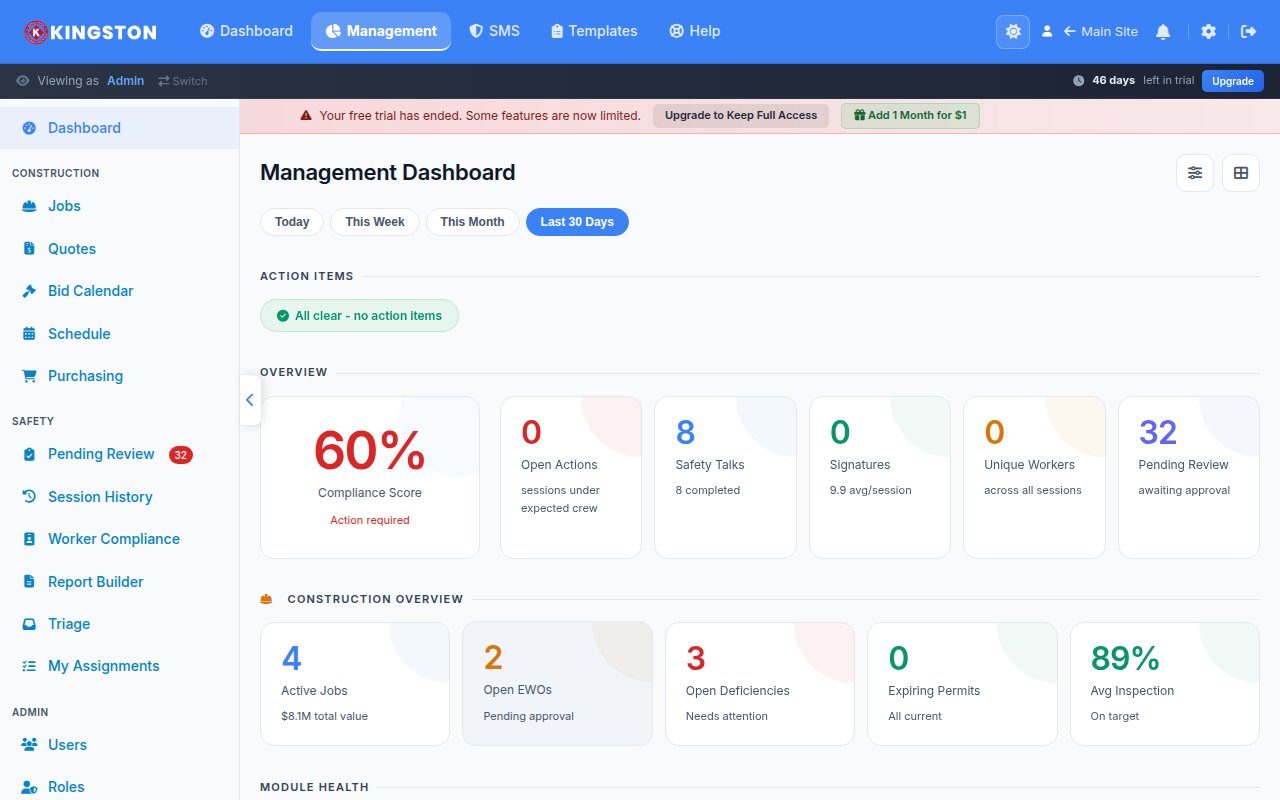
- Real-time dashboards: See incident trends, compliance scores and overdue inspections at a glance.
- Automated alerts: Get notified when an inspection is overdue, a certification is expiring, or an incident severity threshold is breached.
- Trend analysis: Spot patterns before they become incidents. Which shift has the most near-misses? Which location has the most overdue inspections?
- Mobile access: Workers in the field can file reports, complete talks and access SOPs from their phone - no trip to the office needed.
The Bottom Line
| Factor | Paper | Digital |
|---|---|---|
| Annual time cost (safety manager) | 400+ hours | ~80 hours |
| Error rate on forms | 15-20% | <2% |
| Audit prep time | 2-4 weeks | Hours |
| Document loss risk | 7.5% | 0% (cloud backup) |
| Real-time visibility | None | Full dashboard |
| Monthly cost | $300-$600 (hidden) | $299-$599 (transparent) |
The math is straightforward: digital safety management pays for itself within the first 1-2 months for most operations and the gap only widens over time.
Ready to make the switch? Start your free 14-day trial and see the difference in your first week. No credit card required.
Ready to make the switch? Explore how digital incident reporting and mobile inspections can transform your safety program.