Asbestos Safety: What Employers and Workers Must Know
Asbestos safety encompasses the identification, assessment, regulatory compliance and abatement procedures required to protect workers from exposure to asbestos-containing materials (ACMs). Despite being heavily regulated since the 1970s, asbestos still kills an estimated 12,000-15,000 people per year in the United States and approximately 2,000 in Canada - primarily from occupational exposures that occurred years or decades ago. The latency period between exposure and disease onset (typically 10-50 years) makes asbestos uniquely insidious: workers exposed today may not develop symptoms until 2040 or beyond.
Any building constructed before 1990 may contain asbestos-containing materials. For employers in construction, renovation, demolition, facility maintenance and property management, understanding asbestos regulations, proper identification methods, and asbestos abatement procedures isn't optional - it's a legal obligation and a moral imperative.
What Is Asbestos and Where Is It Found?
Asbestos is a group of naturally occurring fibrous silicate minerals valued historically for their heat resistance, tensile strength and insulating properties. When asbestos-containing materials are disturbed - cut, drilled, sanded, broken, or deteriorated - they release microscopic fibers that, when inhaled, embed in lung tissue and cause progressive, irreversible disease.
Free Download: 5 Safe Work Procedures
Choose from 112 professionally written SWPs. No credit card required.
Get Free SWPsTypes of Asbestos
- Chrysotile (white asbestos): The most commonly used form, accounting for approximately 95% of asbestos in buildings. Found in roofing materials, brake linings, cement products and textiles.
- Amosite (brown asbestos): Commonly found in thermal insulation products, cement sheets and pipe insulation.
- Crocidolite (blue asbestos): Considered the most hazardous form. Used in spray-on coatings, pipe insulation and cement products.
- Tremolite, actinolite and anthophyllite: Less commonly used commercially but can be found as contaminants in other products, including vermiculite insulation (notably Zonolite).
Common Locations of Asbestos-Containing Materials
| Location/Material | Common ACM Products | Risk Level When Disturbed |
|---|---|---|
| Pipe and boiler insulation | Wrap, blankets, mud coatings | Very high - friable material |
| Spray-on fireproofing | Structural steel coating, ceiling texture | Very high - friable material |
| Floor tiles and adhesive | 9"x9" and 12"x12" vinyl tiles, black mastic | Moderate - non-friable unless sanded or broken |
| Cement products | Corrugated roofing, siding, pipes | Moderate - non-friable unless cut or drilled |
| Drywall joint compound | Pre-mixed and setting-type compounds (pre-1980) | High when sanded |
| Vermiculite insulation | Loose-fill attic insulation (Zonolite brand) | High - can contain tremolite asbestos |
| Gaskets and packing | Flange gaskets, valve packing | Moderate - risk during removal and replacement |
| Brake and clutch components | Pads, linings, disc facings | High during repair work |
Asbestos Identification: The Mandatory First Step
You cannot identify asbestos by visual inspection alone. Materials suspected of containing asbestos must be sampled and analyzed by an accredited laboratory using polarized light microscopy (PLM) or transmission electron microscopy (TEM). Assuming a material is "probably fine" is both illegal and dangerous.
When Is Identification Required?
- Before any renovation or demolition: OSHA, EPA and all Canadian provincial regulations require building owners to identify ACMs before disturbing them
- During building condition assessments: Facility managers should inventory ACMs in all buildings constructed before 1990
- When suspected materials are found during work: If workers encounter materials they weren't expecting, work must stop until sampling is completed
- OSHA's "presumed asbestos-containing material" (PACM) rule: In construction, thermal system insulation, surfacing materials and resilient flooring in buildings built before 1981 are presumed to contain asbestos unless tested and proven otherwise
Asbestos Survey Types
- Management survey: Identifies the location, extent and condition of ACMs in a building for ongoing management purposes
- Refurbishment/demolition survey: A more intrusive survey conducted before renovation or demolition to identify all ACMs that could be disturbed
Asbestos Regulations: A Multi-Jurisdictional Landscape
United States - OSHA Standards
OSHA regulates asbestos exposure through three industry-specific standards:
- 29 CFR 1926.1101 (Construction): Covers demolition, renovation, maintenance and repair activities. Establishes permissible exposure limits, mandatory competent persons and Class I-IV work classifications.
- 29 CFR 1910.1001 (General Industry): Covers custodial and maintenance workers in buildings with ACMs, as well as brake and clutch repair.
- 29 CFR 1915.1001 (Shipyard Employment): Covers asbestos work in shipbuilding, repair and breaking.
OSHA Permissible Exposure Limits:
- PEL: 0.1 fibers per cubic centimeter (f/cc) as an 8-hour TWA
- Excursion Limit: 1.0 f/cc averaged over 30 minutes
United States - EPA Regulations
The EPA's National Emission Standards for Hazardous Air Pollutants (NESHAP) under 40 CFR Part 61, Subpart M requires:
- Notification to the appropriate authority before demolition or renovation involving regulated ACM
- Proper work practices during asbestos removal
- Adequate wetting of ACM during removal
- Proper disposal at licensed landfills
Canadian Regulations
Canada banned asbestos and asbestos-containing products in 2018 under the Prohibition of Asbestos and Products Containing Asbestos Regulations. However, existing ACMs in buildings remain a major occupational hazard, regulated provincially:
- British Columbia: WorkSafeBC OHS Regulation Part 6 provides detailed requirements for asbestos management, removal and worker protection
- Alberta: OHS Code Part 4 (Chemical Hazards, Biological Hazards and Harmful Substances) and the Asbestos Abatement Manual
- Ontario: O. Reg. 278/05 (Designated Substance - Asbestos on Construction Projects and in Buildings and Repair Operations) classifies work into Type 1, 2 and 3 operations
- Federal: Canada Occupational Health and Safety Regulations Part 10 covers federally regulated workplaces
OSHA Asbestos Work Classifications (Construction)
OSHA's construction standard classifies asbestos work into four classes, each with escalating requirements for controls, training and monitoring:
| Class | Type of Work | Key Requirements |
|---|---|---|
| Class I | Removal of thermal system insulation and surfacing ACM | Licensed contractor; full negative-pressure enclosure; continuous air monitoring; decontamination unit; trained workers and competent person |
| Class II | Removal of non-friable ACM (floor tile, roofing, siding, cement pipe) | Competent person on-site; wet methods; specific work practices per material type; air monitoring |
| Class III | Repair and maintenance that may disturb ACM | Competent person; wet methods; glove bags or mini-enclosures for small-scale work; air monitoring where exposure may exceed PEL |
| Class IV | Custodial activities (cleanup of ACM debris, maintaining ACM-containing surfaces) | 2-hour awareness training; wet methods; HEPA vacuuming; no dry sweeping |
Asbestos Abatement Procedures
Asbestos abatement is the process of removing, encapsulating, or enclosing ACMs to eliminate the risk of fiber release. Abatement work must be performed by trained, licensed professionals following strict protocols.
Full Removal Under Negative-Pressure Enclosure
For Class I work and large-scale friable asbestos removal:
- Pre-abatement air sampling: Establish baseline ambient fiber levels
- Construct containment: Build a sealed enclosure using 6-mil polyethylene sheeting with negative air pressure maintained by HEPA-filtered air machines
- Decontamination unit: Establish a three-stage decontamination corridor (clean room, shower, equipment room) at the enclosure entrance
- Worker PPE: Disposable coveralls, gloves, boot covers and appropriate respiratory protection (typically a full-face PAPR or supplied-air respirator for Class I work)
- Wet removal: Thoroughly saturate ACM with amended water (water with a surfactant to improve penetration) before and during removal
- Waste handling: Double-bag all ACM waste in labeled, 6-mil poly bags or wrap larger pieces in poly sheeting and seal with tape. Label all containers with asbestos warning labels.
- Final cleaning: HEPA vacuum all surfaces, wet-wipe and visually inspect
- Clearance air monitoring: Conduct aggressive air sampling (using fans and leaf blowers to simulate worst-case disturbance) to verify fiber levels are below clearance criteria before releasing the work area
Encapsulation and Enclosure
When removal is impractical or creates greater risk, ACMs can be managed in place:
- Encapsulation: Applying a sealant that penetrates or coats the ACM to bind fibers and prevent release. Appropriate for non-friable or lightly damaged materials.
- Enclosure: Building an airtight barrier around the ACM (e.g., drywall over asbestos plaster). The ACM must be labeled and tracked for future management.
Worker Protection During Asbestos Work
Respiratory Protection
Respiratory protection for asbestos work follows a hierarchy based on exposure levels:
- Below PEL (0.1 f/cc): Half-face respirator with P100 filters is the minimum for any intentional disturbance of ACM
- Up to 1.0 f/cc: Half-face APR with P100 filters (APF = 10)
- Up to 5.0 f/cc: Full-face APR with P100 filters (APF = 50) or PAPR with HEPA filters
- Above 5.0 f/cc or Class I work: Full-face PAPR (APF = 1,000) or supplied-air respirator
Medical Surveillance
OSHA requires medical surveillance for workers exposed above the PEL or who wear respirators for asbestos work for 30 or more days per year. Medical examinations must include:
- Detailed work and medical history
- Chest X-ray (at baseline and as medically indicated)
- Pulmonary function testing
- Annual examinations for the duration of exposure and afterward
Training Requirements
OSHA training requirements vary by work class:
- Class I and II workers: 32-hour EPA/AHERA-accredited asbestos worker training plus annual 8-hour refresher
- Class III workers: 16-hour operations and maintenance training plus annual refresher
- Class IV workers: 2-hour asbestos awareness training
- Competent person: Additional training in project monitoring, air sampling and regulatory requirements specific to the class of work being supervised
Documentation and Record-Keeping
Asbestos regulations impose extensive documentation requirements. Failing to maintain proper records is itself a citable violation.
- Asbestos survey reports: Must be maintained for the life of the building and provided to subsequent owners
- Exposure monitoring records: OSHA requires retention for 30 years
- Medical surveillance records: Must be retained for the duration of employment plus 30 years
- Training records: Must document training content, dates and attendees
- Abatement project records: Including air monitoring results, waste manifests and clearance documentation
Managing this volume of documentation across multiple projects and workers demands a robust document management system that keeps records organized, searchable and accessible for the decades they must be retained.
Asbestos Management in Existing Buildings
Not all ACMs require immediate removal. The EPA and most Canadian jurisdictions support an "operations and maintenance" approach for ACMs in good condition:
- Maintain an up-to-date asbestos register identifying the location, type, quantity and condition of all ACMs
- Conduct periodic re-inspections to assess material condition (typically every 6-12 months)
- Label ACMs or post warning signs in areas where maintenance workers might encounter them
- Establish a permit-to-work system for any activity that could disturb ACMs
- Train all building maintenance staff in asbestos awareness
- Report any damage to ACMs immediately through your incident reporting system
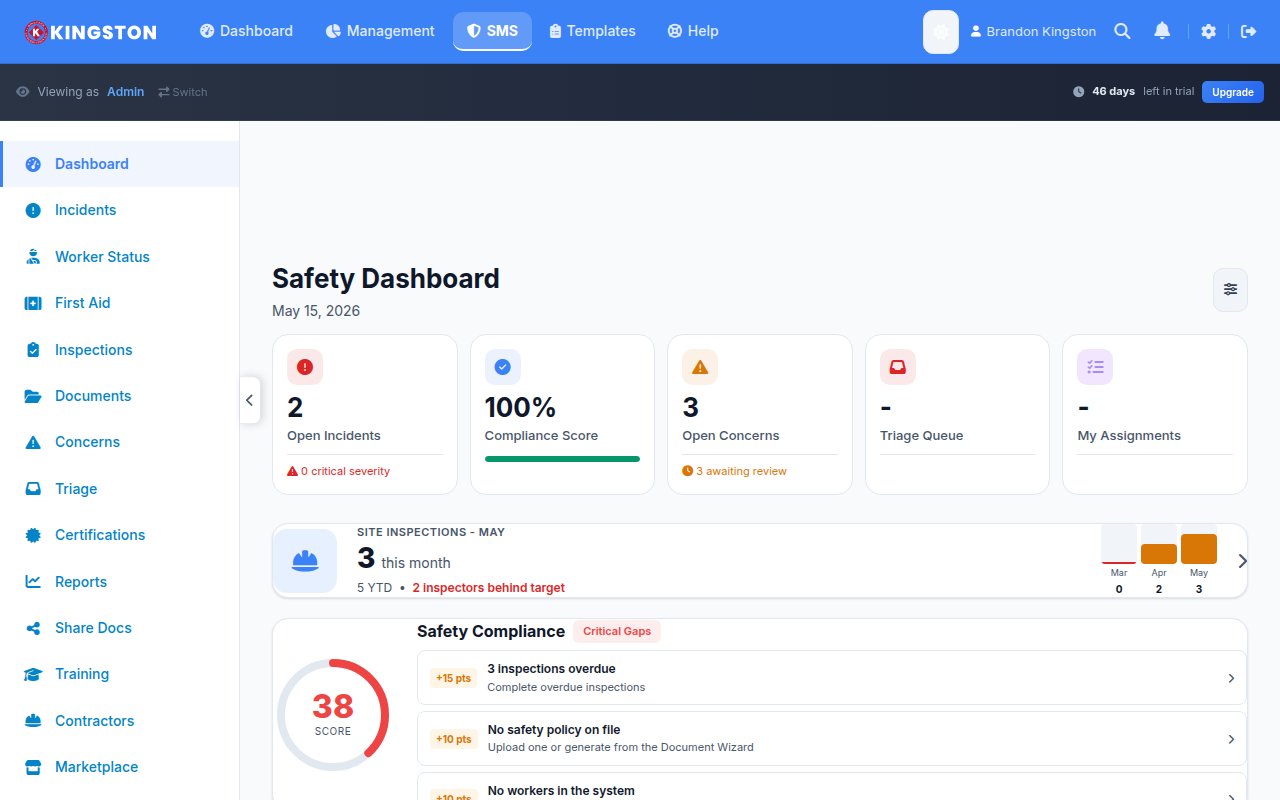
How Make Safety Easy Supports Asbestos Safety Programs
Asbestos safety programs generate mountains of documentation that must be retained for decades and produced on demand during regulatory inspections. Make Safety Easy provides:
- Centralized document management for survey reports, air monitoring data, abatement records and waste manifests
- Incident reporting for documenting suspected ACM disturbances and fiber release events
- Inspection tracking for periodic ACM condition assessments with photo documentation
- Training record management with automated expiry alerts for worker certifications and refresher training
Managing asbestos risks in your buildings or on your job sites? Request a demo to see how Make Safety Easy keeps your asbestos safety program organized and audit-ready, or explore our pricing to get started.
Ready to simplify your safety program?
Make Safety Easy helps teams run toolbox talks, inspections, incident reports and more - all from one platform.
Start Your Free TrialNo credit card required. 14-day free trial.