A safety culture framework is a structured system of shared values, behaviors and accountability mechanisms that make workplace safety an automatic priority for every person in an organization - from the CEO to the newest hire. Companies with strong safety cultures experience up to 70% fewer recordable incidents, lower workers' compensation costs and significantly higher employee retention rates compared to organizations that treat safety as a compliance checkbox.
If you have been struggling with inconsistent safety performance, high turnover or near-miss underreporting, the root cause is almost always cultural - not procedural. This guide walks you through the five pillars of safety culture, a maturity model for measuring where you stand, practical implementation steps and the common failures that derail even well-intentioned programs. Whether you manage 15 employees or 15,000, the framework here will give you a clear path from reactive firefighting to proactive safety excellence.
What Is a Safety Culture Framework?
A safety culture framework is the blueprint for how an organization integrates safety into its identity. It goes beyond written policies and compliance programs to address the underlying beliefs, attitudes and norms that drive day-to-day behavior. The framework encompasses leadership commitment, employee participation, communication systems, learning processes and continuous improvement mechanisms that collectively determine whether workers take shortcuts or follow procedures when no one is watching.
Free Download: 5 Safe Work Procedures
Choose from 112 professionally written SWPs. No credit card required.
Get Free SWPsThe concept originated from the International Nuclear Safety Advisory Group (INSAG) following the 1986 Chernobyl disaster. Their landmark report identified "safety culture" as the assembly of characteristics and attitudes in organizations and individuals that establishes safety as an overriding priority. Since then, industries from construction and manufacturing to healthcare and energy have adopted and refined safety culture models.
Why Safety Culture Matters More Than Safety Programs
Programs are external. Culture is internal. A safety program tells employees what to do. A safety culture makes employees want to do it. Research from the National Safety Council shows that organizations in the top quartile of safety culture maturity experience:
- 70% fewer recordable injuries than the industry average
- 52% lower workers' compensation costs
- 41% reduction in absenteeism related to workplace injuries
- 28% higher productivity due to fewer disruptions and work stoppages
- 3x faster return-to-work rates after incidents do occur
The business case is overwhelming, yet most organizations stall at the early stages of cultural transformation because they focus on lagging indicators rather than the behavioral and systemic changes that actually move the needle.
The 5 Pillars of Safety Culture
Every sustainable safety culture rests on five interconnected pillars. Weakening any single pillar compromises the entire structure. Here is a detailed breakdown of each one and how to build it within your organization.
Pillar 1: Leadership Commitment and Visible Engagement
Leadership commitment is the foundation upon which every other pillar stands. Without genuine, visible engagement from senior leaders, safety culture initiatives will be perceived as lip service. Employees are remarkably skilled at detecting the gap between what leaders say and what leaders do.
Visible leadership commitment means more than signing off on a safety policy. It requires leaders to:
- Participate in safety walkthroughs and field observations at least weekly
- Open every meeting (board meetings included) with a safety moment or story
- Allocate budget for safety improvements without requiring exhaustive justification
- Stop work personally when they observe an unsafe condition - even if it costs production time
- Share personal safety experiences and admit their own mistakes openly
- Recognize and reward safe behaviors publicly and consistently
- Include safety performance in executive compensation and performance reviews
Leadership Commitment Checklist
| Action Item | Frequency | Responsible | Measurement |
|---|---|---|---|
| Safety walkthrough participation | Weekly | All senior leaders | Number of walkthroughs completed per quarter |
| Safety moment at meetings | Every meeting | Meeting organizer | Audit of meeting agendas |
| Stop-work authority exercised | As needed | All leaders | Number of stop-work events logged |
| Safety budget review | Quarterly | CFO/Safety Director | Percentage of requested funds approved |
| Public safety recognition | Weekly | Supervisors and above | Number of recognitions given per month |
| Personal safety story sharing | Monthly | Executives | Employee survey feedback on leadership authenticity |
A common trap is delegating safety leadership entirely to the EHS department. When employees see that safety is "someone else's job," they mirror that attitude. The EHS team should facilitate and coordinate - not own - the culture. That ownership must sit with line leadership.
Pillar 2: Employee Engagement and Participation
Employees who feel ownership over safety outcomes are dramatically more likely to follow procedures, report hazards and intervene when they see at-risk behavior. Engagement is not a nice-to-have; it is the engine that sustains cultural change after the initial executive enthusiasm fades.
Effective employee engagement strategies include:
- Safety committees with real authority. Give frontline workers decision-making power over safety improvements - not just an advisory role. Budget a small discretionary fund that committees can deploy without management approval.
- Peer observation programs. Train employees to observe each other constructively and provide feedback without blame. Programs like BBS (Behavior-Based Safety) work when implemented as coaching tools rather than surveillance systems.
- Toolbox talks led by workers. Rotate facilitation so that every team member leads a safety discussion at least once per quarter. This builds competence and ownership simultaneously. Make Safety Easy's toolbox talk feature simplifies scheduling and tracking these sessions.
- Suggestion systems with fast feedback loops. When an employee submits a safety suggestion, acknowledge it within 24 hours and provide a status update within one week. Nothing kills engagement faster than suggestions that vanish into a black hole.
- Cross-functional safety teams. Bring together workers from different departments to solve safety challenges. Fresh perspectives often identify hazards that insiders have normalized.
Engagement Level Assessment
Use the following scale to assess where your workforce stands on the engagement spectrum:
| Level | Description | Indicators | Action Required |
|---|---|---|---|
| 1 - Disengaged | Workers see safety as an obstacle to productivity | Low reporting, frequent shortcuts, hostility toward safety staff | Rebuild trust through leadership behavior change and listening sessions |
| 2 - Compliant | Workers follow rules when observed | Compliance drops on night shifts and weekends, minimal voluntary participation | Introduce peer observation and recognition programs |
| 3 - Involved | Workers participate when asked | Moderate reporting rates, willingness to join committees when recruited | Shift from invitation to empowerment - give workers decision authority |
| 4 - Committed | Workers proactively identify and solve safety problems | High near-miss reporting, self-organized safety improvements, mentoring new hires | Sustain through recognition, resource allocation and expanded roles |
| 5 - Ownership | Workers view safety as personal responsibility and professional identity | Peer intervention is normal, safety innovations come from the floor, zero tolerance for at-risk behavior | Maintain by involving workers in strategic safety decisions |
Pillar 3: Open Communication and Reporting
A safety culture lives or dies on the quality of its communication systems. Information must flow freely in all directions - up from the frontline, down from leadership, across departments and out to contractors and visitors. The moment employees feel that reporting a hazard or mistake will result in punishment, the information pipeline shuts down and your organization becomes blind to risk.
Building robust safety communication requires:
- Non-punitive reporting systems. Implement a clear policy that distinguishes between honest mistakes (protected) and willful violations (subject to discipline). Publish this policy widely and reinforce it through consistent action. Use digital incident reporting tools that allow anonymous submissions when needed.
- Multiple reporting channels. Not everyone is comfortable reporting the same way. Offer mobile apps, paper forms, verbal reporting to supervisors, anonymous hotlines and digital kiosks. The easier you make reporting, the more data you receive.
- Feedback loops. Every report should generate a visible response. Post corrective actions on bulletin boards, share them in toolbox talks and track them to completion. When employees see that their reports drive real change, reporting rates climb.
- Safety alerts and lessons learned. When an incident or significant near miss occurs, distribute a safety alert within 48 hours. Include what happened, why it happened, what was done about it and what everyone can learn. Avoid blame-focused language.
- Regular two-way forums. Host monthly town halls or quarterly safety summits where workers can ask questions, raise concerns and hear directly from leadership about safety priorities and progress.
Pillar 4: Learning and Continuous Improvement
A generative safety culture treats every incident, near miss and observation as a learning opportunity. It goes beyond asking "who made the mistake?" to asking "what conditions allowed this to happen?" and "how do we redesign the system so it cannot happen again?"
Key elements of a learning-oriented safety culture include:
- Root cause analysis for every significant event. Use structured methodologies like the 5 Whys, fishbone diagrams or TapRooT to dig beneath surface causes. Document findings and share them across the organization.
- Proactive learning from external events. Monitor industry incidents through CSB reports, OSHA alerts and trade publications. Conduct "Could it happen here?" exercises with your teams.
- Training that evolves. Safety training should be updated at least annually based on incident trends, near-miss data and regulatory changes. Move beyond PowerPoint lectures to hands-on simulations, scenario-based exercises and peer-led discussions.
- Monthly safety reviews. Dedicate time each month to review safety metrics, incident trends and the status of corrective actions. Structured monthly review tools keep this process consistent and actionable.
- Benchmarking against best-in-class. Compare your safety performance and practices against industry leaders. Participate in safety conferences, industry associations and peer networking groups.
Pillar 5: Accountability and Recognition
Accountability and recognition are the reinforcement mechanisms that sustain safety culture over time. Without them, even the best-designed systems gradually decay as competing priorities erode attention and effort.
Effective accountability means:
- Safety expectations are clearly defined for every role and level
- Performance evaluations include specific safety metrics and behaviors
- Consequences for willful violations are consistent and fair
- Leaders are held to the same (or higher) standards as frontline workers
- Contractors and temporary workers are included in the accountability framework
Effective recognition means:
- Catching people doing things right - not just wrong
- Recognizing safe behaviors (leading indicators) rather than just outcomes (days without injury)
- Making recognition timely, specific and public
- Using a variety of recognition methods - verbal praise, written acknowledgment, small rewards, team celebrations
- Avoiding incentive programs that inadvertently discourage reporting (such as "X days without a recordable" bonuses that punish teams for honest reporting)
The Safety Culture Maturity Model
Understanding where your organization sits on the safety culture maturity spectrum is essential for targeting the right interventions. The following model, adapted from the work of Patrick Hudson and the Hearts and Minds program, defines five stages of cultural maturity.
Stage 1: Pathological
At this stage, safety is viewed as an obstacle to business objectives. The prevailing attitude is "who cares as long as we don't get caught?" There is minimal investment in safety, incidents are hidden or blamed on worker carelessness and regulatory agencies are seen as adversaries. Organizations at this stage typically have incident rates 3-5 times the industry average.
Stage 2: Reactive
Safety action occurs only after incidents happen. The organization responds to accidents and regulatory pressure but does little to prevent problems proactively. Safety is the EHS department's responsibility. Investigations focus on blame rather than systemic causes. Most organizations begin their cultural journey at this stage.
Stage 3: Calculative
The organization has systems in place - policies, procedures, audits and metrics. Safety is managed through data and compliance programs. However, the focus remains on numbers and documentation rather than genuine behavioral change. Employees follow rules because they are told to, not because they understand or believe in them. This is where many organizations plateau.
Stage 4: Proactive
Leadership and workers actively seek out hazards before incidents occur. Near-miss reporting is robust, employees are empowered to stop unsafe work and the organization invests in leading indicators. Safety is integrated into business planning and decision-making. The shift from "safety because we have to" to "safety because we want to" is underway.
Stage 5: Generative
Safety is embedded in the organizational DNA. It is not a separate program or priority - it is simply how work gets done. Information flows freely, failures are treated as learning opportunities and the organization is resilient to novel hazards. High-reliability organizations (HROs) like nuclear power plants, aircraft carriers and elite surgical teams operate at this level.
Maturity Model Comparison Table
| Characteristic | Pathological | Reactive | Calculative | Proactive | Generative |
|---|---|---|---|---|---|
| Information flow | Hidden | Ignored until incident | Collected but siloed | Actively sought | Flows freely everywhere |
| Responsibility | Avoided | Blame-focused | Compartmentalized | Shared broadly | Universal ownership |
| Failure response | Cover-up | Punishment | System fixes | Root cause learning | Inquiry and innovation |
| New ideas | Discouraged | Ignored | Considered if data supports | Welcomed | Actively cultivated |
| Safety investment | Minimal | After incidents | Based on ROI calculations | Strategic priority | Embedded in all budgets |
The 12-Month Implementation Roadmap
Transforming safety culture is a multi-year journey, but the first 12 months establish the trajectory. The following roadmap provides a month-by-month guide for launching and sustaining a safety culture initiative.
Phase 1: Foundation (Months 1-3)
Month 1: Assessment and Alignment
- Conduct a baseline safety culture survey across all levels and locations
- Review three years of incident data, near-miss reports and audit findings
- Interview a cross-section of employees (frontline to executive) about safety perceptions
- Benchmark current TRIR, DART and EMR against industry averages
- Present findings to the executive team and secure formal commitment (budget, resources, timeline)
Month 2: Vision and Strategy
- Draft a safety culture vision statement with input from all organizational levels
- Define 3-5 measurable safety culture objectives for the next 12 months
- Identify 2-3 "quick wins" that demonstrate commitment and build momentum
- Select and train safety culture champions from each department and shift
- Develop a communication plan for rolling out the initiative
Month 3: Launch
- Announce the initiative through a company-wide event with executive participation
- Implement quick wins identified in Month 2
- Launch the new or improved reporting system
- Begin weekly leadership safety walkthroughs
- Start the first cycle of peer observation training
Phase 2: Building Momentum (Months 4-6)
Month 4: Engagement Systems
- Establish or revitalize safety committees with clear charters and decision authority
- Launch the employee suggestion system with a 24-hour acknowledgment commitment
- Begin employee-led toolbox talks on a rotating schedule
- Implement the recognition program with specific criteria and methods
Month 5: Learning Systems
- Conduct the first formal root cause analysis training for supervisors and safety committee members
- Establish a monthly safety review process with standardized agenda and metrics
- Create a "lessons learned" distribution system for sharing incident and near-miss insights
- Begin "Could it happen here?" exercises based on external industry incidents
Month 6: Mid-Year Review
- Conduct a pulse survey to measure early cultural shifts
- Review leading indicator trends (reporting rates, observations, training completion, corrective action closure)
- Celebrate successes and acknowledge challenges openly
- Adjust the strategy based on data and feedback
- Prepare a mid-year report for executive leadership
Phase 3: Deepening (Months 7-9)
Month 7: Accountability Integration
- Integrate safety metrics into performance evaluations for all supervisors and managers
- Review and update the just culture policy based on six months of experience
- Begin including safety culture questions in hiring interviews
- Extend safety expectations formally to contractors and temporary workers
Month 8: Advanced Training
- Roll out human factors and error prevention training
- Train leaders in safety coaching and positive reinforcement techniques
- Develop scenario-based training modules based on actual incidents and near misses from your organization
- Launch a safety mentoring program pairing experienced workers with newer employees
Month 9: System Optimization
- Analyze reporting data to identify underreporting areas and address barriers
- Streamline corrective action tracking and closure processes
- Integrate safety data into operational dashboards visible to all employees
- Begin planning for Year 2 objectives based on maturity model progress
Phase 4: Sustaining (Months 10-12)
Month 10: External Benchmarking
- Conduct a formal benchmarking exercise against industry leaders
- Invite an external auditor or consultant to assess progress objectively
- Participate in industry safety forums or conferences to share and learn
- Identify best practices from other organizations that could be adapted
Month 11: Reinforcement and Renewal
- Refresh the safety culture communication campaign with new stories and data
- Rotate safety committee membership to expand engagement
- Review and update all safety procedures based on the year's learnings
- Conduct advanced recognition events (annual safety awards, team celebrations)
Month 12: Annual Review and Planning
- Conduct a full safety culture survey and compare to the Month 1 baseline
- Calculate ROI from reduced incidents, lower insurance costs and improved productivity
- Present a comprehensive annual report to executive leadership and the board
- Set Year 2 objectives focused on moving to the next maturity level
- Update the implementation roadmap based on lessons learned
Case Examples: Safety Culture Transformation in Practice
Case Example 1: Manufacturing Facility Turnaround
A mid-sized manufacturing operation with 340 employees was experiencing a TRIR of 8.2 - more than double the industry average for their sector. Turnover in production roles exceeded 45% annually and workers' compensation costs consumed 4.2% of revenue. An internal assessment placed the organization at Stage 2 (Reactive) on the maturity model.
The leadership team committed to a 24-month transformation. Key interventions included:
- The plant manager began conducting daily safety walkthroughs instead of weekly
- All supervisors received 40 hours of safety leadership training
- An anonymous near-miss reporting app was deployed, generating 847 reports in the first year (up from 23 paper reports the prior year)
- Safety committees were given a quarterly discretionary budget for improvements
- Root cause analysis replaced blame-based investigations for all events
After 24 months, TRIR dropped to 3.1 (a 62% reduction), turnover fell to 22% and workers' compensation costs decreased by 38%. The organization assessed itself at Stage 3 (Calculative) moving toward Stage 4 (Proactive).
Case Example 2: Construction Company Culture Shift
A regional construction firm operating across 12 active job sites struggled with inconsistent safety performance. Some sites operated near zero incidents while others averaged a recordable every month. The root cause was traced to a supervisor-dependent culture where safety outcomes were entirely a function of the individual superintendent's attitude.
The company implemented a standardized safety culture framework that included:
- A company-wide safety vision developed collaboratively with input from every superintendent
- Weekly toolbox talks with standardized topics but flexibility for site-specific concerns
- A peer mentoring program where superintendents from high-performing sites coached those from lower-performing sites
- Monthly cross-site safety reviews that fostered healthy competition and shared learning
- Integration of subcontractor safety performance into bid evaluation criteria
Within 18 months, the performance gap between the best and worst sites narrowed by 74%. The company's EMR dropped from 1.14 to 0.87, unlocking access to contracts that had previously been out of reach due to safety prequalification requirements.
Case Example 3: Healthcare System Transformation
A multi-hospital healthcare system with over 8,000 employees recognized that their safety culture was fragmented across facilities. Patient safety initiatives were well-funded but worker safety lagged behind. Needle sticks, patient handling injuries and workplace violence incidents were trending upward.
The system adopted an integrated approach that treated patient safety and worker safety as inseparable:
- Combined patient safety and worker safety committees at each facility
- Trained all clinical leaders in psychological safety and just culture principles
- Deployed a unified reporting system for patient and worker safety events
- Established a system-wide "Safety Champion" certification program
- Linked department safety performance to annual budget allocation decisions
Over three years, worker injury rates fell by 41%, patient safety events decreased by 33% and employee engagement scores in the "safety climate" domain improved from the 34th to the 71st percentile nationally.
Common Failures That Derail Safety Culture Initiatives
Understanding why safety culture efforts fail is as important as knowing what to do right. The following are the most frequent derailers and how to avoid them.
Failure 1: The Flavor-of-the-Month Problem
Organizations launch safety culture initiatives with great fanfare, then move on to the next corporate priority within six months. Employees who have seen this pattern before become cynical and resistant. The antidote is a multi-year commitment with sustained resources, executive attention and visible progress markers.
Failure 2: All Talk, No Walk
Leadership declares safety as the "top priority" but continues to pressure supervisors to meet production targets at the expense of safety. Workers observe the contradiction and conclude that safety talk is performative. The fix requires leaders to demonstrate through action - stopping production for safety, spending money on improvements and disciplining managers who cut safety corners.
Failure 3: Punishment-Based Reporting
When employees are disciplined for reporting incidents or near misses, reporting goes underground. The organization loses visibility into its true risk profile and incidents escalate in severity. Implementing a genuine just culture policy - and enforcing it consistently - is the only way to maintain the information flow that cultural health requires.
Failure 4: Measurement Obsession Without Action
Some organizations collect enormous amounts of safety data but fail to act on it. Dashboards become wallpaper. Reports gather dust. Metrics without corresponding action plans are just numbers. Every data point should connect to a decision or an intervention.
Failure 5: Ignoring the Middle Layer
Frontline supervisors and middle managers are the critical transmission layer between executive vision and worker behavior. If this layer is not trained, supported and held accountable, the culture message gets distorted or lost entirely. Invest disproportionately in developing your supervisors - they are the culture carriers.
Failure 6: Excluding Contractors and Temporary Workers
In many industries, contractors and temporary workers constitute 30-50% of the workforce on any given day. Excluding them from the safety culture creates a two-tier system where incidents cluster among the workers with the least organizational connection. Extend your culture framework to encompass everyone who works on your sites.
Measuring Safety Culture: Beyond Incident Rates
While TRIR and DART rates are important lagging indicators, they are inadequate measures of cultural health. A comprehensive safety culture measurement framework should include the following categories of metrics.
Perception Metrics
- Annual safety culture survey scores (tracked by department, level and location)
- Pulse survey results on specific cultural dimensions
- Focus group findings and qualitative themes
- Exit interview data on safety-related reasons for departure
Behavior Metrics
- Peer observation rates and safe behavior percentages
- Near-miss reporting rates (per 200,000 work hours for comparison)
- Toolbox talk attendance and participation quality
- Safety committee meeting attendance and action item completion rates
- Percentage of employees who have stopped work for safety in the past 12 months
System Metrics
- Time to close corrective actions (average days from identification to completion)
- Percentage of safety suggestions implemented
- Training completion rates and competency assessment results
- Audit scores and trends over time
- Safety budget utilization rates
Outcome Metrics
- TRIR, DART and severity rates
- Workers' compensation costs and EMR trends
- Regulatory citation frequency and severity
- Lost workday rates and return-to-work timelines
The strongest indicator of cultural health is the ratio of near misses reported to recordable incidents. Mature safety cultures typically report 50-100 near misses for every recordable incident. If your ratio is less than 10:1, your reporting culture needs attention.
Technology's Role in Safety Culture
Technology does not create safety culture, but the right tools can accelerate cultural transformation by removing friction from reporting, streamlining communication and making safety data visible and actionable in real time.
When evaluating safety culture technology, prioritize platforms that offer:
- Mobile-first reporting. Workers should be able to report a hazard or near miss in under 60 seconds from their phone. If the tool is harder to use than sending a text message, adoption will lag.
- Real-time dashboards. Leaders at every level should see current safety data - not last month's report. Visibility drives accountability and timely intervention.
- Automated workflows. Corrective actions should be automatically assigned, tracked and escalated when deadlines pass. Manual tracking in spreadsheets is where good intentions go to die.
- Communication tools. Toolbox talk distribution, safety alert broadcasting and recognition features should be built into the platform - not separate systems.
- Analytics and trend identification. The platform should surface patterns that humans might miss - recurring hazard types, high-risk locations, time-of-day trends and leading indicator correlations.
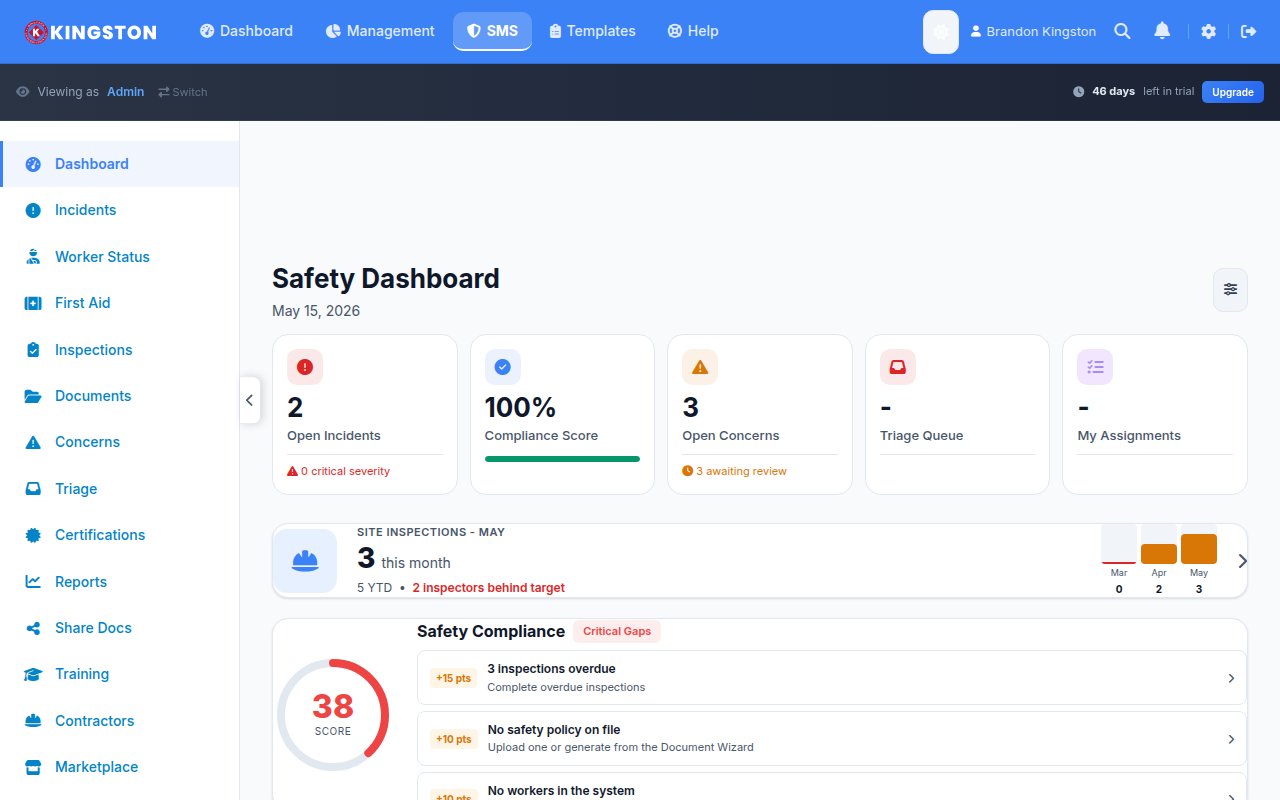
Schedule a demo of Make Safety Easy to see how our platform supports every pillar of safety culture - from toolbox talks and incident reporting to monthly reviews and corrective action tracking.
Building Safety Culture in Remote and Distributed Workforces
The rise of remote work, multi-site operations and distributed teams presents unique challenges for safety culture. When workers are geographically dispersed, the informal cultural transmission that happens naturally in a shared workspace must be deliberately engineered.
Strategies for distributed safety culture include:
- Virtual safety walkthroughs using video calls where remote leaders observe conditions at dispersed sites
- Digital toolbox talks and safety moments delivered through mobile platforms
- Standardized safety processes and expectations across all locations with local adaptation flexibility
- Regular cross-site safety forums where teams share challenges and solutions
- Centralized reporting and analytics with local visibility and accountability
- Consistent onboarding that immerses new hires in the safety culture regardless of their location
The Psychology of Safety Culture Change
Understanding the psychological dynamics of cultural change helps leaders anticipate resistance and design more effective interventions.
The Change Curve
Every cultural initiative follows a predictable emotional arc. Initial excitement gives way to the "valley of despair" as implementation challenges surface and the gap between aspiration and reality becomes apparent. Leaders who understand this curve can prepare their organizations for the difficult middle phase and sustain momentum through it.
Social Proof and Normalization
Humans are profoundly influenced by what they perceive others doing. When workers see their peers reporting near misses, stopping unsafe work and participating in safety activities, these behaviors become normalized. This is why peer observation programs and public recognition are so powerful - they make safe behavior visible and socially reinforced.
Psychological Safety
Amy Edmondson's research on psychological safety has direct implications for safety culture. Workers must feel safe to speak up about physical safety concerns without fear of ridicule, retaliation or career consequences. Building psychological safety requires leaders to respond to reports with gratitude rather than frustration, to treat mistakes as learning opportunities and to model vulnerability by admitting their own errors.
Identity and Belonging
The most powerful cultural shift occurs when safety becomes part of workers' professional identity - "I am someone who works safely" rather than "I follow safety rules." This identity shift is fostered through storytelling, mentoring, peer recognition and opportunities to contribute to safety in meaningful ways.
Integrating Safety Culture with Organizational Culture
Safety culture does not exist in isolation. It is a subset of organizational culture and must be aligned with the broader values, systems and priorities of the business. Organizations that try to build a participative safety culture within an autocratic management system will encounter constant friction.
Key alignment areas include:
- Operational excellence. Frame safety as a core component of quality and efficiency, not a competing priority
- Human resources. Integrate safety into hiring criteria, onboarding processes, performance management and promotion decisions
- Finance. Track and communicate the financial impact of safety performance - both costs of failure and returns on investment
- Strategy. Include safety culture objectives in the organization's strategic plan alongside financial and operational goals
For a deeper exploration of workplace safety culture principles and how they connect to daily operations, read our Workplace Safety Culture Guide.
Your Next Step: Start Where You Are
Building a safety culture framework does not require perfection. It requires commitment, consistency and the willingness to listen. Start by assessing where you are today using the maturity model above. Identify one or two interventions in each pillar that are achievable within the next 90 days. Secure executive commitment. Engage your frontline workers. Measure what matters. And keep going.
The organizations that achieve safety excellence are not the ones with the biggest budgets or the most sophisticated systems. They are the ones that refuse to accept injuries as inevitable and commit to building a culture where every person goes home safe every day.
Ready to accelerate your safety culture transformation? Explore Make Safety Easy's pricing to find the plan that fits your organization, or request a personalized demo to see how our platform supports every element of the framework described in this guide.
Ready to simplify your safety program?
Make Safety Easy helps teams run toolbox talks, inspections, incident reports and more - all from one platform.
Start Your Free TrialNo credit card required. 14-day free trial.