Due Diligence in Workplace Safety: What Canadian Employers Must Prove
Due diligence in workplace safety is the legal standard that determines whether a Canadian employer has done everything reasonably practicable to protect workers from harm. Under Canadian OHS legislation, most offenses are "strict liability" - the prosecution only needs to prove the offense occurred (such as a violation of a regulation), and the burden then shifts to the employer to prove, on a balance of probabilities, that they exercised due diligence. Employers who cannot demonstrate they took every reasonable precaution face fines, prosecution and in extreme cases, personal liability for directors and officers.
This guide breaks down the due diligence defense as it applies across Canadian jurisdictions, identifies the specific evidence regulators and courts expect to see and provides a practical framework for building a safety management system that satisfies the standard - not just on paper, but in daily practice.
The Legal Foundation of Due Diligence
The due diligence defense in Canadian OHS law was established by the Supreme Court of Canada in R. v. Sault Ste. Marie (City) (1978) and has been refined through decades of subsequent case law. The core test asks two questions:
Free Download: 5 Safe Work Procedures
Choose from 112 professionally written SWPs. No credit card required.
Get Free SWPs- Did the employer take all reasonable precautions? This means identifying foreseeable hazards and implementing controls before an incident occurs - not reacting after the fact.
- Did the employer exercise all reasonable care? This means ensuring that the precautions were actually implemented, communicated, monitored and enforced on a continuous basis.
The standard is objective: would a reasonable employer in similar circumstances have done more? If the answer is yes, the due diligence defense fails.
Every Canadian province and territory, as well as the federal jurisdiction under the Canada Labour Code, recognizes the due diligence defense. While specific regulatory requirements vary by jurisdiction, the underlying evidentiary framework is consistent nationwide.
The Three Pillars of Due Diligence
Courts and regulatory tribunals evaluate due diligence by examining three interconnected areas. Weakness in any one pillar can collapse the entire defense.
Pillar 1: Foreseeability - Identifying Hazards Before They Cause Harm
Employers must demonstrate that they made systematic, ongoing efforts to identify workplace hazards. This is not a one-time exercise - it is a continuous obligation that responds to changes in work activities, equipment, personnel and conditions.
Evidence regulators expect to see:
- Documented hazard assessments for every work area, task and process - updated when conditions change.
- Regular workplace inspections performed on a defined schedule, with findings recorded and corrective actions tracked to completion.
- Job hazard analyses (JHAs) or task-specific risk assessments for non-routine and high-risk work.
- Review of incident history, near-miss data and industry hazard information to identify trends and emerging risks.
- Monitoring of regulatory changes and industry best practices relevant to the employer's operations.
What undermines this pillar: Hazard assessments that have not been updated in years. Inspection programs that exist on paper but show gaps in actual completion. No evidence of responding to near-miss reports. Failure to identify a hazard that was well-known in the industry.
Pillar 2: Prevention - Implementing Effective Controls
Once hazards are identified, employers must implement controls that are appropriate to the level of risk. The hierarchy of controls applies: elimination, substitution, engineering controls, administrative controls and PPE - in that order of preference.
Evidence regulators expect to see:
- Written safety policies and procedures that address each identified hazard.
- A documented training program with records showing who was trained, when, on what topics and with what assessment of competency.
- Procurement and maintenance records for safety equipment, PPE and engineering controls.
- Safe work procedures that are specific, practical and accessible to workers in the field.
- Emergency response plans that are documented, communicated and practiced through drills.
- Corrective action records showing that identified deficiencies were addressed within reasonable timescales.
What undermines this pillar: Policies that exist but are not communicated to workers. Training records that show attendance but no competency verification. PPE that is specified but not provided or not maintained. Corrective actions that were identified months ago but never completed.
Pillar 3: Supervision and Enforcement - Making the System Work in Practice
This pillar is where most due diligence defenses succeed or fail. Courts have consistently held that having good policies and providing good training is not sufficient if the employer does not also take reasonable steps to ensure workers actually follow the rules. An employer who creates a program but does not enforce it has not exercised due diligence.
Evidence regulators expect to see:
- Documentation that supervisors actively monitor work practices and correct unsafe behavior when observed.
- Records of progressive discipline for repeated safety violations (verbal warning, written warning, suspension, termination) - showing that non-compliance has consequences.
- Supervisor training records demonstrating that those responsible for enforcement were competent to fulfill that role.
- Management safety observations, site visits and documented involvement in the safety program at the leadership level.
- Incident and near-miss investigation records showing that root causes were identified and systemic corrective actions were implemented - not just individual blame assigned.
What undermines this pillar: A supervisor who witnessed unsafe work and did nothing. A pattern of safety violations without documented corrective action. A management team that has no documented involvement in safety activities. Investigations that stop at "worker error" without examining system failures.
Common Due Diligence Failures: What Courts Have Cited
Reviewing case law reveals recurring patterns in failed due diligence defenses. These real-world failures illustrate what regulators consider unreasonable:
| Failure Category | Example | Court Finding |
|---|---|---|
| No hazard assessment | Employer could not produce a hazard assessment for the task being performed when the incident occurred | Due diligence defense failed - hazard was foreseeable and known in the industry |
| Paper-only program | Employer had a written safety manual but workers testified they had never seen it and were never trained on its contents | Due diligence defense failed - a program that is not communicated provides no protection |
| No enforcement | Workers routinely bypassed a machine guard; supervisor was aware but took no action | Due diligence defense failed - employer had constructive knowledge of the violation and failed to act |
| Inadequate training | Worker was assigned to operate equipment for which they received only verbal instruction with no competency verification | Due diligence defense failed - training was not reasonable for the level of risk |
| Delayed corrective action | Inspection identified a fall hazard; corrective action was not completed for three months; a fall occurred during that period | Due diligence defense failed - employer knew of the hazard and did not act within a reasonable time |
Building a Due Diligence Documentation Framework
Documentation is not bureaucracy - it is the literal evidence of your due diligence defense. If it is not documented, it did not happen in the eyes of a court. Build your framework around these records:
- Hazard assessments and inspection records. Date-stamped, signed, with photos where applicable. Tracked from identification through corrective action to closure. Use digital inspection tools to create a chain of evidence that is timestamped, geotagged and accessible.
- Training records. Who attended, what was covered, when, who delivered the training and how competency was assessed. Signatures or digital acknowledgment required.
- Policies and procedures. Version-controlled documents with distribution records proving workers received them. Store and distribute through a document management system that tracks acknowledgment.
- Incident and near-miss investigation records. Documented through your incident reporting system with root cause analysis, corrective actions, implementation timelines and closure verification.
- Supervision and enforcement records. Safety observation logs, corrective coaching records, progressive discipline documentation and management site visit records.
- Meeting minutes. Safety committee meetings, management safety reviews and toolbox talk records with attendance and topics covered.
- Equipment and maintenance records. Inspection logs, calibration records, maintenance schedules and repair histories for safety-critical equipment.
The Cost of Failing Due Diligence
The consequences of an unsuccessful due diligence defense are severe and personal:
- Corporate fines. Maximum fines vary by province but can reach $1.5 million or more per offense in several jurisdictions. Ontario's maximum fine for a corporation is $2 million per offense under the OHSA.
- Personal liability. Directors, officers and supervisors can be personally charged and fined. Prison sentences are possible under the Criminal Code of Canada (Bill C-45 / Westray amendments, Section 217.1) for criminal negligence causing death or bodily harm.
- Reputational damage. OHS convictions are public record. In competitive industries - particularly those involving government contracts - a conviction can disqualify an employer from bidding.
- Workers' compensation surcharges. Increased premiums follow a pattern of incidents, compounding the financial impact for years.
- Civil liability. Beyond regulatory penalties, employers face civil suits from injured workers (in limited circumstances) and from third parties affected by workplace incidents.
Digital Safety Management as a Due Diligence Tool
The single biggest practical challenge with due diligence is maintaining the volume and quality of documentation required across multiple sites, shifts and years. Paper systems develop gaps. Spreadsheets go missing. Email trails are incomplete. When an inspector or prosecutor asks for records, you need to produce them - complete, organized and date-verified - in hours, not weeks.
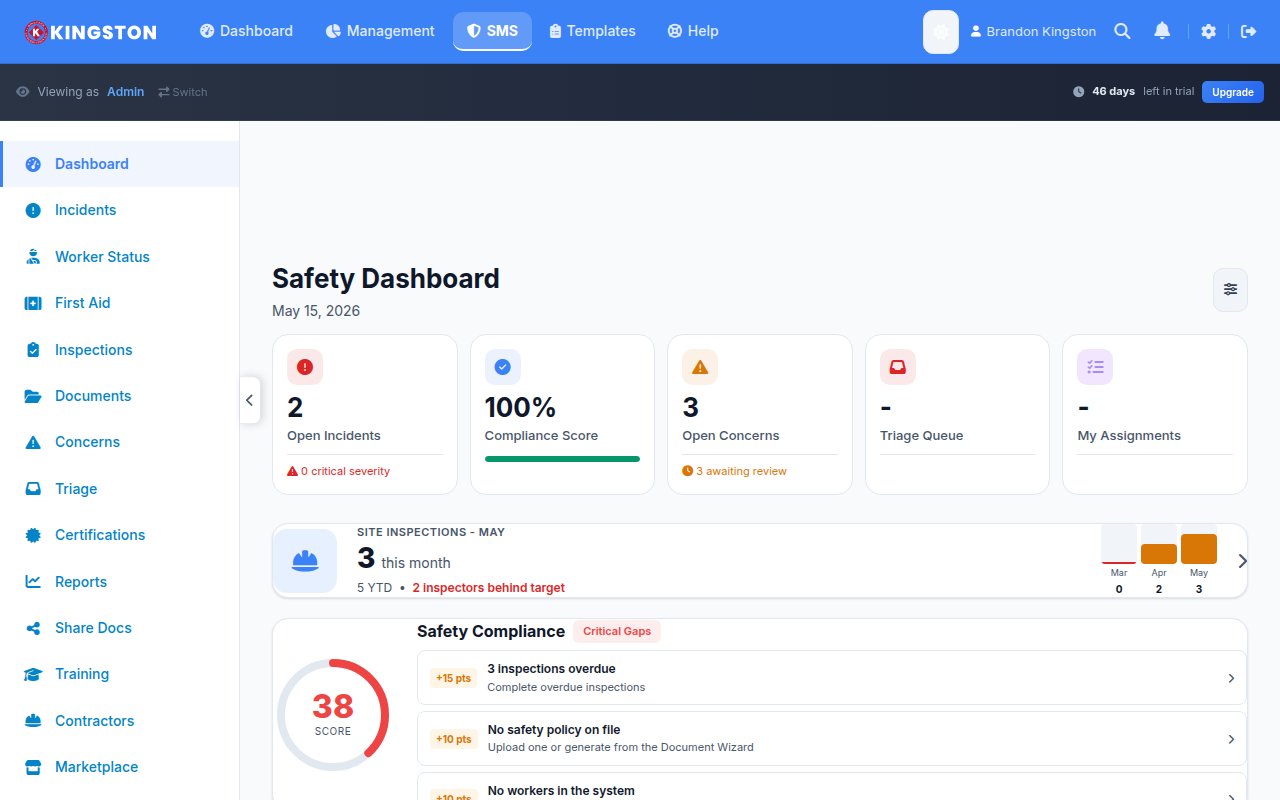
Make Safety Easy is built to serve as the documentation backbone of your due diligence program. Inspections, incident reports, and document management all feed into a centralized, searchable system with automatic timestamps, completion tracking and audit-ready reports. Every inspection, every training record, every corrective action is preserved and accessible from any device.
Your due diligence defense is only as strong as your records. Book a demo to see how Make Safety Easy builds the evidence trail that protects your workers and your organization, or explore our pricing to get started.
Ready to simplify your safety program?
Make Safety Easy helps teams run toolbox talks, inspections, incident reports and more - all from one platform.
Start Your Free TrialNo credit card required. 14-day free trial.