Environmental safety management is the systematic approach to identifying, controlling and reducing environmental hazards and workplace safety risks within a single integrated framework. Often called EHS (Environment, Health and Safety) management, this discipline combines environmental compliance (EPA, state agencies) with occupational safety compliance (OSHA) to protect workers, communities and natural resources simultaneously. Organizations with mature EHS management systems experience fewer regulatory violations, lower incident rates and stronger operational performance than those that treat environmental and safety programs as separate silos.
What Is an EHS Management System?
An EHS management system is a structured set of policies, procedures, processes and tools that an organization uses to manage its environmental and safety obligations. The most widely recognized framework is ISO 45001 (occupational health and safety) paired with ISO 14001 (environmental management), though many organizations build systems aligned with these standards without pursuing formal certification.
The core elements of any effective EHS management system include:
Free Download: 5 Safe Work Procedures
Choose from 112 professionally written SWPs. No credit card required.
Get Free SWPs- Leadership commitment: Documented management support with defined roles, responsibilities and authority
- Hazard identification and risk assessment: Systematic processes for identifying environmental and safety hazards across all operations
- Legal compliance tracking: Mechanisms for identifying applicable regulations and monitoring ongoing compliance
- Objectives and targets: Measurable goals for reducing environmental impact and improving safety performance
- Operational controls: Procedures, engineering controls and administrative measures to manage identified risks
- Training and competency: Programs to ensure all employees have the knowledge and skills to perform their roles safely and in compliance
- Monitoring and measurement: Data collection and analysis to track performance against objectives
- Incident investigation and corrective action: Processes for investigating incidents, identifying root causes and implementing corrections
- Management review: Periodic evaluation of system effectiveness by senior leadership
- Continuous improvement: The Plan-Do-Check-Act cycle applied to every element of the system
Key Regulatory Frameworks
Environmental Regulations
In the United States, environmental compliance is governed primarily by federal laws administered by the Environmental Protection Agency (EPA), with additional requirements from state and local agencies:
- Clean Air Act (CAA): Regulates air emissions from stationary and mobile sources. Facilities may need Title V operating permits and must comply with National Emission Standards for Hazardous Air Pollutants (NESHAP)
- Clean Water Act (CWA): Controls discharge of pollutants into navigable waters. Facilities with point source discharges need National Pollutant Discharge Elimination System (NPDES) permits
- Resource Conservation and Recovery Act (RCRA): Governs the generation, transportation, treatment, storage and disposal of hazardous waste
- Emergency Planning and Community Right-to-Know Act (EPCRA): Requires facilities to report chemical inventories and toxic releases to the public and emergency responders
- Toxic Substances Control Act (TSCA): Regulates the manufacturing, importation, processing and distribution of chemical substances
In Canada, the Canadian Environmental Protection Act (CEPA) serves a similar function at the federal level, with provincial regulations adding further requirements.
Workplace Safety Regulations
OSHA sets the baseline for workplace safety in the United States. In Canada, workplace safety falls under provincial jurisdiction with additional federal oversight for federally regulated industries. Key overlap areas between environmental and safety regulations include:
- Hazardous chemical management (OSHA HazCom + EPA RCRA/EPCRA)
- Emergency response planning (OSHA 1910.120 + EPA's Risk Management Program)
- Air quality (OSHA permissible exposure limits + EPA emission standards)
- Spill prevention and response (OSHA + EPA SPCC requirements)
Building Your Environmental Safety Program
Step 1: Conduct a Baseline Assessment
Before building or improving your EHS program, you need an honest evaluation of where you stand. Conduct a comprehensive assessment that covers:
- Current permits, licenses and regulatory obligations
- Existing policies and procedures (and whether they are being followed)
- Recent inspection results, citations and corrective actions
- Incident history (environmental releases, safety incidents and near misses)
- Training records and gaps
- Waste generation and disposal practices
- Chemical inventory and Safety Data Sheets
Step 2: Identify Applicable Regulations
Create a regulatory register that lists every environmental and safety regulation applicable to your operations. This register should include:
- The regulation or standard (citation number)
- What it requires
- How your facility complies (or plans to comply)
- Key deadlines (permit renewals, reporting dates, training due dates)
- Responsible person or department
Storing this register in a centralized document management system ensures it is accessible to everyone who needs it and can be updated without version confusion.
Step 3: Develop Operational Controls
For each identified hazard and regulatory requirement, establish the controls needed to manage risk:
- Engineering controls: Ventilation systems, containment structures, spill berms, machine guarding
- Administrative controls: Standard operating procedures, work permits, job hazard analyses
- PPE: Chemical-resistant gloves, respirators, eye protection, specialized clothing
- Monitoring: Air sampling, water sampling, noise monitoring, waste tracking
Step 4: Implement a Training Program
EHS training must cover both environmental and safety topics relevant to each employee's role. Common training requirements include:
- Hazard communication (GHS/SDS)
- Hazardous waste management (RCRA generator training)
- Spill prevention and response
- Emergency action plans
- Stormwater pollution prevention
- Job-specific safety training (fall protection, confined space, lockout/tagout)
Step 5: Establish Inspection and Audit Programs
Regular inspections and audits are the backbone of a functioning EHS system. Develop inspection programs that cover:
- Daily or shift-level operational inspections (equipment checks, housekeeping, PPE compliance)
- Weekly or monthly area inspections (waste storage areas, chemical storage, stormwater controls)
- Quarterly or annual compliance audits (permit conditions, regulatory requirements, program effectiveness)
- Post-incident inspections (following any release, spill or safety event)
Waste Management Best Practices
Waste management is often the area where environmental and safety management intersect most directly. Best practices include:
- Waste characterization: Identify and classify every waste stream (hazardous, non-hazardous, universal, special)
- Proper labeling and storage: All containers must be labeled with contents and accumulation start dates. Hazardous waste must be stored in compatible containers in designated areas with secondary containment
- Accumulation time limits: Large quantity generators (LQGs) have 90 days; small quantity generators (SQGs) have 270 days
- Manifesting: All hazardous waste shipments require a Uniform Hazardous Waste Manifest
- Waste minimization: Reduce waste at the source through process changes, material substitution and recycling
Emergency Preparedness
An integrated EHS approach ensures that emergency planning addresses both environmental and human safety concerns. Your emergency plan should cover:
- Chemical spills and releases (containment, notification and cleanup)
- Fire and explosion response
- Medical emergencies
- Natural disasters
- Regulatory notification requirements (who to call and when)
Measuring EHS Performance
Leading organizations track both lagging indicators (what already happened) and leading indicators (what predicts future performance):
Lagging Indicators
- OSHA recordable incident rate (TRIR)
- Days Away, Restricted or Transferred (DART) rate
- Environmental violations and notices of violation
- Reportable spills or releases
- Workers' compensation costs
Leading Indicators
- Inspection completion rates
- Near-miss reporting frequency
- Training completion rates
- Corrective action closure timelines
- Audit finding resolution rates
- Management participation in safety activities
Common EHS Compliance Pitfalls
Even organizations with established EHS programs frequently stumble on these issues:
- Siloed departments: Environmental compliance is managed by one team while safety is managed by another, with no coordination. Hazards that cross both domains - like chemical handling - fall through the cracks between them
- Reactive management: The EHS program only gets attention after a citation, spill or serious injury. Proactive identification and correction of hazards is the foundation of an effective system
- Outdated documentation: Permits, procedures and plans that have not been reviewed in years. Regulatory requirements change, processes evolve and documents must keep pace
- Inadequate contractor oversight: Contractors working on-site are subject to the same environmental and safety requirements as employees. Many incidents involve contractor activities that were not properly managed
- Poor data utilization: Organizations collect inspection data, incident reports and audit findings but never analyze them for trends. The data only has value if it drives decisions
The Business Case for Integrated EHS Management
Beyond regulatory compliance, a well-functioning EHS management system delivers measurable business value. Organizations with strong EHS programs report lower insurance premiums, reduced legal liability, fewer production disruptions from incidents and improved employee retention. Workers who feel safe and see that their employer invests in protecting both people and the environment are more engaged and productive.
From a financial perspective, the cost of a single environmental violation or serious safety incident can dwarf the annual investment in an EHS management system. EPA penalties for environmental violations can reach tens of thousands of dollars per day per violation. OSHA penalties for serious safety violations exceed $16,000 per instance. When you add litigation costs, remediation expenses, production downtime and reputational damage, the return on investment for proactive EHS management is clear.
Frequently Asked Questions
What is the difference between EHS and HSE?
EHS (Environment, Health and Safety) and HSE (Health, Safety and Environment) refer to the same discipline. The order of letters varies by region and company preference, but the scope is identical.
Does my small business need an EHS management system?
Every business that generates waste, uses chemicals or employs workers has environmental and safety obligations. The complexity of your EHS system should scale with your risk profile, but even small operations benefit from a structured approach to compliance.
How often should EHS audits be conducted?
Most organizations conduct internal EHS audits annually at minimum. High-risk facilities, multi-site operations and organizations in heavily regulated industries often audit more frequently (quarterly or semi-annually).
What certifications are available for EHS professionals?
The most recognized certifications include the Certified Safety Professional (CSP), Certified Industrial Hygienist (CIH), Certified Hazardous Materials Manager (CHMM) and the NEBOSH International General Certificate for international practice.
Centralize Your EHS Program
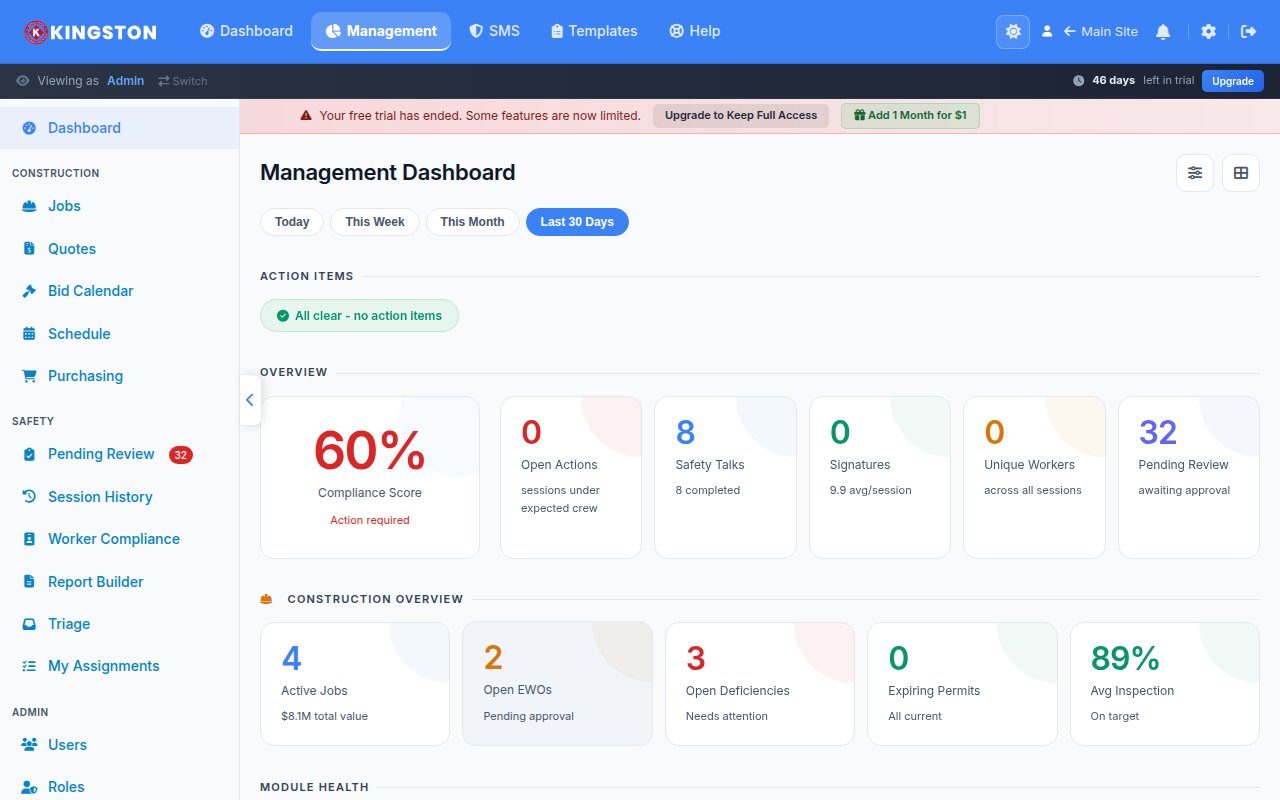
Running an effective environmental safety management program requires a platform that brings inspections, documents, training records and incident data together in one place. Make Safety Easy gives you digital inspection workflows, centralized document storage and real-time dashboards that make EHS management visible and accountable. Book a demo to see how it works for your operation.
Ready to simplify your safety program?
Make Safety Easy helps teams run toolbox talks, inspections, incident reports and more - all from one platform.
Start Your Free TrialNo credit card required. 14-day free trial.