BC forestry safety requirements are governed by WorkSafeBC's Occupational Health and Safety Regulation (OHSR), with dedicated sections under Parts 26 (Forestry Operations) and 26.1 (Falling). Employers operating in British Columbia's forests must maintain a comprehensive safety program that addresses falling and bucking hazards, heavy equipment protocols, remote worksite emergency preparedness and mandatory worker training certifications. Non-compliance doesn't just invite fines - it puts lives at risk in an industry that consistently ranks among Canada's most dangerous.
If you run a logging operation, silviculture crew, or any forestry-adjacent business in BC, this guide is your roadmap. We'll walk through the specific hazards, the regulations that apply and practical steps you can take today to protect your workers and your business.
Why Forestry Safety Matters More in BC Than Almost Anywhere Else
British Columbia's forestry sector is massive. It contributes billions to the provincial economy and employs tens of thousands of workers across the Interior, the Coast and the North. But the terrain is unforgiving. Steep slopes, unpredictable weather, remote locations hours from the nearest hospital - these aren't edge cases. They're the norm.
Free Download: 5 Safe Work Procedures
Choose from 112 professionally written SWPs. No credit card required.
Get Free SWPsWorkSafeBC data consistently shows forestry among the top industries for serious injuries and fatalities. Falling trees, rolling logs, heavy machinery strikes and environmental hazards like widowmakers and unstable root systems create a risk profile unlike any office or warehouse setting. The stakes are real and the margin for error is razor-thin.
That's precisely why BC forestry safety compliance isn't optional - it's a legal and moral imperative. And the regulatory framework reflects that urgency.
Falling and Bucking Hazards: The Core Risk in BC Logging
Falling (the act of felling trees) and bucking (cutting felled trees into logs) remain the single greatest source of fatalities in BC forestry. WorkSafeBC's OHSR Part 26.1 is dedicated entirely to falling operations and for good reason.
Key Regulatory Requirements for Falling Operations
- Certified Fallers Only: All fallers must hold a valid BC Faller Training Standard (BCFTS) certification. No exceptions. Employers must verify this certification before any worker sets foot on a cutblock.
- Falling Plans: A written falling plan must be prepared for each cutblock, identifying hazards like danger trees, terrain features and escape routes.
- Two-Tree-Length Rule: Workers not involved in the falling operation must remain at least two tree lengths away from the faller - a minimum safe distance that accounts for unpredictable fall trajectories.
- Danger Tree Assessment: Every worksite must be assessed for danger trees (dead, leaning, or structurally compromised trees) before and during operations. Workers conducting these assessments need specific training under the Wildlife/Danger Tree Assessor program.
- Escape Routes: Fallers must plan and clear escape routes at 45-degree angles away from the intended fall direction before making their back cut.
Bucking introduces its own hazards: logs under tension can spring violently when cut, steep slopes cause logs to roll unpredictably and chainsaw kickback remains an ever-present danger. Employers must ensure workers understand log tension assessment and use proper bucking techniques as outlined in the BCFTS curriculum.
Tracking these hazards in real time matters. A digital incident reporting system lets field supervisors document near-misses and hazardous conditions the moment they're identified - not three days later when the paperwork finally reaches the office.
Equipment Safety: Machines That Can Save or Take Lives
Modern BC forestry relies heavily on mechanized equipment - feller bunchers, grapple yarders, skidders, processors and log loaders. These machines have dramatically improved productivity. They've also introduced a distinct set of hazards that employers must manage under OHSR Part 16 (Mobile Equipment) and Part 26.
What WorkSafeBC Expects From Employers
- Operator Certification and Competency: Operators must be trained and competent on each specific piece of equipment they use. Generic "heavy equipment" training is insufficient. Employers must document this training.
- Pre-Shift Inspections: Every machine must undergo a documented pre-shift inspection. This includes checking rollover protective structures (ROPS), falling object protective structures (FOPS), hydraulic lines, brakes and safety systems.
- Lockout/Tagout Procedures: Before any maintenance or repair work, equipment must be locked out and tagged according to OHSR Part 10. This is non-negotiable and a frequent audit point.
- Traffic Management Plans: On active logging roads, employers need traffic management plans that address vehicle interactions, road conditions, radio protocols and right-of-way rules. Loaded trucks always have the right-of-way on single-lane logging roads - everyone in your operation needs to know this.
- Guarding and Emergency Stops: All moving parts must be properly guarded. Emergency stop mechanisms must be functional and accessible.
Here's the thing many employers miss: equipment safety isn't just about the machines. It's about the systems around them. Do your operators know the radio channel? Is there a spotter for blind-side operations? Are service trucks carrying spill kits for hydraulic fluid leaks in sensitive riparian areas?
These details separate compliant operations from those that end up on the wrong side of a WorkSafeBC inspection order.
Remote Worksite Protocols: When Help Is Hours Away
This is where BC forestry diverges sharply from most other industries. Your worksite might be 90 minutes by logging road from the nearest town. Cell service? Forget it. A medical emergency that would be routine in an urban setting becomes life-threatening when evacuation means a helicopter or a long, rough ambulance ride.
WorkSafeBC requires employers to address remote worksite challenges head-on.
Communication Requirements
Employers must provide reliable communication systems at remote forestry worksites. This typically means:
- Two-way radio systems with repeater coverage across the operating area
- Satellite phones or satellite communication devices (like inReach or SPOT) as backup
- A clearly documented communication plan that every worker understands
- Regular check-in schedules - if a worker misses a check-in, there must be a defined response protocol
Transportation and Access
Workers must have a reliable means of transportation to and from the worksite. Employers must assess road conditions, bridge weight limits and seasonal access restrictions. Helicopter-access-only sites carry additional regulatory requirements around landing zones, weight limits and pilot qualifications.
Working Alone or in Isolation
OHSR Part 4.20.1 through 4.23 specifically address working alone or in isolation. In forestry, this is common - a faller working a cutblock, a road maintenance worker on a remote spur, a tree planter separated from their crew. Employers must implement a check-in procedure at defined intervals and the procedure must include a response plan if a check-in is missed.
Daily toolbox talks are one of the most effective ways to reinforce remote safety protocols. Five minutes each morning reviewing communication procedures, hazard conditions and emergency contacts can be the difference between a close call and a catastrophe.
WorkSafeBC Forestry Requirements: The Compliance Checklist
Let's consolidate the core logging safety requirements that every BC forestry employer must meet. Consider this your baseline audit checklist:
| Requirement | OHSR Reference | Key Action |
|---|---|---|
| Occupational Health & Safety Program | Part 3 | Written program required for employers with 20+ workers; basic program for fewer |
| Joint Health & Safety Committee | Part 3 | Required for worksites with 20+ workers; worker health & safety representative for 9-19 |
| Falling Certification | Part 26.1 | All fallers must hold valid BCFTS certification |
| New & Young Worker Orientation | Part 3.22-3.25 | Site-specific orientation before work begins |
| First Aid Requirements | Part 3, Schedule 3-A | Level of first aid based on risk, travel time to hospital and number of workers |
| Emergency Response Plan | Part 4.13-4.19 | Written plan addressing rescue, evacuation and communication |
| PPE Requirements | Part 8 | Hard hats, high-vis, chainsaw chaps/pants, steel-toed boots, hearing and eye protection |
| Equipment Inspections | Parts 16, 26 | Documented pre-shift inspections for all mobile equipment |
| Incident Investigation & Reporting | Part 3.4-3.6 | Serious incidents must be reported to WorkSafeBC immediately; investigation within 48 hours |
Missing even one of these items can result in compliance orders, administrative penalties, or - in serious cases - prosecution under the Workers Compensation Act. And the financial impact extends far beyond the fine itself. Lost-time claims, increased premiums, project shutdowns and reputational damage add up fast. If you haven't already, read our breakdown of the real cost of workplace injuries in Canada to understand the full picture.
Emergency Response in Remote Areas: Planning for the Worst
Every forestry employer in BC needs an Emergency Response Plan (ERP). But in remote operations, a generic plan won't cut it. Your ERP must be tailored to the specific challenges of each worksite.
What a Strong Forestry ERP Includes
- Evacuation Routes and Methods: Define primary and secondary evacuation routes. Identify helicopter landing zones if road access may be compromised. Know which hospitals have trauma capabilities and which are limited-service facilities.
- First Aid Coverage: WorkSafeBC's Schedule 3-A calculates your minimum first aid requirements based on a risk matrix. For high-risk forestry operations more than 20 minutes from a hospital, you'll likely need a Level 3 first aid attendant and a dedicated first aid vehicle (industrial ambulance).
- Rescue Procedures: Steep-slope rescue, river crossings, vehicle extrication - your ERP must address the realistic scenarios your workers face. Annual rescue drills aren't just best practice; they're increasingly expected by WorkSafeBC inspectors.
- Fire Response: Wildfire risk is part of operating in BC's forests. Your ERP must include fire suppression equipment requirements, evacuation triggers (typically tied to BC Wildfire Service danger ratings), and communication protocols with the relevant fire centre.
- Environmental Spill Response: Fuel, hydraulic fluid and other contaminants must be contained immediately. Spill kits must be on site and workers must be trained in their use - particularly near waterways and sensitive ecosystems.
The best ERP in the world is useless if workers don't know it exists. Post it. Review it. Drill it. And document everything - because when a WorkSafeBC officer arrives after an incident, the first thing they'll ask for is your written plan and proof that your crew was trained on it.
Simplifying Forestry Safety Compliance With Digital Tools
Paper-based safety management in forestry is a losing battle. Forms get soaked in the rain. Binders sit in the crummy and never get opened. Incident reports arrive at the office days or weeks late. By the time you realize there's a compliance gap, it's already too late.
That's why forward-thinking forestry employers across BC are moving to digital safety platforms. With the right system, you can:
- Conduct and record daily toolbox talks with automatic timestamping and worker sign-off - even offline in areas without cell service
- File incident reports from the field, complete with photos, GPS coordinates and corrective action tracking
- Maintain a living library of falling plans, ERPs and equipment inspection records that WorkSafeBC can access during an audit
- Track worker certifications (BCFTS, first aid, equipment-specific) with automated expiry alerts so nothing lapses
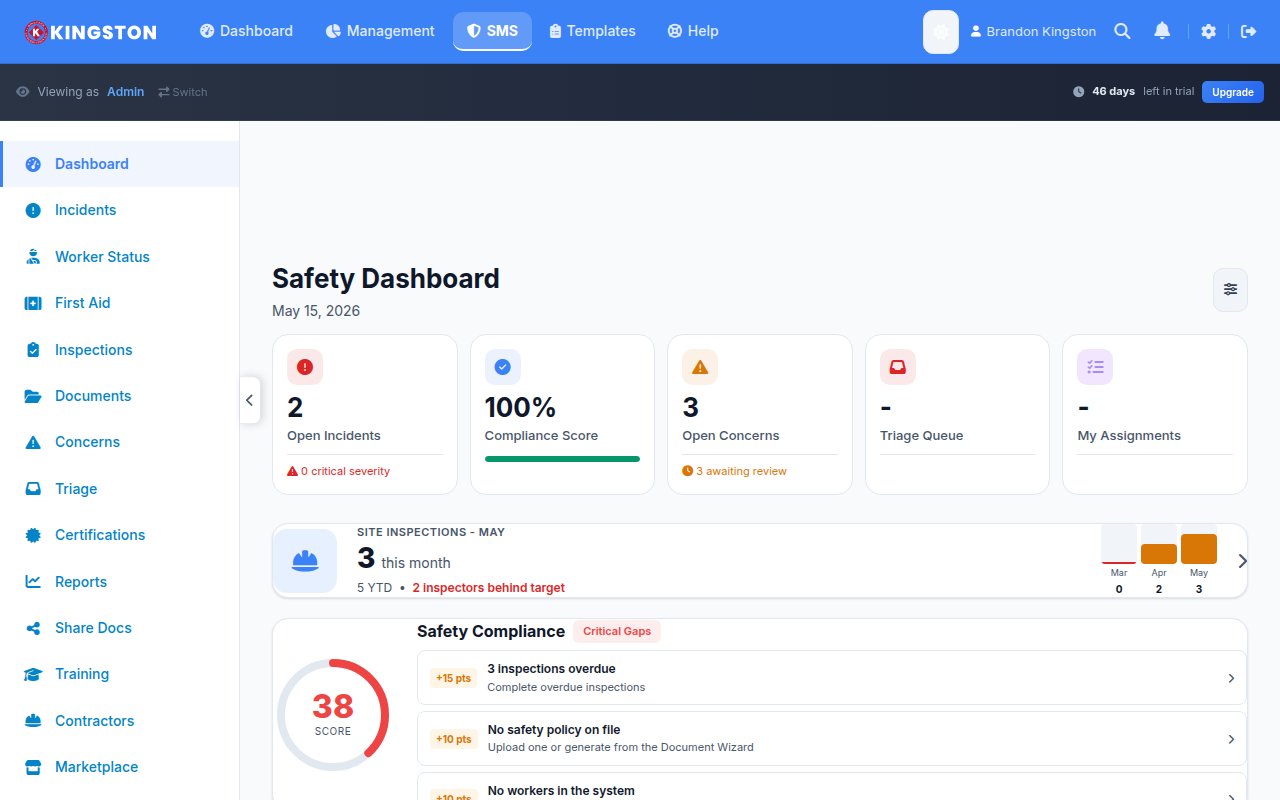
- Generate compliance dashboards that give you a real-time view of your safety program's health
The cost of implementing a digital safety system is a fraction of a single lost-time claim - and it's not even close.
The Bottom Line: Compliance Is the Floor, Not the Ceiling
Meeting WorkSafeBC's forestry safety requirements is the minimum. It's the legal floor. The employers who truly protect their workers go beyond the checklist - they build a culture where safety isn't a box to tick but a value that drives every decision, from the bid stage to the final load.
BC's forests are beautiful, valuable and dangerous. The workers who harvest them deserve every protection we can provide. Start with compliance. Then keep going.