Forklift Safety: The Complete Employer's Guide
Forklift safety is a critical concern for any workplace that uses powered industrial trucks - from warehouses and distribution centers to manufacturing floors and construction sites. OSHA estimates that forklifts are involved in approximately 85 fatalities and 34,900 serious injuries annually in the United States, with tip-overs, pedestrian strikes and falling loads representing the most common fatal and serious incident types. The forklift training requirements under OSHA 29 CFR 1910.178 and equivalent Canadian provincial regulations exist because untrained operators are the single greatest risk factor in forklift incidents.
This guide covers everything employers and safety professionals need to know: regulatory training mandates, forklift inspection checklists, operational best practices and how to build a sustainable forklift safety program that protects workers and keeps you compliant.
OSHA Forklift Training Requirements
OSHA's powered industrial truck standard (29 CFR 1910.178) is among the most frequently cited standards during inspections. The training requirements are specific and non-negotiable.
Free Download: 5 Safe Work Procedures
Choose from 112 professionally written SWPs. No credit card required.
Get Free SWPsWho Needs Training?
Every employee who operates a powered industrial truck must be trained and evaluated before they operate a forklift unsupervised. This applies to:
- Full-time forklift operators
- Employees who operate forklifts occasionally or as a secondary duty
- Temporary and contract workers
- Supervisors who may operate forklifts
Holding a driver's license does not qualify someone to operate a forklift. Period.
Required Training Components
OSHA requires training to include three distinct elements:
- Formal instruction: Classroom-style training covering truck-related topics and workplace-related topics (can include lectures, written materials, videos, or interactive programs)
- Practical training: Hands-on exercises performed under direct supervision of a qualified trainer, including actual operation of the forklift type the worker will use
- Evaluation: The employer must evaluate the operator's ability to safely operate the forklift in the actual workplace conditions where they'll work
Specific Training Topics Required by OSHA
Training must address both truck-related topics and workplace-related topics:
| Truck-Related Topics | Workplace-Related Topics |
|---|---|
| Operating instructions and warnings | Surface and ground conditions |
| Differences between forklift and automobile operation | Composition of loads and load stability |
| Forklift controls and instrumentation | Pedestrian traffic patterns |
| Engine/motor operation and limitations | Narrow aisles, intersections, blind spots |
| Steering and maneuvering (rear-steer dynamics) | Ramps, grades and inclines |
| Fork and attachment operation | Hazardous locations and classified atmospheres |
| Vehicle capacity and stability (load center, tip-over triangle) | Dock operations and trailer securing |
| Inspection and maintenance requirements | Operating near edge of loading docks or ramps |
| Refueling/recharging procedures | Environmental conditions (ventilation, lighting) |
Refresher Training and Re-Evaluation
OSHA requires refresher training when:
- The operator is observed operating unsafely
- The operator is involved in an incident or near miss
- An evaluation reveals unsafe operation
- The operator is assigned a different type of forklift
- Workplace conditions change (new racking, different floor surfaces, layout changes)
Additionally, OSHA requires an evaluation of every operator at least once every three years, regardless of whether any triggering events have occurred.
Canadian Forklift Training Requirements
In Canada, forklift training requirements are set by provincial OHS regulations. Common elements include:
- British Columbia: WorkSafeBC requires operators to be trained and evaluated as competent; CSA B335 is the referenced standard for lift truck operator training
- Alberta: OHS Code Part 40 requires powered mobile equipment operators to be competent, with training documented
- Ontario: Regulation 851 requires training for operators of powered material handling equipment, with operator records maintained
- CSA B335-15: The Canadian national standard for safety training of lift truck operators, widely referenced across provinces
Forklift Pre-Shift Inspection Checklist
Daily pre-shift inspections are required by OSHA and are the first line of defense against mechanical failures that cause incidents. Operators must inspect the forklift before starting work each shift.
Visual (Walk-Around) Inspection
- Tires: check for damage, proper inflation (pneumatic), and wear
- Forks: check for cracks, bends, uneven height and proper locking pin engagement
- Mast and chains: check for wear, damage and proper lubrication
- Hydraulic system: check for leaks (cylinders, hoses, connections)
- Fluid levels: engine oil, coolant, hydraulic fluid, battery water level (electric units)
- Safety devices: overhead guard integrity, load backrest, seat belt, warning lights/horn
- Data plate: legible and present, showing rated capacity
- Battery and cables (electric forklifts): no corrosion, secure connections, adequate charge
- LP tank (LP-powered): properly secured, not expired, connections tight
Operational Check (Seated)
- Service brake: stops and holds on grade
- Parking brake: holds on grade with transmission in neutral
- Steering: smooth operation through full range with no excessive play
- Lift and tilt controls: smooth operation, no jerking or drifting when released
- Horn: functioning
- Lights: headlights, taillights, warning/strobe lights operational
- Backup alarm: functioning
- Gauges and instruments: all reading within normal ranges
- Seat belt: retracts and latches properly
Critical rule: Any forklift that fails a pre-shift inspection must be immediately removed from service and tagged out until repaired. Operators must be trained - and empowered - to shut down an unsafe machine without fear of reprisal.
Common Forklift Hazards and Prevention Strategies
Tip-Overs
Forklift tip-overs (both lateral and longitudinal) are the leading cause of forklift fatalities. The physics are unforgiving: forklifts have a high center of gravity, rear-steer dynamics and a three-point stability triangle that is easily exceeded.
Prevention:
- Never exceed the rated capacity shown on the data plate
- Keep loads low and tilted back during travel
- Slow down on turns - centrifugal force shifts the center of gravity
- Never turn on a ramp or incline
- Always wear the seat belt - in a tip-over, staying in the operator compartment is safer than jumping
Pedestrian Strikes
Forklifts and pedestrians operating in the same space is inherently dangerous. Limited visibility (especially when carrying loads), quiet electric motors and the "familiarity effect" all contribute to collisions.
Prevention:
- Establish dedicated pedestrian walkways separated from forklift traffic
- Install mirrors and warning signs at blind intersections
- Use blue spot lights or red zone lights to project visible warnings ahead of the forklift
- Require horn use at intersections, doorways and blind corners
- Implement a zero-tolerance policy for pedestrians walking under raised forks
Falling Loads
Improperly secured, unevenly stacked, or overloaded pallets can shift or fall during transport, racking placement, or sudden stops.
Prevention:
- Verify load stability before lifting - refuse unstable loads
- Use load-securing devices (stretch wrap, banding, pallet collars) for irregular loads
- Never stack loads higher than the load backrest unless appropriate attachments are used
- Approach racking squarely and slowly; use spotters when visibility is limited
Dock Falls
Forklifts driving off unsecured loading docks - or into trailers that pull away prematurely - cause severe injuries and fatalities every year.
Prevention:
- Use wheel chocks and/or vehicle restraint systems on every trailer before loading/unloading
- Verify trailer floor integrity before entering (especially older refrigerated trailers)
- Use dock locks or communication protocols to prevent premature trailer departure
- Install dock barriers or gates to prevent edge falls
Building a Forklift Safety Program
Compliance with training and inspection requirements is the baseline. An effective forklift safety program goes further with these elements:
- Operator authorization system: Maintain a list of trained, evaluated and authorized operators. Only authorized individuals operate forklifts.
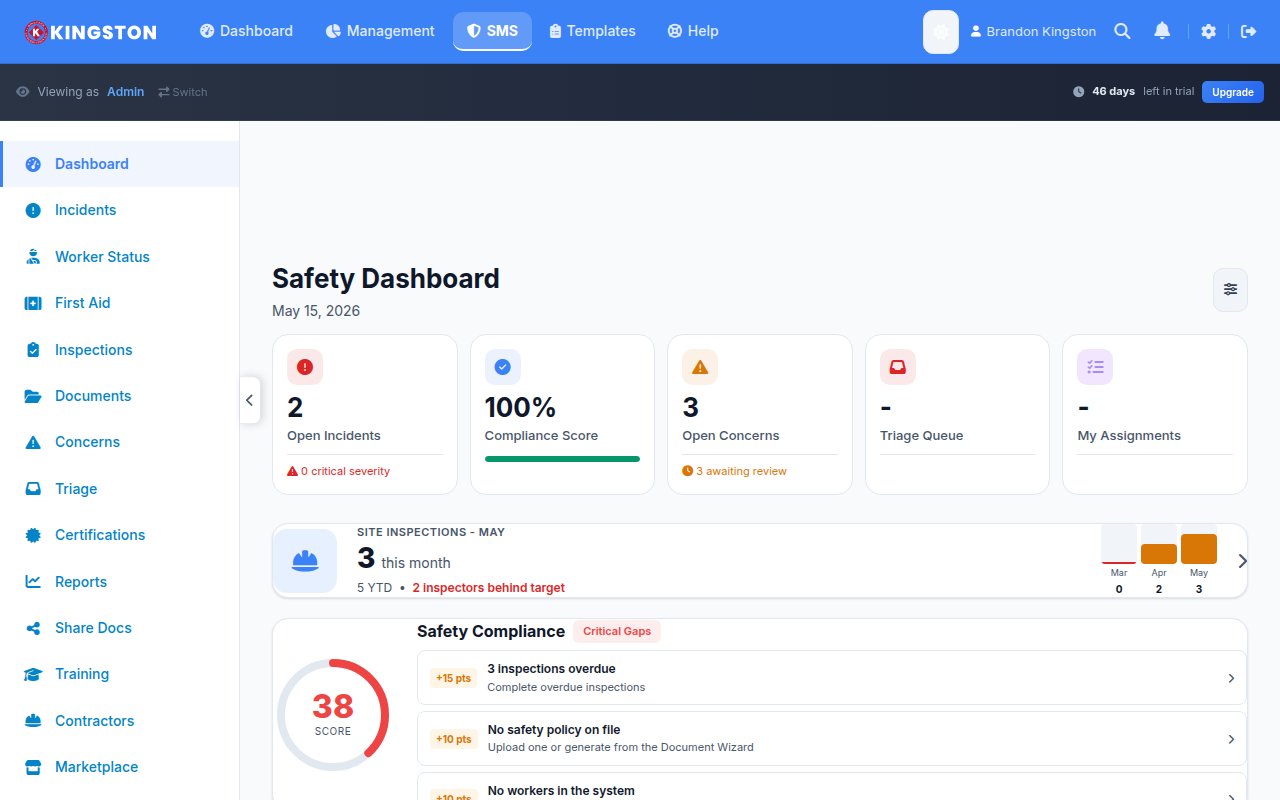
- Digital inspection tracking: Use a digital inspection platform to ensure pre-shift inspections are completed, documented and deficiencies are acted on before the forklift is operated.
- Regular toolbox talks: Conduct short, focused toolbox talks on forklift topics - tip-over physics, pedestrian awareness, load stability, charging safety - to keep awareness high between formal training sessions.
- Speed management: Establish posted speed limits appropriate to each area and enforce them. Consider electronic speed limiters in high-traffic zones.
- Traffic management plan: Map out forklift routes, pedestrian paths, intersection protocols and one-way aisles. Post the plan visibly and review it during orientation. Refer to your warehouse safety management guide for comprehensive layout strategies.
- Maintenance program: Beyond daily inspections, follow the manufacturer's recommended maintenance schedule. Keep maintenance logs and ensure only qualified technicians perform repairs.
Forklift Incident Response
Despite best efforts, incidents happen. How you respond determines whether the same incident happens again.
- Secure the scene: Shut down the forklift, establish a perimeter and attend to any injured persons
- Report immediately: Use your incident reporting system to document the event while details are fresh
- Investigate root causes: Go beyond "operator error" - was training adequate? Was the forklift maintained? Were traffic management controls in place? Was the operator fatigued?
- Implement corrective actions: Assign specific actions with deadlines and responsible persons
- Communicate lessons learned: Share findings (without blame) through toolbox talks and safety bulletins
- Re-evaluate the operator: OSHA requires refresher training and re-evaluation after an incident
Manage Your Forklift Safety Program with Make Safety Easy
Tracking operator certifications, daily inspections, maintenance schedules and incident investigations across a fleet of forklifts requires more than spreadsheets and paper forms. Make Safety Easy gives you a centralized platform to manage digital inspections, schedule and document toolbox talks, and maintain a complete audit trail of your forklift safety program.
Ready to take control of forklift safety at your operation? Book a free demo to see the platform in action, or view our pricing to find the right plan for your team.
Learn more about how Make Safety Easy serves the forklift safety in warehousing industry with purpose-built safety tools.
Ready to simplify your safety program?
Make Safety Easy helps teams run toolbox talks, inspections, incident reports and more - all from one platform.
Start Your Free TrialNo credit card required. 14-day free trial.