The Total Recordable Incident Rate (TRIR) is a standardized safety metric that measures the number of OSHA-recordable injuries and illnesses per 100 full-time equivalent workers over a one-year period. The formula is: (Number of recordable incidents x 200,000) / Total hours worked. The 200,000 figure represents 100 employees working 40 hours per week for 50 weeks. TRIR is the most widely used lagging indicator in occupational safety, referenced by OSHA, insurance carriers, prequalification services and clients evaluating contractor safety performance.
Understanding and accurately calculating your TRIR matters for two reasons. First, it provides a standardized way to compare your safety performance against your industry average and your own historical trend. Second, a high TRIR can disqualify your company from contracts, increase your Experience Modification Rate (EMR) and drive up insurance premiums. A low TRIR signals to clients and insurers that you manage risk effectively.
The TRIR Formula Explained
The formula is simple, but getting the inputs right requires attention:
Free Download: 5 Safe Work Procedures
Choose from 112 professionally written SWPs. No credit card required.
Get Free SWPsTRIR = (Number of OSHA-recordable incidents x 200,000) / Total hours worked by all employees
Breaking down each component:
Number of OSHA-Recordable Incidents
This is the total count of injuries and illnesses that meet OSHA's recording criteria under 29 CFR 1904. Recordable incidents include:
- Any work-related fatality
- Any work-related injury or illness resulting in days away from work
- Any work-related injury or illness resulting in restricted work or job transfer
- Any work-related injury or illness requiring medical treatment beyond first aid
- Any work-related loss of consciousness
- Any significant work-related injury or illness diagnosed by a physician or licensed healthcare professional (fractures, punctured eardrums, chronic irreversible diseases, etc.)
First aid cases do not count. The distinction between first aid and medical treatment is defined by OSHA in 29 CFR 1904.7. Common confusion points: prescription medications make a case recordable; over-the-counter medications at nonprescription strength do not. Stitches (sutures) make a case recordable; butterfly bandages do not.
The 200,000 Multiplier
This is a constant. It represents the equivalent hours worked by 100 full-time employees in one year (100 workers x 40 hours/week x 50 weeks). The multiplier normalizes the rate so companies of different sizes can be compared on equal footing.
Total Hours Worked
This is the sum of all hours actually worked by all employees during the period being measured. Include regular time, overtime and hours worked by temporary employees who are on your payroll. Do not include paid time off (vacation, sick days, holidays) because those hours do not represent exposure to workplace hazards.
Getting this number right matters. Overestimating hours worked will make your TRIR appear artificially low. Underestimating hours will inflate it. Pull the number from your payroll system, not from an estimate.
TRIR Calculation Examples
Example 1: Small Company
A roofing contractor with 25 employees worked a total of 52,000 hours last year. They had 2 recordable incidents (one broken wrist, one laceration requiring stitches).
TRIR = (2 x 200,000) / 52,000 = 400,000 / 52,000 = 7.69
This means that for every 100 full-time workers, there would be approximately 7.69 recordable incidents per year. For the construction industry, the 2024 BLS average was approximately 2.8, so this contractor is significantly above the industry average.
Example 2: Mid-Size Manufacturer
A manufacturing plant with 200 employees worked 416,000 hours and recorded 5 incidents.
TRIR = (5 x 200,000) / 416,000 = 1,000,000 / 416,000 = 2.40
The manufacturing sector average TRIR is roughly 3.3 (varies by sub-sector), so this plant is performing better than the industry norm.
Example 3: Large Contractor
A general contractor with 1,500 employees across multiple projects worked 3,120,000 hours and recorded 18 incidents.
TRIR = (18 x 200,000) / 3,120,000 = 3,600,000 / 3,120,000 = 1.15
This is a strong result for a large construction firm and would be competitive in most prequalification evaluations.
What Is a Good TRIR?
There is no universal "good" number because rates vary by industry. However, these benchmarks provide context:
- Construction: Industry average around 2.8. Below 2.0 is considered strong.
- Manufacturing: Industry average around 3.3. Below 2.0 is strong.
- Oil and gas extraction: Industry average around 0.8. Below 0.5 is strong.
- Transportation and warehousing: Industry average around 4.5. Below 3.0 is strong.
- All private industry: Average around 2.8.
These figures come from the Bureau of Labor Statistics (BLS) Survey of Occupational Injuries and Illnesses. Check the most current BLS data for your specific NAICS code to get the most accurate benchmark.
Many owner/clients and prequalification platforms (ISNetworld, Avetta, Veriforce) have their own TRIR thresholds. Falling above their cutoff can disqualify you from bidding on work, regardless of how you compare to the industry average.
Related Incident Rate Calculations
DART Rate
The Days Away, Restricted or Transferred (DART) rate is a subset of TRIR that only counts incidents resulting in days away from work, restricted duty or job transfer. The formula is the same, but the numerator is smaller:
DART Rate = (DART incidents x 200,000) / Total hours worked
DART is considered a more meaningful metric by many safety professionals because it excludes "minor" recordables (those requiring only medical treatment) and focuses on incidents with greater impact.
LTIR (Lost Time Incident Rate)
The Lost Time Incident Rate counts only incidents that result in one or more days away from work:
LTIR = (Lost time incidents x 200,000) / Total hours worked
LTIR is stricter than DART because it excludes restricted duty and job transfer cases.
Severity Rate
The severity rate measures the total number of lost workdays per 100 full-time workers:
Severity Rate = (Total lost workdays x 200,000) / Total hours worked
This adds a dimension that TRIR misses. Two companies could have the same TRIR, but if one company's incidents result in 5 lost days total and the other's result in 500 lost days, their safety performance is not equivalent.
For a deeper exploration of how leading and lagging indicators work together to drive safety improvement, see our guide on leading vs. lagging safety indicators.
Common TRIR Calculation Mistakes
Including first aid cases. Only OSHA-recordable incidents belong in the numerator. A bandaged cut or an ice pack for a bruise is first aid, not a recordable. Including first aid inflates your rate.
Using headcount instead of hours worked. The denominator must be actual hours worked, not estimated hours based on employee count. If you have 50 employees, their hours worked might be 95,000 or 110,000 depending on overtime, part-time schedules and turnover. Use payroll data.
Excluding temporary workers. If temporary employees are on your payroll (you direct their work and they appear on your OSHA 300 log), their hours and incidents must be included in your calculation.
Calculating for the wrong time period. TRIR is typically calculated annually, but it can be calculated quarterly or monthly for internal trending. Just ensure the hours worked and incidents cover the same time period.
Omitting recordable incidents. Under-recording is a serious compliance issue. OSHA audits 300 logs and has penalized employers for failing to record qualifying incidents. Every case that meets the recording criteria must be on the log and in your TRIR calculation.
How to Lower Your TRIR
Improving your TRIR is not about avoiding recordkeeping (that creates legal risk). It is about preventing incidents. Practical strategies include:
- Strengthen leading indicators. Track near-miss reports, safety observations, training completion rates and inspection scores. These predict future incidents before they happen.
- Invest in hazard identification. Job Safety Analyses, pre-task plans and site inspections catch hazards before they cause injuries.
- Improve incident investigation. Every recordable incident should trigger a root-cause investigation. Identify systemic failures, not just individual errors.
- Increase supervisor engagement. Supervisors who conduct regular safety observations and address hazards immediately create safer work environments.
- Review your return-to-work program. Effective transitional duty programs reduce lost-time days, which improves your DART rate and demonstrates that your organization supports injured workers.
Tracking and Reporting Your TRIR
Calculating TRIR once a year for your OSHA 300A summary is the minimum. Best-in-class safety programs calculate and review incident rates monthly. This allows you to spot trends early - a spike in incidents at a particular job site, a seasonal pattern or a correlation with new employee onboarding.
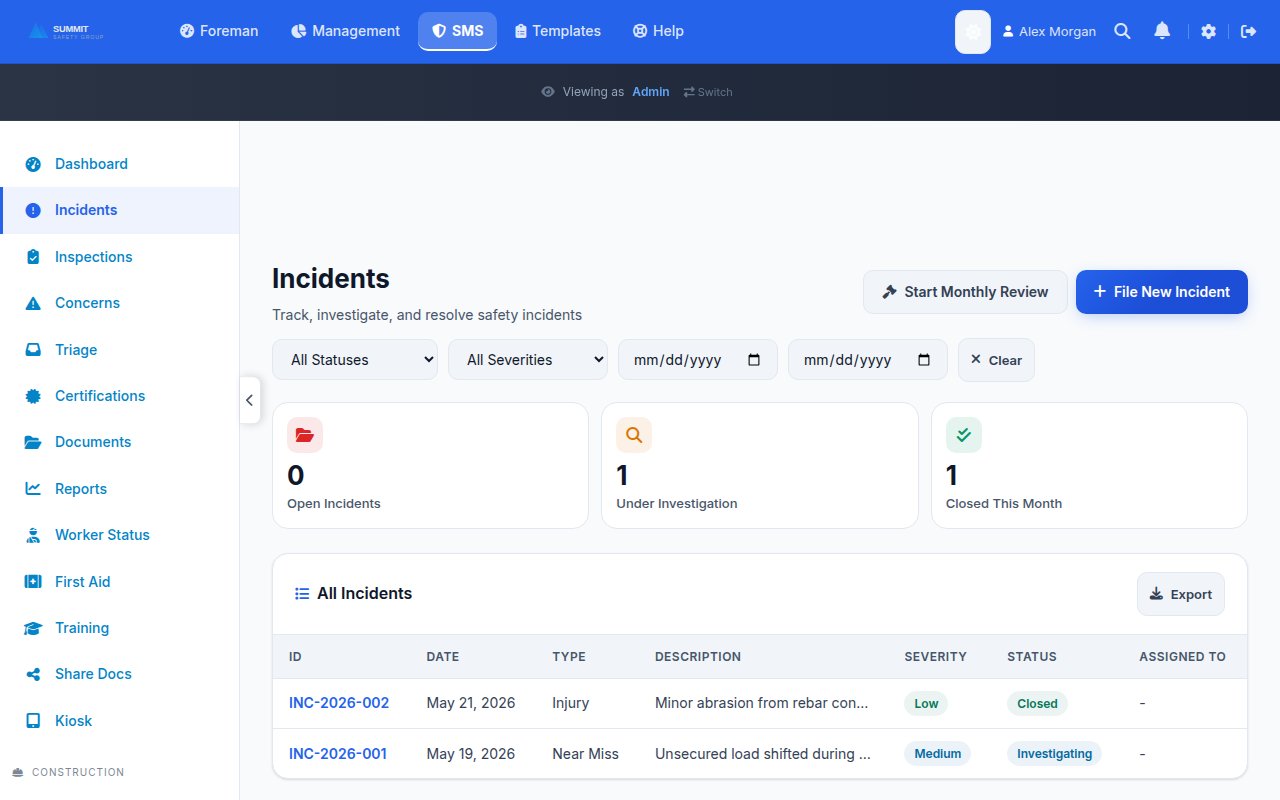
Make Safety Easy's monthly review feature automates incident rate tracking. The platform pulls data from your incident logs and hours worked, calculates TRIR, DART and severity rates automatically and presents trends in a dashboard your leadership team can review in minutes.
Make Your Safety Data Work for You
Manually calculating TRIR on a spreadsheet works until it does not - missed incidents, incorrect hours, formula errors and outdated data all compromise accuracy. Make Safety Easy tracks every recordable incident, calculates your rates in real time and gives you the dashboards to prove your safety performance to clients, insurers and regulators. Book a demo to see automated TRIR tracking in action, or check our pricing page to get started.
Ready to simplify your safety program?
Make Safety Easy helps teams run toolbox talks, inspections, incident reports and more - all from one platform.
Start Your Free TrialNo credit card required. 14-day free trial.