To calculate TRIR (Total Recordable Incident Rate), multiply the number of OSHA-recordable incidents by 200,000, then divide by the total hours worked by all employees during the period. The formula is: TRIR = (Number of Recordable Incidents x 200,000) / Total Hours Worked. The 200,000 figure represents the approximate hours 100 full-time employees work in a year (100 workers x 40 hours x 50 weeks). This metric is the standard way companies, insurers and regulators benchmark workplace safety performance.
The TRIR Formula Explained
The OSHA incident rate calculation is straightforward once you understand its components:
TRIR = (N x 200,000) / EH
Free Download: 5 Safe Work Procedures
Choose from 112 professionally written SWPs. No credit card required.
Get Free SWPsWhere:
- N = Number of OSHA-recordable injuries and illnesses during the period
- 200,000 = Base hours representing 100 full-time equivalent workers
- EH = Total employee hours worked during the same period
The result tells you how many recordable incidents occurred per 100 full-time workers. A TRIR of 3.0 means that for every 100 employees working full-time for a year, there were 3 recordable incidents.
Step-by-Step TRIR Calculation Example
Let's walk through a real-world scenario to make the math concrete.
Example 1: Mid-Size Manufacturer
A manufacturing facility with 250 employees recorded 8 OSHA-recordable incidents over the past 12 months. The total hours worked by all employees during that period was 480,000.
TRIR = (8 x 200,000) / 480,000
TRIR = 1,600,000 / 480,000
TRIR = 3.33
This means the facility experienced 3.33 recordable incidents per 100 full-time workers - slightly above the national average for manufacturing.
Example 2: Construction Company
A construction company with 75 field workers and 25 office staff logged 5 recordable incidents. Total hours worked across all 100 employees: 195,000.
TRIR = (5 x 200,000) / 195,000
TRIR = 1,000,000 / 195,000
TRIR = 5.13
Example 3: Small Service Company
A 30-person service company had zero recordable incidents over 58,500 total hours worked.
TRIR = (0 x 200,000) / 58,500
TRIR = 0.00
A TRIR of zero is the ideal outcome, though for very small companies the rate can swing dramatically with just one incident. That is why context matters when evaluating this metric.
What Counts as an OSHA-Recordable Incident?
Not every workplace injury or illness counts toward your TRIR. Under OSHA's recordkeeping standard (29 CFR Part 1904), an incident is recordable if it results in any of the following:
- Death
- Days away from work (lost-time injury)
- Restricted work or job transfer
- Medical treatment beyond first aid
- Loss of consciousness
- Significant injury or illness diagnosed by a physician (such as a fracture, punctured eardrum or chronic condition)
First-aid-only cases do not count. The distinction between "first aid" and "medical treatment" is critical. For example, using a non-prescription medication at non-prescription strength is first aid. Getting a prescription medication is medical treatment - making the case recordable.
What Is a Good TRIR?
TRIR benchmarks vary significantly by industry. The Bureau of Labor Statistics (BLS) publishes annual incidence rates that serve as the standard comparison. Here are approximate benchmarks based on recent BLS data:
| Industry | Average TRIR |
|---|---|
| Construction | 2.5 - 3.5 |
| Manufacturing | 2.8 - 3.5 |
| Oil and Gas Extraction | 0.8 - 1.5 |
| Transportation and Warehousing | 4.0 - 5.5 |
| Healthcare and Social Assistance | 3.5 - 5.0 |
| Retail Trade | 2.5 - 3.5 |
| Professional Services | 0.5 - 1.5 |
Generally, a TRIR below your industry average signals above-average safety performance. Many world-class safety programs target a TRIR under 1.0 regardless of industry. Clients, general contractors and insurance underwriters often use TRIR as a qualifying threshold - a company with a TRIR above a certain cutoff may be disqualified from bids or face higher premiums.
TRIR vs. Other Safety Metrics
TRIR is one of several incident-based metrics. Understanding how it relates to other rates helps you paint a complete safety picture.
DART Rate (Days Away, Restricted or Transferred)
DART uses the same formula as TRIR but only counts incidents that result in days away from work, restricted duty or job transfer. It excludes medical-treatment-only cases. DART is always equal to or lower than TRIR.
DART = (DART Incidents x 200,000) / Total Hours Worked
LTIR (Lost Time Incident Rate)
LTIR only counts incidents that result in one or more days away from work. It is the most restrictive of the three common rates.
LTIR = (Lost-Time Incidents x 200,000) / Total Hours Worked
Severity Rate
The severity rate measures the number of lost workdays per 100 full-time workers, giving weight to how serious incidents are rather than just how many occurred.
Severity Rate = (Number of Lost Workdays x 200,000) / Total Hours Worked
TRIR and DART are considered lagging indicators because they measure events that already happened. For a balanced approach to safety measurement, pair these with leading indicators like near-miss reports, training completion rates and inspection scores. Our guide on leading vs. lagging safety indicators explores how to build a metrics program that drives improvement rather than just counting failures.
How to Calculate Total Hours Worked
Accurate hours data is the foundation of a reliable TRIR. Common approaches include:
- Payroll records: The most accurate source for hours actually worked
- Time-tracking systems: Digital time clocks or project management tools
- Estimation method: If exact data is unavailable, OSHA allows estimation using the formula: Number of employees x Average hours per week x Weeks worked per year
Important considerations when calculating hours:
- Include all hours worked by all employees - full-time, part-time, temporary and seasonal
- Exclude vacation, sick leave, holidays and other non-work time
- Include overtime hours
- Do not include hours worked by contractors (they track their own rates)
Common Mistakes in TRIR Calculation
Even experienced safety professionals make errors that skew their TRIR. Watch out for these pitfalls:
- Misclassifying recordability: Counting first-aid cases as recordable or failing to record cases that qualify as medical treatment
- Using headcount instead of hours: A common shortcut that produces inaccurate results, especially for companies with significant part-time or overtime hours
- Excluding temporary workers: If you supervise temporary workers on a day-to-day basis, their hours and injuries typically count on your OSHA log
- Mixing time periods: Using incidents from one time frame and hours from a different one
- Forgetting the 200,000 multiplier: The raw fraction of incidents to hours is a very small number - the multiplier scales it to a meaningful rate
How to Lower Your TRIR
Reducing your incident rate requires a proactive approach that addresses hazards before they cause injuries. High-impact strategies include:
- Strengthen hazard identification: Regular workplace inspections and job hazard analyses catch risks before incidents occur
- Invest in training: Well-trained employees recognize hazards and follow safe work practices consistently
- Encourage near-miss reporting: For every recordable incident, there are hundreds of near misses. Capturing and addressing near misses prevents future injuries
- Conduct incident investigations: Root-cause analysis of every recordable event prevents recurrence
- Track and review monthly: Use monthly safety reviews to spot trends early and take corrective action before rates climb
Using TRIR in Business Decisions
Your TRIR is not just a safety metric - it is a business metric. Here is how stakeholders use it:
- Insurance underwriting: Workers' compensation and general liability premiums are directly influenced by your incident rate through experience modification rates (EMR)
- Client prequalification: Many general contractors and industrial clients require a TRIR below a specific threshold (often 1.0 or 2.0) to bid on projects
- Investor and ESG reporting: Environmental, Social and Governance frameworks increasingly include workplace safety metrics
- Internal benchmarking: Comparing TRIR across departments, facilities or time periods reveals where safety programs are working and where they need attention
Frequently Asked Questions
Can TRIR be calculated for a quarter or month instead of a full year?
Yes. Use the same formula with the incidents and hours from the shorter period. However, shorter periods produce less statistically reliable results, especially for smaller workforces. A single incident in a slow month can make the rate spike dramatically.
Do near misses count toward TRIR?
No. TRIR only includes OSHA-recordable incidents. Near misses are not recordable events. However, tracking near misses is one of the most effective ways to prevent future recordable incidents.
What does a TRIR of zero mean?
It means no OSHA-recordable incidents occurred during the measurement period. While this is the goal, a sustained zero TRIR in high-hazard industries should be examined carefully to ensure incidents are being properly recorded and not underreported.
Automate Your Safety Metrics
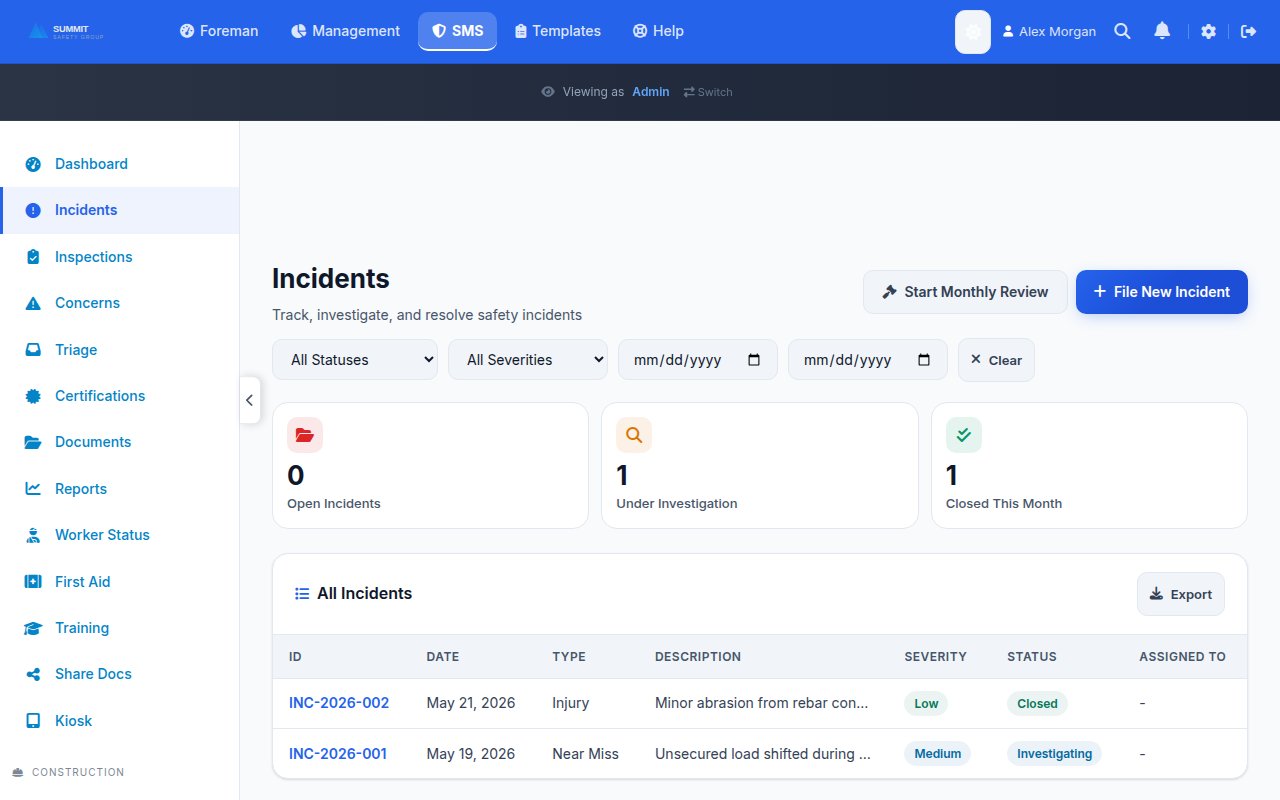
Manually calculating TRIR from spreadsheets and paper logs is tedious and error-prone. Make Safety Easy automatically computes your incident rates from your recorded data, tracks trends over time and generates the reports clients and insurers request. Book a demo to see real-time safety dashboards in action, or view our plans to find the right solution for your team.
Ready to simplify your safety program?
Make Safety Easy helps teams run toolbox talks, inspections, incident reports and more - all from one platform.
Start Your Free TrialNo credit card required. 14-day free trial.