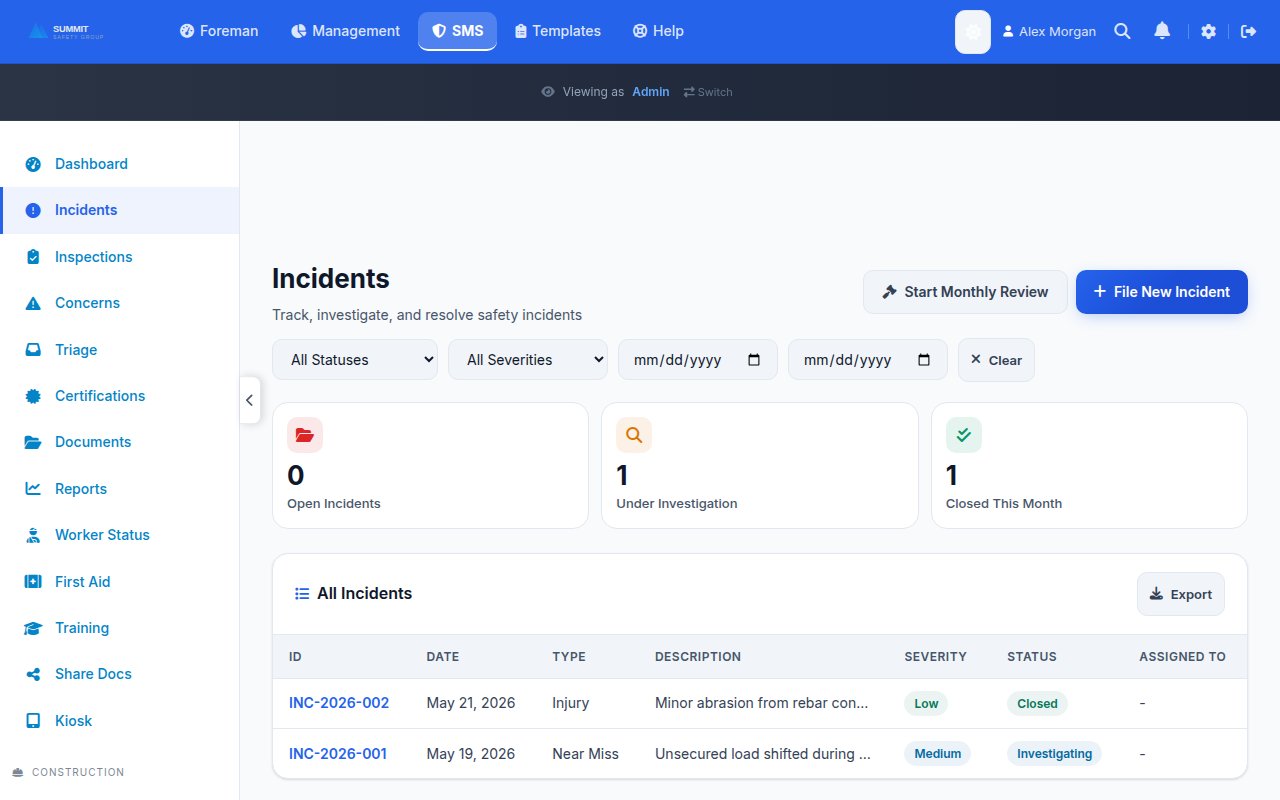
An incident is any unplanned event that disrupts normal work operations, whether or not it results in injury, illness or damage. An accident is a specific type of incident that causes actual harm to people, property or the environment. The key difference is outcome: all accidents are incidents, but not all incidents are accidents. This distinction matters because organizations that track and investigate all incidents - not just accidents - catch warning signs early and prevent serious injuries before they happen.
Defining Incident and Accident
What Is an Incident?
In workplace safety, an incident is any unplanned or undesired event that could have resulted in harm or did result in harm. The term is intentionally broad. It covers:
- Near misses - events where harm was narrowly avoided
- Unsafe conditions - hazards discovered before anyone was hurt
- Property damage - events that damaged equipment or facilities but caused no injuries
- Environmental releases - spills or emissions that did not injure anyone directly
- Injuries and illnesses - events that actually harmed a worker
The common thread is that something went wrong or could have gone wrong. An incident does not require injury. A scaffold board that falls and lands in an empty area is an incident. A forklift that tips but the operator walks away unharmed is an incident. A chemical container that leaks overnight in an unoccupied storage room is an incident.
Free Download: 5 Safe Work Procedures
Choose from 112 professionally written SWPs. No credit card required.
Get Free SWPsWhat Is an Accident?
An accident is a type of incident that results in actual injury, illness, death or significant property damage. When the scaffold board hits a worker, it becomes an accident. When the forklift tip-over injures the operator, it becomes an accident. The word "accident" implies that harm occurred.
In modern safety practice, many professionals avoid the word "accident" altogether because it carries an implication of inevitability or randomness. Saying something was "an accident" can suggest it was unavoidable - when in reality, most workplace injuries are preventable through better hazard controls, training and procedures.
Why the Distinction Matters
Prevention Opportunity
Research consistently shows that for every serious injury, there are hundreds of near misses and unsafe conditions that preceded it. This concept, often attributed to Heinrich's safety pyramid (and refined by later researchers like Frank Bird), illustrates a critical principle: near misses are free lessons. They reveal the same hazards and system failures that cause serious injuries - without the human cost.
Organizations that only track "accidents" miss the vast majority of their prevention opportunities. If your reporting system only captures events where someone got hurt, you are working with a tiny fraction of available data.
Language Shapes Culture
The words you use matter. When leaders call a serious injury "an accident," they subtly communicate that it was nobody's fault and nothing could have been done differently. This undermines investigation efforts and discourages workers from reporting hazards.
Switching to "incident" as the default term signals a cultural shift. It says: we investigate everything, we look for root causes and we believe most events are preventable. This framing encourages reporting, supports accountability without blame and drives continuous improvement.
Regulatory and Legal Implications
OSHA and most provincial/territorial OHS regulators use the term "incident" in their reporting requirements. OSHA's recordkeeping standard (29 CFR 1904) requires employers to record work-related injuries, illnesses and fatalities - but also encourages tracking near misses as a best practice. Some jurisdictions mandate near-miss reporting for specific high-hazard industries.
From a legal perspective, the language in your investigation reports can have consequences. Calling an event an "accident" in official documentation may weaken your position in litigation by implying the event was unforeseeable. Calling it an "incident" keeps the focus on facts and root causes.
Types of Workplace Incidents
Understanding the full spectrum of incidents helps build a more comprehensive reporting and investigation program:
| Type | Definition | Example |
|---|---|---|
| Near miss | An event that could have caused harm but did not | A heavy tool falls from height but nobody is below |
| First aid event | Minor injury treated on site without medical attention | Small cut cleaned and bandaged at the first aid station |
| Medical treatment case | Injury requiring professional medical treatment | Laceration requiring stitches at a clinic |
| Lost-time injury | Injury causing the worker to miss scheduled shifts | Fractured wrist resulting in 4 weeks off work |
| Fatality | A work-related death | Electrocution from contact with energized equipment |
| Property damage | Damage to equipment, structures or vehicles | Forklift strikes a storage rack, causing collapse |
| Environmental release | Uncontrolled release of a substance | Chemical spill reaching a storm drain |
How to Build an Effective Incident Reporting System
An effective system captures every type of incident - not just the ones that result in injury. Here is how to build one that works:
Make Reporting Easy
If reporting takes more than a few minutes, workers will skip it. Use mobile-friendly incident reporting tools that let employees submit a report from the field. Include options for photo attachments, voice notes and pre-populated fields to reduce friction.
Eliminate Fear of Retaliation
Workers will not report near misses if they think they will be punished. Establish a clear non-retaliation policy and enforce it visibly. Some organizations offer anonymous reporting channels for sensitive situations.
Investigate Every Report
A reporting system is only as good as the follow-up. Every submitted report should trigger an investigation - even if the event seems minor. Near misses deserve the same root cause analysis as serious injuries because they share the same underlying failures.
Track Trends Over Time
Individual reports tell stories. Aggregated data reveals patterns. Track incident types, locations, times, contributing factors and corrective action completion rates. Look for clusters that indicate systemic issues rather than isolated events.
For a detailed guide on building your near-miss reporting capability, see our post on near-miss reporting programs.
Root Cause Analysis: Going Beyond "What" to "Why"
Whether you are investigating an incident or an accident, the goal is the same: find the root cause. Surface-level explanations like "worker error" or "carelessness" do not prevent recurrence. Effective investigations dig deeper using structured methods:
- 5 Whys - ask "why" repeatedly until you reach the systemic failure
- Fishbone diagram - map contributing factors across categories (people, process, equipment, environment)
- Fault tree analysis - work backward from the event to identify all possible contributing conditions
The output of every investigation should be a set of corrective actions with assigned owners, deadlines and verification steps. Without this follow-through, investigations are just paperwork.
Real-World Examples
Understanding the difference between incident and accident becomes clearer with practical scenarios:
Scenario 1: The Falling Object
A wrench slips from a worker's tool belt on scaffolding and lands on the ground 20 feet below. Nobody is in the drop zone. This is an incident - specifically a near miss. The same hazard conditions exist (unsecured tools at height) whether someone is below or not. Investigating this near miss and implementing a tool-tethering policy prevents the future accident where someone is standing in the drop zone.
Scenario 2: The Chemical Splash
During a transfer operation, a hose fitting fails and sprays a corrosive chemical. In one case, the worker is wearing a full face shield and chemical-resistant apron - they are unharmed. This is an incident. In another case, a worker performing the same task without proper PPE suffers chemical burns to the face and arms. This is an accident. The root cause is the same: a failed hose fitting. The difference in outcome depends on the control measures in place.
Scenario 3: The Slip on a Wet Floor
A worker slips on a wet floor near the loading dock. They catch themselves on a railing and do not fall. This is a near miss. The following week, a different worker slips in the same location and fractures their wrist. This is an accident. If the near miss had been reported and investigated, the wet-floor condition could have been addressed before the fracture occurred.
In each of these examples, the near miss and the accident share the same underlying hazard. The only variable is whether someone happened to be in the wrong place at the wrong time. Organizations that dismiss near misses as non-events are essentially waiting for probability to catch up with them.
Moving from Reactive to Proactive Safety
The incident-versus-accident distinction reflects a broader shift in safety philosophy. Reactive organizations wait for people to get hurt, then respond. Proactive organizations track leading indicators - near misses reported, inspections completed, training hours delivered - and intervene before harm occurs.
This shift requires investment in systems, culture and technology. It means valuing a near-miss report as highly as an injury report. It means celebrating the team that identifies 50 hazards in a month rather than the team with "zero incidents" (which often just means zero reporting).
The safety pyramid concept reinforces this approach. Research suggests that for every major injury, there are approximately 10 minor injuries, 30 property damage incidents and 600 near misses. Each near miss is a data point that reveals where your controls are failing. Organizations that mine this data systematically can predict and prevent serious injuries with far greater accuracy than those that only react after someone gets hurt.
Start Capturing the Full Picture
Every unreported near miss is a missed opportunity to prevent the next serious injury. Every "accident" that is not investigated at the root cause level will repeat itself. The language you use, the systems you build and the culture you foster determine whether your organization learns from incidents or simply reacts to accidents.
Ready to build a reporting system that captures incidents at every level? Schedule a demo of Make Safety Easy to see how digital incident reporting drives real prevention. Or visit our pricing page to get started today.
Ready to simplify your safety program?
Make Safety Easy helps teams run toolbox talks, inspections, incident reports and more - all from one platform.
Start Your Free TrialNo credit card required. 14-day free trial.