What Is ISO 45001?
ISO 45001 is the international standard for occupational health and safety (OH&S) management systems, published by the International Organization for Standardization. It provides a framework that organizations of any size and industry can use to systematically improve worker safety, reduce workplace risks and create healthier working conditions. ISO 45001 replaced the previous OHSAS 18001 standard in March 2018, introducing a more modern, leadership-driven and worker-participative approach to managing occupational health and safety.
Unlike regulations such as OSHA standards in the United States or provincial OH&S legislation in Canada, ISO 45001 is a voluntary standard. Organizations choose to implement it because it provides a structured, internationally recognized framework for managing safety - one that goes well beyond minimum regulatory compliance. Certification demonstrates to clients, regulators, insurers and workers that an organization is committed to proactive safety management, not just reactive compliance.
Why ISO 45001 Matters
The International Labour Organization estimates that approximately 2.78 million workers die each year from occupational accidents and work-related diseases. Millions more suffer non-fatal injuries that result in extended absences, permanent disability and diminished quality of life. These are not just statistics - they represent a massive failure of organizational systems to protect the people who generate value.
Free Download: 5 Safe Work Procedures
Choose from 112 professionally written SWPs. No credit card required.
Get Free SWPsISO 45001 matters because it shifts the paradigm from reactive to proactive. Instead of waiting for incidents to occur and then investigating them, the standard requires organizations to:
- Identify hazards and assess risks before they cause harm
- Engage workers meaningfully in safety decisions - not as checkbox consultation, but as genuine participation
- Establish leadership accountability at the highest level of the organization
- Integrate safety into business processes rather than treating it as a parallel activity
- Continuously improve through measurement, review and adaptation
ISO 45001 Requirements: The Core Structure
ISO 45001 follows the High-Level Structure (HLS) common to all modern ISO management system standards (ISO 9001, ISO 14001, etc.). This makes integration with existing management systems significantly easier. The standard is organized into ten clauses, with clauses 4 through 10 containing the auditable requirements.
Clause 4: Context of the Organization
You must understand the internal and external factors that affect your OH&S management system. This includes identifying interested parties (workers, regulators, clients, unions, communities), understanding their needs and expectations and defining the scope of your management system. This is not a theoretical exercise - it directly informs what your system must cover and how it must perform.
Clause 5: Leadership and Worker Participation
This is where ISO 45001 diverges most significantly from its predecessor. Top management must demonstrate direct leadership and commitment to the OH&S management system. They cannot delegate this responsibility to the safety department. Specifically, leadership must:
- Take overall accountability for the protection of workers' health and safety
- Establish an OH&S policy that includes a commitment to elimination of hazards and reduction of risks
- Ensure that OH&S objectives are established and compatible with strategic direction
- Ensure resources are available
- Promote continual improvement
Equally important, workers at all levels must be consulted and encouraged to participate in the development, planning, implementation, evaluation and improvement of the system. This means providing mechanisms, time, training and access to information necessary for participation.
Clause 6: Planning
Planning addresses how the organization identifies hazards, assesses risks and opportunities, determines legal and other requirements and establishes OH&S objectives. The standard requires a systematic process for hazard identification that considers routine and non-routine activities, emergency situations, human factors, changes in processes and the design of work areas and processes.
Risk assessment must use defined methodologies to evaluate both OH&S risks (to workers) and opportunities for improvement. Legal requirements must be identified, access to them maintained and their implications understood.
Clause 7: Support
Support covers the resources needed to establish, implement, maintain and continually improve the system. This includes:
- Competence: Ensuring workers have the education, training and experience needed to perform their roles safely
- Awareness: Workers must be aware of the OH&S policy, their contributions to system effectiveness, the implications of non-conformance and relevant incidents
- Communication: Internal and external communication processes must be defined
- Documented information: The system requires documented procedures, records and controls. A robust document management system is essential for maintaining the documented information ISO 45001 demands
Clause 8: Operation
Operational planning and control addresses how the organization manages its identified risks through the hierarchy of controls: elimination, substitution, engineering controls, administrative controls and PPE. It also covers management of change, procurement, contractor management and emergency preparedness and response.
Clause 9: Performance Evaluation
You cannot improve what you do not measure. Clause 9 requires monitoring, measurement, analysis and evaluation of OH&S performance. This includes:
- Evaluation of compliance with legal and other requirements
- Internal audits conducted at planned intervals
- Management review by top management, covering system adequacy, suitability, effectiveness and opportunities for improvement
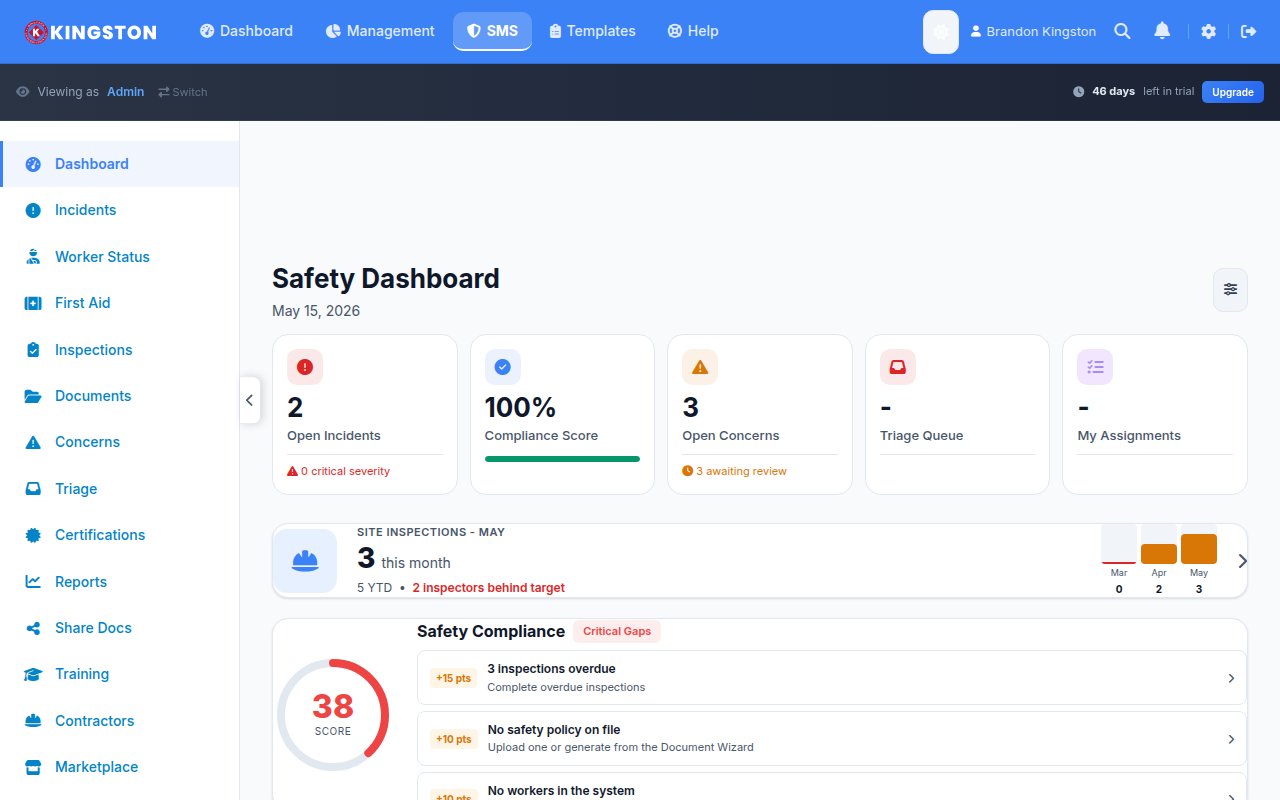
Monthly safety reviews and regular workplace inspections are practical tools that directly support the performance evaluation requirements of ISO 45001.
Clause 10: Improvement
The final clause requires organizations to determine opportunities for improvement and take action. This includes managing incidents and nonconformities (including investigation and corrective action) and driving continual improvement of the system's suitability, adequacy and effectiveness.
Benefits of ISO 45001 Certification
Organizations that implement ISO 45001 report a range of tangible and intangible benefits:
- Reduced incident rates. The systematic approach to hazard identification and risk control leads to measurable reductions in workplace injuries and illnesses.
- Regulatory compliance. While ISO 45001 is voluntary, implementing it creates a robust compliance framework that satisfies - and typically exceeds - regulatory requirements in any jurisdiction.
- Lower insurance and workers' compensation costs. Insurers recognize ISO 45001 certification as evidence of effective risk management, often resulting in premium reductions.
- Competitive advantage. Many clients, particularly in oil and gas, mining, construction and government contracting, require or prefer suppliers with ISO 45001 certification.
- Improved worker morale and retention. Workers who feel safe and whose input is valued are more engaged, productive and loyal.
- Integration with other management systems. The High-Level Structure makes it straightforward to integrate ISO 45001 with ISO 9001 (quality) and ISO 14001 (environmental) into a single integrated management system.
- Legal protection. In the event of an incident, demonstrating a certified management system can be a significant factor in due diligence defenses.
Implementing ISO 45001: A Practical Roadmap
Implementation timelines vary based on organization size and complexity, but most organizations achieve certification within 6 to 18 months. Here is a practical roadmap:
- Secure leadership commitment. Without genuine top management buy-in, implementation will stall. Leadership must understand both the business case and their direct responsibilities under the standard.
- Conduct a gap analysis. Compare your current OH&S practices against the requirements of ISO 45001. Identify what already meets the standard and what needs development.
- Define scope and context. Determine what parts of your organization the system will cover and identify the internal and external issues and interested parties that influence it.
- Develop your OH&S policy and objectives. The policy must be appropriate to the organization and include commitments to providing safe and healthy working conditions, eliminating hazards, reducing risks, consultation and participation of workers and continual improvement.
- Build your hazard identification and risk assessment process. This is the engine of the system. It must be systematic, proactive and participative.
- Establish operational controls. Implement the procedures, training and controls needed to manage identified risks.
- Implement documented information controls. Set up your document management system to create, control and maintain the records ISO 45001 requires.
- Train your team. Everyone needs to understand their role in the system. Internal auditors need specific competency.
- Conduct internal audits. Audit the system before seeking certification to identify and correct nonconformities.
- Conduct management review. Top management must formally review system performance and direct improvements.
- Select a certification body and undergo the certification audit. This typically occurs in two stages: a documentation review (Stage 1) and an on-site implementation audit (Stage 2).
ISO 45001 vs. OHSAS 18001: Key Differences
If your organization held OHSAS 18001 certification, understanding the key differences helps frame your transition:
| Element | OHSAS 18001 | ISO 45001 |
|---|---|---|
| Structure | OHSAS-specific structure | ISO High-Level Structure (Annex SL) - aligns with ISO 9001, 14001 |
| Leadership role | Delegated to management representative | Direct top management accountability required |
| Worker participation | Consultation required | Both consultation AND participation required at all levels |
| Risk approach | Focused on hazards and OH&S risks | Addresses risks AND opportunities for improvement |
| Context | Not explicitly required | Must analyze organizational context and interested parties |
| Outsourcing/procurement | Limited requirements | Explicit requirements for contractor and procurement controls |
Frequently Asked Questions About ISO 45001
Is ISO 45001 certification mandatory?
No. ISO 45001 is a voluntary international standard. However, many industries and clients require or strongly prefer certified suppliers. Additionally, some jurisdictions reference ISO 45001 principles in their regulatory guidance. Even without a client mandate, the systematic approach to safety management typically delivers a strong return on investment through reduced incidents, lower insurance costs and improved operational efficiency.
How much does ISO 45001 certification cost?
Costs vary widely based on organization size, complexity and existing safety maturity. For a small to medium-sized organization, budget for: consultant fees (if used) ranging from a few thousand to tens of thousands of dollars, internal resource time for development and implementation, training costs for internal auditors and staff and certification body audit fees that can range from several thousand dollars for small organizations to significantly more for large, multi-site operations. The investment typically pays for itself through reduced incident costs within the first one to two years.
How long does it take to get ISO 45001 certified?
Most organizations achieve certification within 6 to 18 months from the start of implementation. Organizations with mature existing safety programs and experience with other ISO management systems tend to reach certification faster. The timeline depends on organizational size, the gap between current practices and standard requirements and the resources dedicated to the project.
Can small businesses implement ISO 45001?
Absolutely. ISO 45001 is designed to be scalable. The standard explicitly states that the extent of documented information and the complexity of processes should be appropriate to the size of the organization and the nature of its activities. A 20-person construction company will have a very different - and much simpler - management system than a 20,000-person multinational, but both can achieve certification.
What is the relationship between ISO 45001 and OSHA?
ISO 45001 and OSHA serve different but complementary roles. OSHA sets minimum legal requirements for workplace safety in the United States. ISO 45001 provides a management system framework for achieving and exceeding those requirements systematically. Implementing ISO 45001 does not replace OSHA compliance - it provides a structured approach to achieving it. Many organizations find that ISO 45001 implementation resolves compliance gaps they were previously unaware of.
Start Building Your OH&S Management System
Implementing ISO 45001 requires a solid foundation: consistent inspections, organized documentation, regular management reviews and meaningful worker participation. Make Safety Easy provides the digital infrastructure to support every element - from workplace inspections and document control to monthly safety reviews that satisfy management review requirements.
Request a demo to see how Make Safety Easy supports ISO 45001 implementation, or check our pricing to get started today.
Ready to simplify your safety program?
Make Safety Easy helps teams run toolbox talks, inspections, incident reports and more - all from one platform.
Start Your Free TrialNo credit card required. 14-day free trial.
Frequently asked questions
Is ISO 45001 certification mandatory?
No. ISO 45001 is a voluntary international standard. However, many industries and clients require or strongly prefer certified suppliers. Additionally, some jurisdictions reference ISO 45001 principles in their regulatory guidance. Even without a client mandate, the systematic approach to safety management typically delivers a strong return on investment through reduced incidents, lower insurance costs and improved operational efficiency.
How much does ISO 45001 certification cost?
Costs vary widely based on organization size, complexity and existing safety maturity. For a small to medium-sized organization, budget for: consultant fees (if used) ranging from a few thousand to tens of thousands of dollars, internal resource time for development and implementation, training costs for internal auditors and staff and certification body audit fees that can range from several thousand dollars for small organizations to significantly more for large, multi-site operations. The investment typically pays for itself through reduced incident costs within the first one to two years.
How long does it take to get ISO 45001 certified?
Most organizations achieve certification within 6 to 18 months from the start of implementation. Organizations with mature existing safety programs and experience with other ISO management systems tend to reach certification faster. The timeline depends on organizational size, the gap between current practices and standard requirements and the resources dedicated to the project.
Can small businesses implement ISO 45001?
Absolutely. ISO 45001 is designed to be scalable. The standard explicitly states that the extent of documented information and the complexity of processes should be appropriate to the size of the organization and the nature of its activities. A 20-person construction company will have a very different - and much simpler - management system than a 20,000-person multinational, but both can achieve certification.
What is the relationship between ISO 45001 and OSHA?
ISO 45001 and OSHA serve different but complementary roles. OSHA sets minimum legal requirements for workplace safety in the United States. ISO 45001 provides a management system framework for achieving and exceeding those requirements systematically. Implementing ISO 45001 does not replace OSHA compliance - it provides a structured approach to achieving it. Many organizations find that ISO 45001 implementation resolves compliance gaps they were previously unaware of.
Ready to simplify your safety program?
Make Safety Easy helps teams run toolbox talks, inspections, incident reports and more - all from one platform. No credit card required. 14-day free trial.