"What are we talking about this month?"
If you have ever stood in front of your crew with nothing prepared, you know the feeling. You default to the same three topics: PPE, slips and falls, housekeeping. Your crew tunes out because they have heard it a hundred times.
Safety meetings matter. But only if the content is relevant, engaging, and new. Here are 12 months of topics - one per month, each with discussion points and a real-world scenario to get your crew talking.
Free Download: 5 Safe Work Procedures
Choose from 112 professionally written SWPs. No credit card required.
Get Free SWPsJanuary: Cold Weather Safety
Winter brings unique hazards that crews in warmer months do not face.
Discussion points:
- Hypothermia and frostbite recognition: what does it look like?
- Layering strategy: moisture-wicking base, insulating mid, wind-blocking outer
- Ice and snow: clear walkways before work, not after someone falls
- Equipment cold-start procedures: hydraulic systems need warm-up time
- Shorter daylight hours: increased lighting requirements
Scenario: "A worker slips on black ice in the parking lot at 6 AM, before the crew has salted the walkways. He breaks his wrist. Who is responsible for ensuring walkways are clear before workers arrive?"
February: Electrical Safety
Electrocution is one of OSHA's "Fatal Four" - the four leading causes of death in construction.
Discussion points:
- Never work on energized circuits unless absolutely necessary (and qualified)
- GFCIs on all temporary power: test them before each shift
- Overhead power line clearances: know the minimum distances for your equipment
- Extension cord inspection: cuts, missing ground prongs, improper ratings
- Water and electricity: rain makes everything more dangerous
Scenario: "An operator swings an excavator boom into an overhead power line. The boom is now energized. What do you do? What do you NOT do?"
March: Ergonomics and Manual Handling
Back injuries do not make headlines, but they end more careers than any other injury type.
Discussion points:
- Proper lifting technique: knees bent, load close, no twisting
- Repetitive motion injuries: rotate tasks when possible
- Tool selection: use the right tool to reduce force requirements
- Stretching: 5-minute warm-up before physical work reduces injury risk
- Ask for help: the strongest person on the crew is the one smart enough to say "this is too heavy"
Scenario: "A worker lifts a 70-pound bag of concrete by bending at the waist and twisting to place it on a pallet. Three weeks later, he cannot get out of bed. What should he have done differently, and what should the supervisor have provided?"
April: Confined Space Entry
Confined spaces kill quickly and without warning. The air you cannot see is the hazard you cannot survive.
Discussion points:
- Definition: limited entry/exit, not designed for continuous occupancy, potential for hazardous atmosphere
- Atmospheric testing: O2, LEL, H2S, CO - test before entry and continuously during
- Never enter to rescue without proper equipment and training
- Permit system: no permit, no entry
- Ventilation: forced air before and during occupancy
Scenario: "A worker enters a manhole to retrieve a dropped tool. Thirty seconds later, he collapses. His partner immediately climbs in to help. Now you have two people down. What went wrong and what should have happened?"
May: Heat Stress Prevention
As temperatures rise, so does the risk of heat-related illness. By the time symptoms appear, the situation is already serious.
Discussion points:
- Water, rest, shade: the three non-negotiables
- Acclimatization: new workers need 7-14 days to adjust to heat
- Know the signs: headache, nausea, confusion, rapid heartbeat
- Buddy system: watch each other for symptoms
- Schedule heavy work for cooler parts of the day
Scenario: "It is 35 degrees. A new worker who started Monday is pouring concrete. By Wednesday afternoon, he is stumbling and confused. Is this heat exhaustion or heat stroke? What do you do RIGHT NOW?"
June: Fall Protection
Falls remain the number one killer in construction. Every year. Without exception.
Discussion points:
- When is fall protection required? (Know your jurisdiction's height threshold)
- Harness inspection: check webbing, D-rings, stitching, labels
- Anchor points: 5,000 lbs minimum capacity
- Fall distance calculation: can you actually fall the distance you need before hitting the ground?
- Guardrails vs. harness: passive protection is always preferred over active
Scenario: "A worker removes a guardrail section to move materials onto a platform. He plans to put it back in five minutes. During those five minutes, another worker walks to the edge and falls 12 feet. Who is responsible?"
July: Fire Prevention
Construction sites are full of ignition sources and fuel. The combination only needs a moment of inattention.
Discussion points:
- Hot work permits: welding, cutting, grinding near combustibles
- Fire extinguisher locations: does everyone know where they are?
- PASS method: Pull, Aim, Squeeze, Sweep
- Flammable storage: approved containers, away from heat sources
- Smoking areas: designated, away from work zones
Scenario: "A welder finishes grinding at 3:30 PM. Everyone leaves at 4:00 PM. At 6:00 PM, the fire department is called because the building is on fire. A spark landed in sawdust that was not cleaned up. What procedure was missed?"
August: Trenching and Excavation Safety
A cubic yard of soil weighs approximately 3,000 pounds. When a trench wall collapses, there is no outrunning it.
Discussion points:
- No entry into unprotected trenches deeper than 5 feet (OSHA) or 1.5 meters (many other jurisdictions)
- Protective systems: sloping, shoring, or shielding
- Competent person inspections: daily and after weather events
- Spoil pile placement: minimum 2 feet from the edge
- Egress: ladder or ramp within 25 feet of any worker
Scenario: "Rain fell overnight. The competent person has not arrived yet, but the crew needs to meet a deadline. The foreman tells two workers to get in the trench and start. What should the workers do?"
September: Hazard Communication
Every chemical product on your site can hurt someone if mishandled. The labels and Safety Data Sheets exist to prevent that - but only if people read them.
Discussion points:
- GHS pictograms: what do they mean? (skull, flame, exclamation mark, corrosion)
- SDS locations: every worker should know where to find them
- Label requirements: product name, hazards, precautions, first aid
- Mixing chemicals: never combine products unless the SDS confirms it is safe
- Spill response: contain, ventilate, report
Scenario: "A worker transfers a cleaning chemical into an unlabeled water bottle for easier carrying. Another worker finds the bottle and drinks from it. How could this have been prevented?"
October: Vehicle and Equipment Safety
Mobile equipment moves fast and weighs a lot. Pedestrians lose every confrontation.
Discussion points:
- Pre-trip inspections: every shift, every machine
- Pedestrian zones: separate people from equipment traffic
- Blind spots: operators cannot see everything - use spotters
- Seat belts: in every piece of equipment, every time
- Speed limits: site-appropriate, not highway speeds
Scenario: "A dump truck backs up in a staging area. The backup alarm is working, but a worker wearing hearing protection does not hear it. The spotter stepped away to take a phone call. What failed in this system?"
November: Incident Reporting and Investigation
Near-misses are free warnings. Ignoring them is choosing to wait for the real thing.
Discussion points:
- Report everything: incidents, near-misses, hazardous conditions
- No-blame culture: reporting is about prevention, not punishment
- Heinrich's Triangle: for every serious injury, there are 300 near-misses
- Investigation focus: root cause, not "who screwed up"
- Corrective actions: identify, implement, verify
Scenario: "A scaffold plank cracks but does not break. Nobody falls. Nobody reports it. Two days later, it breaks completely under load and a worker falls 15 feet. What should have happened after the crack was noticed?"
December: Year in Review and Goal Setting
End the year by looking back and planning forward. What went right? What can improve?
Discussion points:
- Review the year's incidents and near-misses: what were the trends?
- Celebrate wins: zero-injury months, compliance improvements, crew engagement
- Set goals for next year: specific, measurable, achievable
- Ask the crew: "What is one thing we could do better next year?"
- Recognize safety champions: who went above and beyond?
Activity: Have each crew member write down one safety improvement they want to see next year. Collect them, read them out loud, and commit to addressing the top three.
Stop Recycling the Same Three Topics
If your safety meetings sound the same every month, your crew will stop listening. Fresh content, real scenarios, and actual engagement make the difference between a meeting that prevents injuries and one that wastes everyone's time.
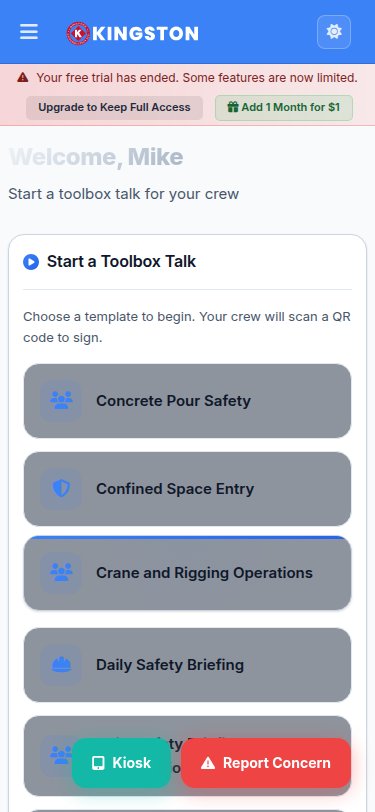
Make Safety Easy gives you a library of ready-to-use toolbox talk templates with digital sign-off, attendance tracking, and compliance reporting. No more crumpled paper sign-in sheets. No more wondering who actually showed up.
Your crew deserves meetings worth attending. Your company deserves proof they happened.
Go Digital with Make Safety Easy
Replace paper checklists, inspection logs and compliance binders with one platform your whole team can use - from the field to the office. Start tracking inspections, incidents and training in minutes.