10 Most Common OSHA Violations (And How to Avoid Them)
The most common OSHA violations are remarkably consistent from year to year: fall protection, hazard communication, scaffolding, lockout/tagout, respiratory protection, ladders, powered industrial trucks, fall protection training, eye and face protection and machine guarding. These ten standards account for the majority of all citations issued by the Occupational Safety and Health Administration - and they represent hazards that are well understood, well documented and entirely preventable. If your organization can master these ten areas, you will eliminate the vast majority of your OSHA compliance risk.
Below, we break down each violation, explain why it persists and provide concrete steps to bring your workplace into compliance. While these are U.S. federal OSHA standards, the underlying hazards are universal - employers operating under Canadian provincial OHS legislation, UK HSE regulations, or Australian WHS laws will find the same principles apply.
1. Fall Protection - General Requirements (29 CFR 1926.501)
Fall protection has been the number-one most cited OSHA standard for more than a decade. Falls are also the leading cause of death in construction. The standard requires employers to provide fall protection systems - guardrails, safety nets, or personal fall arrest systems - whenever workers are exposed to falls of six feet or more in construction (and four feet in general industry under 1910.28).
Free Download: 5 Safe Work Procedures
Choose from 112 professionally written SWPs. No credit card required.
Get Free SWPsWhy it persists: Workers sometimes bypass fall protection because it slows them down. Supervisors may fail to enforce compliance on short-duration tasks. Employers may not provide adequate anchor points.
How to avoid it:
- Conduct a fall hazard assessment before any work at height begins.
- Install permanent guardrail systems wherever feasible - they protect without requiring worker action.
- Inspect personal fall arrest equipment before every use and retire damaged components immediately.
- Enforce a zero-tolerance policy for unprotected work at height. No job is worth a fall.
2. Hazard Communication (29 CFR 1910.1200)
The Hazard Communication standard - often called "HazCom" or the "Right to Know" standard - requires employers to inform workers about the chemical hazards in their workplace through labels, Safety Data Sheets (SDS), and training. Since the 2012 alignment with the Globally Harmonized System (GHS), this standard mirrors international norms, including Canada's WHMIS 2015.
Why it persists: Companies introduce new chemicals without updating their SDS library. Training happens at hire but is not refreshed when new hazards arrive. Secondary containers go unlabeled.
How to avoid it:
- Maintain a current chemical inventory and ensure every product has an accessible SDS.
- Label all secondary containers with the product identity and appropriate hazard warnings.
- Train workers at hire and whenever a new chemical hazard is introduced.
- Use a digital document management system to keep SDS files current and accessible from any device.
3. Scaffolding (29 CFR 1926.451)
Scaffolding violations typically involve missing guardrails, improper construction, lack of competent-person oversight, or inadequate access. The standard requires a competent person to direct scaffold erection and guardrails on all open sides and ends of platforms more than 10 feet above the ground.
Why it persists: Scaffold configurations change frequently on construction sites. Components get damaged and are not replaced. Workers modify scaffolds without authorization.
How to avoid it:
- Designate a trained competent person responsible for scaffold oversight on every project.
- Inspect scaffolds daily before use and after any event that could affect structural integrity.
- Tag defective scaffolds out of service immediately - use a red-tag system that is visible and understood by all workers.
- Document inspections using a standardized checklist. Make Safety Easy's inspection feature makes this fast and audit-ready.
4. Lockout/Tagout (29 CFR 1910.147)
The Control of Hazardous Energy standard requires employers to establish procedures for isolating energy sources during machine servicing and maintenance. Violations include the absence of written procedures, failure to use individual locks and inadequate training.
Why it persists: Workers take shortcuts to save time. Machines have multiple energy sources that are not all identified. Procedures exist on paper but are not followed in practice. Annual inspections of energy control procedures are skipped.
How to avoid it:
- Develop machine-specific lockout/tagout procedures for every piece of equipment that requires servicing.
- Provide individual locks and tags to every authorized employee.
- Conduct annual periodic inspections of each energy control procedure - OSHA requires this and it is one of the most overlooked elements.
- Train both authorized employees (who perform lockout) and affected employees (who work in the area).
5. Respiratory Protection (29 CFR 1910.134)
This standard covers everything from the written respiratory protection program to fit testing, medical evaluations and maintenance. Citations often involve missing fit tests, lack of a written program, or use of respirators without medical clearance.
Why it persists: Fit testing is perceived as time-consuming and expensive. Employers provide respirators without the required medical evaluation. Voluntary use of filtering facepiece respirators (N95s) is not managed per Appendix D requirements.
How to avoid it:
- Develop and maintain a written respiratory protection program that covers selection, fit testing, training and maintenance.
- Ensure all workers who wear tight-fitting respirators receive a medical evaluation and annual fit test.
- Provide Appendix D information to workers who voluntarily use filtering facepiece respirators.
- Track fit test dates and medical evaluation expiration in a centralized system to prevent lapses.
6. Ladders (29 CFR 1926.1053)
Ladder violations involve improper use, defective equipment and failure to provide fall protection on fixed ladders exceeding certain heights. Common citations include using damaged ladders, failing to extend the ladder three feet above the landing surface and using the top rung.
Why it persists: Ladders are ubiquitous and perceived as low-risk. Workers grab whatever ladder is available rather than selecting the right type and size. Pre-use inspections are skipped. Training is treated as common sense rather than a formal requirement.
How to avoid it:
- Train all workers who use ladders - OSHA requires it, and "everyone knows how to use a ladder" is not a defense.
- Implement a pre-use inspection protocol: check rungs, rails, feet, locks and labels.
- Enforce the three-point contact rule and prohibit carrying tools or materials while climbing.
- Remove defective ladders from service immediately and destroy them to prevent reuse.
7. Powered Industrial Trucks (29 CFR 1910.178)
Forklift-related violations include untrained operators, lack of refresher training and failure to perform daily pre-operation inspections. OSHA requires that forklift operators be trained and evaluated before operating equipment, with refresher training every three years or after an incident.
Why it persists: High employee turnover leads to untrained operators running equipment. "Experienced" operators are assumed to be trained. Pre-shift inspections are viewed as busywork.
How to avoid it:
- Maintain a registry of trained and evaluated forklift operators. No one operates without documentation of training.
- Conduct performance evaluations in the actual workplace, not just in a classroom.
- Require daily pre-operation checklists - and actually review them.
- Provide refresher training after any incident, near miss, or observed unsafe operation.
8. Fall Protection Training (29 CFR 1926.503)
Separate from the fall protection requirements themselves, this standard requires employers to train each worker who might be exposed to fall hazards. The training must cover how to recognize fall hazards and how to use the fall protection systems provided. A written certification of training is required.
Why it persists: Employers provide fall protection equipment but assume workers know how to use it. Training is delivered informally without documentation. Retraining does not occur when conditions or equipment change.
How to avoid it:
- Deliver formal fall protection training with written certification for every worker exposed to fall hazards.
- Include hands-on components - donning a harness, connecting to an anchor, inspecting equipment.
- Retrain when fall protection systems change, when workers demonstrate a lack of understanding, or when new hazards are introduced.
- Store training records digitally for easy retrieval during audits. A document management platform eliminates the filing cabinet problem.
9. Eye and Face Protection (29 CFR 1926.102)
This standard requires employers to ensure that workers use appropriate eye or face protection when exposed to flying particles, molten metal, liquid chemicals, acids, caustic liquids, chemical gases, vapors, or potentially injurious light radiation.
Why it persists: Workers find safety glasses uncomfortable or claim they impair vision. Hazard assessments do not adequately identify eye hazards. Employers provide generic safety glasses when the hazard requires splash goggles or face shields.
How to avoid it:
- Conduct a hazard assessment for each task that might involve eye or face hazards.
- Match the protection to the hazard - impact-rated glasses for flying particles, chemical splash goggles for liquids, face shields for grinding.
- Allow workers to choose from multiple approved styles to improve comfort and compliance.
- Enforce use through supervision and integrate eye protection checks into daily safety inspections.
10. Machine Guarding (29 CFR 1910.212)
Machine guarding violations involve the absence or improper installation of guards on machines with points of operation, ingoing nip points, rotating parts, flying chips, or sparks. Amputations remain one of the most devastating workplace injuries and they are almost always linked to inadequate guarding.
Why it persists: Guards are removed for maintenance and not replaced. Workers bypass interlocks to speed up production. Older machines were manufactured before current guarding standards and have not been retrofitted.
How to avoid it:
- Survey all machines and document existing guarding. Identify gaps against OSHA requirements and ANSI standards.
- Install guards that cannot be easily removed without tools. Use interlocked guards where feasible.
- Incorporate guard-in-place verification into pre-operation checklists and routine inspections.
- Train workers on the purpose of guards and the consequences of bypassing them - include real-world case studies to drive the point home.
The Cost of Non-Compliance
OSHA penalties are significant and have been adjusted for inflation. As of 2024, maximum penalties are:
| Violation Type | Maximum Penalty Per Violation |
|---|---|
| Serious / Other-Than-Serious | $16,550 |
| Failure to Abate | $16,550 per day |
| Willful or Repeated | $165,514 |
Note: Penalty amounts are adjusted annually for inflation. Check OSHA.gov for the most current figures.
But fines are only the beginning. Factor in workers' compensation costs, legal fees, production downtime, increased insurance premiums and reputational damage and the true cost of a single serious violation can be orders of magnitude higher than the penalty itself.
A Proactive Approach to OSHA Compliance
The most effective way to avoid OSHA violations is to stop thinking about "compliance" and start thinking about "hazard elimination." Compliance is a byproduct of a well-managed safety program. If you are systematically identifying hazards, implementing controls, training workers and documenting everything, the citations will not come.
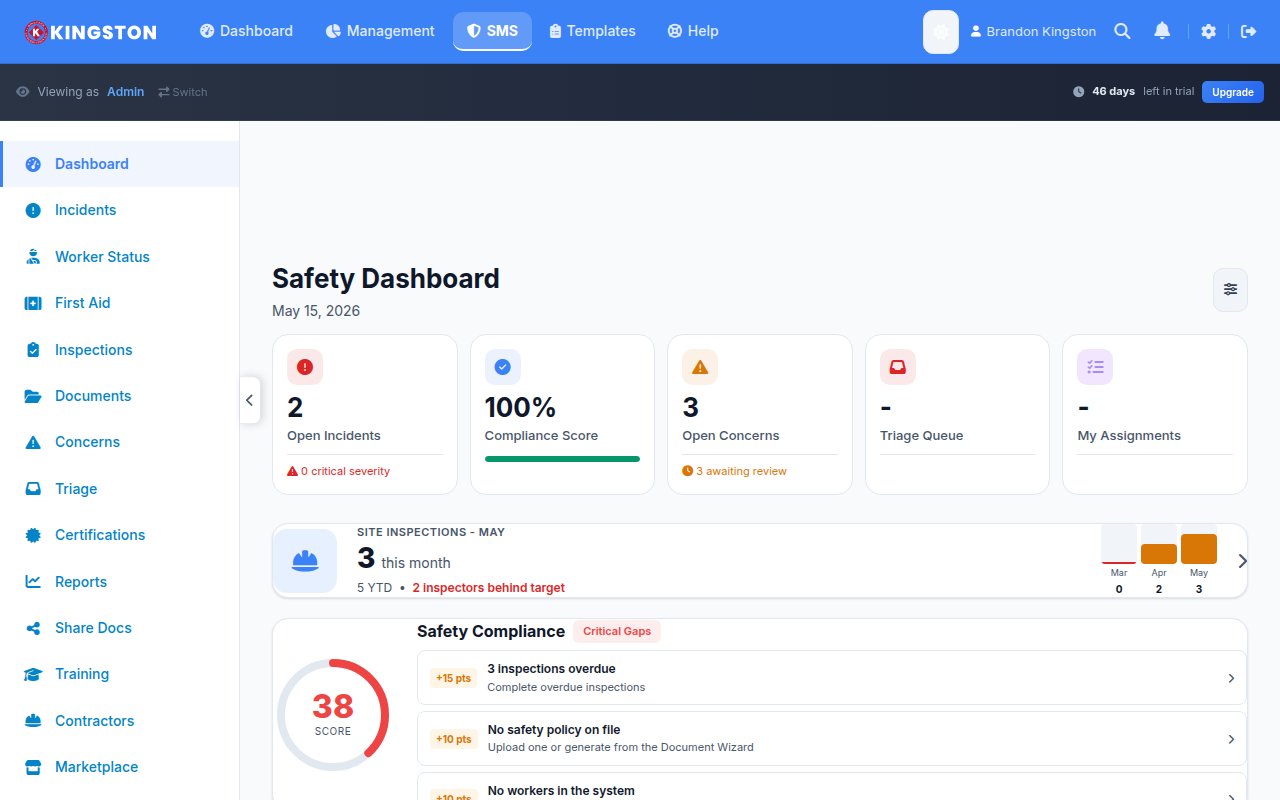
This requires tools that make the process efficient. Paper-based inspection checklists get lost. Training records in spreadsheets become outdated. SDS binders gather dust. The organizations that consistently pass OSHA inspections are the ones that have moved to digital platforms that centralize documentation, automate reminders and surface gaps before an inspector does.
Take Control of Your Compliance Program
Every violation on this list is preventable - with the right combination of training, equipment, procedures and documentation. Make Safety Easy brings all four elements together in a single platform with inspections, incident reporting, and document management designed specifically for frontline safety teams.
Request a free demo to see how we help organizations reduce violations and build safety programs that actually work. Or view our pricing to find a plan that fits your team.
Ready to simplify your safety program?
Make Safety Easy helps teams run toolbox talks, inspections, incident reports and more - all from one platform.
Start Your Free TrialNo credit card required. 14-day free trial.