An OSHA walk-around inspection is an on-site examination of a workplace conducted by an OSHA compliance safety and health officer (CSHO) to determine whether the employer is meeting Occupational Safety and Health Act requirements. During this inspection, both employers and employees have specific legal rights - including the right to accompany the inspector through the facility. Understanding these rights before an inspector arrives is the difference between a controlled, professional interaction and a chaotic one that results in unnecessary citations and penalties.
This guide explains exactly what happens during an OSHA walk-around inspection, what rights employers and employees have and how to prepare your organization so you are ready when the knock comes.
What Triggers an OSHA Inspection?
OSHA does not inspect every workplace every year. The agency prioritizes inspections based on a hierarchy of factors:
Free Download: 5 Safe Work Procedures
Choose from 112 professionally written SWPs. No credit card required.
Get Free SWPs- Imminent danger: Situations where workers face immediate risk of death or serious physical harm receive the highest priority
- Fatalities and catastrophes: Any workplace fatality or incident hospitalizing three or more workers triggers a mandatory investigation
- Worker complaints: Formal complaints from current employees (filed in writing or online) result in inspections. Informal complaints may result in a phone/fax investigation
- Referrals: Reports from other government agencies, media coverage or observations by OSHA personnel during other activities
- Programmed inspections: Planned inspections targeting high-hazard industries, worksites with high injury rates or specific emphasis programs (like trenching or fall protection)
- Follow-up inspections: Verification that previously cited hazards have been corrected
Most inspections are unannounced. OSHA is legally prohibited from giving advance notice of an inspection except in limited circumstances (such as imminent danger situations requiring immediate correction).
The Four Phases of an OSHA Inspection
Every OSHA inspection follows a standard four-phase process. Knowing what to expect at each stage helps you exercise your rights effectively.
Phase 1: Presentation of Credentials
The CSHO arrives at the workplace and presents their official OSHA credentials (a U.S. Department of Labor identification card with a photograph and serial number). You have the right to verify these credentials. If you have any doubt about the inspector's identity, contact your local OSHA office to confirm.
At this point, you should:
- Verify credentials carefully
- Note the inspector's name, office location and the stated reason for the inspection
- Contact your company's designated representative (safety manager, legal counsel or senior management) immediately
- Be professional and cooperative - but do not volunteer information beyond what is asked
Phase 2: Opening Conference
The CSHO explains the purpose, scope and expected duration of the inspection. They describe what areas and records they plan to examine. This is an informational meeting - not an interrogation.
During the opening conference:
- The CSHO explains the reason for the inspection (complaint, programmed, referral, etc.)
- The employer selects an employer representative to accompany the inspector
- Employees or their union representative have the right to select an employee representative to accompany the inspector
- The CSHO may request access to specific records (OSHA 300 logs, safety programs, training records)
Phase 3: The Walk-Around Inspection
This is the core of the inspection. The CSHO physically walks through the workplace, observing conditions, interviewing employees and documenting potential violations. The walk-around may cover the entire facility or may be limited to specific areas related to the inspection's purpose.
During the walk-around, the CSHO may:
- Take photographs and video of conditions
- Collect air samples, noise measurements or other environmental data
- Review written safety programs and permits
- Examine equipment, guarding and safety devices
- Interview employees privately about workplace conditions
- Review posting requirements (OSHA poster, injury logs, citations)
Phase 4: Closing Conference
After the walk-around, the CSHO holds a closing conference to discuss observations, potential violations and the citation process. This is your opportunity to:
- Provide additional context about observed conditions
- Demonstrate corrective actions already taken during the inspection
- Ask questions about the timeline for citations
- Identify any factual errors in the inspector's observations
Employer Rights During an OSHA Inspection
Employers are not passive participants in OSHA inspections. You have specific legal rights that protect your interests throughout the process.
Right to Require a Warrant
Under the Supreme Court's ruling in Marshall v. Barlow's Inc. (1978), employers may require OSHA to obtain a warrant before entering the workplace. Requesting a warrant is not an admission of guilt and cannot be used against you. However, be aware that OSHA can generally obtain a warrant quickly and the scope of a warranted inspection may be broader than the original request.
Whether to require a warrant is a strategic decision that should involve legal counsel. In many cases, cooperation without a warrant is the better approach - but the right exists and should be understood.
Right to an Employer Representative
You have the right to have a representative accompany the CSHO during the entire walk-around. This representative should be someone knowledgeable about the workplace - such as the safety manager, plant manager or a designated supervisor. The representative should take detailed notes, photograph everything the CSHO photographs and document every conversation.
Right to Participate in the Opening and Closing Conferences
Both the employer and employee representatives may participate in these meetings. Use the opening conference to understand the scope and the closing conference to provide context.
Right to Contest Citations
If OSHA issues citations following the inspection, you have 15 working days to file a Notice of Contest. This initiates a formal hearing before the Occupational Safety and Health Review Commission. You may contest the violation itself, the proposed penalty, the abatement period or any combination.
Employee Rights During an OSHA Inspection
Employees have robust rights during OSHA inspections that exist independently of the employer's cooperation.
Right to an Employee Representative
Employees (or their authorized union representative) have the right to select a representative to accompany the CSHO during the walk-around. In unionized workplaces, this is typically a union steward or safety committee member. In non-union workplaces, the CSHO selects employees to interview and may designate an employee representative.
Recent regulatory developments have expanded the definition of who qualifies as an employee representative. Under current rules, third parties - such as community organizers, family members or technical advisors - may serve as the employee representative under certain circumstances.
Right to Speak Privately with the Inspector
Employees have the right to speak privately with the CSHO without the employer present. The employer may not retaliate against employees for exercising this right. Private employee interviews are a standard part of OSHA inspections and often reveal conditions that a visual walk-through alone would not uncover.
Right to File a Complaint
Employees can file safety complaints with OSHA at any time - before, during or after an inspection. Complaints can be filed online, by phone, by mail or in person at an OSHA area office. Employees have the right to request that their identity be kept confidential.
Right to Protection from Retaliation
Section 11(c) of the OSH Act prohibits employers from retaliating against employees who exercise their rights under the Act. This includes filing complaints, participating in inspections, requesting records and reporting injuries. Retaliation can include termination, demotion, transfer, reduction in hours or any other adverse action.
How to Prepare for an OSHA Walk-Around Inspection
The best time to prepare for an OSHA inspection is long before one occurs. Proactive preparation reduces citation risk and demonstrates good faith. For detailed preparation strategies, see our guide on preparing for safety inspections.
Maintain Inspection-Ready Documentation
Keep these records organized, current and readily accessible:
- OSHA 300, 300A and 301 injury and illness logs
- Written safety programs (HazCom, lockout/tagout, fall protection, respiratory protection, etc.)
- Training records with dates, topics, trainer names and attendee signatures
- Equipment inspection records
- Safety data sheets
- Incident investigation reports
- Permit records (confined space, hot work, energized electrical work)
Using a digital inspection and documentation platform keeps all of these records in a centralized, searchable system that you can access immediately when an inspector asks.
Conduct Regular Self-Inspections
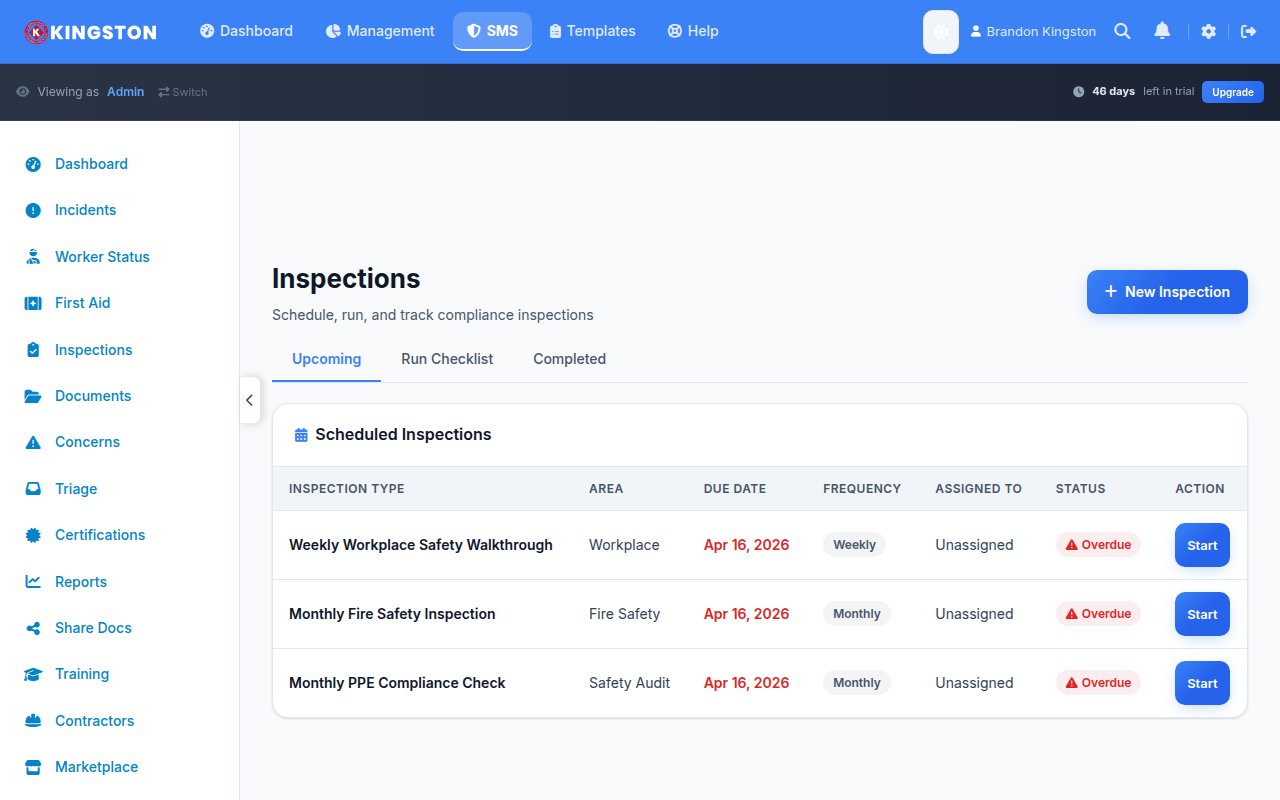
Walk your facility with the same critical eye that an OSHA inspector would. Use standardized checklists, document findings and correct hazards promptly. These self-inspections create a record of proactive compliance that can be presented during an inspection to demonstrate your safety commitment.
Designate an Inspection Response Team
Identify in advance who will serve as the employer representative, who will contact legal counsel, who will gather requested documents and who will accompany the inspector. Rehearse the process so that everyone knows their role when the CSHO arrives.
Train Your Workforce
Employees should understand their rights during an inspection, know where safety documents are located and be able to describe their training honestly. Do not coach employees on what to say - this can backfire and create the appearance of obstruction. Instead, ensure your safety program is strong enough that honest answers reflect well on the organization.
After the Inspection
Following the closing conference, OSHA has up to six months to issue citations. If citations are issued:
- Post the citation at or near the location of the violation for three working days or until the hazard is abated, whichever is longer
- Correct cited hazards by the abatement date specified
- Submit abatement verification to the OSHA area office
- Decide within 15 working days whether to accept or contest the citations
Be Ready Before OSHA Arrives
An OSHA walk-around inspection does not have to be a crisis. When your safety programs are current, your documentation is organized and your team understands the process, an inspection becomes a demonstration of your commitment to worker safety - not an exercise in damage control.
Make Safety Easy helps you maintain inspection-ready documentation, conduct self-inspections and organize training records - so you are always prepared. Book a demo to see how the platform works, or check our pricing to get started today.
Ready to simplify your safety program?
Make Safety Easy helps teams run toolbox talks, inspections, incident reports and more - all from one platform.
Start Your Free TrialNo credit card required. 14-day free trial.