To prepare for a WorkSafeBC inspection, start by organizing your health and safety documentation, verifying that your workplace hazard assessments are current, confirming all employee training records are accessible and conducting a thorough internal walkthrough of your site. A WorkSafeBC officer can arrive announced or unannounced and British Columbia employers who maintain inspection-ready operations year-round face fewer orders, lower penalties and significantly less downtime. This guide breaks the entire preparation process into clear, actionable steps so you know exactly what to do before, during and after an officer steps onto your worksite.
What Triggers a WorkSafeBC Inspection?
Understanding why inspections happen is the first step in staying ahead of them. WorkSafeBC conducts thousands of workplace inspections across British Columbia every year and they don't all come from the same trigger. Here's what can bring an officer to your door:
- Scheduled and targeted inspections: WorkSafeBC runs industry-specific inspection campaigns (called "initiatives") that focus on high-risk sectors such as construction, forestry, manufacturing and healthcare. If your industry is flagged, expect visits.
- Worker complaints: Any worker in BC can file a confidential complaint with WorkSafeBC. Officers are obligated to investigate.
- Incident reports: A serious injury, fatality, or dangerous incident reported under the Workers Compensation Act will almost always trigger an on-site investigation. Timely incident reporting is both a legal requirement and a practical shield.
- Follow-up inspections: If you received previous orders or compliance directives, expect a return visit to verify corrective action.
- Random audits: Some inspections are simply part of WorkSafeBC's ongoing enforcement mandate. No specific trigger -just the agency doing its job.
The takeaway? You cannot predict every inspection. But you can be ready for all of them.
Free Download: 5 Safe Work Procedures
Choose from 112 professionally written SWPs. No credit card required.
Get Free SWPsStep 1: Build Your WorkSafeBC Audit Checklist
Every successful preparation effort starts with a checklist. Not a generic one pulled from the internet -a checklist built around your specific workplace, industry classification and the requirements of the Occupational Health and Safety Regulation (OHSR) that apply to your operations in British Columbia.
Your WorkSafeBC audit checklist should include:
- Occupational Health and Safety (OHS) program documentation - Required for employers with 20 or more workers and recommended for smaller operations.
- Joint Health and Safety Committee (JHSC) meeting minutes - Must be current, signed and accessible. For workplaces with 10-19 workers, a worker health and safety representative must be designated.
- Hazard assessments and risk evaluations - Must reflect actual conditions, not boilerplate language from three years ago.
- Training records - WHMIS 2015, fall protection, confined space, first aid, equipment-specific certifications. Officers verify that training is both completed and documented.
- First aid assessments and records - The first aid assessment determines the level of first aid required. Officers check that supplies, equipment and attendant certifications match the assessment.
- Exposure monitoring and control records - Applicable if workers are exposed to noise, chemicals, silica, asbestos, or biological hazards.
- Equipment inspection and maintenance logs - Forklifts, scaffolding, fall protection equipment, ventilation systems -all must show regular inspection.
- Incident investigation reports - Every workplace incident must be investigated, documented and followed by corrective actions.
- Emergency response procedures - Fire, evacuation, spill response and violence-specific protocols.
- Young and new worker orientation records - BC regulation requires documented orientation for every new or young worker.
Managing all of this on paper or in scattered spreadsheets is where most employers slip. A centralized document management system keeps every record audit-ready and retrievable in seconds -not hours.
Step 2: Conduct an Internal Pre-Inspection Walkthrough
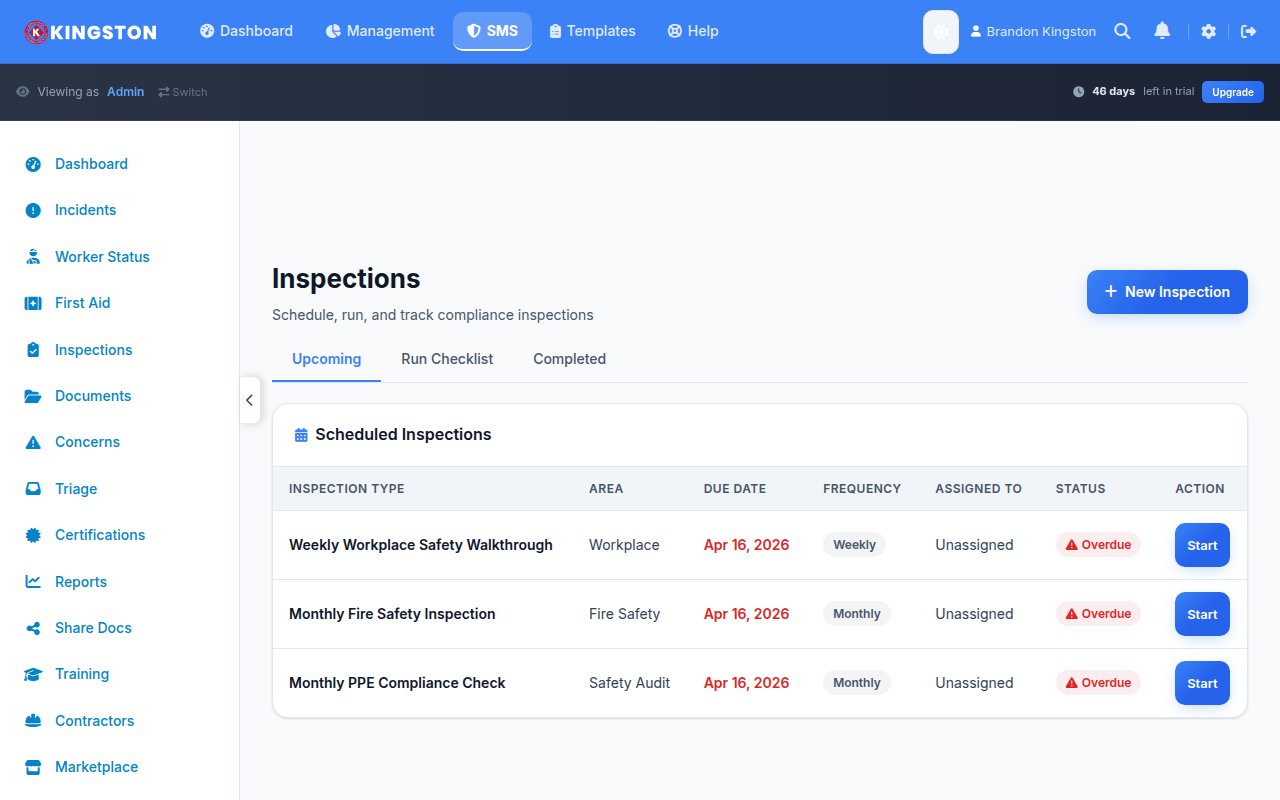
Think of this as your dress rehearsal. Walk your site the way an officer would. Grab a clipboard. Better yet, use a digital inspection tool that mirrors the criteria WorkSafeBC officers actually evaluate.
During your walkthrough, look for:
- Blocked fire exits or obstructed emergency equipment
- Missing or illegible safety signage (WHMIS labels, hazard warnings, emergency contact info)
- Housekeeping issues -cluttered walkways, spills, poor lighting
- Improper storage of hazardous materials
- Workers not wearing required PPE
- Unguarded machinery or missing lockout/tagout procedures
- Damaged fall protection equipment still in use
- Electrical hazards (exposed wiring, overloaded circuits, missing covers on panels)
Document everything you find. Fix what you can immediately. For items that require time or resources, create a written corrective action plan with deadlines and assigned responsibility. WorkSafeBC officers look favourably on employers who can demonstrate that they identified a hazard and are actively addressing it.
Step 3: Verify Training and Certification Compliance
This is where inspections sting the most. Training violations are among the most frequently cited issues in WorkSafeBC orders across British Columbia.
Ask yourself these questions:
- Is every worker's WHMIS 2015 training current and documented?
- Do all workers who operate equipment (forklifts, aerial lifts, cranes) hold valid certifications?
- Are fall protection training records on file for every worker exposed to fall hazards?
- Have confined space entry procedures been reviewed and trained within the required intervals?
- Are first aid attendant certifications current? WorkSafeBC checks expiry dates.
- Have new and young workers received documented orientation that covers site-specific hazards?
One expired certification. One missing signature. That is all it takes to generate a compliance order. Keep training records centralized and set automated reminders for renewals.
Step 4: Review Your JHSC or Worker Representative Records
WorkSafeBC officers routinely review Joint Health and Safety Committee documentation. They want to see that the committee is functional -not just a name on paper.
Confirm the following:
- Meetings are held at least monthly (or as required by your OHS program).
- Minutes are recorded, signed by co-chairs and posted where workers can access them.
- The committee includes both employer and worker representatives.
- Recommendations from the committee are being addressed in writing, with documented employer responses.
- Committee members have received the required eight hours of annual educational leave.
A well-functioning JHSC signals to an officer that your organization takes safety governance seriously. A dormant one signals the opposite.
Step 5: Know the Most Common WorkSafeBC Violations
Prevention is easier when you know what goes wrong most often. Based on WorkSafeBC enforcement data, these violations appear repeatedly across BC workplaces:
- Inadequate fall protection - Missing guardrails, lack of personal fall protection systems, untrained workers at height.
- WHMIS non-compliance - Outdated Safety Data Sheets (SDSs), missing labels, insufficient training.
- Lack of written safe work procedures - Officers expect documented procedures for high-risk tasks, not verbal instructions.
- Deficient OHS program - Programs that exist on paper but are not implemented, communicated, or reviewed.
- Failure to investigate incidents - Every incident, including near-misses, must be investigated and documented.
- Improper lockout/tagout - Missing procedures, untrained workers, no verification steps.
- Inadequate first aid provisions - Wrong level of first aid supplies, expired certifications, or no assessment on file.
- Poor housekeeping - It sounds minor until it contributes to a slip, trip, or struck-by incident.
Review this list against your own operations. Be honest about the gaps. The point is to fix them before an officer documents them.
Step 6: Prepare Your Team for the Inspection Itself
When a WorkSafeBC officer arrives, your team's response matters. Panic helps no one. Obstruction creates legal problems. Here is what to do:
Before the Officer Arrives
- Designate a point person (typically the OHS coordinator or site supervisor) to accompany the officer.
- Ensure the JHSC worker co-chair or worker representative is available to participate -this is their right under BC legislation.
- Brief supervisors: cooperate fully, answer questions honestly and do not volunteer information beyond what is asked.
During the Inspection
- Cooperate. WorkSafeBC officers have the legal authority to enter any workplace in British Columbia without a warrant. Obstruction is an offence under the Workers Compensation Act.
- Take notes. Document everything the officer examines, every question asked and every comment made. This is your record.
- Ask questions. You are permitted to ask the officer to clarify concerns, identify which regulation applies and explain the inspection scope.
- Provide requested documents promptly. This is where your organized document management pays dividends. Fumbling through filing cabinets while an officer waits does not inspire confidence.
- Fix immediate hazards on the spot. If the officer identifies a hazard that can be corrected immediately, do it. This demonstrates good faith and may reduce the severity of any orders issued.
What Not to Do
- Do not argue with the officer about the validity of a regulation.
- Do not coach workers on what to say. Officers interview workers privately and coached answers are transparent.
- Do not alter, hide, or destroy documents. This escalates a routine inspection into something far more serious.
Step 7: Post-Inspection Actions
The inspection does not end when the officer leaves. What you do next determines whether you close the loop cleanly or face escalating enforcement.
- Review all inspection orders carefully. Each order will reference a specific section of the OHSR or the Workers Compensation Act. Understand exactly what is required and by what deadline.
- Create a corrective action plan. Assign responsibility, set deadlines and document every step taken to achieve compliance.
- Submit compliance reports on time. WorkSafeBC sets deadlines for a reason. Missing them can result in additional penalties or a stop-work order.
- Communicate findings to your JHSC. Inspection results must be shared with the committee and posted for workers.
- Update your OHS program. If the inspection revealed gaps, revise your program, procedures and training accordingly.
- Consider a Request for Review. If you believe an order was issued in error, you have 45 days to request a formal review through WorkSafeBC's Review Division. This is a legitimate process -use it when warranted, not as a stalling tactic.
Track every corrective action digitally. When the follow-up inspection arrives -and it will -you want to show a clear, documented trail from order to resolution.
Build an Inspection-Ready Culture, Not a Last-Minute Scramble
The employers who handle WorkSafeBC inspections well are never the ones who "crammed" the night before. They are the ones who treat compliance as a daily operating standard. Safety documentation is always current. Training records are always accessible. Hazards are identified and addressed in real time, not during a frantic pre-inspection sweep.
That level of readiness requires the right systems. Spreadsheets and paper binders worked in 2005. They do not work now -not with the volume of records, the complexity of regulations and the speed at which WorkSafeBC expects responses.