How to Reduce Your Workers' Compensation Premiums
Employers can reduce workers' compensation premiums by improving workplace safety performance, implementing effective return-to-work programs, managing claims proactively and leveraging experience rating systems that reward lower injury rates with lower costs. In the United States, the average workers' compensation cost per employee ranges from $0.50 to over $3.00 per $100 of payroll depending on the industry and state - for a 100-person construction firm, that can exceed $300,000 annually. In Canada, WCB premiums follow a similar structure, with provincial boards adjusting employer rates based on industry classification and individual claims history.
The critical insight most employers miss: your premium isn't fixed. It's a direct reflection of your safety culture, your injury management practices and your willingness to invest in prevention. Every dollar spent on prevention returns multiples in premium savings. Here's exactly how to make that happen.
Understanding How Workers' Compensation Premiums Are Calculated
Before you can lower your premiums, you need to understand the formula that drives them. While specifics vary by jurisdiction, the core mechanics are consistent.
Free Download: 5 Safe Work Procedures
Choose from 112 professionally written SWPs. No credit card required.
Get Free SWPsBase Rate Components
Every employer is assigned a rate group (or classification code) based on their industry. This industry rate reflects the average claims experience for all employers in that sector. Your base premium is calculated as:
Premium = (Payroll / $100) x Industry Rate x Experience Modification Factor
Experience Rating / Experience Modification
This is the lever you can actually control. Experience rating compares your company's actual claims costs to the expected costs for your industry classification.
| Jurisdiction | System Name | How It Works |
|---|---|---|
| United States | Experience Modification Rate (EMR/e-Mod) | Calculated by NCCI or state bureau; compares your 3-year claims history to industry average. EMR of 1.0 = average; below 1.0 = better than average (lower premium); above 1.0 = worse (higher premium) |
| Alberta | Experience Rating | WCB Alberta uses a Partnership in Injury Reduction (PIR) program and experience rating that adjusts premiums based on claims costs relative to industry |
| British Columbia | Experience Rating | WorkSafeBC's experience rating adjusts premiums based on 3 years of claims cost history compared to the industry average |
| Ontario | Rate Framework | WSIB uses a prospective experience rating model that adjusts premium rates based on claims history within the employer's rate group |
The key takeaway: a single serious claim can inflate your premiums for 3-5 years. Prevention is always cheaper than response.
Strategy 1: Build a Strong Safety Program
This is the most impactful long-term strategy for reducing premiums. A well-documented, actively managed safety program prevents the injuries that drive claims costs up.
Essential Safety Program Components
- Written safety policies and procedures: Covering all significant hazards in your operation
- Regular workplace inspections: Monthly, at minimum, with documented findings and corrective actions
- Incident investigation: Every injury, near miss and property damage event should be investigated to identify root causes using a structured incident reporting system
- Worker training: Orientation, task-specific training and annual refreshers - all documented
- Management commitment: Visible participation from senior leadership, not just a signed policy in a binder
- Joint health and safety committee: Required in most Canadian jurisdictions; best practice everywhere
COR Certification (Canada)
In most Canadian provinces, earning a Certificate of Recognition (COR) through your industry safety association qualifies you for significant premium discounts:
- Alberta: Up to 20% rebate on WCB premiums through PIR program
- British Columbia: Financial incentives through WorkSafeBC's COR program
- Saskatchewan: Premium rebates for COR-certified employers
- Manitoba, Nova Scotia, New Brunswick: Similar COR incentive programs
COR requires an external audit of your safety program against established standards. The investment in achieving and maintaining COR typically pays for itself through premium reductions within the first year.
Strategy 2: Implement an Effective Return-to-Work Program
Claims costs - and by extension, premiums - are driven not just by injury frequency but by claim duration. A worker who's off work for 12 months costs exponentially more than one who returns to modified duties within a week. An early and safe return-to-work (RTW) program is one of the most powerful premium reduction tools available.
Key RTW Program Elements
- Early contact: Reach out to the injured worker within 24 hours. Express genuine concern and discuss the return-to-work process.
- Modified/transitional duties: Have a bank of meaningful modified duties ready before an injury occurs. These should be productive tasks that accommodate the worker's restrictions.
- Medical collaboration: Provide the treating physician with a physical demands analysis of the worker's job and available modified duties. Doctors are far more likely to approve an early return when they understand the workplace options.
- Gradual return: Start with reduced hours and lighter duties, progressively increasing to full duties as the worker recovers.
- Documentation: Record every step - the initial contact, modified duty offers, medical updates and progressive return milestones.
Research consistently shows that workers who return to modified duties within 7 days of injury have significantly better long-term recovery outcomes than those who remain off work for extended periods. The longer the absence, the lower the probability of ever returning to full duties.
Strategy 3: Proactive Claims Management
Many employers file a workers' compensation claim and then forget about it until the next premium statement arrives. That passive approach is expensive. Active claims management can substantially reduce total claim costs.
- Report claims promptly: Late reporting delays treatment, extends disability duration and increases total claim costs. File within 24 hours of the incident.
- Investigate immediately: A thorough investigation within 48 hours preserves evidence, identifies witnesses and demonstrates due diligence to the WCB/insurer.
- Monitor claim status: Use a WCB tracking system to monitor open claims, follow up on medical appointments and ensure the injured worker is progressing through the return-to-work plan.
- Challenge inappropriate claims: Not every claim is legitimate. If your investigation reveals that an injury didn't occur at work or doesn't meet the criteria for workers' compensation, you have the right - and the financial obligation - to dispute it.
- Close claims promptly: Open claims continue to accrue costs. Work with the WCB/insurer and the worker's physician to reach maximum medical improvement and close claims as quickly as medically appropriate.
Strategy 4: Focus on High-Cost Claim Prevention
Not all injuries impact your premiums equally. A single catastrophic claim - a serious fall, an amputation, a crush injury - can dwarf the combined cost of dozens of minor first-aid incidents. Target your prevention efforts where the financial exposure is greatest.
Highest-Cost Claim Categories
| Injury Type | Average Claim Cost (US) | Key Prevention Strategies |
|---|---|---|
| Amputations | $100,000+ | Machine guarding, lockout/tagout, proper training |
| Falls from height | $50,000-$150,000+ | Fall protection systems, working-at-heights training |
| Motor vehicle incidents | $75,000+ | Driver training, fleet management, journey management plans |
| Back injuries (chronic) | $40,000-$80,000 | Ergonomic assessments, mechanical lifting aids, rotation |
| Electrocutions (non-fatal) | $75,000+ | Electrical safety programs, arc flash assessments, lockout/tagout |
By analyzing your own claims data - or working with your WCB/insurer to obtain it - you can identify which injury types are driving the largest portion of your costs and direct prevention resources accordingly.
Strategy 5: Leverage Available Discounts and Incentive Programs
Most workers' compensation systems offer financial incentives that employers either don't know about or don't pursue. Here are common opportunities:
- Safety group programs: In Ontario, WSIB's Safety Groups Program allows employers in similar industries to pool resources and earn rebates for collective safety performance improvements.
- Voluntary protection programs: OSHA's VPP in the United States recognizes employers with exemplary safety programs - participants often negotiate better insurance terms.
- Premium discount programs: Many US states offer scheduled credits or premium discounts for employers who implement specific safety measures (drug-free workplace programs, safety committees, formal training programs).
- Retrospective rating: For larger employers, retrospective rating plans adjust your premium after the policy period based on actual loss experience - rewarding strong performance with lower final costs.
- Pay-as-you-go programs: While these don't reduce the rate, they improve cash flow by basing premium payments on actual payroll rather than estimates.
Strategy 6: Track, Measure and Improve
You can't improve what you don't measure. The employers who achieve the lowest premiums treat safety metrics with the same rigor they apply to financial performance.
- Track your EMR/experience rating trend: Monitor it annually and understand what's driving changes.
- Analyze claims data: Break down claims by type, body part, department, time of day and tenure of injured worker. Patterns reveal prevention opportunities.
- Calculate the true cost of workplace injuries: Include direct costs (medical, indemnity) and indirect costs (lost productivity, overtime for replacement workers, investigation time, administrative burden). The true cost is typically 3-5x the direct claim cost.
- Benchmark against industry: Compare your performance to your rate group average to understand where you stand and set realistic improvement targets.
How Make Safety Easy Reduces Your Premiums
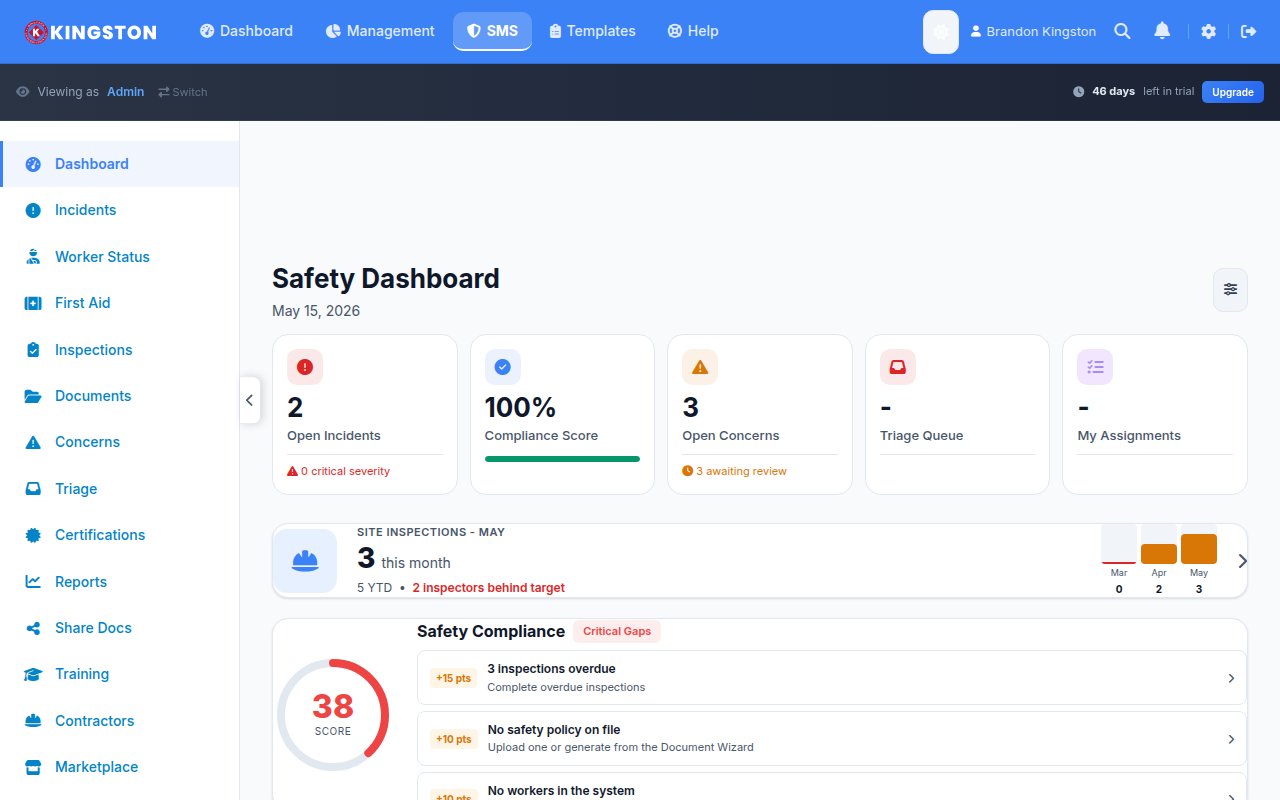
Every strategy in this guide requires documentation, tracking and data analysis. That's where technology makes the difference between good intentions and actual results. Make Safety Easy provides:
- WCB/workers' comp tracking that monitors open claims, return-to-work progress and cost trends in one dashboard
- Incident reporting that captures near misses and injuries in real time from any device, enabling faster investigation and claims filing
- Inspection and audit management that documents your proactive safety activities - the evidence that justifies COR certification and premium discounts
- Analytics and reporting that turn raw safety data into actionable insights for targeting high-cost injury prevention
Want to see the impact on your bottom line? Request a demo to learn how Make Safety Easy helps employers lower their workers' compensation costs, or explore pricing plans that deliver ROI from day one.
Ready to simplify your safety program?
Make Safety Easy helps teams run toolbox talks, inspections, incident reports and more - all from one platform.
Start Your Free TrialNo credit card required. 14-day free trial.