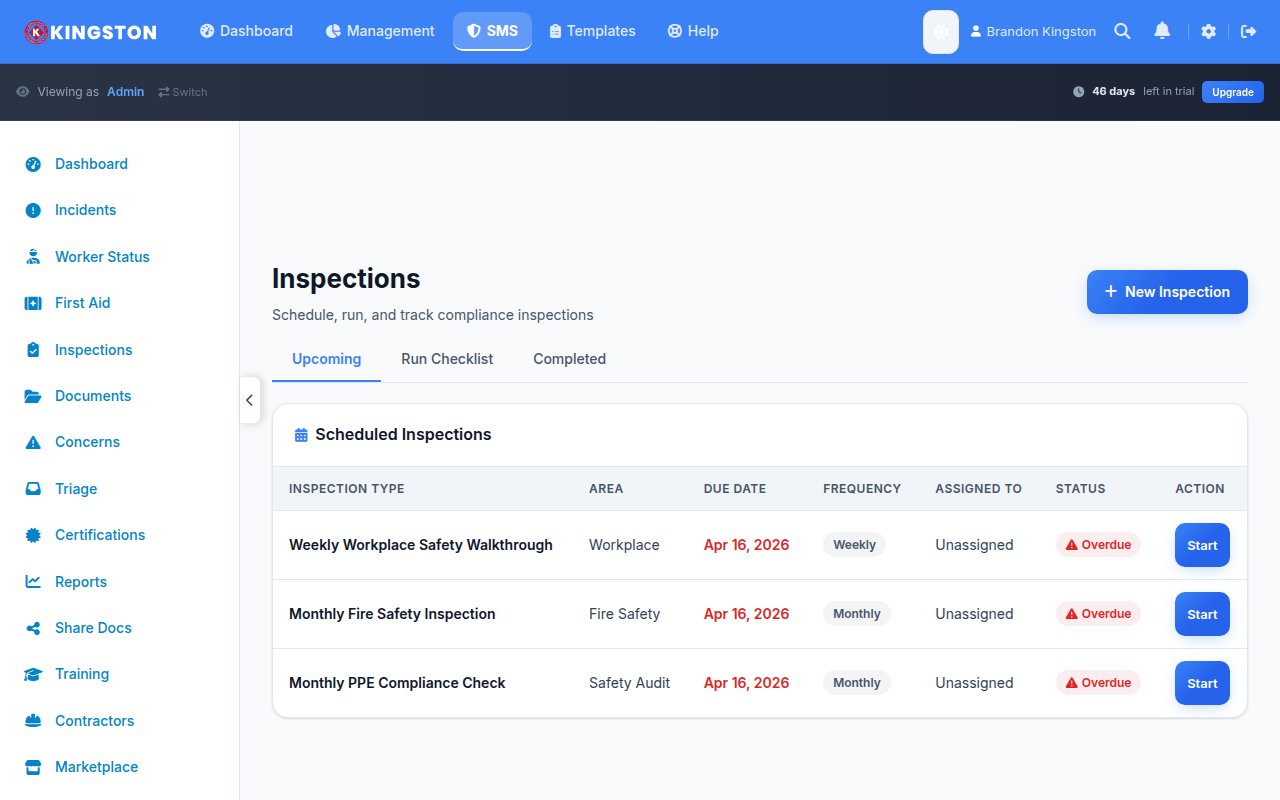
A safety audit checklist is a structured tool used to evaluate whether a workplace is meeting its legal, regulatory and internal safety obligations. Unlike a routine inspection that looks at physical conditions on a specific day, a workplace safety audit examines the entire safety management system - policies, procedures, training records, inspection logs and incident data - to determine whether the program is actually working. Organizations that audit regularly find problems at the policy level before those problems manifest as injuries on the floor.
This guide covers everything you need to plan, conduct and follow up on an OHS audit, including a ready-to-use checklist organized by category. Whether you are preparing for an external COR audit, an OSHA inspection, or an internal program review, the framework here applies.
What Is a Safety Audit?
A safety audit is a systematic, documented evaluation of a workplace safety program. It goes beyond hazard identification (that is what inspections do) and instead asks whether the management system designed to control hazards is functioning as intended.
Free Download: 5 Safe Work Procedures
Choose from 112 professionally written SWPs. No credit card required.
Get Free SWPsSafety Audit vs. Safety Inspection
| Feature | Safety Audit | Safety Inspection |
|---|---|---|
| Scope | Entire safety management system | Physical workplace conditions |
| Focus | Policies, procedures, compliance, documentation | Hazards, deficiencies, housekeeping |
| Frequency | Annually or semi-annually | Weekly, monthly, or per-task |
| Conducted by | Trained auditors (internal or external) | Supervisors, safety reps, workers |
| Output | Audit report with findings and recommendations | Inspection report with corrective actions |
Both are essential. Regular inspections catch hazards in real time; audits verify that the system producing those inspections is sound.
Types of Safety Audits
Internal Audits
Conducted by your own team - safety managers, supervisors, or trained internal auditors. Internal audits are lower cost, can be done more frequently and help you identify issues before an external auditor arrives. The trade-off is potential bias or blind spots.
External Audits
Performed by independent third parties. These include COR (Certificate of Recognition) audits in Canada, ISO 45001 certification audits, client or general contractor pre-qualification audits and regulatory compliance audits. External audits carry more weight with insurers and regulators.
Gap Audits
A targeted audit that compares your current program against a specific standard (such as ISO 45001 or a provincial OHS regulation) and identifies what is missing. Gap audits are commonly done before pursuing certification.
How to Prepare for a Safety Audit
Preparation is where audits are won or lost. Walking into an audit with disorganized documentation virtually guarantees negative findings.
Pre-Audit Checklist
- Define the scope. What parts of the safety program will be audited? All elements, or specific ones like hazard assessment or emergency response?
- Select the audit criteria. Which standard or regulation are you auditing against? OSHA General Industry (29 CFR 1910)? A provincial OHS act? ISO 45001? Your own internal policy manual?
- Gather documentation. Collect all relevant records: policies, safe work procedures, training records, inspection reports, incident investigations, meeting minutes, equipment maintenance logs and corrective action records.
- Notify stakeholders. Let managers, supervisors and the joint health and safety committee know the audit is happening. Brief workers who may be interviewed.
- Schedule interviews and walkthroughs. The audit should include document review, workplace observation and worker interviews to triangulate findings.
- Review previous audit findings. Confirm that corrective actions from the last audit were actually completed. Outstanding items from a prior audit are among the most damaging findings.
A centralized document management system makes preparation dramatically easier by keeping all safety documents in one searchable, organized location.
Comprehensive Safety Audit Checklist
The following safety audit checklist covers the major elements of a workplace safety program. Adapt it to your industry, jurisdiction and organizational size.
1. Safety Policy and Leadership
- Is there a written health and safety policy signed by senior management?
- Has the policy been reviewed and updated within the past 12 months?
- Is the policy communicated to all workers (posted, distributed, discussed)?
- Are safety responsibilities clearly defined for management, supervisors and workers?
- Does senior leadership participate in safety meetings, walkthroughs, or reviews?
- Is there a documented safety budget?
2. Hazard Identification and Risk Assessment
- Are formal hazard assessments conducted for all work activities?
- Are hazard assessments reviewed when tasks, equipment, or conditions change?
- Is a hierarchy of controls (elimination, substitution, engineering, administrative, PPE) applied?
- Are job hazard analyses (JHAs) available for high-risk tasks?
- Is there a process for workers to report new hazards?
3. Inspections
- Are workplace inspections conducted at a defined frequency (weekly, monthly)?
- Do inspection checklists cover relevant hazard categories?
- Are inspections documented with date, inspector name and findings?
- Are corrective actions assigned, tracked and closed out?
- Do inspections include both physical conditions and work practices?
- Is there management review of inspection trends? Monthly safety reviews can systematize this.
4. Incident Reporting and Investigation
- Is there a defined process for reporting injuries, illnesses, near misses and property damage?
- Are incidents investigated promptly (within 24 to 48 hours)?
- Do investigations identify root causes, not just immediate causes?
- Are corrective actions from investigations tracked to completion?
- Is incident data analyzed for trends (recurring injury types, locations, times)?
- Are regulatory reporting requirements met (OSHA fatality/severe injury reporting, provincial requirements)?
5. Training and Competency
- Is there a training matrix identifying required training by job role?
- Are training records maintained for all workers (dates, topics, trainer, attendance)?
- Is orientation training provided to all new hires before they begin work?
- Is refresher training conducted at required intervals?
- Are workers trained on specific hazards relevant to their tasks (WHMIS/GHS, fall protection, confined space, etc.)?
- Is training effectiveness evaluated (tests, observations, interviews)?
6. Emergency Preparedness
- Is there a written emergency response plan?
- Are emergency evacuation routes posted and unobstructed?
- Are fire extinguishers inspected monthly and serviced annually?
- Are emergency drills conducted at required intervals?
- Are first aid kits stocked and accessible?
- Are sufficient trained first aiders on each shift?
- Are emergency contact numbers posted prominently?
7. Personal Protective Equipment (PPE)
- Has a PPE hazard assessment been conducted for each work area?
- Is appropriate PPE provided at no cost to workers?
- Are workers trained on proper PPE selection, use, maintenance and limitations?
- Is PPE inspected before each use and replaced when damaged?
- Are PPE requirements posted in relevant areas?
8. Contractor Management
- Is there a contractor pre-qualification process that includes safety performance review?
- Are contractors oriented to site-specific hazards and rules?
- Are contractor safety performance and compliance monitored on site?
- Do contracts include safety requirements and expectations?
9. Documentation and Record Keeping
- Are all required safety documents current, organized and accessible?
- Are records retained for the required periods (OSHA: 5 years for 300 logs; training records per applicable standard)?
- Is there a document control process (version control, review dates, approvals)?
- Are safety data sheets (SDSs) available for all hazardous materials on site?
10. Management Review and Continuous Improvement
- Does management formally review the safety program at least annually?
- Are safety objectives and targets set and tracked?
- Are leading indicators (inspection rates, training completion, near-miss reports) measured?
- Are audit findings from previous years tracked to closure?
- Is there a process for incorporating lessons learned from incidents and audits?
Conducting the Audit
An effective audit has three components, each designed to verify the same things from different angles:
Document Review
Start by reviewing written policies, procedures and records against the audit criteria. Look for gaps (missing documents), staleness (policies not reviewed in years), and inconsistency (procedures that do not match actual practice).
Workplace Observation
Walk the facility or site. Observe work practices, housekeeping, PPE use, signage, equipment condition and emergency preparedness. Compare what you see to what the documents say should be happening.
Worker Interviews
Interview workers and supervisors to assess whether they understand the safety policies, know how to report hazards and incidents, have received required training and feel comfortable raising safety concerns. Interviews are often the most revealing part of the audit.
After the Audit: Closing Findings
An audit is only as valuable as the corrective actions that follow it. Every finding should be:
- Documented clearly - describe what was found, what the requirement is and the gap between the two.
- Classified by severity - major non-conformance, minor non-conformance, or observation/opportunity for improvement.
- Assigned to a responsible person with a target completion date.
- Tracked to completion with evidence of closure (updated documents, photos, training records).
- Verified - confirm the corrective action actually resolved the issue.
Stop losing audit findings in email threads and spreadsheets. Make Safety Easy tracks corrective actions from identification through verification, with automated reminders and a complete audit trail. Book a demo to see how it streamlines your audit follow-up, or check out our pricing plans.
Ready to simplify your safety program?
Make Safety Easy helps teams run toolbox talks, inspections, incident reports and more - all from one platform.
Start Your Free TrialNo credit card required. 14-day free trial.