What Is a Toolbox Talk?
A toolbox talk is a brief, informal safety meeting - typically 5 to 15 minutes - held at the start of a shift or before a specific task begins. Its purpose is simple: remind workers of the hazards they will face that day and reinforce the safe work practices that prevent injuries. Sometimes called a safety briefing, tailgate meeting, or pre-job safety talk, the toolbox talk is one of the most effective frontline safety tools available to supervisors, foremen and safety professionals across every industry.
Whether you operate under OSHA regulations in the United States, provincial OHS legislation in Canada, or international safety standards, toolbox talks fulfill a common requirement: ongoing worker education and hazard communication. They are not a replacement for formal training programs, but they fill a critical gap - the daily, real-time reinforcement that keeps safety top of mind when it matters most.
Why Toolbox Talks Matter
The numbers tell the story. According to the Bureau of Labor Statistics, there were over 5,400 fatal workplace injuries in the United States in a single recent year. Many of these deaths involved hazards that a five-minute conversation could have addressed. Slips, falls, struck-by incidents, electrocution - these are not exotic risks. They are predictable. And predictable hazards are preventable ones.
Free Download: 5 Safe Work Procedures
Choose from 112 professionally written SWPs. No credit card required.
Get Free SWPsToolbox talks work because they:
- Reinforce training at the point of work. Formal safety courses happen once or twice a year. Toolbox talks happen every day.
- Address site-specific hazards. A general training module cannot account for the trench that was dug yesterday or the crane arriving this afternoon. A toolbox talk can.
- Create a culture of open communication. When workers are encouraged to ask questions and share concerns in a daily briefing, they are more likely to speak up when something feels wrong.
- Demonstrate due diligence. Regulators and insurers look for evidence that employers actively communicate hazards. Documented toolbox talks are powerful proof.
- Reduce incident rates. Organizations that implement regular safety briefings consistently report fewer injuries, lower workers' compensation costs and improved morale.
What Makes a Good Toolbox Talk?
Not all toolbox talks are created equal. A supervisor reading from a laminated sheet while half the crew checks their phones is technically a toolbox talk. It is not, however, an effective one. The best talks share a few characteristics.
They are short and focused. Pick one topic. Cover it thoroughly in 5 to 15 minutes. If you try to address fall protection, chemical handling and confined spaces in the same talk, nobody will remember any of them.
They are relevant to the day's work. A talk about heat stress in January is well-intentioned but poorly timed. Match the topic to the tasks, the weather, recent incidents, or upcoming changes on site.
They are interactive. Ask questions. Invite workers to share their own experiences. The moment it becomes a lecture, engagement drops.
They are documented. Record the date, topic, presenter and attendees. This documentation is invaluable during audits, investigations and insurance reviews. A talk that is not documented might as well not have happened - at least from a regulatory perspective.
Toolbox Talk Examples
Here are three sample formats that organizations use successfully:
Example 1: Construction - Working at Heights
Topic: Fall protection for scaffold work
Duration: 10 minutes
Key points covered:
- OSHA standard 1926.451 requires guardrails, safety nets, or personal fall arrest systems on scaffolds above 10 feet.
- Inspect all harnesses and lanyards before use - check for frayed webbing, cracked D-rings and deployment indicators on shock absorbers.
- Never climb on cross-braces. Use the built-in ladder or stair tower.
- Report any scaffold defects to the supervisor immediately. A defective scaffold must be tagged out of service.
Discussion question: "Has anyone noticed damage to any of the fall protection equipment this week?"
Example 2: Manufacturing - Lockout/Tagout
Topic: Energy isolation before maintenance
Duration: 8 minutes
Key points covered:
- OSHA standard 1910.147 - the Control of Hazardous Energy - applies every time a machine is serviced or maintained.
- Review the specific lockout procedure for the packaging line that will be serviced today.
- Each worker applies their own lock and tag. No exceptions. No shared locks.
- Verify zero energy state before beginning work - attempt to start the machine after lockout to confirm isolation.
Discussion question: "Walk me through the lockout steps for this machine. Who goes first?"
Example 3: Office/General - Ergonomics
Topic: Preventing repetitive strain injuries
Duration: 7 minutes
Key points covered:
- Adjust your chair so your feet are flat on the floor and your knees are at a 90-degree angle.
- Your monitor should be at arm's length, with the top of the screen at or just below eye level.
- Take micro-breaks every 30 minutes - stand, stretch and look away from the screen.
- Report any discomfort early. Early intervention prevents chronic injury.
Free Toolbox Talk Topics List
Running out of ideas? Here are 40 toolbox talk topics organized by category. Each one can be delivered in under 15 minutes.
| Category | Topics |
|---|---|
| General Safety | Slip, trip and fall prevention; Housekeeping; Emergency evacuation procedures; Fire extinguisher use; First aid basics |
| PPE | Hard hat care and inspection; Hearing protection selection; Respiratory protection fit; Glove selection by hazard; Eye and face protection |
| Construction | Trench safety; Scaffold inspection; Crane signal review; Power tool safety; Ladder safety |
| Chemical Safety | Reading an SDS; WHMIS/GHS pictograms; Spill response procedures; Chemical storage compatibility; Ventilation requirements |
| Seasonal/Environmental | Heat stress prevention; Cold stress and frostbite; UV exposure; Lightning safety; Wildfire smoke and air quality |
| Ergonomics & Wellness | Manual lifting technique; Workstation setup; Fatigue management; Mental health awareness; Substance impairment policies |
| Driving & Mobile Equipment | Distracted driving; Pre-trip vehicle inspection; Forklift pedestrian safety; Backing and blind spots; Seatbelt use |
| Electrical & Energy | Lockout/tagout refresher; Arc flash awareness; Ground fault protection; Extension cord safety; Overhead power lines |
For a deeper dive into delivering talks that actually change behavior, see our guide to running effective toolbox talks.
How to Run a Toolbox Talk: Step by Step
- Choose a relevant topic. Base it on the day's tasks, recent incidents, seasonal hazards, or upcoming changes.
- Prepare briefly. Review the key points. You do not need a script, but you do need a plan.
- Gather the crew. Everyone who will be exposed to the hazard should attend. No exceptions for "experienced" workers.
- Deliver the talk. State the hazard, explain the controls and describe what to do if something goes wrong.
- Engage the audience. Ask open-ended questions. Let workers share relevant experiences.
- Document it. Record the date, topic, presenter, attendees (with signatures if possible), and any follow-up actions.
- Follow up. If someone raised a concern, address it. Nothing kills participation faster than ignored feedback.
Digital Toolbox Talks: The Modern Approach
Paper-based toolbox talk records have served the industry for decades. They have also been lost in truck cabs, soaked by rain and filed in boxes that nobody ever opens again. The modern approach is digital.
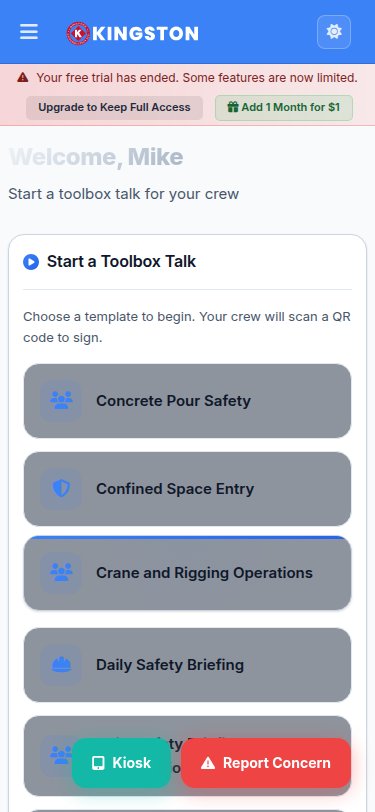
With a platform like Make Safety Easy's Toolbox Talk feature, supervisors can:
- Select from a library of pre-built topics or create custom talks in minutes.
- Deliver talks on a phone or tablet - even offline in remote areas.
- Capture digital signatures and automatic timestamps.
- Track completion rates across crews, sites and time periods.
- Generate audit-ready reports with a single click.
The result is less paperwork, better compliance records and more time spent on what actually matters - the conversation with your crew.
Toolbox Talks and Regulatory Compliance
While no single OSHA standard mandates "toolbox talks" by name, numerous standards require employers to inform workers of hazards and provide ongoing safety instruction. OSHA's Hazard Communication standard (29 CFR 1910.1200), construction training requirements (29 CFR 1926.21), and the General Duty Clause (Section 5(a)(1) of the OSH Act) all support the practice.
In Canada, every province and territory requires employers to provide information, instruction and supervision to protect worker health and safety. Toolbox talks are widely recognized as a practical means of meeting these obligations under acts such as Ontario's Occupational Health and Safety Act and Alberta's OHS Act.
Internationally, the ISO 45001 occupational health and safety management system standard emphasizes competence, awareness and communication - all of which toolbox talks directly support.
Common Mistakes to Avoid
- Reading word-for-word from a script. Workers disengage instantly. Know your material and talk naturally.
- Repeating the same topics on rotation. If your crew has heard the ladder safety talk eight times this year, they have stopped listening. Vary your content.
- Skipping documentation. An undocumented talk offers zero legal protection.
- Holding talks after work has already started. The talk should happen before exposure to the hazard, not during lunch.
- Making it punitive. Toolbox talks are educational, not disciplinary. If workers associate them with blame, they will stop contributing.
Start Running Better Toolbox Talks Today
Toolbox talks are one of the highest-impact, lowest-cost safety activities any organization can implement. They require no special equipment, no expensive consultants and no lengthy approval processes. They just require commitment - a few minutes each day to remind your team that they deserve to go home safe.
Ready to streamline your toolbox talks with digital delivery, tracking and reporting? Book a free demo of Make Safety Easy or explore our pricing plans to find the right fit for your team.
Ready to simplify your safety program?
Make Safety Easy helps teams run toolbox talks, inspections, incident reports and more - all from one platform.
Start Your Free TrialNo credit card required. 14-day free trial.