Workplace first aid kit contents must be adequate for the types of injuries and illnesses reasonably expected in each work environment. OSHA requires employers under 29 CFR 1910.151 (general industry) and 29 CFR 1926.50 (construction) to provide first aid supplies that are readily accessible, properly stocked and appropriate for the hazards present. The ANSI/ISEA Z308.1 standard provides the minimum contents benchmark that most employers use to meet this obligation, though high-hazard workplaces typically need supplies well beyond the ANSI minimum.
OSHA First Aid Kit Requirements
OSHA does not publish a single mandatory list of first aid kit contents. Instead, the agency takes a performance-based approach: employers must ensure that first aid materials are "adequate and readily available" based on the specific hazards in their workplace. This means the contents of a first aid kit in an office building will differ significantly from one on a construction site or in a chemical manufacturing plant.
For construction sites, OSHA 1926.50(d)(1) is more prescriptive, requiring at least one first aid kit for every 25 workers and referencing the contents recommended in ANSI Z308.1 as the baseline. OSHA also requires that first aid kits be weatherproof in outdoor environments and that the contents be checked and replenished before being sent to each job site.
Free Download: 5 Safe Work Procedures
Choose from 112 professionally written SWPs. No credit card required.
Get Free SWPsThe Consulting Physician Requirement
OSHA's general industry standard (1910.151) states that first aid supplies should be "approved by the consulting physician." This means employers should have a medical professional review their first aid kit contents based on workplace hazards, number of employees and proximity to emergency medical services. In practice, many employers satisfy this by following ANSI standards and documenting their hazard assessment, but the consulting physician review adds an extra layer of compliance assurance.
ANSI Z308.1 Minimum First Aid Kit Contents
The ANSI/ISEA Z308.1 standard establishes the minimum supplies for a basic workplace first aid kit. The current edition specifies two classes of kits:
Class A - Basic Workplace Environments
Class A kits are designed for common workplace injuries in low-risk environments such as offices, retail spaces and light manufacturing. Required contents include:
- Adhesive bandages (assorted sizes) - minimum 16
- Adhesive tape - 1 roll
- Antibiotic treatment packets - minimum 10
- Antiseptic packets - minimum 10
- Breathing barrier (CPR mask) - 1
- Burn treatment packets - minimum 6
- Cold pack (instant) - 1
- Eye covering with means of attachment - 2
- Eye/skin wash - minimum 1 fluid ounce
- First aid guide - 1
- Hand sanitizer packets - minimum 6
- Medical exam gloves - minimum 4 pairs
- Roller bandage (2-inch) - 1
- Roller bandage (4-inch) - 1
- Scissors - 1
- Sterile pads (3x3 inch) - minimum 4
- Trauma pad (5x9 inch minimum) - minimum 2
- Triangular bandage (40x40x56 inch) - 1
Class B - High-Risk Workplace Environments
Class B kits are designed for environments with more complex hazards and larger workforces such as construction sites, warehouses and manufacturing plants. Class B kits contain all Class A items in greater quantities plus additional supplies:
- Adhesive bandages - minimum 50
- Antibiotic treatment - minimum 25
- Antiseptic - minimum 50
- Burn treatment - minimum 10
- Cold packs - minimum 2
- Eye/skin wash - minimum 4 fluid ounces
- Medical exam gloves - minimum 8 pairs
- Roller bandages - 2 of each size (2-inch and 4-inch)
- Sterile pads - minimum 8
- Tourniquet - 1
- Splint - 1
- Additional trauma pads and triangular bandages
First Aid Supplies by Workplace Type
While ANSI provides the minimum baseline, smart employers customize their first aid kits based on their specific hazard profile. Here is what to consider for common workplace types.
Office and Commercial Workplaces
Office injuries tend to involve minor cuts, burns from break room equipment, slips and falls and ergonomic strain. A Class A kit supplemented with the following usually suffices:
- Over-the-counter pain relievers (individually packaged)
- Hydrocortisone cream packets for minor irritation
- Additional cold packs for sprains and strains
- Finger splints
- Blood pressure cuff and stethoscope (if trained first aiders are present)
Construction Sites
Construction first aid kits face harsher conditions and more severe injury potential. Beyond the Class B minimum, construction kits should include:
- Hemostatic gauze or wound packing material for severe bleeding
- Commercial tourniquet (CAT or similar)
- Emergency thermal blankets
- Chest seal for puncture wounds
- Irrigation bottles (minimum 16 ounces) for eye and wound flushing
- SAM splint or similar moldable splint
- Burn gel or burn blanket for thermal burns
- Tweezers for splinter and debris removal
Construction first aid kits must be stored in weatherproof containers and positioned so that no worker is more than a few minutes away from supplies. For jurisdictions with specific first aid requirements, verify that your kit contents meet or exceed local regulations as well as federal standards.
Manufacturing and Industrial Facilities
Manufacturing environments introduce chemical exposure, machine-related lacerations, burns and eye injuries. Industrial first aid kits should add:
- Emergency eyewash supplies (portable bottles in addition to fixed stations)
- Chemical-specific neutralizing agents where appropriate
- Large wound dressings for machine-related lacerations
- Multiple tourniquets and hemostatic agents
- Burn sheets for large-area thermal or chemical burns
- Amputated part bags (sterile, with ice packs)
Remote and Outdoor Workplaces
Worksites far from hospitals - including forestry, mining and pipeline operations - need expanded kits that can sustain patient care until evacuation arrives. Consider adding:
- Advanced bleeding control supplies (multiple tourniquets, hemostatic gauze)
- Cervical collar for suspected spinal injuries
- Oral glucose for diabetic emergencies
- Epinephrine auto-injectors (where permitted by jurisdiction and employer policy)
- Hypothermia prevention supplies (heat packs, emergency blankets, dry clothing)
- Portable oxygen unit (if trained personnel are available)
First Aid Kit Placement and Accessibility
Having the right supplies means nothing if workers cannot reach them quickly. OSHA requires that first aid materials be "readily available," which means:
- Kits must be positioned within reasonable travel distance of all work areas
- Kits must not be locked in cabinets or offices that are inaccessible during off-hours
- Kit locations must be clearly marked with standardized signage
- All employees must know where first aid kits are located
- Kits must be accessible to workers with disabilities
A general guideline is to place first aid kits so that no worker is more than a 3-4 minute walk from supplies. In large facilities, this may require multiple kits on each floor or in each department. Construction sites should have kits at the site office, on each active floor and in each major work zone.
First Aid Kit Inspection and Maintenance
A first aid kit with expired supplies, empty compartments or missing components is a liability, not an asset. Regular inspection and replenishment is essential.
Inspection Frequency
- Before each shift (construction sites): Verify kit is present, sealed and accessible
- Weekly: Open the kit and visually confirm that all supplies are present and in good condition
- Monthly: Conduct a detailed inventory against the contents list, check expiration dates and replace used or damaged items
- After any use: Replenish all consumed supplies immediately
Documenting Inspections
Maintaining inspection records demonstrates compliance during OSHA audits and ensures accountability. Each inspection log should document the date, inspector name, kit location, items found missing or expired and replacement actions taken. A document management system keeps these records organized, searchable and accessible for audits.
Expiration Date Management
Many first aid supplies have expiration dates that affect their effectiveness:
- Antibiotic ointments: typically 2-3 years
- Antiseptic wipes: typically 1-3 years
- Cold packs: check manufacturer dating
- Medications (pain relievers, antihistamines): follow labeled dates
- Sterile dressings: lose sterility over time, replace per packaging dates
Set calendar reminders or use inventory management software to flag upcoming expirations so replacements are ordered before items expire.
First Aid Training Requirements
Supplies without trained responders provide limited value. OSHA requires employers to ensure the availability of first aid trained personnel when a medical facility is not "in near proximity" to the workplace. The construction standard (1926.50) is more explicit, requiring at least one person with valid first aid certification on each job site.
First aid training programs should cover CPR, AED use, bleeding control, shock management, burn treatment and emergency scene assessment at minimum. Training certifications typically expire every two years and must be renewed to remain compliant.
Centralize Your First Aid Compliance
Managing first aid kit inventories, inspection schedules, training certifications and jurisdiction-specific requirements across multiple locations or job sites is a logistical challenge. When one kit goes uninspected or one certification lapses, the gap creates both a compliance risk and a safety risk.
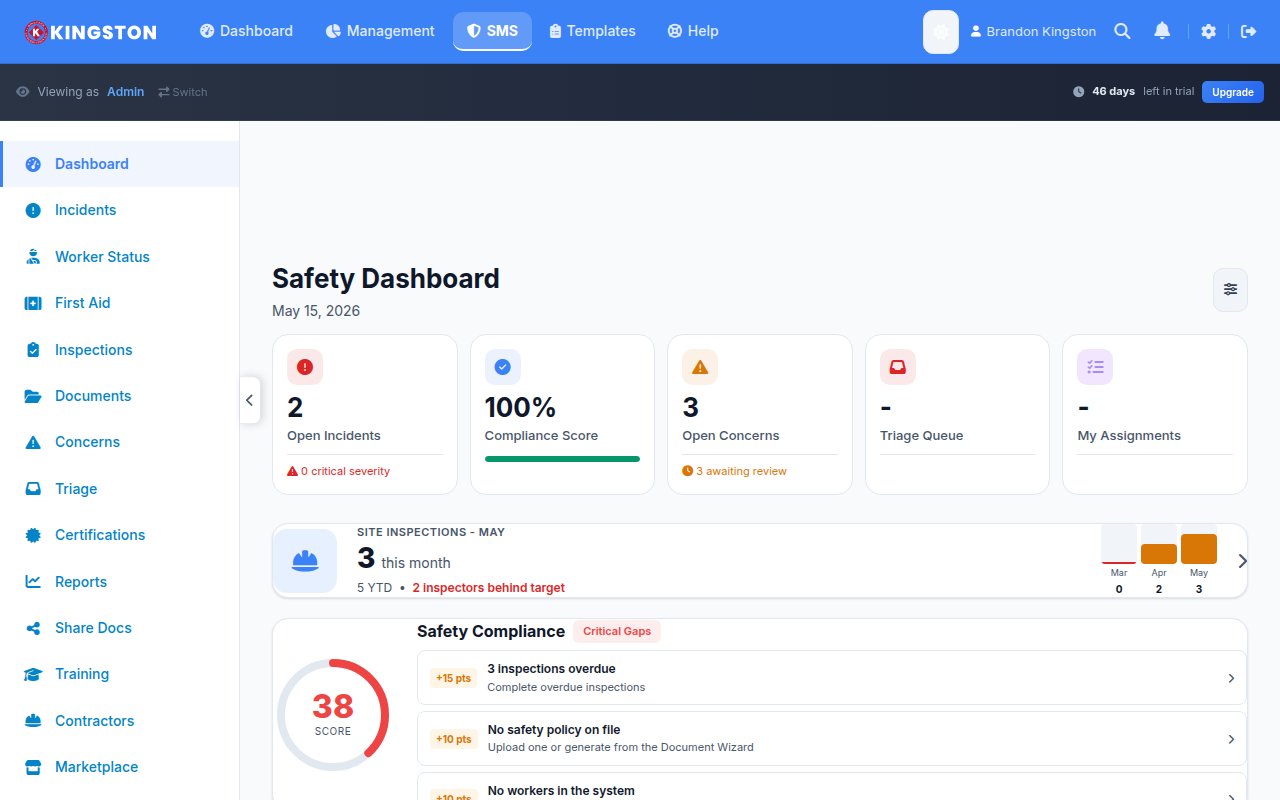
A centralized safety management platform automates inspection reminders, stores training records, tracks supply inventories and generates audit-ready documentation - all from a single dashboard.
Ready to simplify your first aid compliance? Request a demo to see how Make Safety Easy tracks inspections, certifications and compliance documentation across every location, or review our pricing to find the right plan for your team.
Ready to simplify your safety program?
Make Safety Easy helps teams run toolbox talks, inspections, incident reports and more - all from one platform.
Start Your Free TrialNo credit card required. 14-day free trial.