How to Create a Workplace Safety Policy (With Template)
A workplace safety policy is a written commitment from an employer to protect workers from occupational hazards - and it is legally required in most North American jurisdictions. In the United States, OSHA's General Duty Clause (Section 5(a)(1) of the OSH Act) mandates that employers provide a workplace free from recognized hazards. In Canada, every province requires a written occupational health and safety policy once an employer reaches a threshold number of workers (typically 5-20 depending on the jurisdiction). Internationally, ISO 45001:2018 makes a documented OHS policy the starting point for any management system. This guide shows you exactly how to build one - and includes a template you can adapt today.
Why You Need a Written Safety Policy
Some employers treat the safety policy as a formality - a laminated poster in the break room that nobody reads. That is a costly mistake. A well-written policy does three things simultaneously:
- Legal protection. During an OSHA inspection or WorkSafeBC audit, inspectors ask for your written policy first. Not having one - or having an outdated one - signals systemic non-compliance and can escalate penalties.
- Cultural signaling. Workers take safety more seriously when leadership commits to it in writing and backs that commitment with action. Research from the National Safety Council consistently links strong safety culture to lower incident rates.
- Operational clarity. The policy sets expectations: who is responsible for what, how hazards get reported and what happens when someone violates a safety rule. Without it, you get confusion - and confusion causes injuries.
What Regulators Expect
Requirements differ by jurisdiction, but the common elements are remarkably consistent:
Free Download: 5 Safe Work Procedures
Choose from 112 professionally written SWPs. No credit card required.
Get Free SWPs| Element | OSHA (U.S.) | Canada (Provincial OHS) | ISO 45001 |
|---|---|---|---|
| Written policy statement | Recommended (required in some state plans) | Required (varies by province) | Required (Clause 5.2) |
| Management commitment | Required under General Duty Clause | Required | Required (Clause 5.1) |
| Employee responsibilities | Recommended | Required | Required (Clause 5.3) |
| Hazard reporting procedures | Required | Required | Required (Clause 6.1) |
| Annual review | Recommended | Required in most provinces | Required (Clause 9.3) |
| Worker consultation | Recommended | Required (Joint Health & Safety Committee) | Required (Clause 5.4) |
Step-by-Step: Building Your Workplace Safety Policy
Step 1: Write the Policy Statement
This is the opening declaration - short, clear and signed by the highest-ranking leader in the organization. It should state three things:
- The company's commitment to providing a safe and healthy workplace.
- That safety takes precedence over production pressure.
- That every worker has the right - and the responsibility - to participate in maintaining safety.
Example: "[Company Name] is committed to providing a safe and healthy work environment for all employees, contractors and visitors. We believe that all workplace injuries and illnesses are preventable and we will not compromise worker safety for any operational objective. Every team member shares responsibility for identifying and controlling hazards."
Step 2: Define Roles and Responsibilities
Ambiguity kills safety programs. Spell out who does what:
- Senior management: Provides resources, reviews safety performance, leads by example.
- Supervisors and foremen: Conduct daily safety observations, enforce PPE requirements, deliver toolbox talks, and investigate incidents.
- Workers: Follow safe work procedures, report hazards immediately, use PPE as required and participate in training.
- Health and Safety Committee / Representative: Conducts workplace inspections, reviews incident reports and makes recommendations to management.
Step 3: Outline Hazard Identification and Reporting Procedures
Your policy must explain how hazards get identified, reported and controlled. This section typically covers:
- Routine workplace inspections - how often, by whom and using what checklists.
- Hazard reporting - the process for workers to report unsafe conditions without fear of retaliation.
- Risk assessment methodology - how the organization evaluates and prioritizes hazards (e.g., a risk matrix).
- Hierarchy of controls - elimination, substitution, engineering controls, administrative controls and PPE, in that order.
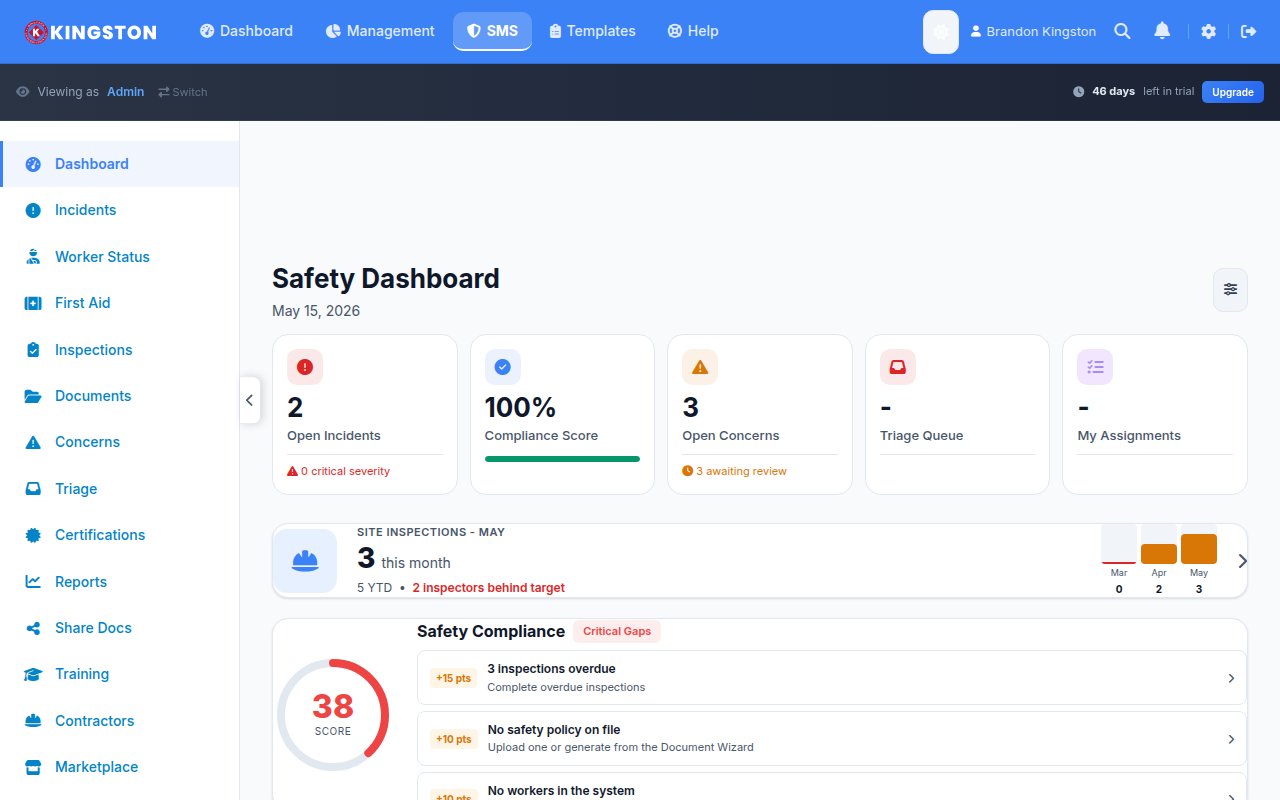
Using a digital platform for workplace inspections ensures hazard reports don't get lost in a stack of paper forms. Every observation is timestamped, assigned and trackable.
Step 4: Include Key Safety Programs
The policy should reference (or incorporate) the specific programs your workplace needs. Common ones include:
- Emergency response plan
- Hazard communication (WHMIS in Canada, HazCom in the U.S.)
- Lockout/tagout (LOTO) procedures
- Fall protection program
- Confined space entry program
- PPE program
- Return-to-work / modified duties program
- Violence and harassment prevention
- Drug and alcohol policy
You don't need to cram every detail into the policy itself. Reference each program and store the detailed procedures in your document management system where workers can access them.
Step 5: Establish Training Requirements
State that all workers will receive safety orientation before starting work, job-specific training when tasks change and ongoing refresher training. Document every training session - who attended, what was covered and when.
Regular toolbox talks are one of the most effective ongoing training methods. They're short, focused and keep safety top of mind between formal training sessions.
Step 6: Define Incident Reporting and Investigation
Your policy must address what happens when something goes wrong:
- Reporting requirements: All incidents, near-misses and first-aid cases must be reported immediately to the supervisor.
- Investigation process: Root-cause analysis within a defined timeframe (typically 24-48 hours for serious incidents).
- Corrective actions: Documented actions with assigned owners and deadlines.
- Regulatory reporting: OSHA requires fatality reports within 8 hours, hospitalizations within 24 hours. Canadian requirements vary by province but are similarly strict.
Step 7: Schedule Regular Reviews
A safety policy is not a "set it and forget it" document. Best practice - and most Canadian provincial regulations - require at least an annual review. Monthly safety reviews catch issues earlier and keep leadership engaged.
Trigger an immediate review after any of these events:
- A serious incident or fatality
- A regulatory change
- Introduction of new equipment, processes, or chemicals
- An organizational restructure
Workplace Safety Policy Template
Below is a framework you can adapt to your organization. Replace bracketed text with your specific information.
[COMPANY NAME] OCCUPATIONAL HEALTH AND SAFETY POLICY
Policy Statement:
[Company Name] is committed to protecting the health and safety of all employees, contractors and visitors. We will comply with all applicable federal, state/provincial and local health and safety legislation. We believe all workplace injuries and occupational illnesses are preventable.
Scope:
This policy applies to all [Company Name] workplaces, operations, employees, contractors and visitors.
Management Responsibilities:
- Provide adequate resources for the implementation of this policy.
- Ensure compliance with all applicable OHS legislation.
- Conduct regular workplace inspections and risk assessments.
- Investigate all incidents and implement corrective actions.
Employee Responsibilities:
- Follow all safe work procedures and use required PPE.
- Report hazards, incidents and near-misses immediately.
- Participate in required training and safety meetings.
- Refuse work that poses an imminent danger to themselves or others (as protected by law).
Review:
This policy will be reviewed at minimum annually, or following a significant incident, regulatory change, or operational change.
Signed:
[Name, Title]
[Date]
Common Mistakes That Weaken Your Policy
- Vague language. "We will try to maintain a safe workplace" is not a commitment. Use "will," not "try."
- No signature. An unsigned policy carries no authority. The highest-ranking person must sign it.
- No review date. An undated policy could be from ten years ago. Regulators notice.
- Inaccessible to workers. If the policy lives only on a network drive nobody can find, it's effectively nonexistent. Post it, discuss it and make it searchable.
- No enforcement mechanism. A policy without consequences for violations is a suggestion - and suggestions don't prevent injuries.
Digitize Your Safety Policy With Make Safety Easy
Paper policies get lost. Binders get outdated. Make Safety Easy lets you store your safety policy, procedures, training records and inspection reports in a single cloud-based platform - accessible to every worker on any device. Pair it with automated toolbox talk scheduling and monthly review reminders, and your safety program runs itself.
Need help building your safety program from the ground up? Request a demo to see how Make Safety Easy turns compliance from a burden into a system. View pricing to find the right plan for your team.
Ready to simplify your safety program?
Make Safety Easy helps teams run toolbox talks, inspections, incident reports and more - all from one platform.
Start Your Free TrialNo credit card required. 14-day free trial.