In 2024, the Bureau of Labor Statistics (BLS) reported approximately 5,283 fatal work injuries in the United States - roughly one death every 99 minutes. Non-fatal injuries requiring days away from work exceeded 2.6 million cases. These workplace safety statistics paint a clear picture: occupational injuries remain a massive public health and business problem and the organizations that invest in prevention consistently outperform those that do not.
This guide compiles the most current workplace injury statistics, fatality data, and occupational safety data available from the BLS, OSHA, the National Safety Council (NSC), and the International Labour Organization (ILO). Whether you are building a business case for a safety program, preparing a board presentation, or benchmarking your own performance, these numbers give you the foundation you need.
Fatal Workplace Injury Statistics
Fatal workplace injuries are tracked annually by the BLS Census of Fatal Occupational Injuries (CFOI). The data consistently shows that certain industries and hazard categories account for a disproportionate share of deaths.
Free Download: 5 Safe Work Procedures
Choose from 112 professionally written SWPs. No credit card required.
Get Free SWPsKey Fatality Numbers
- Total fatal work injuries (2024): Approximately 5,283, a figure that has remained stubbornly above 5,000 for over a decade.
- Fatal injury rate: 3.5 per 100,000 full-time equivalent (FTE) workers.
- Transportation incidents: The leading cause of workplace fatalities, accounting for roughly 38% of all deaths.
- Falls, slips and trips: The second leading cause, responsible for approximately 16% of fatal injuries.
- Contact with objects and equipment: Accounts for about 15% of workplace deaths, including struck-by and caught-in/between incidents.
- Exposure to harmful substances or environments: Approximately 14%, a category that has grown as overdose deaths in the workplace have increased.
Fatalities by Industry
| Industry | Estimated Fatal Injuries (2024) | Rate per 100,000 FTE |
|---|---|---|
| Construction | 1,032 | 9.5 |
| Transportation and Warehousing | 962 | 13.8 |
| Agriculture, Forestry, Fishing | 453 | 18.2 |
| Manufacturing | 378 | 2.5 |
| Government (all levels) | 412 | 1.8 |
| Mining, Quarrying, Oil/Gas | 142 | 11.4 |
Source: BLS Census of Fatal Occupational Injuries. Figures are rounded estimates based on the most recent published data. Confirm exact numbers at bls.gov/iif.
Non-Fatal Workplace Injury Statistics
For every fatal workplace injury, hundreds of non-fatal injuries occur. The BLS Survey of Occupational Injuries and Illnesses (SOII) tracks these cases across private industry and public-sector employers.
Overall Non-Fatal Injury Data
- Total recordable cases (private industry, 2024): Approximately 2.6 million.
- Total recordable incident rate (TRIR): 2.7 cases per 100 FTE workers.
- Days-away-from-work cases: Roughly 1.1 million, meaning nearly half of all recordable injuries were serious enough to require time off.
- Median days away from work: 8 days per injury.
Most Common Non-Fatal Injuries
- Overexertion and bodily reaction: The number one cause of non-fatal injuries, driven by lifting, pushing, pulling and repetitive motions. Accounts for roughly 31% of days-away cases.
- Falls on the same level: Slips and trips without a height component cause approximately 18% of lost-time injuries.
- Contact with objects: Struck-by injuries from tools, materials and equipment represent about 14% of cases.
- Falls to a lower level: Falls from ladders, scaffolds, roofs and platforms account for roughly 10% of lost-time cases but carry a much higher severity rate.
- Repetitive motion injuries: Carpal tunnel syndrome and similar musculoskeletal disorders represent a growing share, particularly in manufacturing and office environments.
Tracking these injuries accurately starts with a reliable incident reporting system that captures data in real time rather than relying on paper forms that get lost or filed late.
The Financial Cost of Workplace Injuries
Workplace injuries are not just a human tragedy - they carry an enormous financial burden for employers, workers and society.
Direct and Indirect Costs
- Total cost of work injuries (NSC estimate, 2024): Approximately $176 billion in the United States alone.
- Average cost per medically consulted injury: $44,000, including wage losses, medical expenses and administrative costs.
- Average cost per death: $1.37 million, factoring in lost productivity and employer costs.
- Workers' compensation costs: Employers pay an estimated $100+ billion annually in workers' compensation premiums across the U.S.
For a deeper breakdown of what injuries actually cost Canadian and North American employers, see our analysis on the cost of workplace injury in Canada.
The Indirect Cost Multiplier
For every dollar spent on direct injury costs (medical bills, compensation payments), employers typically spend $2 to $4 on indirect costs. These include:
- Overtime to cover absent workers
- Hiring and training replacement staff
- Accident investigation time
- Equipment repair or replacement
- Lost productivity and project delays
- Increased insurance premiums
- Legal fees and potential litigation
- Regulatory fines and penalties
OSHA Enforcement and Violation Statistics
OSHA conducts tens of thousands of inspections annually and the penalties for non-compliance have increased significantly in recent years.
OSHA Inspection Data
- Federal OSHA inspections conducted annually: Approximately 32,000 to 36,000.
- Maximum penalty for a serious violation (2026): $16,550 per violation (adjusted annually for inflation).
- Maximum penalty for a willful or repeat violation: $165,514 per violation.
- Most cited OSHA standards: Fall protection (1926.501), hazard communication (1910.1200), respiratory protection (1910.134), ladders (1926.1053), and scaffolding (1926.451) consistently top the list.
Top 10 Most Cited OSHA Violations
- Fall Protection - General Requirements (1926.501)
- Hazard Communication (1910.1200)
- Respiratory Protection (1910.134)
- Ladders (1926.1053)
- Scaffolding (1926.451)
- Lockout/Tagout (1910.147)
- Powered Industrial Trucks (1910.178)
- Fall Protection - Training (1926.503)
- Personal Protective Equipment - Eye and Face (1926.102)
- Machine Guarding (1910.212)
Staying ahead of these common violations requires consistent workplace inspections and a system that tracks corrective actions to completion.
Canadian Workplace Safety Statistics
Canada tracks workplace injury data through the Association of Workers' Compensation Boards of Canada (AWCBC) and individual provincial regulators.
- Workplace fatalities (AWCBC, most recent year): Over 1,000 annually, including occupational disease claims.
- Accepted time-loss injury claims: Approximately 245,000 per year across all provinces and territories.
- Leading causes: Musculoskeletal injuries (sprains and strains) dominate, followed by fractures, contusions and concussions.
- Highest-risk provinces by claim rate: Alberta, British Columbia and Manitoba consistently report higher per-capita claim rates, driven by resource extraction, forestry and construction activity.
Global Workplace Safety Statistics
The International Labour Organization estimates that approximately 2.93 million workers die each year from occupational accidents and work-related diseases worldwide. An additional 395 million workers suffer non-fatal injuries. The economic burden is staggering - the ILO estimates that occupational injuries and illnesses cost roughly 4% of global GDP annually.
Industry-Specific Injury Rate Comparisons
| Industry | TRIR (per 100 FTE) | DART Rate |
|---|---|---|
| Construction | 2.8 | 1.6 |
| Manufacturing | 3.2 | 1.7 |
| Healthcare and Social Assistance | 4.5 | 2.1 |
| Retail Trade | 3.0 | 1.3 |
| Transportation and Warehousing | 4.3 | 2.5 |
| Agriculture | 4.8 | 2.6 |
| Mining | 1.5 | 0.9 |
| Professional and Business Services | 1.0 | 0.5 |
TRIR = Total Recordable Incident Rate. DART = Days Away, Restricted, or Transferred rate. Source: BLS SOII. Rates are approximate and based on most recent published data.
Trends Shaping Workplace Safety in 2026
Several trends are influencing the occupational safety data landscape heading into 2026 and beyond:
1. Workplace Violence Is Rising
Assaults and violent acts in the workplace have increased across healthcare, retail and social services. OSHA has made workplace violence prevention a strategic priority and several states have enacted specific legislation targeting healthcare settings.
2. Mental Health Is Now a Safety Issue
Psychological injuries - including PTSD, burnout and anxiety disorders - are increasingly recognized as occupational injuries. Several Canadian provinces now include presumptive PTSD coverage for first responders and the conversation is expanding to all industries.
3. Heat-Related Illness Is Gaining Regulatory Attention
OSHA's proposed heat illness prevention standard would establish mandatory water, rest and shade requirements for outdoor and indoor workers exposed to high heat. Climate change is making this an urgent priority across construction, agriculture and warehousing.
4. Technology Is Changing Data Collection
Organizations using digital safety management platforms report higher near-miss capture rates, faster corrective action closure and more accurate injury data. The shift from paper-based systems to digital incident reporting is improving data quality industry-wide.
What These Statistics Mean for Your Organization
Numbers without action are just numbers. Here is how to translate these workplace safety statistics into meaningful improvements:
- Benchmark your performance. Compare your TRIR and DART rates against your industry average. If you are above the benchmark, you have a measurable gap to close.
- Focus on leading indicators. Lagging indicators like injury rates tell you what already happened. Leading indicators - inspection completion rates, near-miss reports, training hours - predict what will happen next.
- Invest in prevention. NSC data consistently shows that every $1 invested in workplace safety returns $2 to $6 in reduced injury costs, lower insurance premiums and improved productivity.
- Use technology to capture better data. You cannot improve what you do not measure. A centralized safety management platform eliminates the data gaps that lead to repeated incidents.
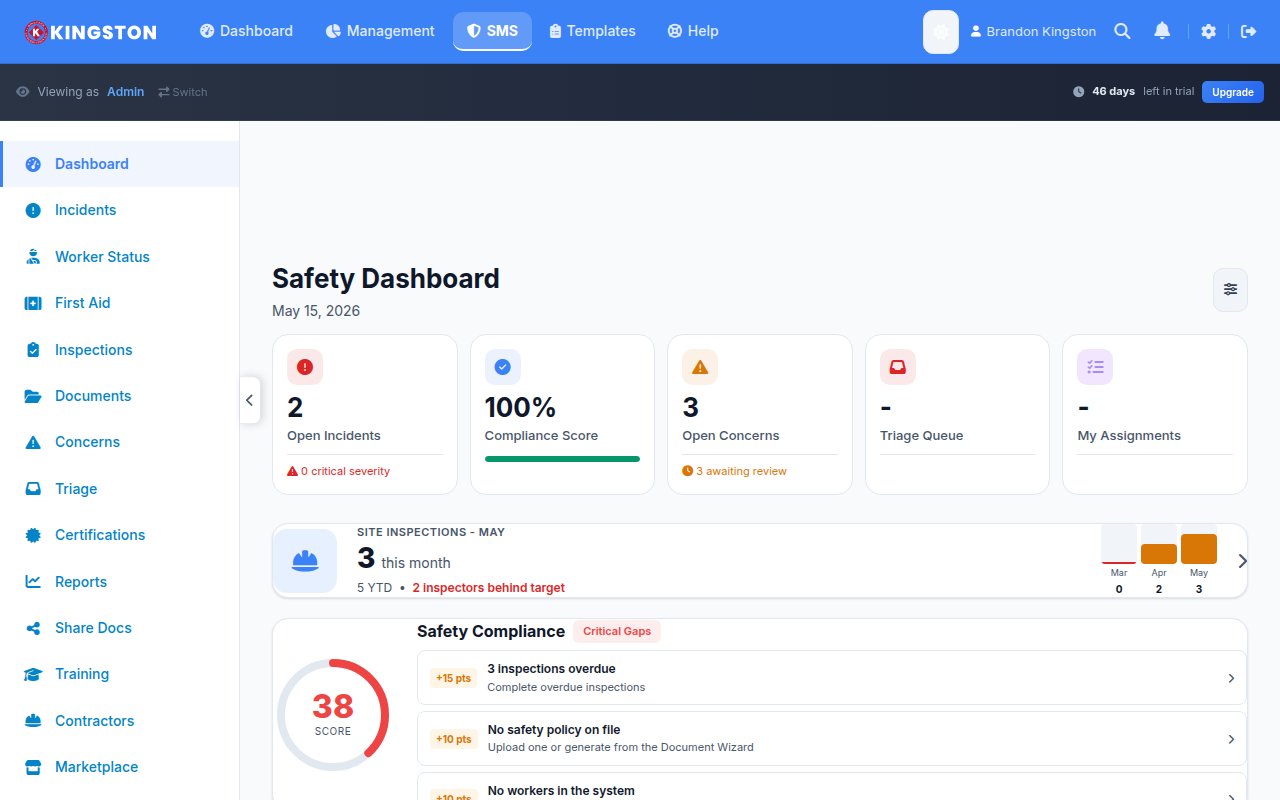
Ready to turn your safety data into action? Make Safety Easy gives you real-time dashboards, automated incident tracking and inspection management in one platform. Book a free demo and see how leading organizations are using better data to drive better outcomes.
Ready to simplify your safety program?
Make Safety Easy helps teams run toolbox talks, inspections, incident reports and more - all from one platform.
Start Your Free TrialNo credit card required. 14-day free trial.