Environmental compliance software is a category of digital tools that helps organizations manage their environmental permits, conduct and document inspections, track corrective actions, maintain regulatory records and generate reports required by agencies like the EPA, OSHA and state environmental departments. The best EHS compliance software platforms replace paper forms, spreadsheets and email chains with centralized workflows that reduce compliance gaps, accelerate corrective actions and ensure audit readiness at all times. For organizations managing environmental obligations across multiple sites, industries or jurisdictions, the right software platform is the difference between reactive firefighting and proactive, systematic compliance.
This guide covers everything you need to evaluate environmental compliance software - from the core features that matter most to the selection criteria that separate leading platforms from underperformers. Whether you are a single-site manufacturer, a multi-site construction company or an oil and gas operator managing hundreds of field locations, this resource will help you make a confident purchasing decision.
Why Organizations Need Environmental Compliance Software
Manual environmental compliance management - using paper inspection forms, spreadsheets for tracking and email for communication - creates systemic risks that grow with organizational complexity. Common pain points include:
Free Download: 5 Safe Work Procedures
Choose from 112 professionally written SWPs. No credit card required.
Get Free SWPs- Missed inspections: Without automated scheduling, routine inspections fall through the cracks, especially during busy periods
- Lost documentation: Paper forms get damaged, misfiled or lost entirely, leaving gaps in the compliance record
- Delayed corrective actions: Without a tracking system, identified issues linger without resolution until regulators find them
- Inconsistent processes: Different sites, crews or inspectors use different forms and standards, creating quality variation
- Reporting burden: Compiling data for regulatory reports from disparate sources consumes hours of administrative time
- Audit vulnerability: When records are scattered across filing cabinets, hard drives and email inboxes, audit preparation becomes a scramble
Environmental compliance software addresses every one of these challenges by creating a single source of truth for all compliance activities across the organization.
Core Features of Environmental Compliance Software
Not all platforms offer the same capabilities. The following features represent the essential functionality that any serious environmental compliance platform must provide.
| Feature Category | What It Does | Why It Matters |
|---|---|---|
| Digital Inspections | Customizable mobile inspection forms with photo capture, GPS tagging and offline capability | Ensures consistent, complete data collection in the field |
| Corrective Action Tracking | Assigns issues to responsible parties with deadlines, escalation rules and completion verification | Closes the loop on identified problems before they become violations |
| Document Management | Centralized, searchable repository for permits, plans, reports, manifests and correspondence | Instant access to any record during audits or inspections |
| Scheduling and Reminders | Automated inspection schedules with notifications for upcoming and overdue tasks | Prevents missed inspections and permit renewal deadlines |
| Incident Reporting | Structured reporting workflow for spills, releases and environmental incidents | Ensures timely reporting and complete documentation |
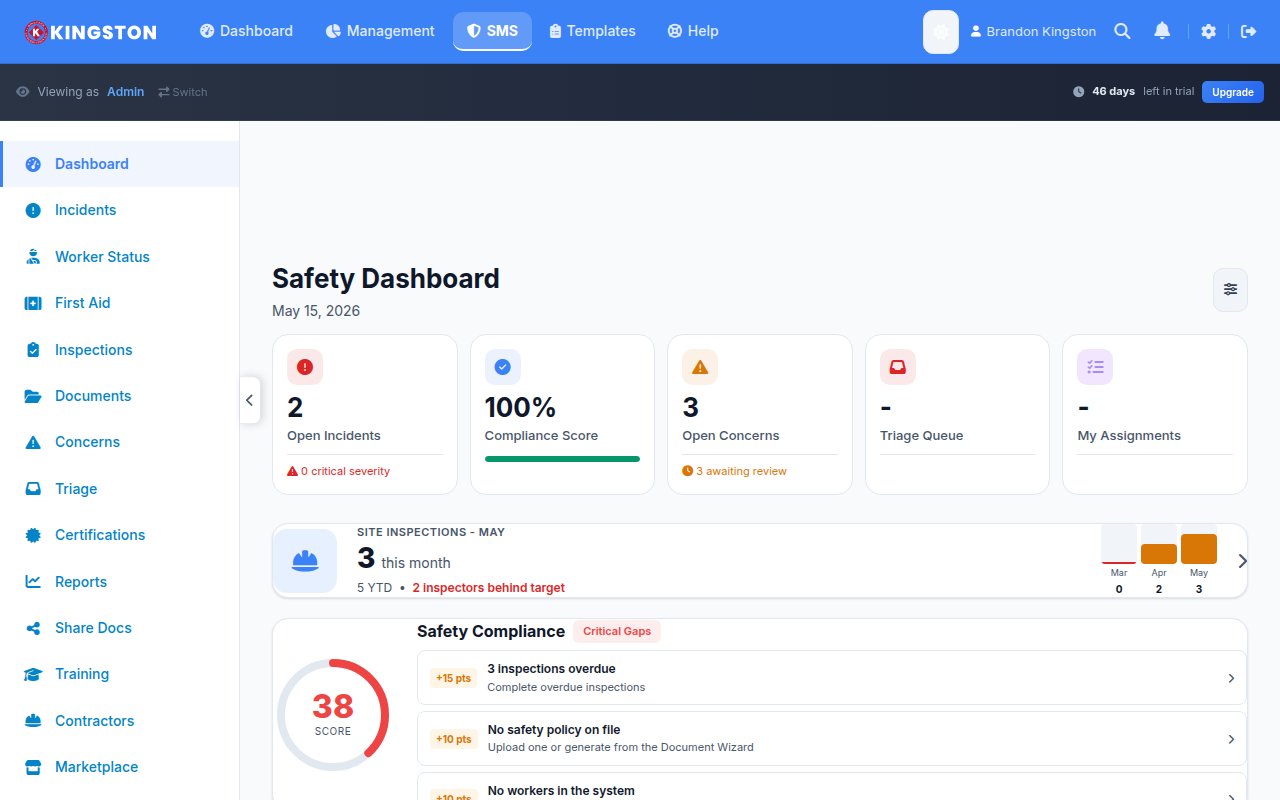
| Dashboard and Analytics | Real-time visibility into compliance status, trends and performance metrics | Enables data-driven decisions and management oversight |
| Audit Trail | Automatic timestamping, user attribution and version history for all records | Provides the evidentiary chain regulators expect |
| Multi-Site Management | Portfolio-level views with site-specific configurations and permissions | Scales compliance management across the organization |
Environmental Compliance Software vs. General EHS Platforms
The market includes both specialized environmental compliance tools and broader EHS (Environment, Health and Safety) platforms that address environmental alongside occupational health and safety. Understanding the differences helps you choose the right solution for your needs.
| Criteria | Specialized Environmental Software | Broad EHS Platform |
|---|---|---|
| Scope | Deep environmental compliance functionality | Environmental + health + safety + sustainability |
| Complexity | Moderate - focused on core workflows | High - many modules and configuration options |
| Implementation time | Weeks to low months | Months to a year or more |
| Cost | Lower entry point, predictable pricing | Higher, often enterprise-only pricing |
| Best for | Organizations needing fast time-to-value on environmental compliance | Large enterprises requiring a unified EHS data model |
| User adoption | Higher - simpler interface, focused training | Lower - complex systems create adoption resistance |
For most mid-market organizations, a focused platform that excels at inspections, document management and corrective action tracking delivers faster ROI than an enterprise EHS suite that takes a year to implement.
Key Evaluation Criteria
When evaluating environmental compliance software, these criteria should guide your selection process.
1. Mobile-First Design
Environmental compliance work happens in the field - on construction sites, at well pads, inside processing plants and along pipelines. If the software is not built for mobile use with offline capability, it will not be adopted by the people who need it most. Look for native mobile apps that work on both iOS and Android with full functionality when disconnected from the network.
2. Ease of Configuration
Every organization has unique inspection forms, workflows and reporting requirements. The software should allow administrators to create and modify forms, workflows and dashboards without requiring vendor professional services or coding knowledge. Template libraries for common regulatory programs are a significant time-saver.
3. Scalability
Your compliance needs will grow as your organization adds sites, operations and regulatory requirements. Evaluate whether the platform can scale from a handful of users to hundreds without performance degradation or architectural limitations.
4. Integration Capabilities
Environmental compliance does not exist in isolation. The software should integrate with your existing systems including:
- Project management platforms
- Asset management systems
- HR systems (for training records)
- GIS and mapping tools
- Business intelligence platforms
- Email and calendar systems for notifications
5. Vendor Track Record
Evaluate the vendor's experience in your specific industry. A platform built for safety management in construction, oil and gas or manufacturing will have inspection templates, workflow configurations and reporting capabilities already tuned to your regulatory environment.
6. Total Cost of Ownership
Look beyond the license or subscription fee. Consider implementation costs, training requirements, ongoing configuration needs and the internal resources required to administer the platform. Per-user pricing models are generally more predictable than per-module or per-feature pricing.
Software Selection Checklist
Use this checklist during your evaluation process to compare platforms objectively.
Core Functionality
- Customizable inspection forms with conditional logic
- Photo and video capture integrated into inspection workflows
- GPS location tagging on all field submissions
- Offline capability for areas without cellular coverage
- Corrective action workflow with assignment, tracking and escalation
- Centralized document repository with search and version control
- Automated scheduling with overdue notifications
- Real-time dashboards and customizable reports
- Incident and spill reporting workflow
- Complete audit trail with timestamps and user attribution
Technical Requirements
- Cloud-based with 99.9%+ uptime SLA
- Native iOS and Android mobile applications
- API for integration with existing systems
- SSO support (SAML, OAuth)
- Role-based access controls
- Data encryption in transit and at rest
- Data export capabilities (CSV, PDF, API)
- SOC 2 Type II or equivalent security certification
Vendor Assessment
- Demonstrated experience in your industry
- Active product development and regular feature releases
- Responsive customer support with defined SLAs
- Implementation support and onboarding program
- Customer references in similar industries and company sizes
- Transparent pricing with no hidden fees
- Free trial or pilot program available
Implementation Best Practices
Selecting the right software is only half the battle. Successful implementation requires careful planning and change management.
Phase 1: Planning (Weeks 1-2)
- Define your top 3-5 compliance pain points and success metrics
- Identify a project champion and core implementation team
- Audit your current inspection forms, checklists and workflows
- Prioritize which processes to digitize first (start with the highest-frequency, highest-risk activities)
Phase 2: Configuration (Weeks 2-4)
- Build or adapt inspection forms for your regulatory requirements
- Configure corrective action workflows and escalation rules
- Set up user accounts, roles and permissions
- Create automated inspection schedules
- Upload existing permits, plans and reference documents
Phase 3: Pilot (Weeks 4-6)
- Deploy to a small group of users at one or two sites
- Gather feedback and refine configurations
- Validate that data capture meets regulatory requirements
- Train pilot users and measure adoption
Phase 4: Rollout (Weeks 6-10)
- Expand to all sites and users
- Conduct training sessions for all user groups
- Retire paper-based processes
- Establish ongoing governance for form updates and system administration
Measuring ROI from Environmental Compliance Software
The return on investment from environmental compliance software comes from multiple sources:
| ROI Driver | How It Generates Value | Typical Impact |
|---|---|---|
| Violation avoidance | Proactive identification and resolution of issues before regulators find them | A single avoided fine can exceed the annual software cost |
| Administrative time savings | Elimination of manual data entry, form distribution and report compilation | 20-40% reduction in compliance administration time |
| Faster corrective actions | Automated assignment and tracking close issues in days instead of weeks | 50-70% reduction in average corrective action closure time |
| Audit preparation | Instant access to all records eliminates pre-audit scramble | Hours of preparation reduced to minutes |
| Insurance and liability | Documented compliance program can reduce insurance premiums and liability exposure | Varies by insurer and industry |
Industry-Specific Considerations
Different industries have different compliance workflows, and the best software platforms accommodate these variations through configurable templates and workflows rather than rigid, one-size-fits-all approaches.
Construction
Construction teams need mobile-first inspection tools that work on dusty job sites without reliable connectivity. Key workflows include SWPPP inspections, erosion and sediment control monitoring, dust control documentation and waste tracking. The platform must handle project-based compliance where sites open and close frequently and teams move between locations.
Oil and Gas
Oil and gas operators manage compliance across hundreds or thousands of geographically dispersed well sites, compressor stations and processing facilities. Critical capabilities include LDAR survey tracking at the component level, SPCC inspection management, produced water volume tracking and air emission calculations. The platform must scale to high site counts and support remote field operations.
Manufacturing
Manufacturing facilities have ongoing, facility-based compliance obligations including air permit monitoring, wastewater discharge tracking, hazardous waste management and chemical inventory reporting. The platform needs to support recurring inspection schedules, integrate with continuous monitoring equipment and generate regulatory reports in required formats.
Mining
Mining operations face extended compliance timelines spanning decades of operation through reclamation and post-closure monitoring. Water quality monitoring, dust management, reclamation progress tracking and waste rock characterization are key workflows. The platform must maintain data integrity across very long project lifecycles.
Questions to Ask During Software Demos
When you reach the demo stage of your evaluation, these questions will help you differentiate between platforms that look good in presentations and those that actually perform in the field:
- Can you show me the mobile app working offline with photo capture and GPS?
- How long does a typical implementation take for an organization of our size?
- Can we create and modify inspection forms without vendor assistance?
- How does the corrective action workflow handle escalation when items are overdue?
- What does the audit trail look like for a single inspection record?
- Can you show me the dashboard view for a multi-site organization?
- What integrations are available out of the box, and what requires custom development?
- What is your data export capability if we ever need to migrate?
- What does your customer support model look like after implementation?
- Can you connect me with a reference customer in our industry?
Common Mistakes to Avoid
- Over-engineering the implementation: Start simple with your highest-priority compliance workflows and expand over time
- Ignoring field user experience: If the mobile app is clunky or slow, field teams will revert to paper
- Choosing on features alone: A platform with 200 features that takes a year to implement delivers less value than one with 50 features deployed in 30 days
- Skipping change management: Training and communication are just as important as the technology itself
- Not defining success metrics: Without clear KPIs, you cannot demonstrate ROI to leadership
Find the Right Platform for Your Team
Environmental compliance software is an investment in operational discipline and regulatory resilience. The right platform pays for itself through avoided violations, time savings and reduced risk - while the wrong choice creates shelfware and frustration.
Make Safety Easy is built for organizations that need powerful inspection management, document control and corrective action tracking without the complexity and cost of enterprise EHS suites. Book a demo to see the platform in action, or view pricing to find the right plan for your team.
Go Digital with Make Safety Easy
Replace paper checklists with one platform your whole team can use.