A near-miss reporting system is a structured process for capturing, investigating and learning from events where injury or damage could have occurred but did not - either by chance or by last-second intervention. Organizations with mature near-miss programs report 50 to 100 near misses for every recordable incident and experience 40-60% fewer serious injuries because they identify and eliminate hazards before those hazards produce harm.
Near-miss reporting is arguably the single most valuable safety activity an organization can invest in. Unlike incident investigations, which happen after someone is hurt, near-miss investigations let you fix the problem while the cost is still zero. This guide covers everything you need to build, implement and sustain a near-miss program that actually works: the science behind the pyramid, how to build the blame-free culture that makes reporting happen, system design for both digital and paper-based approaches, investigation methodology, trend analysis techniques and the metrics that prove your program is reducing risk.
The Science Behind Near-Miss Reporting
Heinrich's Safety Pyramid
In 1931, H.W. Heinrich published a study of industrial accidents that revealed a consistent ratio: for every serious injury, there were 29 minor injuries and 300 near misses (also called "no-injury accidents"). This ratio - known as Heinrich's Pyramid or the Safety Triangle - established the foundational principle that serious incidents do not appear from nowhere. They emerge from a much larger base of less severe events and unsafe conditions.
Free Download: 5 Safe Work Procedures
Choose from 112 professionally written SWPs. No credit card required.
Get Free SWPsModern research has refined Heinrich's original ratios, but the core principle holds across every major study:
| Study/Source | Fatality/Serious Injury | Minor Injuries | Near Misses/Unsafe Conditions |
|---|---|---|---|
| Heinrich (1931) | 1 | 29 | 300 |
| Bird and Germain (1966) | 1 | 10 | 30 property damage / 600 near misses |
| ConocoPhillips Marine Study | 1 | 10 | 30 property damage / 600 near misses |
| UK HSE Research | 1 | 7-10 | 50-100 near misses per recordable |
The practical implication is clear: if you want to prevent the one fatality or serious injury at the top of the pyramid, you must identify and address the hundreds of near misses at the base. Each near miss is a free warning - a chance to intervene without the cost of an injury, a workers' comp claim or a regulatory citation.
Why Near Misses Are More Valuable Than Incidents
Near misses are superior learning opportunities compared to actual incidents for several reasons:
- Volume. There are far more near misses than incidents, providing a much larger data set for identifying patterns and trends
- Objectivity. Because no one was hurt, investigations can focus on systems and processes without the emotional and legal complications of an injury
- Timeliness. Near misses can be reported and investigated immediately while details are fresh, without the distraction of medical care, workers' comp management and regulatory reporting
- Predictive power. Near-miss trends predict future incidents. A cluster of fall-related near misses is a leading indicator that a fall injury is coming unless conditions change
- Cost. Investigating and correcting a near miss costs a fraction of what an actual incident costs in medical bills, lost productivity, insurance impact and regulatory exposure
Defining Near Misses: What Counts
One of the most common barriers to effective near-miss reporting is confusion about what qualifies as a near miss. Without a clear, shared definition, workers either report everything (overwhelming the system with trivial observations) or report nothing (because they are not sure what qualifies).
The Working Definition
A near miss is an unplanned event that did not result in injury, illness or damage but had the potential to do so. The key criterion is potential - if circumstances had been slightly different (timing, position, direction, speed), someone could have been harmed.
Near Miss vs. Hazard Observation vs. Unsafe Act
| Category | Definition | Example | Reporting Action |
|---|---|---|---|
| Near Miss | An event occurred; no one was hurt but could have been | A wrench falls from scaffolding, landing where a worker was standing 5 seconds earlier | Report, investigate root cause, implement corrective action |
| Hazard Observation | A condition or situation that could lead to an event but no event has occurred yet | A missing guardrail on the second level of scaffolding | Report, correct immediately if possible, track to completion |
| Unsafe Act | A behavior that increases the probability of an incident | A worker carrying materials up a ladder using only one hand for balance | Coach in the moment, address systemic causes, document for trend analysis |
| First Aid Case | An event occurred and someone was mildly injured (treated with first aid only) | A worker cuts their finger on a sharp edge and receives a bandage | Report, investigate, track as a first aid case (may be OSHA recordable depending on treatment) |
For program simplicity, many organizations include all four categories in their near-miss reporting system. The more information flowing in, the better your visibility into risk. The important thing is that employees know they should report anything that concerned them, regardless of the exact category.
Examples of Near Misses by Industry
Construction
- A steel beam swings during a crane lift and passes within inches of a worker
- A trench wall shows signs of soil movement but no collapse occurs
- A worker steps on a nail that penetrates the boot sole but does not reach the foot
- A power line is contacted by equipment but the operator is insulated and uninjured
- A scaffold plank shifts underfoot but the worker catches their balance
Manufacturing
- A machine guard is found disengaged during routine operation but no one contacted the moving parts
- A forklift backs into a rack support column, causing a near-spill of stacked pallets
- A chemical spill occurs in a contained area but vapors briefly reach an unprotected worker
- A lockout/tagout procedure is discovered incomplete during a verification check
- An overhead crane load shifts during transport but is corrected before dropping
Healthcare
- A medication is prepared at the wrong dose but caught during the verification step before administration
- A patient becomes agitated and swings at a nurse but misses
- A wet floor in a patient room is discovered before anyone slips
- A needlestick cap fails to engage but the needle does not contact the clinician's skin
- An equipment alarm is found silenced in a critical care area
Office/General Industry
- A ceiling tile falls from a damaged grid onto an unoccupied desk
- An extension cord across a walkway is tripped over but the employee catches themselves
- A space heater is found operating next to combustible materials
- An ergonomic concern causes tingling in a worker's hands but no diagnosed condition yet
- A parking lot pothole causes a vehicle to swerve near a pedestrian
Building a Blame-Free Reporting Culture
The single greatest determinant of near-miss program success is whether employees believe they can report without negative consequences. Every other element - the forms, the technology, the investigation process - is secondary to trust. If workers fear punishment, they will not report. Period.
The Psychology of Reporting
When an employee witnesses or experiences a near miss, they make a rapid mental calculation: "Is reporting this worth the risk?" Their decision depends on:
- Past experience. Have they seen others punished or praised for reporting? What happened the last time they reported something?
- Perceived management attitude. Do supervisors and managers genuinely welcome reports, or do they react with frustration, skepticism or blame?
- Social norms. Do their coworkers report near misses, or is reporting seen as "snitching" or "making trouble"?
- Effort required. Is reporting quick and easy, or does it require filling out a complicated form, finding a supervisor and interrupting their work?
- Visible outcomes. Do reports lead to visible improvements, or do they disappear into a void?
The Just Culture Framework
A just culture (also called a "fair culture") distinguishes between three types of behavior:
| Behavior Type | Definition | Example | Appropriate Response |
|---|---|---|---|
| Human Error | Unintentional slip, lapse or mistake despite good intentions | A worker forgets a step in a procedure they normally follow correctly | Console, coach, look for systemic fixes (procedure redesign, error-proofing, training) |
| At-Risk Behavior | A conscious choice to take a shortcut or deviate, often because the risk is not perceived or is accepted as normal | A worker removes safety glasses briefly because they fog up | Coach and educate about the risk. Fix the systemic incentive (provide anti-fog glasses). Address normalized deviation. |
| Reckless Behavior | Conscious, unjustifiable disregard for a known and substantial risk | A worker intentionally disables a machine guard and tells others to do the same | Disciplinary action appropriate. This is the only category where discipline is the primary response. |
The critical insight of just culture is that human errors and at-risk behaviors should not be punished - they should be understood and addressed through system improvements. Only truly reckless behavior warrants discipline. When employees understand this framework, reporting increases because they know that honest mistakes and good-faith reports are protected.
Seven Steps to Build a Blame-Free Culture
- Publish a formal non-retaliation policy. Create a written policy that explicitly protects employees who report near misses and safety concerns in good faith. Have it signed by the CEO or site leader and post it prominently.
- Train all leaders in just culture principles. Supervisors and managers must understand the difference between human error, at-risk behavior and recklessness - and respond appropriately to each. One punitive response to an honest report can undo months of culture-building.
- Respond to every report with gratitude. The first words out of a supervisor's mouth when receiving a near-miss report should be "thank you." Every time. No exceptions.
- Act visibly on reports. When a near miss is reported and a corrective action is implemented, publicize the connection. "Because Juan reported a near miss with the dock leveler, we installed a new warning system." This creates a positive feedback loop.
- Offer anonymous reporting options. While attributed reports are more useful for investigation, anonymous reporting provides a safety valve for workers who are not yet confident in the system. As trust builds, the proportion of anonymous reports typically decreases.
- Leaders report their own near misses. When a supervisor or manager shares a near miss they experienced or observed, it normalizes reporting and demonstrates that no one is above the process.
- Measure and celebrate reporting rates. Track and publicize the number of near misses reported per month. Celebrate milestones. Recognize high-reporting teams. Make reporting a badge of honor, not a mark of failure.
Psychological Safety: The Foundation
Harvard professor Amy Edmondson's research on psychological safety is directly applicable to near-miss reporting. Psychological safety exists when team members believe they can speak up, ask questions, report concerns and admit mistakes without fear of humiliation or punishment.
Leaders build psychological safety by:
- Framing reporting as a learning opportunity, not a failure indicator
- Asking genuine questions rather than making accusations when receiving reports
- Acknowledging their own fallibility and uncertainty
- Expressing appreciation for dissenting views and uncomfortable information
- Following through on concerns raised - consistently and visibly
Designing Your Near-Miss Reporting System
The reporting system must balance thoroughness (capturing enough information for meaningful investigation) with simplicity (making it easy enough that people actually use it). Err on the side of simplicity. A brief report that gets submitted is infinitely more valuable than a detailed form that sits blank.
Essential Information to Capture
At minimum, every near-miss report should capture:
- Date, time and location of the event
- What happened - a brief description of the event in the reporter's own words
- What could have happened - the potential consequence if circumstances had been different
- Immediate action taken - what was done right away to address the situation
- Reporter identification (optional for anonymous systems)
That is it for the initial report. Five fields. A worker should be able to submit a near-miss report in under 60 seconds. Additional details can be gathered during the investigation phase.
Digital vs. Paper Reporting Systems
| Factor | Digital (Mobile App/Web) | Paper Forms |
|---|---|---|
| Accessibility | Report from anywhere with a phone; available 24/7 | Requires physical access to forms and a place to submit them |
| Speed of submission | Under 60 seconds with pre-filled fields and drop-downs | 2-5 minutes for legible handwritten completion |
| Photo/video attachment | Built-in camera integration | Not practical |
| Data aggregation | Automatic; real-time dashboards and trend analysis | Requires manual data entry into a spreadsheet or database |
| Anonymity | Can be configured for anonymous submission | Truly anonymous if drop-box is used |
| Notification | Instant notification to supervisor and safety team | Delayed until form is collected and reviewed |
| Follow-up tracking | Automated workflow with assignments, reminders and escalation | Manual tracking required; easy to lose or forget |
| Cost | Software subscription (often included in safety management platforms) | Printing costs; significant labor cost for manual data management |
| Adoption barrier | Requires smartphone or computer access; some workers may resist technology | Familiar format; no technology barriers |
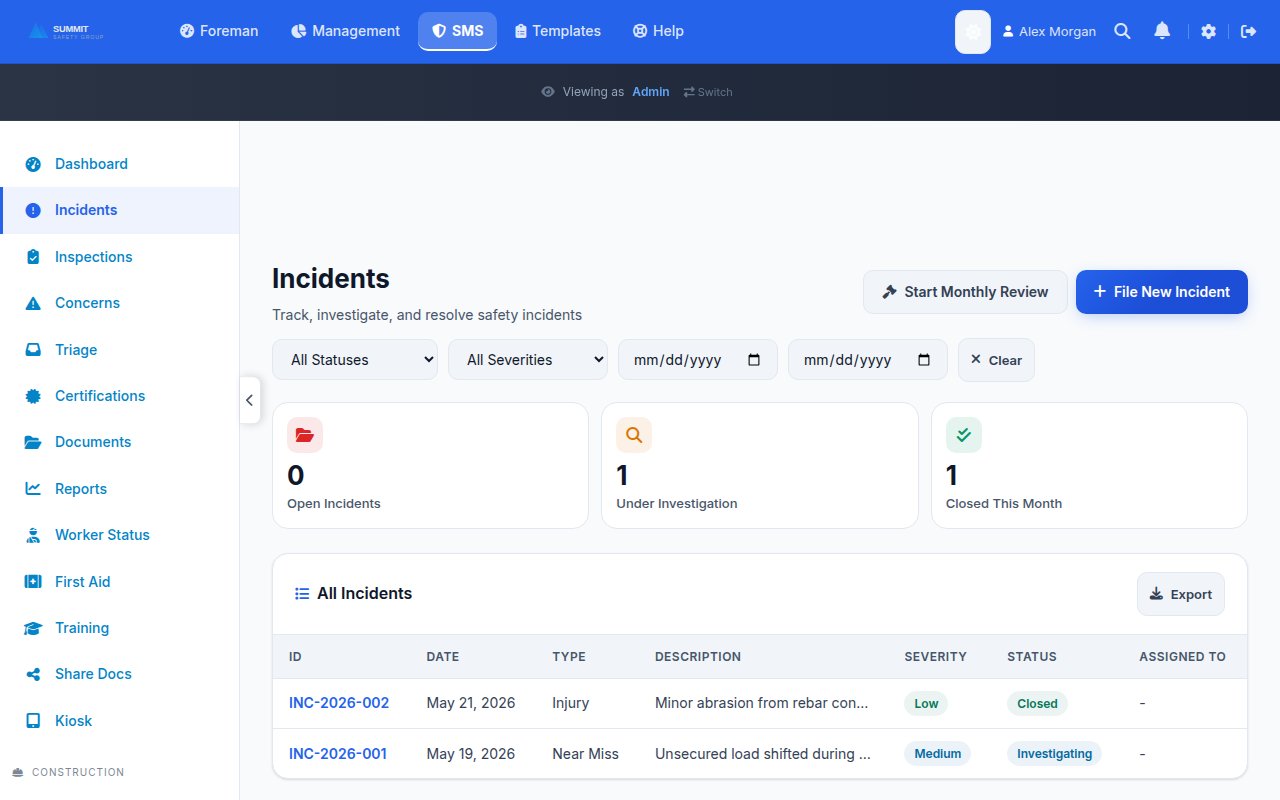
For most organizations, a digital system is the clear winner. The ability to report instantly from a mobile device, attach photos, receive automatic acknowledgments and track corrective actions through completion creates a vastly superior experience for both reporters and investigators. Make Safety Easy's incident reporting feature handles near-miss reporting with a mobile-first interface designed for field workers.
System Design Best Practices
- Keep the form short. Five fields for initial submission. You can always gather more detail during investigation.
- Make it mobile-first. Most frontline workers carry a smartphone. Make that the primary reporting channel.
- Enable photos. A picture often communicates the hazard more effectively than a written description.
- Auto-acknowledge. Send an automatic confirmation to the reporter within seconds: "Your report has been received. Thank you."
- Route automatically. Reports should be instantly visible to the area supervisor, the safety team and the site manager based on location and severity.
- Close the loop. Notify the reporter when their near miss has been investigated and corrective action has been taken.
- Allow offline submission. For locations with limited connectivity, the system should queue reports and submit them when connection is restored.
Investigating Near Misses
Not every near miss requires a full investigation. Use a tiered approach that matches investigation depth to potential severity:
Investigation Tiers
| Tier | Potential Severity | Investigation Depth | Investigator | Timeline |
|---|---|---|---|---|
| Tier 1 - Low | Could have caused first aid or minor injury | Supervisor review, immediate correction, brief documentation | Direct supervisor | Same day |
| Tier 2 - Medium | Could have caused a recordable injury or significant property damage | Root cause analysis using 5 Whys or similar method, corrective action plan | Supervisor + safety coordinator | Within 3 days |
| Tier 3 - High | Could have caused a serious injury, fatality or major loss | Full investigation with team, detailed root cause analysis, systemic review, lessons learned distribution | Cross-functional investigation team | Within 5 days |
The 5 Whys Method for Near-Miss Investigation
The 5 Whys is the most accessible root cause analysis technique and works well for the majority of near-miss investigations. The method is simple: ask "why" repeatedly until you reach the underlying systemic cause.
Example: Falling Object Near Miss
Event: A hammer fell from the third floor of scaffolding and landed where a worker had been standing moments earlier.
Why #1: Why did the hammer fall?
Because it was placed on the scaffold plank edge and was knocked off when another worker walked past.
Why #2: Why was the hammer placed on the scaffold plank edge?
Because there was no designated tool storage area on the scaffold platform.
Why #3: Why was there no designated tool storage area?
Because the scaffold setup procedure does not include a requirement for tool storage or toe boards with adequate height to contain tools.
Why #4: Why does the scaffold setup procedure not include this requirement?
Because the procedure has not been updated since it was written in 2019 and does not reflect current best practices for falling object prevention.
Why #5: Why has the procedure not been updated?
Because there is no scheduled review cycle for safety procedures.
Root cause: Lack of a systematic procedure review cycle.
Corrective actions:
- Immediate: Install tool lanyards and secure tool storage on all scaffold platforms
- Short-term: Update the scaffold setup procedure to include falling object prevention
- Systemic: Establish an annual review cycle for all safety procedures with assigned owners and deadlines
For more investigation techniques including fishbone diagrams and formal root cause analysis, see our guide on incident investigation and root cause analysis.
Investigation Documentation
Every investigated near miss should produce a record that includes:
- Original report details (date, time, location, description)
- Investigation team members
- Evidence gathered (photos, witness statements, relevant procedures)
- Root cause analysis findings
- Contributing factors identified
- Corrective actions assigned (who, what, when)
- Corrective action completion verification
- Lessons learned summary for distribution
Trend Analysis: Finding Patterns That Predict Incidents
Individual near-miss investigations fix individual problems. Trend analysis across your entire near-miss database reveals systemic patterns that predict where incidents are likely to occur next. This is where near-miss reporting transitions from reactive correction to predictive prevention.
Key Trend Analysis Dimensions
- By hazard type. Are fall-related near misses increasing? Are struck-by events clustered in a particular area? Track near misses by hazard category to identify which risk types are most active.
- By location. Some work areas generate disproportionately more near misses than others. These hot spots demand targeted intervention.
- By time. Near misses may cluster around shift changes, overtime periods, Monday mornings or seasonal transitions. Time-based patterns point to fatigue, transition management and scheduling issues.
- By task or process. Certain tasks may generate near misses repeatedly, indicating that the task design, procedure or training is inadequate.
- By root cause. When the same root cause appears across multiple near-miss investigations, you have identified a systemic issue that requires a systemic solution.
- By severity potential. Track the potential severity distribution of near misses. An increase in high-potential near misses (events that could have been fatal or caused permanent disability) is an urgent warning sign.
Trend Analysis Reporting Framework
| Report | Frequency | Audience | Content |
|---|---|---|---|
| Weekly Near-Miss Summary | Weekly | Supervisors and safety coordinators | Count of reports, high-potential events, open corrective actions |
| Monthly Trend Report | Monthly | Safety managers and site leadership | Trending by hazard type, location, time; root cause patterns; corrective action status |
| Quarterly Analysis | Quarterly | Senior leadership | Reporting rate trends, correlation with incident data, systemic findings, resource requests |
| Annual Program Review | Annually | Executive team/board | Year-over-year comparison, program ROI, cultural health indicators, strategic recommendations |
Using Near-Miss Data to Predict Incidents
When near-miss data is analyzed over time, it becomes a predictive tool. Watch for these warning signs:
- Clustering. A sudden increase in near misses involving a specific hazard type, location or activity often precedes an incident in that same category. If you see three slip-related near misses in the warehouse this month when the average is one, investigate before someone gets hurt.
- Escalation. When near misses in a particular category are increasing in potential severity (from "nuisance" to "could have been serious"), the system is signaling that conditions are deteriorating.
- Repeat root causes. When the same root cause appears in multiple investigations and the systemic fix has not been implemented, an incident is predictable. Escalate to leadership immediately.
- Reporting decline. A sudden drop in near-miss reporting does not mean your workplace is safer. It usually means reporting barriers have increased (new supervisor, cultural shift, system change). Investigate the drop before it results in an invisible risk build-up.
Management Buy-In: Making the Business Case
Securing and maintaining management support for near-miss reporting requires translating safety benefits into business language. Here is how to build the case.
The Financial Argument
The National Safety Council estimates the following average costs per workplace event:
| Event Type | Average Direct Cost | Average Total Cost (Direct + Indirect) |
|---|---|---|
| Near miss (investigated and corrected) | $50-500 (investigation time + corrective action) | $50-500 |
| First aid case | $250-1,000 | $1,000-5,000 |
| OSHA recordable (medical treatment) | $5,000-15,000 | $20,000-60,000 |
| Lost time injury | $30,000-80,000 | $100,000-300,000 |
| Serious injury (hospitalization/amputation) | $100,000-500,000 | $400,000-1,500,000 |
| Fatality | $500,000-2,000,000+ | $2,000,000-10,000,000+ |
The math is straightforward: investing $200 to investigate and correct a near miss prevents an incident that would cost $20,000 to $10,000,000. Even if only 1 in 50 near-miss corrections prevents a recordable incident, the ROI is extraordinary.
The Regulatory Argument
OSHA's recommended practices for safety and health programs explicitly call for near-miss reporting as a core element of hazard identification. During inspections, OSHA compliance officers view an active near-miss program as evidence of good faith and proactive hazard management. This can influence penalty calculations and citation classifications.
The Insurance Argument
Workers' compensation insurers increasingly evaluate near-miss programs as part of their underwriting process. An active program demonstrates proactive risk management and can positively influence your Experience Modification Rate over time by preventing the claims that drive EMR increases.
The Competitive Argument
Client prequalification systems (ISNetworld, Avetta, BROWZ) increasingly require documentation of near-miss reporting programs. Companies without established programs may lose access to contracts with safety-conscious clients.
Case Studies: Near-Miss Programs That Reduced Incidents
Case Study 1: Electrical Contractor
A commercial electrical contractor with 180 field employees had a TRIR of 6.8 and was losing contract opportunities due to poor safety metrics. They implemented a mobile near-miss reporting system with the following results over 24 months:
- Month 1-3: 12 near-miss reports submitted (mostly by supervisors)
- Month 4-6: 47 reports submitted as field workers began participating. Three recurring themes identified: ladder safety, energized work procedures and material handling
- Month 7-12: 156 reports submitted. Targeted interventions deployed for the three theme areas. Corrective action closure rate reached 88%.
- Month 13-24: 312 reports submitted. TRIR dropped from 6.8 to 2.9 (57% reduction). EMR improved from 1.22 to 0.98. The company won three major contracts that had previously been out of reach.
The total investment in the near-miss program (software, training, investigation time) was approximately $45,000 over two years. The estimated savings from reduced incidents, lower insurance premiums and new contract revenue exceeded $620,000.
Case Study 2: Food Processing Plant
A food processing facility with 420 employees was experiencing high rates of slip, trip and fall injuries (accounting for 60% of all recordables) as well as repetitive motion injuries from production line tasks. They launched a near-miss program focused on these two areas.
Key program elements:
- Simplified one-page paper form (the workforce had limited smartphone access on the production floor)
- Collection boxes at each department entrance checked twice daily by supervisors
- Weekly "top near miss" posted on the safety board with the corrective action taken
- Monthly drawing for a small prize among all reporters (participation incentive, not outcome-based)
- Quarterly trend review by the safety committee with management action commitments
Results after 18 months:
- Near-miss reports went from near-zero to an average of 85 per month
- Slip, trip and fall injuries decreased by 52%
- Ergonomic-related recordables decreased by 38%
- Overall TRIR improved from 7.1 to 3.8
- Workers' compensation costs decreased by $180,000 annually
Case Study 3: Multi-Site Property Management Company
A property management company overseeing 35 commercial and residential sites had inconsistent safety performance and very low visibility into field conditions. Maintenance technicians worked independently across scattered locations, making traditional safety oversight difficult.
They implemented a mobile near-miss reporting app integrated with their work order system:
- Technicians could report a near miss directly from their phones in under 45 seconds
- Reports automatically generated work orders for corrective actions
- GPS location tagging identified high-risk properties
- Weekly automated reports showed reporting trends by region and technician
Results after 12 months:
- 427 near-miss reports submitted across 35 sites (from zero baseline)
- Three properties identified as "high risk" based on near-miss clustering - targeted improvements reduced their combined incidents from 9 to 2
- Company-wide recordable incidents decreased by 34%
- Insurance carrier noted the program favorably during the annual review, contributing to a premium reduction
Near-Miss Program Metrics
Track these metrics to evaluate the health and effectiveness of your near-miss program:
Activity Metrics (Is the program being used?)
| Metric | Calculation | Healthy Range |
|---|---|---|
| Near-Miss Reporting Rate | (Near Misses Reported x 200,000) / Hours Worked | Trending upward in first 12-18 months, then stable at high level |
| Participation Rate | Percentage of employees who have submitted at least one report in the past 12 months | Above 30% and growing |
| Reporting Distribution | Percentage of reports from frontline workers vs. supervisors vs. managers | Majority from frontline workers indicates broad cultural adoption |
| Reports per Department | Count by department normalized by headcount | Relatively even distribution; low-reporting departments need attention |
| Anonymous vs. Attributed Ratio | Percentage of reports submitted anonymously | Decreasing over time as trust builds (below 20% in mature programs) |
Quality Metrics (Is the program effective?)
| Metric | Calculation | Healthy Range |
|---|---|---|
| Investigation Completion Rate | Percentage of Tier 2 and Tier 3 near misses investigated within target timeline | Above 90% |
| Corrective Action Closure Rate | Percentage of near-miss corrective actions completed by deadline | Above 85% |
| Time to Acknowledgment | Average time from report submission to first response | Under 24 hours (under 4 hours for digital systems) |
| Repeat Near-Miss Rate | Percentage of near misses involving the same hazard at the same location after corrective action was implemented | Below 5% (indicating corrective actions are effective) |
| Near-Miss to Incident Ratio | Number of near misses reported per recordable incident | 50:1 or higher in mature programs |
Impact Metrics (Is the program reducing risk?)
| Metric | Calculation | Healthy Trend |
|---|---|---|
| TRIR Trend | Compare TRIR before and after program implementation | Decreasing |
| High-Potential Near-Miss Ratio | Percentage of near misses with serious injury potential | Decreasing (indicates high-severity hazards are being eliminated) |
| Hazards Identified and Corrected | Total unique hazards identified and permanently corrected through near-miss data | Increasing |
| Estimated Cost Avoidance | Sum of estimated incident costs avoided based on corrected hazards | Increasing (presents compelling ROI data for leadership) |
Sustaining the Program Long-Term
Many near-miss programs launch strong and then fade within 12-18 months as initial enthusiasm wanes and competing priorities take over. Sustaining the program requires deliberate strategies:
Keep It Visible
- Feature a "near miss of the month" in safety communications
- Include near-miss data in every safety meeting and management review
- Post near-miss reporting rates alongside other safety metrics on visible dashboards
- Share success stories where near-miss reports prevented injuries
Keep It Simple
- Resist the urge to add more fields to the reporting form over time
- Remove barriers to reporting whenever they are identified
- Continuously seek feedback from reporters on the system's usability
Keep It Rewarding
- Maintain recognition programs for active reporters
- Celebrate milestones (100th report, 500th report, reporting rate achievements)
- Ensure that reporters see tangible improvements resulting from their submissions
Keep It Accountable
- Include near-miss reporting and response in supervisor performance evaluations
- Track and report corrective action closure rates - never let them slip below 85%
- Address low-reporting departments or shifts with targeted engagement
Keep It Evolving
- Review the program annually and make improvements based on data and feedback
- Introduce new analysis techniques as your data set grows
- Benchmark against other organizations and adopt best practices
- Upgrade technology as better tools become available
Common Near-Miss Program Pitfalls
Pitfall 1: Launching Without Cultural Readiness
If trust between workers and management is low, launching a near-miss program will produce minimal results. Address the trust deficit first through leadership behavior change, just culture training and demonstrated commitment before expecting high reporting rates.
Pitfall 2: Overcomplicating the System
A 15-field reporting form, mandatory root cause categories and required supervisor approval before submission will kill your program before it starts. Start simple and add complexity only when the culture can absorb it.
Pitfall 3: Not Investigating or Acting on Reports
If reports are collected but nothing happens, workers learn that reporting is pointless. Every report must receive acknowledgment and significant reports must receive investigation and corrective action. This is non-negotiable.
Pitfall 4: Punishing Reporters
Even one instance of a worker being disciplined for something they reported will shut down reporting across the organization. Train every supervisor and manager on the just culture framework and monitor compliance rigorously.
Pitfall 5: Setting Reporting Quotas
Mandatory reporting quotas ("every employee must submit at least one near-miss report per month") create fake reports. Workers will manufacture trivial observations to meet their quota, diluting the data and wasting investigation resources. Encourage reporting through culture, not quotas.
Pitfall 6: Ignoring Low-Reporting Areas
When one department or shift reports significantly fewer near misses than comparable areas, it does not mean they are safer. It means they have reporting barriers. Investigate and address the barriers - they are often supervisor-specific.
Getting Started: Your 90-Day Launch Plan
Days 1-30: Prepare
- Assess current cultural readiness through informal conversations and existing survey data
- Draft (or update) the non-retaliation/just culture policy
- Select the reporting system (digital or paper) and configure it
- Train supervisors and managers on just culture principles and their specific role in the program
- Develop the communication materials for the launch
- Define the investigation tiers and assign responsibilities
Days 31-60: Launch
- Announce the program through a company-wide communication (meeting, email, video from leadership)
- Train all employees on what a near miss is, how to report, what happens with their report and the non-retaliation commitment
- Have senior leaders submit the first few near-miss reports to model the behavior
- Begin investigating and acting on incoming reports immediately
- Publicize the first corrective actions with "because you reported" messaging
Days 61-90: Reinforce
- Track and publicize reporting rates weekly
- Recognize active reporters in safety meetings
- Address low-reporting areas with targeted engagement (supervisor coaching, additional training, barrier removal)
- Conduct the first monthly trend analysis and share findings
- Gather feedback from reporters and investigators; adjust the process based on input
- Report early results to leadership with the business case reinforced by actual data
For more on building a near-miss program within the broader context of safety culture and incident prevention, explore our near-miss reporting program guide.
Take the First Step Today
Near-miss reporting is not complicated. It requires a simple system, a culture of trust and the discipline to investigate and act on what employees tell you. The organizations that master this capability gain an enormous advantage: they see risk before it becomes an injury, they fix problems at a fraction of the cost and they build the kind of safety culture that attracts and retains top talent.
The pyramid is real. For every serious incident, hundreds of warnings came before it. The question is whether your organization was listening.
Ready to launch or upgrade your near-miss reporting program? View Make Safety Easy pricing to find the right plan, or schedule a demo to see how our mobile-first reporting platform makes it effortless for your workforce to report near misses, track corrective actions and analyze trends that prevent injuries.
Go Digital with Make Safety Easy
Replace paper checklists with one platform your whole team can use.