OSHA compliance in 2026 requires employers to maintain accurate injury and illness records using OSHA 300, 300A and 301 forms, calculate incident rates like TRIR and DART correctly, prepare for inspections and stay current with evolving standards across general industry, construction and maritime sectors. Failure to comply can result in penalties exceeding $16,500 per serious violation and $165,000 per willful or repeated violation under the current penalty structure.
This guide is built for safety professionals, HR directors and business owners who need a single authoritative resource covering every dimension of OSHA compliance. Whether you are setting up a recordkeeping system for the first time, preparing for an inspection or evaluating compliance software, the frameworks and calculations here will get you there. We cover the regulatory requirements, walk through the math with real examples and provide implementation checklists you can put to work immediately.
Understanding OSHA's Regulatory Framework
The Occupational Safety and Health Administration was established under the OSH Act of 1970 with a clear mandate: to ensure safe and healthful working conditions for American workers. OSHA sets and enforces standards, provides training, outreach and education and establishes partnerships with employers and workers to reduce workplace hazards.
Free Download: 5 Safe Work Procedures
Choose from 112 professionally written SWPs. No credit card required.
Get Free SWPsOSHA's jurisdiction covers most private sector employers and workers in all 50 states, the District of Columbia and other U.S. territories. There are currently 22 states that operate their own OSHA-approved state plans covering private sector and state/local government workers. Seven additional states operate plans covering only state and local government workers. State plans must be at least as effective as the federal OSHA program.
Who Must Comply
With limited exceptions, every employer with one or more employees operating in the United States falls under OSHA jurisdiction. Key exemptions include:
- Self-employed individuals with no employees
- Immediate family members of farm employers
- Workplace hazards regulated by other federal agencies (such as the Mine Safety and Health Administration or the Federal Aviation Administration)
- State and local government employees in states without an approved state plan (though many states provide equivalent protections)
General Duty Clause: Section 5(a)(1)
Even when no specific OSHA standard addresses a particular hazard, the General Duty Clause requires employers to provide a workplace "free from recognized hazards that are causing or are likely to cause death or serious physical harm." This catch-all provision gives OSHA the authority to cite employers for hazardous conditions that fall outside the scope of existing standards.
OSHA Recordkeeping Requirements: The Complete Breakdown
Recordkeeping is the backbone of OSHA compliance. Accurate records are not just a regulatory requirement - they provide the data foundation for identifying trends, targeting interventions and demonstrating due diligence. Here is every form and requirement you need to understand.
Which Employers Must Keep Records
All employers with 11 or more employees at any time during the previous calendar year must maintain OSHA injury and illness records, unless they fall into a partially exempt industry classification. Partially exempt industries (listed in Appendix A to Subpart B of 29 CFR Part 1904) include certain low-hazard retail, service and finance sectors. However, even partially exempt employers must report fatalities, in-patient hospitalizations, amputations and losses of an eye.
OSHA Form 300: Log of Work-Related Injuries and Illnesses
The OSHA 300 Log is the master record of all recordable work-related injuries and illnesses that occur during the calendar year. Each recordable case is entered as a single line item that includes:
- Case number (assigned sequentially)
- Employee name (or "privacy case" designation for sensitive conditions)
- Job title at the time of injury or illness
- Date of injury or illness onset
- Where the event occurred (department or location)
- Description of the injury/illness, body parts affected and object/substance involved
- Classification: death, days away from work, job transfer/restriction or other recordable
- Number of days away from work and/or days of restricted/transferred duty
What Makes a Case Recordable
A work-related injury or illness is recordable if it results in any of the following:
| Outcome | Description | Recording Requirement |
|---|---|---|
| Death | Any work-related fatality | Always recordable; must also report to OSHA within 8 hours |
| Days away from work | Employee misses one or more days following the day of injury | Record case and count calendar days away (cap at 180) |
| Restricted work or transfer | Employee cannot perform all routine functions or is transferred to another job | Record case and count calendar days restricted (cap at 180) |
| Medical treatment beyond first aid | Treatment goes beyond the defined first aid list in 1904.7(a) | Record as "other recordable case" |
| Loss of consciousness | Any loss of consciousness regardless of duration | Always recordable |
| Significant injury or illness diagnosed by a physician | Cancer, chronic irreversible disease, fractured/cracked bone, punctured eardrum | Always recordable even if no other criteria are met |
First Aid vs. Medical Treatment: The Definitive List
The distinction between first aid and medical treatment is one of the most misunderstood aspects of OSHA recordkeeping. The following treatments are considered first aid - anything beyond this list constitutes medical treatment and makes the case recordable:
- Using non-prescription medications at nonprescription strength
- Tetanus immunizations
- Cleaning, flushing or soaking wounds on the surface of the skin
- Using wound closure devices such as butterfly bandages and Steri-Strips
- Using splints and slings during the first visit
- Using elastic bandages during the first visit
- Removing foreign bodies from the eye using irrigation or a cotton swab
- Removing splinters or foreign material from areas other than the eye by irrigation, tweezers, cotton swabs or other simple means
- Using finger guards
- Using massages
- Drinking fluids for heat stress relief
- Using hot or cold therapy
- Using any non-rigid means of support (elastic bandages, wraps, non-rigid back belts)
- Using temporary immobilization devices while transporting an accident victim
- Drilling of a fingernail or toenail to relieve pressure, or draining fluid from a blister
- Using eye patches
- Removing foreign bodies from the eye using only irrigation or a cotton swab
- Using oxygen
OSHA Form 300A: Summary of Work-Related Injuries and Illnesses
The 300A is the annual summary that must be:
- Completed using the previous year's 300 Log data
- Certified by a company executive (owner, officer, highest-ranking official at the establishment or their authorized representative)
- Posted in a conspicuous location from February 1 through April 30 of the following year
- Maintained for five years following the year to which it relates
The 300A includes totals for each injury/illness category and requires the calculation of average annual employment and total hours worked - both of which are essential for computing incident rates.
OSHA Form 301: Injury and Illness Incident Report
The 301 form captures detailed information about each recordable case, including:
- Employee information (name, address, date of birth, hire date)
- Physician/healthcare provider information
- Emergency room treatment details
- Hospitalization information
- Detailed narrative of how the injury or illness occurred
- Object or substance that directly harmed the employee
- Date and time of the event
Employers may use an equivalent form (such as a state workers' compensation first report of injury) as a substitute for the 301, provided it contains all the required data elements.
Electronic Recordkeeping Submission Requirements
Under the current electronic submission rule (updated through 2026), employers must submit recordkeeping data electronically through OSHA's Injury Tracking Application (ITA):
| Establishment Size | Industry Classification | Submission Requirement | Deadline |
|---|---|---|---|
| 250+ employees | All industries required to keep records | Submit 300, 300A and 301 data annually | March 2 of the following year |
| 20-249 employees | Designated high-hazard industries (Appendix A to Subpart E) | Submit 300A summary data annually | March 2 of the following year |
| All sizes | All industries | Submit data when notified in writing by OSHA or BLS | As specified in the notification |
Calculating TRIR: Total Recordable Incident Rate
TRIR (also called Total Recordable Incident Rate or Total Recordable Case Rate) is the most widely used safety metric in North America. It measures the number of recordable incidents per 100 full-time equivalent workers per year. Insurance carriers, prequalification systems and contracting organizations all rely on TRIR to evaluate safety performance.
The TRIR Formula
TRIR = (Number of Recordable Incidents x 200,000) / Total Hours Worked
The 200,000 figure represents the approximate number of hours that 100 full-time employees work in a year (100 employees x 40 hours/week x 50 weeks).
TRIR Calculation Examples
Example 1: Single-Site Employer
A manufacturing facility had 7 recordable incidents during the year. Their 85 employees worked a total of 176,800 hours.
TRIR = (7 x 200,000) / 176,800 = 1,400,000 / 176,800 = 7.92
This TRIR of 7.92 is significantly above the 2024 BLS average for manufacturing (3.2), indicating a serious performance gap.
Example 2: Multi-Site Employer
A construction company operates five job sites. Their combined recordable incidents and hours for the year:
| Site | Recordable Incidents | Hours Worked |
|---|---|---|
| Site A | 2 | 95,000 |
| Site B | 0 | 62,000 |
| Site C | 3 | 110,000 |
| Site D | 1 | 48,000 |
| Site E | 1 | 73,000 |
| Total | 7 | 388,000 |
TRIR = (7 x 200,000) / 388,000 = 1,400,000 / 388,000 = 3.61
TRIR Benchmarks by Industry (2024-2025 BLS Data)
| Industry | Average TRIR | Top Quartile | Best in Class |
|---|---|---|---|
| Construction | 2.8 | 1.5 | Below 0.8 |
| Manufacturing | 3.2 | 1.8 | Below 1.0 |
| Transportation and Warehousing | 4.2 | 2.3 | Below 1.2 |
| Healthcare and Social Assistance | 4.8 | 2.5 | Below 1.5 |
| Agriculture, Forestry, Fishing | 4.6 | 2.6 | Below 1.3 |
| Retail Trade | 3.1 | 1.7 | Below 0.9 |
| Wholesale Trade | 2.6 | 1.4 | Below 0.7 |
Calculating DART Rate: Days Away, Restricted or Transferred
The DART rate measures the number of recordable cases that resulted in days away from work, restricted duty or job transfer per 100 full-time workers. It is a more severe subset of TRIR and is often used by insurance carriers and prequalification systems as a measure of injury severity.
The DART Formula
DART Rate = (Number of DART Cases x 200,000) / Total Hours Worked
A DART case is any recordable incident that resulted in at least one day away from work, one day of restricted duty or a transfer to a different job.
DART Calculation Example
Using the manufacturing facility from the TRIR example: of their 7 recordable incidents, 4 resulted in days away, restricted duty or job transfer. Total hours worked: 176,800.
DART Rate = (4 x 200,000) / 176,800 = 800,000 / 176,800 = 4.52
Counting Days Correctly
Accurate day counting is essential for both DART calculations and 300 Log entries:
- Do not count the day the injury occurred
- Count calendar days, not workdays (include weekends and holidays)
- If the employee would not have worked even without the injury (scheduled vacation, plant shutdown), you still count those days
- Cap the count at 180 days per case
- If a case results in both days away and restricted days, count them separately in the appropriate columns on the 300 Log
Experience Modification Rate (EMR)
The EMR (also called Experience Mod or E-Mod) is a workers' compensation insurance metric that compares your actual loss experience to the expected losses for companies of similar size in your industry. An EMR of 1.0 means your losses match the expected average. Below 1.0 means better than average; above 1.0 means worse.
How EMR Is Calculated
EMR calculations are performed by the National Council on Compensation Insurance (NCCI) or by the state rating bureau in monopolistic states. The formula considers:
- Your actual incurred losses over the most recent three complete policy years (excluding the current year)
- Your expected losses based on payroll classifications and state rates
- Primary losses (the first portion of each claim, weighted more heavily) vs. excess losses (amounts above the primary threshold)
- Frequency weighting (many small claims hurt your EMR more than one large claim of equal total value)
EMR Impact on Business
| EMR | Premium Impact | Prequalification Impact | Competitive Position |
|---|---|---|---|
| 0.70 | 30% discount on base premium | Exceeds most requirements | Strong competitive advantage |
| 0.85 | 15% discount on base premium | Meets most requirements | Favorable position |
| 1.00 | No adjustment | Meets minimum thresholds | Average |
| 1.15 | 15% surcharge on base premium | May fail some prequalifications | Competitive disadvantage |
| 1.30+ | 30%+ surcharge on base premium | Fails most prequalifications | Significant competitive disadvantage |
Top OSHA Citations: Where Employers Get It Wrong
OSHA publishes its top 10 most frequently cited standards annually. Understanding these high-priority areas helps employers target compliance efforts where violations are most common. The following list reflects the most frequently cited standards from recent fiscal years with relevance to 2026 compliance planning.
The Top 10 Most Cited Standards
| Rank | Standard | Description | Typical Violations |
|---|---|---|---|
| 1 | 1926.501 - Fall Protection | Duty to have fall protection in construction | Unprotected edges, holes, leading edges above 6 feet |
| 2 | 1910.1200 - Hazard Communication | Chemical hazard information and labeling | Missing SDSs, incomplete written program, unlabeled containers |
| 3 | 1926.1153 - Respirable Crystalline Silica | Silica exposure limits in construction | No exposure assessment, missing controls, no medical surveillance |
| 4 | 1910.134 - Respiratory Protection | Respirator use and program requirements | No written program, no fit testing, no medical evaluations |
| 5 | 1926.451 - Scaffolding | Scaffold construction and use requirements | Missing guardrails, improper access, inadequate foundation |
| 6 | 1910.147 - Lockout/Tagout | Control of hazardous energy | No written procedures, no periodic inspections, inadequate training |
| 7 | 1926.503 - Fall Protection Training | Training requirements for fall hazards | No training provided, no retraining after changes, no documentation |
| 8 | 1926.502 - Fall Protection Systems | Criteria for fall protection systems | Inadequate anchor points, improper harness use, damaged equipment |
| 9 | 1910.178 - Powered Industrial Trucks | Forklift operation and training | Untrained operators, no three-year recertification, unsafe operation |
| 10 | 1910.303 - Electrical (Wiring) | General electrical installation requirements | Exposed wiring, missing covers, improper grounding |
For a focused checklist on each of these citation categories, see our OSHA Compliance Checklist for 2026 and our breakdown of the most common OSHA violations.
The OSHA Inspection Process: What to Expect
OSHA conducts approximately 35,000-40,000 inspections annually. Understanding the process reduces anxiety and improves outcomes. Here is a step-by-step walkthrough of what happens during an OSHA inspection.
Inspection Priorities
OSHA prioritizes inspections in the following order:
- Imminent danger situations - conditions where there is reasonable certainty that a danger exists that can cause death or serious physical harm immediately
- Fatalities and catastrophes - any workplace death or hospitalization of three or more employees
- Complaints and referrals - formal complaints from employees, referrals from other agencies or reports from the media
- Programmed inspections - scheduled inspections targeting high-hazard industries, specific emphasis programs or National/Local Emphasis Programs (NEPs/LEPs)
- Follow-up inspections - to verify that previously cited hazards have been corrected
Step-by-Step Inspection Walkthrough
Step 1: Arrival and Credentials
The OSHA Compliance Safety and Health Officer (CSHO) will arrive unannounced, present credentials and request to enter the workplace. You have the right to verify credentials by calling the local OSHA office. You also have the right to require a warrant, though this typically escalates the inspection's priority and scope.
Step 2: Opening Conference
The CSHO will explain the purpose, scope and likely duration of the inspection. They will request employee representatives to participate. If a union represents employees, the union representative has a right to accompany the CSHO. In non-union workplaces, the CSHO may speak with employees privately during the walkaround.
Step 3: Walkaround Inspection
The CSHO will tour the workplace, observing conditions, examining records, taking photographs, collecting samples (air, noise, surface) and interviewing employees. During the walkaround:
- Designate a knowledgeable escort to accompany the CSHO at all times
- Take your own photographs and notes that mirror the CSHO's documentation
- Correct any hazards immediately if possible - this demonstrates good faith
- Do not volunteer information beyond what is asked, but never obstruct or provide false information
- If the CSHO identifies a hazard, ask clarifying questions about the applicable standard and the specific alleged violation
Step 4: Record Review
The CSHO will typically request:
- OSHA 300 Logs, 300A Summaries and 301 Reports for the current and past three years
- Written safety programs (HazCom, Respiratory Protection, LOTO, etc.)
- Training records
- Inspection and audit records
- Maintenance records for specific equipment
Step 5: Closing Conference
The CSHO will summarize findings, discuss potential violations and outline the citation process. This is your opportunity to present additional information, explain mitigating circumstances and ask questions about abatement expectations. No citations are issued at this point.
Step 6: Citation and Notification
OSHA must issue citations within six months of identifying a violation. Citations include the specific standard violated, the classification (other-than-serious, serious, willful, repeat or failure-to-abate), proposed penalties and the abatement deadline.
Your Rights During an Inspection
- Right to require a warrant (though this may expand the scope)
- Right to have a company representative accompany the CSHO during the walkaround
- Right to take your own photographs, notes and samples
- Right to an opening and closing conference
- Right to contest citations within 15 working days
- Right to request an informal conference with the OSHA Area Director before the contest deadline
OSHA Penalty Structure (2026)
OSHA penalties are adjusted annually for inflation. The following table reflects the penalty maximums applicable in 2026:
| Violation Type | Maximum Penalty per Violation | Description |
|---|---|---|
| Other-Than-Serious | $16,550 | Violation directly related to safety/health but unlikely to cause death or serious harm |
| Serious | $16,550 | Substantial probability that death or serious harm could result and employer knew or should have known |
| Willful | $165,514 | Employer intentionally and knowingly committed the violation (minimum $11,524) |
| Repeat | $165,514 | Substantially similar violation found within 5 years at any company establishment |
| Failure to Abate | $16,550 per day | Failure to correct a previously cited hazard by the abatement deadline |
| Posting Requirement | $16,550 | Failure to post the OSHA poster, 300A summary or citations as required |
Penalty Reduction Factors
OSHA may reduce proposed penalties based on:
- Employer size: Up to 60% reduction for employers with 25 or fewer employees
- Good faith: Up to 25% reduction for employers with effective written safety programs
- History: Up to 10% reduction for no serious citations in the past 5 years
These reductions are not automatic. They are applied at the Area Director's discretion based on the totality of circumstances.
Severe Violator Enforcement Program (SVEP)
OSHA's SVEP targets employers who demonstrate indifference to their obligations through willful, repeat or failure-to-abate violations. Placement on the SVEP list results in:
- Mandatory follow-up inspections at the cited establishment
- Potential inspections at other company establishments nationwide
- Enhanced settlement requirements
- Public listing on OSHA's website as a severe violator
- Referral to other enforcement agencies when appropriate
Compliance Software Selection: What to Look For
Managing OSHA compliance through spreadsheets and paper forms is increasingly untenable, especially for multi-site operations. The right compliance software can dramatically reduce administrative burden while improving accuracy and timeliness. Here is a framework for evaluating options.
Essential Features for OSHA Compliance Software
| Feature Category | Must-Have Capabilities | Nice-to-Have Capabilities |
|---|---|---|
| Recordkeeping | Electronic 300/300A/301 generation, auto-calculation of incident rates, electronic submission to OSHA ITA | Integration with workers' comp claims systems, automatic first-aid vs. recordable determination guidance |
| Incident Management | Mobile incident reporting, photo/video attachment, root cause analysis tools, corrective action tracking | Automated OSHA notification for reportable events, witness statement collection, body map diagrams |
| Inspections | Customizable inspection checklists, mobile completion, finding assignment and tracking | AI-assisted hazard identification, photo comparison over time, regulatory reference integration |
| Training | Training assignment and tracking, competency verification, certificate management | Built-in training content library, LMS integration, automatic retraining alerts |
| Document Management | Centralized document storage, version control, access controls | Automated document review reminders, regulatory update alerts, SDS management |
| Reporting and Analytics | Standard OSHA metrics (TRIR, DART), trend analysis, exportable reports | Predictive analytics, benchmarking against industry data, customizable dashboards |
Software Evaluation Checklist
Use this 10-point checklist when evaluating OSHA compliance software:
- Mobile accessibility. Can frontline workers and supervisors use the system from their phones without training?
- Ease of setup. Can you be operational within weeks rather than months?
- Regulatory currency. Does the vendor update the platform when OSHA standards change?
- Data migration. Can you import existing records from spreadsheets or legacy systems?
- Multi-site support. Can you manage multiple locations with consolidated and site-level reporting?
- Role-based access. Can you control who sees what based on job role and location?
- Integration. Does it connect to your existing HR, payroll and insurance systems?
- Scalability. Will it grow with your organization without proportional cost increases?
- Support and training. What level of customer support is included? Is onboarding assistance available?
- Total cost of ownership. What is the all-in cost including implementation, training, support and annual licensing?
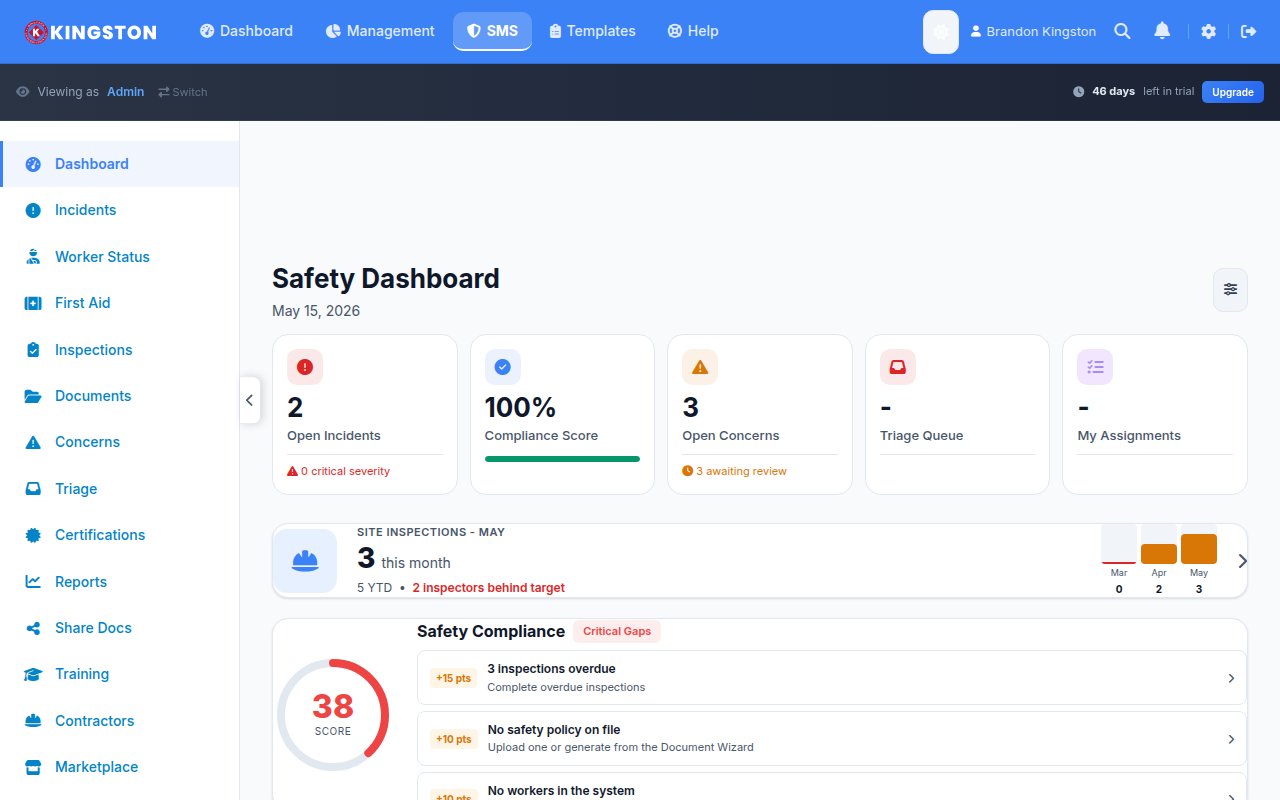
Make Safety Easy covers every capability in the "must-have" column and most in the "nice-to-have" column. Our platform handles inspections, incident reporting and document management in a single mobile-first solution. Request a demo to see it in action.
Implementation Best Practices
Selecting the right software is only half the battle. Successful implementation requires careful planning and execution. Follow this framework to maximize adoption and value.
Phase 1: Planning (Weeks 1-2)
- Assemble an implementation team with representatives from EHS, operations, IT and frontline workers
- Document your current processes, pain points and desired outcomes
- Define success metrics (time savings, reporting rates, data accuracy, compliance gaps closed)
- Create a communication plan for announcing the new system to all employees
- Negotiate the implementation timeline with your vendor
Phase 2: Configuration (Weeks 3-4)
- Set up the organizational structure (locations, departments, roles)
- Configure inspection checklists based on your specific hazards and regulatory requirements
- Customize incident reporting forms to capture the data you need
- Import historical data (300 Logs, training records, inspection results)
- Set up automated workflows (assignments, escalations, reminders)
Phase 3: Training and Pilot (Weeks 5-6)
- Train administrators on system configuration and reporting
- Train supervisors on daily use (incident reporting, inspections, corrective action management)
- Train frontline workers on mobile reporting and participation features
- Pilot the system at one or two locations before full rollout
- Collect feedback and make adjustments
Phase 4: Full Rollout (Weeks 7-8)
- Deploy across all locations with on-site support during the first week
- Monitor adoption metrics daily and intervene where usage is low
- Celebrate early adopters and success stories publicly
- Maintain a rapid-response support channel for questions and issues
Phase 5: Optimization (Ongoing)
- Review system usage and data quality monthly
- Refine checklists, forms and workflows based on user feedback
- Expand use cases as the organization matures (add hazard assessments, JHAs, permit-to-work)
- Leverage analytics to identify trends and drive proactive interventions
Reporting Requirements Beyond Recordkeeping
OSHA compliance extends beyond 300 Log maintenance. Employers must also meet immediate reporting obligations for severe events:
- Fatalities: Report to OSHA within 8 hours of learning about a work-related fatality
- In-patient hospitalizations: Report within 24 hours
- Amputations: Report within 24 hours
- Loss of an eye: Report within 24 hours
Reports can be made by calling the nearest OSHA Area Office, calling the OSHA 24-hour hotline (1-800-321-OSHA) or submitting online through OSHA's website. Failure to report these events within the required timeframe is itself a citable violation.
Multi-Employer Worksite Compliance
On construction sites and other multi-employer worksites, OSHA applies a framework that assigns compliance responsibility based on the employer's role:
| Employer Type | Definition | Compliance Responsibility |
|---|---|---|
| Creating Employer | Caused the hazardous condition | Must correct the hazard even if only other employers' workers are exposed |
| Exposing Employer | Employees are exposed to the hazard | Must protect employees or remove them from exposure; must ask creating employer to correct |
| Correcting Employer | Responsible for correcting the hazard (by contract or trade practice) | Must correct the hazard with reasonable diligence |
| Controlling Employer | General supervisory authority over the worksite | Must exercise reasonable care to detect and correct hazards; typically the general contractor |
Staying Current: Regulatory Changes to Watch in 2026
OSHA's regulatory agenda is dynamic. The following areas are evolving and may impact compliance requirements in 2026 and beyond:
- Heat Illness Prevention Standard. OSHA has been developing a federal heat illness standard that would establish specific requirements for heat injury and illness prevention across all industries. Employers should prepare by implementing heat safety programs now.
- Workplace Violence in Healthcare. A proposed standard targeting violence prevention in healthcare settings is progressing through the rulemaking process.
- Emergency Response Standard. OSHA is working to update the outdated HAZWOPER standard with a comprehensive emergency response framework.
- Personal Protective Equipment (PPE) for Construction. Updates to construction PPE standards including requirements for better-fitting equipment for all body types.
- Electronic Recordkeeping Expansion. Continued expansion of electronic submission requirements with potential public disclosure of establishment-specific data.
Building a Compliance Calendar
Staying compliant requires proactive scheduling. Use this annual compliance calendar as a starting point:
| Month | Compliance Activity |
|---|---|
| January | Review and finalize previous year's 300 Log; begin preparing 300A Summary |
| February 1 | Post 300A Summary in a conspicuous location (keep posted through April 30) |
| March 2 | Submit electronic recordkeeping data through OSHA ITA (if required) |
| Quarterly | Review and update written safety programs; conduct internal compliance audits |
| Quarterly | Review training records for upcoming expirations and schedule renewals |
| Semi-annually | Conduct mock OSHA inspections at each location |
| Annually | Update hazard assessments, PPE evaluations and emergency action plans |
| Annually | Review and recertify forklift operators (every 3 years minimum) |
| Annually | Conduct respiratory protection fit testing |
| May 1 | Remove 300A Summary from posting (may keep posted longer voluntarily) |
Common Compliance Mistakes and How to Avoid Them
Mistake 1: Confusing First Aid with Medical Treatment
This is the single most common recordkeeping error. When in doubt, refer to the first aid list in 29 CFR 1904.7(a). If the treatment is not on the list, the case is likely recordable. When a physician or nurse provides treatment, evaluate the treatment itself - not who provided it - to determine recordability.
Mistake 2: Not Counting Weekends and Holidays
Days away and restricted days are counted as calendar days, not workdays. If an employee is injured on Friday and returns to work on Monday, that is two days away (Saturday and Sunday), not zero.
Mistake 3: Using Injury-Free Incentive Programs
Programs that reward workers or teams for achieving a certain number of "injury-free days" can discourage reporting and violate OSHA's anti-retaliation provisions under Section 11(c). Instead, incentivize leading indicator behaviors like hazard reporting, safety observations and training participation.
Mistake 4: Failing to Record Musculoskeletal Disorders
Repetitive strain injuries, carpal tunnel syndrome and other musculoskeletal disorders are recordable if they are work-related and meet the recording criteria. Many employers overlook these because they develop gradually rather than occurring in a single incident.
Mistake 5: Not Updating Records
The 300 Log must be updated within seven calendar days of receiving information about a new recordable case. Additionally, if a case initially classified as "first aid only" later results in medical treatment, days away or restricted duty, the Log must be updated.
Your OSHA Compliance Action Plan
Use this action plan to assess and strengthen your current compliance posture:
- Audit your current recordkeeping. Review the past three years of 300 Logs for accuracy. Check every case against the recording criteria. Correct any errors.
- Calculate your current rates. Compute TRIR and DART for the current and past three years. Compare against industry benchmarks.
- Review your written programs. Ensure every required written program is current, specific to your workplace and accessible to employees.
- Check training records. Verify that all required training is documented, current and tied to specific competency requirements.
- Conduct a self-inspection. Walk your facilities with OSHA's top 10 citations list in hand. Document and correct any gaps.
- Evaluate your reporting systems. Can employees report hazards and incidents easily? Are reports investigated promptly? Are corrective actions tracked to completion?
- Prepare for inspections. Designate inspection coordinators, assemble document packages and brief your team on inspection procedures.
- Implement or upgrade your software. If you are managing compliance on paper or spreadsheets, evaluate digital solutions that can automate recordkeeping, inspections and corrective actions.
OSHA compliance is not a destination - it is a continuous process of monitoring, improving and adapting. The organizations that excel treat compliance as the floor, not the ceiling, of their safety performance.
Ready to simplify your OSHA compliance? View Make Safety Easy pricing plans or schedule a demo to see how our platform automates recordkeeping, streamlines inspections and keeps your organization audit-ready every day of the year.
Ready to simplify your safety program?
Make Safety Easy helps teams run toolbox talks, inspections, incident reports and more - all from one platform.
Start Your Free TrialNo credit card required. 14-day free trial.