Safety leadership - the visible and measurable commitment of executives and managers to workplace safety - is the most powerful driver of injury prevention in any organization. Research from the National Safety Council consistently shows that workplaces with engaged executive leadership experience 50 to 70 percent fewer recordable incidents than those where safety is delegated entirely to a safety department. If you are an executive, director or senior manager looking for a complete framework to lead safety from the top, this guide delivers the strategies, accountability structures and measurement tools that separate world-class safety organizations from the rest.
Why Safety Leadership Matters More Than Safety Programs
Organizations spend billions annually on safety programs, training platforms and compliance tools. Yet the single variable that predicts whether those investments produce results is leadership commitment. A 2024 study published in the Journal of Safety Research found that worker perception of management commitment to safety correlated more strongly with injury rates than any other organizational factor - including training hours, PPE availability and safety staffing ratios.
This is not a soft concept. When leaders visibly prioritize safety, three measurable things happen:
Free Download: 5 Safe Work Procedures
Choose from 112 professionally written SWPs. No credit card required.
Get Free SWPs- Reporting rates increase. Workers report hazards and near-misses when they trust that leadership will act on the information rather than punish the messenger.
- Compliance improves organically. When leaders model safe behavior, peer pressure shifts from "cutting corners is normal" to "following procedures is expected."
- Investment becomes strategic. Safety budgets move from reactive spending on incidents to proactive investment in prevention.
The bottom line is straightforward: no safety program will outperform the commitment level of the leadership team that funds it.
Leadership Styles and Their Impact on Safety Outcomes
Not all leadership approaches produce the same safety results. Understanding where your leadership style falls on the spectrum - and where it needs to move - is the starting point for improvement.
Transactional Safety Leadership
Transactional leaders manage safety through compliance, rules and consequences. They set expectations, monitor performance and apply rewards or discipline based on outcomes. This approach works for establishing baseline compliance but often creates a "compliance ceiling" where workers follow rules when observed but revert to shortcuts when unsupervised.
Characteristics:
- Heavy reliance on written policies and procedures
- Safety performance tied to bonuses or disciplinary action
- Focus on lagging indicators (incident rates and lost-time days)
- Safety communication is top-down and directive
Typical outcomes: Moderate incident reduction, plateau effect after initial gains, underreporting of near-misses due to fear of consequences.
Transformational Safety Leadership
Transformational leaders inspire commitment to safety through vision, personal example and genuine concern for worker wellbeing. They create psychological safety that encourages reporting and innovation. Research consistently shows that transformational safety leadership produces superior long-term outcomes.
Characteristics:
- Leaders articulate a compelling safety vision beyond "zero injuries"
- Personal engagement with workers on safety topics
- Focus on leading indicators (hazard reports, training completion, inspection quality)
- Two-way communication with frontline feedback loops
Typical outcomes: Sustained incident reduction, high near-miss reporting, strong safety culture scores, lower turnover.
Servant Safety Leadership
Servant leaders approach safety by asking "what do you need to work safely?" rather than "why aren't you following the rules?" This approach is particularly effective in high-hazard industries where frontline workers possess critical safety knowledge that leaders need to access.
Characteristics:
- Leaders actively remove barriers to safe work
- Resource allocation driven by frontline input
- Safety meetings facilitated rather than lectured
- Leaders spend significant time in the field listening
Typical outcomes: Highest engagement scores, strongest hazard identification rates, most innovative safety solutions, deepest trust between management and workers.
Leadership Style Comparison Matrix
| Dimension | Transactional | Transformational | Servant |
|---|---|---|---|
| Primary driver | Compliance | Vision and inspiration | Worker needs |
| Communication | Top-down | Two-way | Bottom-up priority |
| Metrics focus | Lagging indicators | Leading and lagging | Leading indicators |
| Near-miss reporting | Low to moderate | Moderate to high | High |
| Sustainability | Requires constant oversight | Self-sustaining once established | Self-sustaining |
| Best suited for | New programs or crisis situations | Maturing safety cultures | Advanced safety cultures |
Most effective safety leaders blend elements from all three styles, adjusting their approach based on the situation and the maturity of their organization's safety culture.
Visible Leadership Practices That Drive Results
Visibility is the currency of safety leadership. Workers judge management commitment not by what leaders say in emails or town halls but by where they spend their time and what they notice. The following practices have the strongest evidence base for driving safety outcomes.
Safety Walks and Gemba Engagements
Safety walks - sometimes called Gemba walks, management safety contacts or leadership visibility tours - are the cornerstone of visible safety leadership. Done well, they build trust, identify hazards and demonstrate commitment. Done poorly, they feel like inspections and destroy trust.
Best practices for effective safety walks:
- Schedule them consistently. Block time weekly or biweekly. Cancelling safety walks sends a clear message about priorities.
- Go with curiosity, not a clipboard. Ask open-ended questions: "What's the biggest safety challenge in your area right now?" and "Is there anything making it harder to work safely today?"
- Listen more than you talk. The ratio should be roughly 80 percent listening and 20 percent talking.
- Follow up visibly. When a worker raises an issue, close the loop within 48 hours. Even if the fix takes months, acknowledge the concern and provide a timeline.
- Vary your routes and times. Visit different areas, shifts and locations to demonstrate organization-wide commitment.
- Bring other leaders. Rotate which executives participate to build safety leadership depth across the management team.
Sample safety walk question framework:
| Category | Sample Questions |
|---|---|
| Hazard awareness | "What hazards do you deal with most frequently?" / "Has anything changed recently that creates new risks?" |
| Procedure effectiveness | "Do the procedures match how the work actually gets done?" / "Are there any procedures that don't make sense?" |
| Resource adequacy | "Do you have the equipment and training you need?" / "Is there anything you've been waiting on?" |
| Communication | "How do you hear about safety changes?" / "Do you feel comfortable raising safety concerns?" |
| Recognition | "Who on your team does a great job with safety?" / "What's working well that we should keep doing?" |
Toolbox Talks and Safety Meeting Participation
When executives attend toolbox talks, they signal that safety communication matters at every level. This does not mean executives should run every meeting - it means they should periodically attend, listen and contribute. Even 15 minutes of executive presence at a frontline safety meeting can shift worker perceptions of leadership commitment.
Incident Response Visibility
How leaders respond to incidents reveals their true safety priorities. Leaders who show up at the scene, express genuine concern for the injured worker and focus on system failures rather than blame build lasting trust. Leaders who respond with "who screwed up?" or fail to appear at all erode trust rapidly.
A recommended practice is for senior leaders to personally contact injured workers within 24 hours of a significant incident - not to investigate but to express concern and offer support. This single gesture has an outsized impact on safety culture. For more on incident management, visit our incident reporting features.
Building an Accountability Framework for Safety
Accountability without structure is just blame. Effective safety accountability requires clear expectations, adequate resources, fair measurement and consistent consequences - both positive and negative.
The Four Pillars of Safety Accountability
Pillar 1: Clear expectations. Every role from the CEO to the newest hire must have documented safety responsibilities. These should be specific, measurable and integrated into job descriptions and performance reviews - not buried in a safety manual nobody reads.
Pillar 2: Adequate resources. You cannot hold people accountable for outcomes if you have not provided the tools, training, time and authority needed to achieve them. Resource gaps are leadership failures, not worker failures.
Pillar 3: Fair measurement. Safety metrics must capture both outcomes (what happened) and activities (what people did to prevent incidents). Measuring only incident rates incentivizes underreporting rather than prevention.
Pillar 4: Consistent consequences. Positive recognition for safe behaviors and leadership should outweigh negative consequences by at least a 4:1 ratio. Discipline should be reserved for willful violations and reckless behavior, not honest mistakes or system failures.
Role-Specific Accountability Matrix
| Role | Key Safety Accountabilities | Measurement Methods |
|---|---|---|
| CEO/President | Safety vision and policy, resource allocation, board reporting, culture tone | Culture survey scores, resource adequacy ratings, safety investment trends |
| VP/Director | Program implementation, budget management, cross-functional coordination | Program completion rates, audit results, leading indicator trends |
| Manager | Daily oversight, hazard correction, training completion, incident follow-up | Inspection completion, corrective action closure rates, training compliance |
| Supervisor | Pre-task planning, worker coaching, hazard identification, near-miss reporting | Observation quality, hazard report volume, toolbox talk delivery |
| Worker | Following procedures, reporting hazards, participating in training, peer support | Training completion, hazard reports submitted, safety meeting attendance |
You can track and automate many of these accountability measures through structured monthly safety reviews that keep leadership engaged without adding administrative burden.
Budgeting for Safety: The Executive Investment Framework
Safety budgeting is where leadership commitment becomes tangible. Organizations that treat safety as a cost center to be minimized inevitably spend more in the long run through incidents, claims, regulatory penalties and lost productivity.
The True Cost of Inadequate Safety Investment
The National Safety Council estimates the average cost of a workplace fatality at $1.34 million in direct costs alone. When indirect costs are included - productivity loss, retraining, investigation time, regulatory scrutiny and reputational damage - the total cost multiplies by a factor of 4 to 10 times. A single serious incident can exceed the entire annual safety budget of most organizations.
Building a Strategic Safety Budget
Effective safety budgets include five categories:
- Prevention programs: Training, hazard assessments, engineering controls, PPE and safety technology. This should represent the largest portion of the budget - ideally 60 to 70 percent.
- Compliance requirements: Regulatory training, certifications, permit fees, required equipment inspections and testing. Non-negotiable items that must be fully funded.
- Safety staffing: Safety professionals, coordinators and administrative support. Industry benchmarks suggest one safety professional per 50 to 100 workers in high-hazard industries and one per 200 to 500 in lower-hazard settings.
- Technology and systems: Safety management software, monitoring equipment, communication tools and data analytics platforms.
- Contingency reserve: Funds for unexpected needs such as new regulatory requirements, equipment failures or post-incident corrective actions. A reserve of 10 to 15 percent of the total safety budget is prudent.
ROI Calculation Framework
Executives need to understand safety investment in business terms. The following formula provides a starting point for calculating return on safety investment:
Safety ROI = (Cost of incidents avoided - Safety investment) / Safety investment x 100
To estimate costs of incidents avoided, use your historical incident data, average cost per incident (including direct and indirect costs) and the reduction rate achieved through your safety programs. Most mature safety programs demonstrate a return of $3 to $6 for every $1 invested in prevention.
Board-Level Safety Reporting
Boards of directors have a fiduciary and legal duty to oversee safety performance. Yet many boards receive safety reports that are either too superficial (a single slide of incident statistics) or too granular (pages of technical data). Effective board reporting requires a structured approach that drives strategic decision-making.
The Executive Safety Dashboard
A quarterly board safety report should include:
| Section | Content | Purpose |
|---|---|---|
| Safety performance summary | TRIR, LTIR, severity rate - trends over 12+ months | Outcome measurement |
| Leading indicator dashboard | Inspection completion, training rates, hazard closure times | Predictive measurement |
| Significant incidents | Brief summaries of serious incidents and high-potential near-misses with root causes and corrective actions | Risk awareness |
| Regulatory update | New or changing regulations, audit results, citation status | Compliance oversight |
| Strategic initiatives | Status of major safety projects, technology implementations, culture programs | Investment tracking |
| Risk assessment | Top 5 safety risks, mitigation status, emerging hazards | Forward-looking governance |
| Resource adequacy | Budget status, staffing levels, technology needs | Resource allocation |
Key Metrics for Board Reporting
Boards should receive a balanced scorecard that includes both lagging and leading indicators:
- Lagging indicators: Total Recordable Incident Rate (TRIR), Lost Time Injury Rate (LTIR), Days Away/Restricted/Transferred (DART), workers' compensation costs, severity rate
- Leading indicators: Safety observation completion rate, hazard report volume and closure time, training completion percentage, inspection quality scores, corrective action closure rate, safety culture survey results
- Financial indicators: Safety budget utilization, workers' compensation experience modification rate (EMR), cost per incident, return on safety investment
Legal Liability: Due Diligence and C-Suite Responsibility
In both the United States and Canada, executives face significant personal liability for workplace safety failures. Understanding this legal landscape is not optional - it is a core leadership responsibility.
United States: OSHA and Personal Liability
Under the Occupational Safety and Health Act, employers have a "General Duty" to provide a workplace free from recognized hazards likely to cause death or serious physical harm. While OSHA penalties are typically assessed against the organization, several mechanisms create personal liability for executives:
- Willful violations: When OSHA determines a violation was committed knowingly, penalties can reach $165,514 per violation (2024 penalty amounts, adjusted annually for inflation). Criminal prosecution is possible for willful violations resulting in death, carrying penalties of up to $500,000 and six months imprisonment for a first offense.
- Responsible Corporate Officer Doctrine: Under this doctrine, executives can be held criminally responsible for violations even without direct knowledge if they had the authority and responsibility to prevent the violation.
- State criminal codes: Several states have prosecuted executives under general criminal statutes (reckless endangerment, involuntary manslaughter) for workplace safety failures resulting in death or serious injury.
Canada: Due Diligence Defense
Canadian occupational health and safety law imposes even more direct personal obligations on corporate officers and directors. Under the Westray Bill (Bill C-45, now Criminal Code Section 217.1), individuals who direct work have a legal duty to take reasonable steps to prevent bodily harm. Officers and directors can face criminal charges for failing to exercise due diligence.
The due diligence defense requires demonstrating that the organization took every reasonable precaution to prevent the incident. This means documenting:
- Hazard identification and risk assessments were conducted
- Appropriate controls were implemented
- Workers were trained and competent
- Compliance was monitored and enforced
- Incidents were investigated and corrective actions implemented
- The safety management system was regularly reviewed and improved
For a deep dive into Canadian due diligence requirements, see our guide on due diligence and workplace safety in Canada.
Building a Due Diligence Defense
Every executive should ensure their organization maintains documentation sufficient to demonstrate due diligence. This includes:
- Written safety policies and programs that are current, comprehensive and communicated to all workers
- Documented hazard assessments reviewed at least annually and updated when conditions change
- Training records showing all workers received required and role-specific safety training
- Inspection and audit records demonstrating regular monitoring of compliance
- Investigation reports showing incidents were thoroughly investigated and root causes addressed
- Management review records showing leadership regularly reviewed safety performance and made data-driven decisions
- Meeting minutes documenting safety discussions at all levels of the organization
Building and Sustaining Management Commitment
Management commitment is not a one-time declaration. It must be built systematically and reinforced continuously. The following framework helps organizations develop and sustain genuine leadership commitment to safety.
The Commitment Cascade Model
Stage 1: Awareness. Leaders understand the moral, legal and business case for safety. This stage often requires a compelling event - a serious incident, regulatory action or benchmark comparison - to create urgency.
Stage 2: Alignment. Leaders agree on safety priorities and their individual roles. This stage requires facilitated workshops where executives openly discuss their beliefs about safety and align on a shared vision.
Stage 3: Action. Leaders begin demonstrating commitment through visible behaviors - safety walks, meeting participation, resource allocation and personal messaging. This stage requires coaching and accountability.
Stage 4: Integration. Safety becomes embedded in business processes, decision-making frameworks and leadership routines. Safety is not a separate agenda item - it is part of every operational discussion.
Stage 5: Advocacy. Leaders actively champion safety internally and externally. They share their safety journey with peers, industry groups and the public. Safety leadership becomes part of their professional identity.
Practical Steps to Build Commitment
- Start with the business case. Translate safety performance into financial impact, productivity metrics and risk exposure. Speak the language of the boardroom.
- Create personal connections. Share stories of real workers and families affected by incidents. Humanize the data.
- Set leadership-specific KPIs. Include safety walk completion, safety meeting attendance and corrective action response time in executive performance reviews.
- Provide coaching. Many leaders want to engage with safety but lack the skills or confidence. Provide training on effective safety conversations, hazard recognition and active listening.
- Celebrate leadership behaviors. Publicly recognize leaders who demonstrate exceptional safety commitment. Peer recognition among executives is a powerful motivator.
Leading by Example: The Executive Safety Behavior Checklist
Workers observe everything leaders do - and everything they fail to do. The following checklist defines the behaviors that signal genuine safety commitment:
- Always wear required PPE in operational areas, without exception
- Stop and address unsafe conditions immediately, regardless of schedule pressure
- Attend safety meetings and training sessions, not just when convenient
- Begin every operational meeting with a safety moment or discussion
- Personally review serious incident investigations
- Visit work areas regularly to observe conditions and engage with workers
- Respond to safety suggestions and concerns within defined timeframes
- Include safety metrics in every business performance review
- Allocate adequate resources for safety programs and technology
- Hold direct reports accountable for safety performance
- Share personal safety experiences and lessons learned
- Never pressure workers to prioritize production over safety
This is the leadership standard that builds a strong workplace safety culture from the top down.
Measuring Leadership Effectiveness in Safety
What gets measured gets managed. Leadership effectiveness in safety should be tracked through a combination of quantitative metrics and qualitative assessments.
Quantitative Measures
| Metric | Target | Frequency |
|---|---|---|
| Safety walk completion rate | 95% or higher of scheduled walks completed | Monthly |
| Corrective action response time | Initial response within 48 hours | Monthly |
| Safety meeting attendance (leadership) | 90% or higher attendance at assigned meetings | Quarterly |
| Safety suggestion response rate | 100% of suggestions acknowledged within 5 business days | Monthly |
| Budget utilization | 90 to 100% of approved safety budget spent on planned initiatives | Quarterly |
| Training completion (management) | 100% of required training completed on time | Quarterly |
Qualitative Measures
- Safety culture survey results: Annual or biannual surveys that specifically measure worker perception of management commitment, communication effectiveness and resource adequacy
- 360-degree safety leadership assessment: Peer and subordinate evaluation of leadership safety behaviors
- Safety walk quality audits: Review of safety walk reports for depth of engagement, quality of questions asked and follow-up completion
- Incident investigation quality: Assessment of whether investigations identify systemic root causes or stop at individual blame
The Leadership Maturity Model
Organizations can use the following maturity model to assess their overall safety leadership effectiveness:
| Level | Description | Indicators |
|---|---|---|
| Level 1: Reactive | Safety addressed only after incidents | No proactive leadership engagement, blame culture, minimal investment |
| Level 2: Compliant | Safety driven by regulatory requirements | Policies exist but leadership involvement is minimal, safety is "the safety department's job" |
| Level 3: Engaged | Leaders actively participate in safety | Regular safety walks, safety in performance reviews, adequate resources allocated |
| Level 4: Integrated | Safety embedded in business decisions | Safety considered in all operational planning, strong leading indicator performance, high trust |
| Level 5: Generative | Safety is a core organizational value | Workers empowered to stop work, continuous improvement, safety innovation, industry leadership |
Common Pitfalls in Safety Leadership
Even well-intentioned leaders fall into patterns that undermine safety effectiveness. Recognizing these pitfalls is the first step to avoiding them.
Pitfall 1: The "Safety Is Number One" Paradox
Many leaders declare that "safety is our number one priority" but then make decisions that clearly prioritize production, cost or schedule. Workers detect this hypocrisy instantly. A more authentic approach is to acknowledge that safety must be balanced with other priorities but commit to never compromising core safety standards.
Pitfall 2: Metrics-Driven Blindness
Focusing exclusively on TRIR or similar lagging indicators creates perverse incentives. Organizations with low incident rates sometimes believe they have no safety problems when in reality they may have significant underreporting or be operating on borrowed time with unaddressed hazards.
Pitfall 3: Program-of-the-Month Syndrome
Rolling out new safety programs frequently without sustaining existing ones creates cynicism and fatigue. Workers learn to wait out each new initiative, knowing it will be replaced by the next one within months.
Pitfall 4: Delegation Without Engagement
Hiring a safety professional and then disengaging from safety leadership is the most common executive failure. Safety professionals need executive sponsorship, resources and visible support to be effective. They cannot substitute for leadership commitment.
Pitfall 5: Blame-Based Accountability
When accountability becomes synonymous with finding someone to blame after incidents, workers stop reporting. Genuine accountability focuses on creating conditions for success and addressing system failures, not punishing individuals for honest mistakes.
Technology and Tools for Safety Leadership
Modern safety leadership is supported by technology that streamlines data collection, automates reporting and provides real-time visibility into safety performance. The right technology stack makes leadership engagement easier and more effective.
Key technology categories include:
- Safety management software: Centralized platforms that track incidents, inspections, training, corrective actions and compliance in a single system
- Mobile inspection tools: Apps that enable leaders to capture safety walk observations, photos and actions on the spot
- Dashboard and analytics platforms: Real-time visualization of safety metrics that enable data-driven decision-making
- Communication tools: Platforms that facilitate two-way safety communication between leadership and frontline workers
- Document management systems: Centralized repositories for policies, procedures, training records and compliance documentation
The right platform eliminates administrative barriers that prevent leaders from engaging effectively. For a closer look at the manager's playbook for safety leadership, including practical daily and weekly routines, see our dedicated guide.
Building Your Safety Leadership Action Plan
Transforming safety leadership is a journey, not an event. The following 90-day action plan provides a structured approach to getting started.
Days 1 to 30: Assessment and Alignment
- Conduct a safety culture survey to establish a baseline
- Review the last 12 months of safety performance data
- Interview frontline workers and supervisors about their perception of leadership commitment
- Assess current leadership safety behaviors against the checklist in this guide
- Convene the leadership team for a safety vision alignment workshop
Days 31 to 60: Foundation Building
- Document role-specific safety accountabilities for all leadership positions
- Integrate safety metrics into executive performance reviews
- Establish a safety walk schedule for all leaders
- Implement a safety suggestion response protocol
- Launch a board-level safety reporting framework
Days 61 to 90: Activation and Momentum
- Begin executing safety walks with coaching and feedback
- Hold the first structured board safety review
- Recognize and celebrate early wins in leadership safety behavior
- Identify and address resource gaps identified through frontline engagement
- Schedule the first quarterly leadership safety effectiveness review
The Path Forward: From Compliance to Commitment
The difference between organizations that achieve sustained safety excellence and those that plateau at mediocre performance is leadership. Not safety programs. Not technology. Not policies. Leadership.
Every data point, every case study and every research finding confirms this truth: when leaders genuinely commit to safety - visibly, measurably and consistently - workers respond. Hazard reports increase. Near-misses get captured. Innovations emerge. And injuries decline.
The frameworks, tools and strategies in this guide provide a proven path from wherever your organization is today to where you need to be. The only variable that determines whether you get there is the commitment of your leadership team to walk the path.
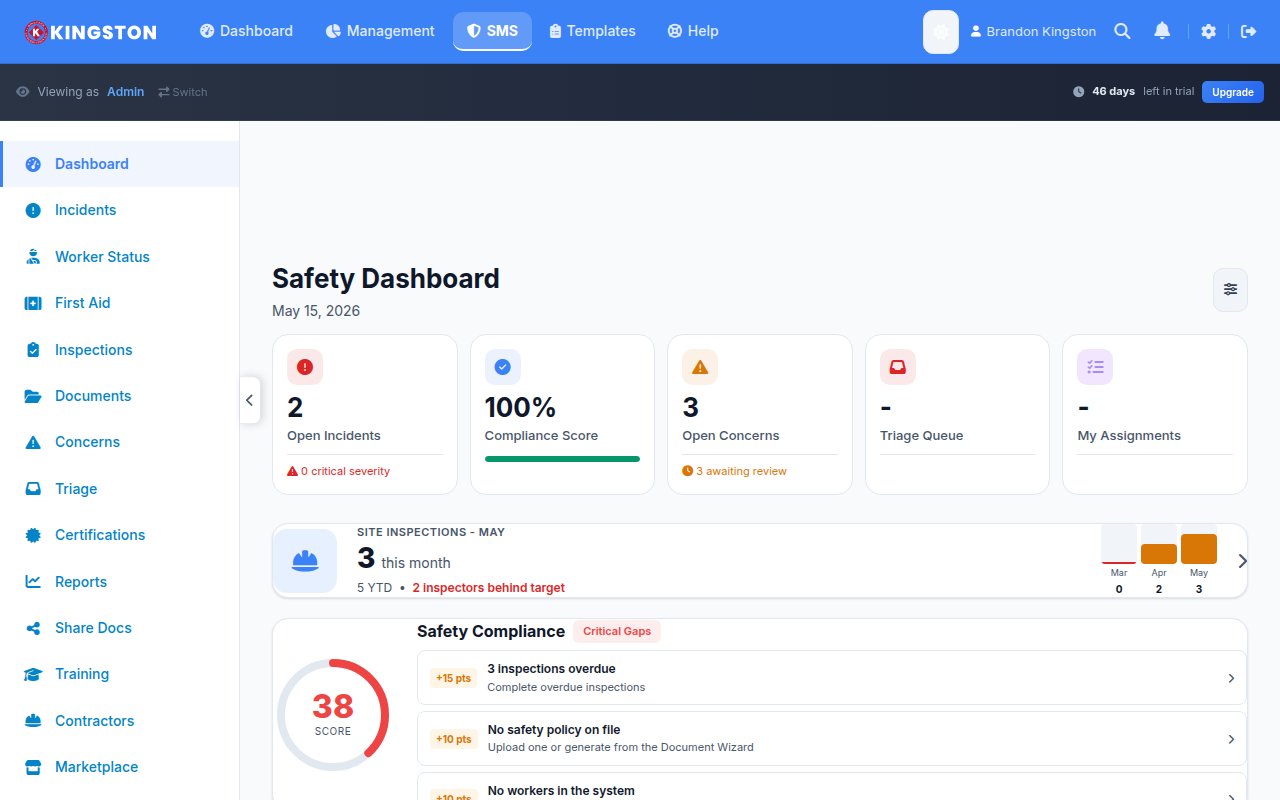
Ready to build a safety management system that supports visible, accountable safety leadership? Book a demo to see how Make Safety Easy streamlines safety walks, accountability tracking, board reporting and leadership engagement - or explore our pricing to find the right plan for your organization.
Ready to simplify your safety program?
Make Safety Easy helps teams run toolbox talks, inspections, incident reports and more - all from one platform.
Start Your Free TrialNo credit card required. 14-day free trial.