Safety training ROI measures the financial return your organization receives for every dollar invested in workplace safety education. The standard formula is: ROI (%) = [(Total Benefits - Total Costs) / Total Costs] x 100. According to the National Safety Council, employers see an average return of $4 to $6 for every $1 spent on safety training when both direct and indirect cost savings are factored in. This guide walks you through the exact calculations, evaluation frameworks and benchmarking data you need to build an airtight business case for your safety training budget.
Why Measuring Safety Training ROI Matters
Safety professionals face a recurring challenge: justifying the training budget to leadership who view safety as a cost center rather than a value driver. Without hard numbers, even the most effective programs risk budget cuts. Measuring ROI transforms safety from a line-item expense into a strategic investment with quantifiable returns.
The stakes are significant. OSHA estimates that employers pay nearly $1 billion per week in direct workers' compensation costs alone. The indirect costs - productivity loss, replacement labor, administrative time and reputational damage - multiply that figure by 2x to 5x depending on the industry. When you can demonstrate that a $50,000 training investment prevented $250,000 in incident-related costs, you shift the conversation from "How much does safety cost?" to "How much does ignoring safety cost?"
Free Download: 5 Safe Work Procedures
Choose from 112 professionally written SWPs. No credit card required.
Get Free SWPsBeyond financial returns, measuring training effectiveness helps you:
- Identify which training modules actually change behavior on the job
- Allocate limited resources to the highest-impact programs
- Benchmark your organization against industry standards
- Satisfy regulatory requirements for training documentation
- Build a culture of continuous improvement in safety performance
The Safety Training ROI Formula: Step-by-Step Calculation
Calculating safety training ROI requires gathering data on both the costs of your training program and the benefits it produces. Here is the complete formula broken down into its components.
Step 1: Calculate Total Training Costs
Your total investment includes both direct and indirect costs. Many organizations undercount costs by focusing only on vendor fees or course materials. Include every expense category below for an accurate calculation.
| Cost Category | Examples | Typical Range |
|---|---|---|
| Direct Training Costs | Course licenses, instructor fees, materials, venue rental, equipment | 40-60% of total |
| Participant Time | Wages and benefits for hours spent in training (not producing) | 25-35% of total |
| Administrative Costs | Scheduling, enrollment, record-keeping, LMS administration | 5-10% of total |
| Travel and Logistics | Transportation, meals, lodging for off-site training | 5-15% of total |
| Technology Costs | LMS subscription, VR equipment, mobile app licenses | 3-8% of total |
| Opportunity Cost | Lost production output during training hours | Varies by industry |
Step 2: Calculate Total Benefits
Benefits fall into two categories: hard savings (directly measurable financial reductions) and soft savings (improvements that indirectly affect the bottom line). Both are legitimate but you should separate them in your analysis for credibility.
Hard Savings
- Reduced workers' compensation premiums: Track your Experience Modification Rate (EMR) year over year. A 0.1-point reduction can save tens of thousands in annual premiums.
- Fewer incident-related costs: Calculate the average cost per incident (medical, indemnity, legal) multiplied by the reduction in incidents.
- Lower OSHA penalty exposure: Avoided citations and fines based on compliance improvements.
- Reduced equipment damage: Fewer incidents mean less damage to machinery, vehicles and property.
- Decreased absenteeism: Fewer injuries lead to fewer lost workdays. Multiply saved days by average daily wage plus benefits.
Soft Savings
- Improved productivity: Workers who feel safe perform better. Studies show a 5-15% productivity improvement in organizations with strong safety cultures.
- Better employee retention: Replacing an injured or dissatisfied worker costs 50-200% of their annual salary. Safety training reduces turnover.
- Enhanced reputation: Strong safety records improve your ability to win contracts, especially in construction, oil and gas and manufacturing.
- Regulatory compliance: Avoiding shutdowns, stop-work orders and project delays.
Step 3: Apply the Formula
With costs and benefits quantified, apply the ROI formula:
ROI (%) = [(Total Benefits - Total Costs) / Total Costs] x 100
Worked Example: Mid-Size Manufacturing Company
Consider a manufacturing company with 250 employees that implements a comprehensive safety training overhaul. Here is the year-one calculation:
| Item | Amount |
|---|---|
| Training Costs | |
| Online course platform (annual license) | $18,000 |
| Hands-on training sessions (12 sessions x $2,500) | $30,000 |
| Employee time in training (avg 16 hrs x 250 employees x $28/hr) | $112,000 |
| Administrative coordination | $8,000 |
| Materials and supplies | $5,000 |
| Total Training Investment | $173,000 |
| Benefits (Year 1) | |
| Workers' comp premium reduction (EMR dropped 0.15 points) | $62,000 |
| Avoided incident costs (8 fewer recordable injuries x $42,000 avg) | $336,000 |
| Reduced absenteeism (180 fewer lost workdays x $224/day) | $40,320 |
| Avoided OSHA citations | $28,000 |
| Reduced equipment repair costs | $15,000 |
| Total Benefits | $481,320 |
ROI = [($481,320 - $173,000) / $173,000] x 100 = 178%
For every dollar spent, the company received $2.78 in return. This is a conservative estimate because it excludes soft savings like improved morale and retention.
The Kirkpatrick Evaluation Model for Safety Training
Financial ROI tells you whether training was worth the money, but it does not tell you why it worked or failed. The Kirkpatrick Model provides a four-level framework for evaluating training effectiveness at every stage. Originally developed by Donald Kirkpatrick in the 1950s, it remains the gold standard for training evaluation across industries.
Level 1: Reaction
Measures how participants responded to the training. Did they find it relevant, engaging and well-delivered? This is the easiest level to measure and provides immediate feedback.
How to measure:
- Post-training surveys (aim for 4.0+ on a 5-point scale)
- Net Promoter Score (NPS) for internal training programs
- Completion rates for voluntary training modules
- Qualitative feedback through focus groups or open-ended questions
Safety-specific indicators: Do workers feel the training addressed hazards they actually encounter? Was the content practical rather than theoretical? Did it respect their existing knowledge and experience?
Level 2: Learning
Measures whether participants actually acquired the intended knowledge and skills. Positive reactions do not guarantee learning occurred.
How to measure:
- Pre-test and post-test comparisons (target 20%+ improvement)
- Skills demonstrations and practical assessments
- Scenario-based evaluations that test applied knowledge
- Certification pass rates
Safety-specific indicators: Can workers correctly identify hazards in a simulated environment? Can they demonstrate proper PPE donning procedures? Do they know the steps for reporting an incident?
Level 3: Behavior
Measures whether participants actually apply what they learned on the job. This is where most training programs fail because there is a significant gap between knowing and doing.
How to measure:
- Behavioral observations at 30, 60 and 90 days post-training
- Safety audit scores before and after training
- Near-miss reporting rates (an increase often indicates improved awareness)
- Supervisor evaluations of on-the-job safety practices
- Peer observation data
Safety-specific indicators: Are workers consistently using fall protection after the training? Has housekeeping improved? Are pre-task risk assessments being completed more thoroughly?
Level 4: Results
Measures the organizational impact of behavior changes. This is where you connect training to business outcomes and financial ROI.
How to measure:
- Total Recordable Incident Rate (TRIR) trends
- Days Away, Restricted or Transferred (DART) rate changes
- Workers' compensation costs and EMR trends
- OSHA citation frequency
- Employee retention rates
- Productivity metrics in high-hazard operations
Kirkpatrick Implementation Timeline
| Level | When to Measure | Who Is Responsible | Data Source |
|---|---|---|---|
| Level 1: Reaction | Immediately after training | Training coordinator | Surveys, feedback forms |
| Level 2: Learning | During and immediately after | Trainer or LMS | Tests, assessments |
| Level 3: Behavior | 30-90 days after training | Supervisors, safety team | Observations, audits |
| Level 4: Results | 6-12 months after training | Safety manager, HR, finance | Incident data, financial reports |
Leading vs. Lagging Training Metrics
Effective measurement requires a balance of leading indicators (predictive) and lagging indicators (reactive). Relying solely on lagging metrics like injury rates means you only know the training failed after someone gets hurt.
Leading Indicators for Training Effectiveness
Leading indicators predict future safety performance and give you time to course-correct before incidents occur.
| Metric | What It Measures | Target Benchmark |
|---|---|---|
| Training completion rate | Percentage of required training completed on time | 95%+ within deadline |
| Assessment pass rate | Knowledge retention from training content | 85%+ on first attempt |
| Behavioral observation compliance | Percentage of workers following trained procedures | 90%+ at 60-day mark |
| Near-miss reporting rate | Willingness to report close calls (indicates engagement) | Increasing trend quarter over quarter |
| Safety suggestion submissions | Proactive engagement with safety improvements | 2+ per employee per year |
| Toolbox talk attendance | Ongoing reinforcement participation | 95%+ of eligible workers |
| Hazard identification rate | Number of hazards reported per inspection | Increasing trend |
| Time to training completion | How quickly new hires complete onboarding safety modules | Within first 5 working days |
Lagging Indicators for Training Effectiveness
| Metric | What It Measures | Target Benchmark |
|---|---|---|
| Total Recordable Incident Rate (TRIR) | Overall injury frequency | Below industry average |
| DART Rate | Severity of injuries | Below industry average |
| Lost Time Injury Frequency Rate (LTIFR) | Incidents causing time away from work | Year-over-year reduction |
| Workers' compensation costs | Financial impact of injuries | Year-over-year reduction |
| Experience Modification Rate (EMR) | Insurance cost relative to industry | Below 1.0 |
| OSHA citation count | Regulatory compliance | Zero serious or willful violations |
| Incident repeat rate | Same type of incident recurring | Zero repeats within 12 months |
Cost-Benefit Analysis Framework
A structured cost-benefit analysis goes beyond simple ROI to help decision-makers understand the full financial picture. Use this five-step framework to build a comprehensive business case.
Step 1: Define the Scope
Clearly define what training program or initiative you are evaluating. Specify the time period (typically 12 months), the population covered and the specific outcomes you expect.
Example scope statement: "Evaluate the cost-benefit of implementing a 16-hour forklift operator recertification program for 45 operators at three warehouse locations over the next 12 months."
Step 2: Quantify All Costs
Use the cost categories from the ROI formula section. Be thorough - understating costs will inflate your ROI and damage credibility with finance teams.
Step 3: Identify and Quantify Benefits
Start with your most easily quantifiable benefits:
- Historical incident data: What did similar incidents cost in the past 3 years?
- Industry benchmarks: What is the average cost per incident in your sector?
- Insurance data: What premium reductions can you realistically project?
- Regulatory data: What fines have been assessed in your industry recently?
Step 4: Calculate Net Present Value (NPV)
For multi-year programs, discount future benefits to present value. Use your company's standard discount rate (typically 8-12%).
NPV = Sum of [Benefits in Year N / (1 + discount rate)^N] - Initial Investment
Step 5: Perform Sensitivity Analysis
Test your assumptions by running best-case, worst-case and most-likely scenarios. This shows leadership that you have considered uncertainty and strengthens your credibility.
| Scenario | Incident Reduction | Cost per Incident | ROI |
|---|---|---|---|
| Conservative | 15% reduction | $30,000 | 85% |
| Most Likely | 25% reduction | $42,000 | 178% |
| Optimistic | 40% reduction | $42,000 | 312% |
Benchmarking Data: What Good Looks Like
Benchmarking your training program against industry data provides context for your ROI numbers and helps set realistic improvement targets. The following data points come from OSHA reports, the Bureau of Labor Statistics and industry surveys.
Average Cost of Workplace Injuries by Type
| Injury Type | Average Direct Cost | Average Total Cost (Direct + Indirect) |
|---|---|---|
| Amputation | $102,500 | $307,500 |
| Fracture | $60,000 | $180,000 |
| Crush injury | $54,000 | $162,000 |
| Burns (second/third degree) | $48,000 | $144,000 |
| Concussion/head injury | $45,000 | $135,000 |
| Laceration requiring surgery | $28,000 | $84,000 |
| Sprain or strain | $22,000 | $66,000 |
| Contusion | $12,000 | $36,000 |
Source: National Safety Council Injury Facts, Liberty Mutual Workplace Safety Index. Indirect cost multiplier of 3x applied based on OSHA's widely cited ratio.
Training Investment Benchmarks by Industry
| Industry | Avg Annual Safety Training Spend per Employee | Avg Training Hours per Employee per Year |
|---|---|---|
| Construction | $800 - $1,500 | 24 - 40 |
| Manufacturing | $600 - $1,200 | 16 - 32 |
| Oil and Gas | $1,200 - $2,500 | 40 - 80 |
| Healthcare | $400 - $900 | 12 - 24 |
| Warehousing/Logistics | $500 - $1,000 | 16 - 28 |
| Utilities | $900 - $1,800 | 32 - 60 |
Measuring Behavior Change: The Missing Link
Most organizations measure training completion (Level 1-2) but fail to measure whether behavior actually changed (Level 3). This is the single biggest gap in safety training evaluation. Knowledge without behavior change produces zero ROI.
The Behavior Change Measurement Framework
Use this five-step process to systematically measure whether training translates to on-the-job behavior:
Step 1: Define Critical Behaviors (Before Training)
Identify 3-5 specific, observable behaviors that the training should produce. These must be concrete and measurable - not vague concepts like "work safely."
- Good example: "Worker performs three-point contact when ascending/descending ladders"
- Poor example: "Worker uses ladders safely"
Step 2: Establish Baseline (Before Training)
Conduct behavioral observations before the training to establish a baseline compliance rate. You need this baseline to measure improvement. Aim for at least 30 observations per critical behavior for statistical reliability.
Step 3: Deliver Training with Behavior Focus
Ensure the training explicitly addresses the critical behaviors and includes practice opportunities. Adult learners retain approximately 75% of what they practice compared to only 5% of what they hear in lectures.
Step 4: Conduct Post-Training Observations
Observe the same critical behaviors at 30, 60 and 90 days post-training. Use the same observation methodology and observers to ensure consistency.
Step 5: Calculate Behavior Change Rate
Behavior Change Rate = [(Post-Training Compliance - Baseline Compliance) / Baseline Compliance] x 100
Behavior Change Benchmarks
| Behavior Change Rate | Interpretation | Action Needed |
|---|---|---|
| 0-10% improvement | Training had minimal impact | Redesign content and delivery method |
| 10-25% improvement | Moderate impact, needs reinforcement | Add coaching, toolbox talks, visual reminders |
| 25-50% improvement | Strong impact | Sustain with periodic refreshers |
| 50%+ improvement | Exceptional impact | Document and replicate across organization |
Common Reasons Behavior Change Fails
- No supervisor reinforcement: If supervisors do not model and enforce trained behaviors, workers revert to old habits within 2-4 weeks
- Environmental barriers: Workers may know the correct procedure but face physical or systemic barriers to following it (wrong equipment available, time pressure, conflicting instructions)
- No accountability: Without observation and feedback systems, behavior change is unsustainable
- One-and-done training: A single training event without follow-up produces a 90% knowledge decay within 30 days (Ebbinghaus forgetting curve)
- Peer pressure: If the crew culture rewards shortcuts, individual behavior change is nearly impossible without addressing the group dynamic
Budget Justification: Presenting ROI to Leadership
Even with solid data, how you present ROI matters as much as the numbers themselves. Finance teams and executives respond to different framing than safety professionals. Use these strategies to build a compelling business case.
Budget Justification Template
Structure your budget proposal using this framework:
1. Executive Summary (1 paragraph)
State the investment amount, the projected ROI and the payback period. Lead with the bottom line.
2. Current State Analysis
- Current TRIR and DART rates versus industry average
- Workers' compensation costs for the past 3 years
- Number and type of incidents in the past 12 months
- Current training gaps identified through audits or inspections
3. Proposed Investment
- Detailed cost breakdown by category
- Implementation timeline
- Resources required (people, technology, space)
4. Projected Returns
- Conservative, most-likely and optimistic scenarios
- Payback period for each scenario
- Non-financial benefits (compliance, culture, retention)
5. Risk of Inaction
- Projected costs if current incident trends continue
- Regulatory risk exposure
- Competitive disadvantage in hiring and contract bidding
Speaking the Language of Finance
Avoid safety jargon when presenting to finance teams. Translate safety metrics into financial language:
| Safety Language | Finance Language |
|---|---|
| "Reduce our TRIR by 25%" | "Reduce operational risk exposure by $336,000 annually" |
| "Improve PPE compliance" | "Protect $2.1M in human capital assets" |
| "Meet OSHA requirements" | "Eliminate $156,000 in regulatory penalty exposure" |
| "Better safety culture" | "Reduce turnover costs by 18% ($94,000 annually)" |
| "More near-miss reports" | "Increase early risk detection, preventing $200K+ in potential losses" |
Technology's Role in Measuring Training ROI
Manual tracking of training metrics is time-consuming and error-prone. Modern safety management platforms automate data collection, analysis and reporting - making ROI measurement practical rather than theoretical.
Key Technology Capabilities for Training ROI
Learning Management System (LMS) Integration
Track completion rates, assessment scores and time-to-completion automatically. Connect training records to individual worker profiles for gap analysis.
Mobile-First Training Delivery
Field workers rarely sit at desks. Mobile platforms enable training delivery at the point of work, improving both completion rates and knowledge retention. Look for platforms with offline capability for remote job sites.
Automated Observation Tracking
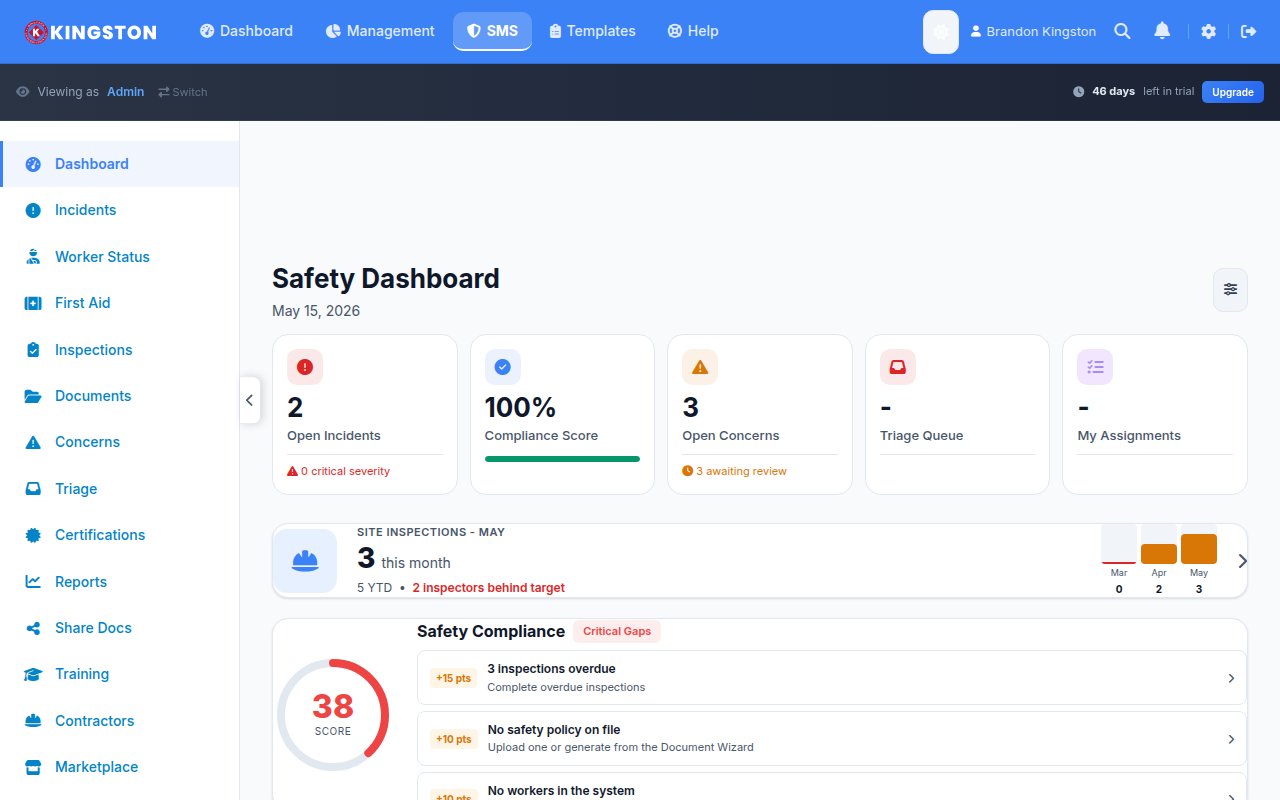
Digital observation tools like those in Make Safety Easy's inspection module enable supervisors to record behavioral observations during walkthroughs. The data automatically populates dashboards showing compliance trends over time.
Integrated Analytics
The most powerful ROI insights come from connecting training data with incident data. When you can correlate specific training modules with incident reductions, you know exactly which programs deliver the highest return. Monthly safety reviews help you track these trends systematically.
Predictive Analytics
Advanced platforms use machine learning to identify patterns - such as which departments or job roles are most likely to experience incidents based on training completion gaps and observation trends.
Technology ROI Multiplier
Organizations using digital safety management platforms report significant improvements in training ROI measurement:
- 67% reduction in administrative time spent tracking training records
- 40% improvement in training completion rates due to automated reminders
- 3x increase in behavioral observation frequency when using mobile tools
- 50% faster identification of training gaps through automated analytics
Want to see how technology can amplify your training ROI? Schedule a demo to see how Make Safety Easy connects training data with real-world safety outcomes.
Advanced ROI Calculation: The Total Value of Prevention
Basic ROI calculations capture direct cost savings, but the total value of effective safety training extends much further. This advanced framework captures the full economic impact.
The Prevention Value Chain
Tier 1: Direct Cost Avoidance (easily quantifiable)
- Medical costs avoided
- Workers' compensation savings
- OSHA penalty avoidance
- Property/equipment damage prevention
Tier 2: Operational Impact (moderately quantifiable)
- Reduced production downtime after incidents
- Lower replacement worker costs
- Decreased overtime for coverage
- Fewer project delays
Tier 3: Strategic Value (estimated based on industry research)
- Improved employee retention (lower recruiting/training costs for replacements)
- Higher employee engagement and productivity
- Better contract win rates due to safety record (especially ISNetworld, Avetta-rated companies)
- Lower insurance costs beyond workers' comp (general liability, umbrella policies)
Tier 4: Enterprise Value (long-term strategic)
- Brand and reputation value
- Reduced litigation exposure
- Competitive advantage in talent acquisition
- ESG/sustainability scoring improvements
Common Mistakes in Safety Training ROI Analysis
Avoid these frequent errors that undermine credibility and produce misleading results:
- Attributing all improvement to training: Incident reductions can result from multiple factors - new equipment, changed processes, seasonal variation. Use control groups or time-series analysis to isolate training's contribution.
- Ignoring the time lag: Training impact on lagging indicators often takes 6-12 months to appear. Do not declare failure after 90 days or success after one good month.
- Cherry-picking data: Report all metrics, including those that did not improve. Selective reporting destroys credibility when discovered.
- Excluding opportunity costs: If 250 workers spend 16 hours in training, that is 4,000 hours of lost production. Include this cost for an honest calculation.
- Comparing incomparable time periods: A construction company's TRIR will naturally differ between summer (high activity) and winter (low activity). Compare equivalent time periods.
- Using industry averages as your baseline: Your baseline should be your own historical data. Industry averages are useful for benchmarking but not for calculating your specific ROI.
Building a Continuous Measurement System
ROI measurement should not be a one-time exercise for budget season. Build a continuous measurement system that provides real-time visibility into training effectiveness.
Monthly Tracking Checklist
- [ ] Review training completion rates against targets
- [ ] Analyze assessment scores for trending weaknesses
- [ ] Conduct and record behavioral observations
- [ ] Track near-miss and incident reports
- [ ] Update cost tracking for incidents and near-misses
- [ ] Review supervisor feedback on behavior change
Quarterly Analysis Checklist
- [ ] Calculate quarterly ROI using the formula
- [ ] Compare leading indicators to targets
- [ ] Identify training modules needing revision based on data
- [ ] Update the cost-benefit analysis with actual figures
- [ ] Report findings to leadership with recommendations
- [ ] Benchmark against industry data where available
Annual Strategic Review Checklist
- [ ] Complete full Kirkpatrick evaluation across all four levels
- [ ] Calculate annual ROI with comprehensive cost and benefit data
- [ ] Update the 3-year trend analysis
- [ ] Conduct sensitivity analysis on projections vs. actuals
- [ ] Prepare budget justification for next fiscal year
- [ ] Set new targets based on updated baselines
- [ ] Review and update the training program based on findings
For a deeper dive into specific safety metrics and KPIs, see our guide on how to calculate safety ROI metrics. If you are building a training program from scratch, start with our workplace safety training plan guide.
Industry-Specific ROI Considerations
ROI calculations vary significantly across industries due to different risk profiles, regulatory requirements and cost structures. Consider these industry-specific factors:
Construction
Construction has among the highest ROI potential for safety training due to the severity and frequency of incidents. Falls, struck-by events, electrocution and caught-in/between hazards (the "Fatal Four") account for over 60% of construction fatalities. A single prevented fatality represents $1.2M+ in avoided costs according to NSC estimates. Focus your ROI analysis on high-hazard task training and competent person qualifications.
Manufacturing
Manufacturing ROI often centers on machine guarding, lockout/tagout and ergonomics training. Repetitive strain injuries are high-frequency but lower-severity, so ROI calculations should emphasize volume (many incidents avoided) rather than single catastrophic events. Machine-related amputations, while less frequent, carry extremely high per-incident costs.
Oil and Gas
The oil and gas sector invests heavily in training and typically sees strong ROI due to the catastrophic consequences of process safety failures. A single well blowout or refinery explosion can cost billions. Focus ROI analysis on process safety management training, permit-to-work compliance and emergency response preparedness.
Healthcare
Healthcare safety training ROI often includes patient safety outcomes alongside worker safety. Sharps injury prevention, patient handling ergonomics and workplace violence prevention are key training areas. The indirect costs of healthcare worker injuries are particularly high due to staff shortages and the cost of agency/travel workers as replacements.
ROI Accelerators: Getting More Return From Your Investment
Once you have established baseline ROI, these strategies can significantly amplify your returns:
1. Microlearning
Replace lengthy annual refreshers with short (5-10 minute) modules delivered weekly or biweekly. Research from the Journal of Applied Psychology shows that distributed practice produces 20-30% better retention than massed practice at the same total training time.
2. Peer-Led Training
Train experienced workers to deliver toolbox talks and hands-on demonstrations. Peer trainers are more credible to frontline workers, cost less than external instructors and reinforce their own knowledge through teaching.
3. Simulation and VR
Virtual reality training for high-hazard scenarios (confined space entry, fall protection, emergency response) produces up to 75% better retention than classroom training according to PwC research. The upfront technology cost is higher but the per-unit cost drops rapidly with scale.
4. Just-in-Time Training
Deliver training content at the moment of need - before a specific task rather than months in advance. Mobile platforms make this practical. A worker reviewing the lockout/tagout procedure on their phone right before performing the task retains and applies the knowledge far more effectively.
5. Integrated Feedback Loops
Connect your training system to your incident reporting and observation platforms. When an incident occurs, automatically trigger refresher training for the relevant topic. When observations identify a behavior gap, route affected workers to targeted microlearning. Learn how Make Safety Easy creates these feedback loops automatically.
Getting Started: Your 90-Day ROI Measurement Plan
Implementing a complete training ROI measurement system does not require a massive upfront investment. Follow this 90-day plan to build momentum:
Days 1-30: Foundation
- Audit current training records for completeness
- Gather 3 years of incident data and workers' compensation costs
- Calculate your current cost-per-incident by injury type
- Identify 3-5 critical behaviors for observation tracking
- Conduct baseline behavioral observations (minimum 30 per behavior)
- Set up a simple tracking spreadsheet or dashboard
Days 31-60: Implementation
- Launch or improve training programs targeting critical behaviors
- Implement post-training assessments at Level 1 and Level 2
- Begin regular behavioral observations (weekly minimum)
- Start tracking leading indicators
- Establish monthly reporting cadence with your leadership team
Days 61-90: Analysis and Reporting
- Conduct 30-day post-training behavioral observations
- Calculate initial behavior change rates
- Prepare your first ROI projection based on early data
- Present preliminary findings to leadership
- Adjust training programs based on Level 1-3 data
- Build the 12-month ROI projection for budget justification
Conclusion: From Cost Center to Value Driver
Measuring safety training ROI is not just about defending your budget - it is about transforming how your organization views safety. When you can demonstrate that every dollar invested in training returns $3, $4 or $5 in measurable value, safety moves from the "overhead" column to the "strategic investment" column.
The formula is straightforward: ROI (%) = [(Total Benefits - Total Costs) / Total Costs] x 100. The challenge is building the systems and discipline to collect the data consistently. Start with the Kirkpatrick framework, track both leading and lagging indicators and connect training activities to financial outcomes.
The organizations that master this measurement discipline do not just have safer workplaces - they have more profitable, more efficient and more resilient operations. Safety training ROI is not a theoretical exercise. It is a competitive advantage.
Ready to see how digital tools can make ROI measurement effortless? Book a demo of Make Safety Easy and discover how our platform connects training completion, behavioral observations and incident data into a single dashboard that calculates your ROI automatically. Or explore our pricing plans to find the right fit for your organization.
Ready to simplify your safety program?
Make Safety Easy helps teams run toolbox talks, inspections, incident reports and more - all from one platform.
Start Your Free TrialNo credit card required. 14-day free trial.